

Table of Contents
Last Updated on November 8, 2026 by XAM CONTENT
Practice these Class 9 Maths Chapter 8 Important Questions from Predicting What Comes Next: Exploring Sequences and Progressions in the new NCERT Ganita Manjari. The set covers sequences, explicit and recursive rules, Fibonacci patterns, arithmetic progressions, geometric progressions, applications and Tower of Hanoi.
Class 9 Maths Chapter 8 Important Questions with Solutions
The first four stages of a dot-square pattern are shown.
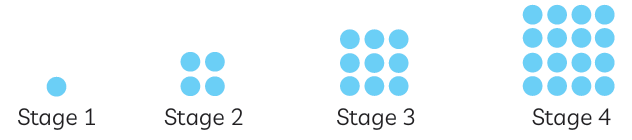
Which explicit rule generates the number of dots in the \(n^{\text {th }}\) stage?
Ans. (c) \(a_{n}=n^{2}\)
Explanation: The sequence is:
So the general term is \(a_{n}=n^{2}\)
A plant is 4 cm tall at the end of week 1. Each subsequent week its height increases by 3 cm. The height at the end of week \(n\) is:
Ans. (a) \(3 n+1\)
Explanation: The heights are 4, 7, 10, 13, …
The pattern is adding 3 each time.
So the explicit rule is \(a_{n}=3 n+1\)
Verification:
For
For
For
For
So, \(a_{n}=3 n+1\) is correct.
For the recursive sequence \(a_{1}=3, a_{n}=2 a_{n-1}+1\) for \(n>1\) :
(I) \(a_{2}=7\)
(II) \(a_{3}=15\)
(III) \(a_{4}=31\)
Choose the correct options:
Ans. (d) All I, II and III are correct.
Explanation: Using the recursive rule:
So, the first four terms are 3, 7, 15, 31.
Riya is drawing her family tree. She writes her own name at the top (Generation 1). In Generation 2 she draws 2 boxes (parents); in Generation 3 she draws 4 boxes (grandparents); in Generation 4 she draws 8 boxes (great-grandparents); and so on. The number of ancestors at each generation forms a sequence.
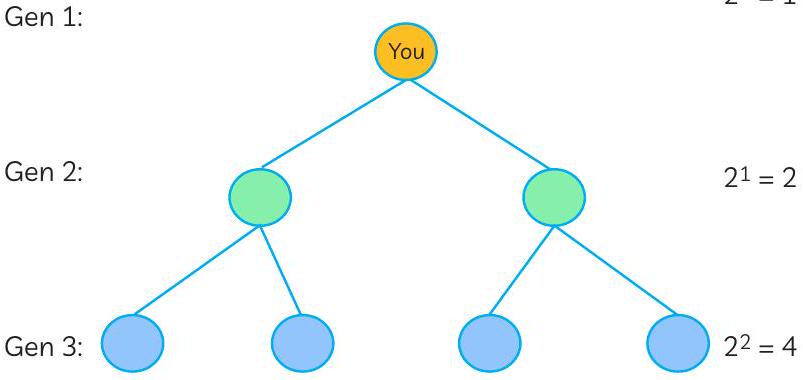
Based on the given information, answer the following questions:
(A) Write the explicit rule \(a_{n}\) for the number of ancestors in the \(n^{\text {th }}\) generation back from Riya, where Generation 2 corresponds to \(n=1\).
(B) How many ancestors does Riya have in the \(8^{\text {th }}\) generation back from her parents (i.e. \(n=8\) )?
(C) Write a recursive rule for the same sequence and use it to verify the \(4^{\text {th }}\) term against your explicit rule.
Ans. (A) The ancestor counts are 2, 4, 8, 16,…
Each term is double the previous term.
So the explicit rule is \(a_{n}=2^{n}\)
(B) The \(8^{\text {th }}\) term:
So, there are 256 ancestors.
(C) Recursive rule:
Verification for \(a_{4}\) :
Using explicit rule:
Both give the same answer.
The Fibonacci sequence is defined by \(a_{1}=1, a_{2}=1, a_{n}=a_{n-1}+a_{n-2}\) for \(n>2\).
(A) Compute \(a_{10}\).
(B) State whether the same numerical sequence can also be described by an explicit rule.
(C) Explain why merely stating “each term is the sum of the two before” does not determine the sequence uniquely.
Ans. (A) Build the terms one by one:
So, the \(10^{\text {th }}\) term is 55.
(B) Yes, there is a special explicit formula for the Fibonacci sequence.
At this level, students only need to know that such a formula exists.
(C) The rule \(a_{n}=a_{n-1}+a_{n-2}\) needs starting values.
With starting terms 1, 1, we get:
1, 1, 2, 3, 5, 8, …
With starting terms 2, 5, we get:
2, 5, 7, 12, 19, …
This shows that the starting values are essential because different starting values produce different sequences.
The \(12^{\text {th }}\) term of the AP 4, 9, 14, 19, … is:
Ans. (b) 59.
Explanation: Given:
First term:
Common difference:
Using the formula for the \(n^{\text {th }}\) term of an arithmetic progression:
For the \(12^{\text {th }}\) term:
Which of these is a GP but not an AP?
Ans. (b) 2, 4, 8, 16.
Explanation:
(a) 5, 10, 15, 20 → Constant difference = 5, so it is an AP, not a GP.
(b) 2, 4, 8, 16 → Constant ratio = 2, so it is a GP. The differences (2, 4, 8) are not constant, so it is not an AP.
(c) 1, 1, 1, 1 → Difference = 0 and ratio = 1, so it is both an AP and a GP.
(d) 1, 4, 9, 16 → Neither the differences nor the ratios are constant, so it is neither an AP nor a GP.
A rubber ball is dropped from 80 cm. Each bounce reaches \(\frac{3}{4}\) of the previous height. The height of the \(3^{\text {rd }}\) bounce is:
Ans. (c) \(33.75 cm\)
Explanation:
Given initial height \(=80 \mathrm{~cm}\)
\(1^{\text {st }}\) bounce:
\(2^{\text {nd }}\) bounce:
3rd bounce:
Height after the \(3^{\text {rd }}\) bounce \(=33.75 \mathrm{~cm}\)
A gardener plants rose bushes in rows. The first row has 23 plants, the next has 21, then 19, and so on each row has 2 fewer plants than the one before. The last row has 5 plants.

Based on the given information, answer the following questions:
(A) Identify whether the plant counts form an AP or GP, and state \(a\) and \(d\) (or \(r\) ).
(B) How many rows of plants are there in the flower bed?
(C) Write the number of rose plants in each row and find the total number of plants by direct addition.
Ans. Given plant counts:
23, 21, 19, 17, 15, …, 5
(A) The difference between consecutive terms is:
Since the difference is constant, it forms an Arithmetic Progression (AP).
First term, \(a=23\)
Common difference,
It is an AP with \(a=23, d=-2\)
(B) Use the nth term formula:
Given, last term \(a_{n}=5, a=23, d=-2 d\)
Substitute:
(C) Rows: 23 21 19 17 15 13 11 9 7 5
Total plants \(=23+21+19+17+15+13+11+9+7+5=140\)
Assertion (A): The perimeter of the Koch snowflake increases without bound at every stage.
Reason (R): The perimeter at stage \(n\) is given by the GP \(3 s \times\left(\frac{4}{3}\right)^{n}\), whose common ratio \(\frac{4}{3}\) is greater than 1.
Choose the correct option.
(a) Both assertion (A) and reason (R) are true and reason (R) is the correct explanation of assertion (A).
(b) Both assertion (A) and reason (R) are true and reason (R) is not the correct explanation of assertion (A).
(c) Assertion (A) is true but reason (R) is false.
(d) Assertion (A) is false but reason (R) is true.
Ans. (a) Both assertion (A) and reason (R) are true and reason (R) is the correct explanation of assertion (A).
Explanation: Since the common ratio is \(r=\frac{4}{3}\) and \(\frac{4}{3}>1\) each new term is greater than the previous term, so the geometric progression keeps increasing without bound.
The minimum-moves sequence for the Tower of Hanoi is 1, 3, 7, 15, 31, …
(A) Verify the recursive rule \(a_{n}=2 \cdot a_{n-1}+1\) by computing \(a_{5}\) from \(a_{4}\).
(B) Use the explicit rule to compute the minimum moves for 12 disks.
(C) State which underlying GP is hidden inside the explicit formula.
Ans. (A) Given, \(a_{4}=15\)
Using the recursive rule:
(B) Explicit formula is given by
(C) The explicit formula is \(a_{n}=2^{n}-1\)
The hidden geometric progression is:
1, 2, 4, 8, 16, 32, …
This is a GP with:
First term: \(a=1\)
Common ratio: \(r=2\)
So the Tower of Hanoi sequence is based on powers of 2, with 1 subtracted each time.
Since the sum of the first n natural numbers as \(S_{n}=n \frac{(n+1)}{2}\).
(A) Find \(S_{100}\).
(B) Find \(S_{200}-S_{100}\).
(C) Find the sum \(21+22+\ldots+50\).
(D) At a party with 25 people, every two people shake hands exactly once, find the total number of handshakes.
(E) Explain why the handshake count in (D) equals \(S_{24}\) (and NOT \(S_{25}\) ).
Ans. (A) Sum of first 100 natural numbers
(B)
(C) \(21+22+\ldots+50\)
(D) Person 1 shakes hands with 24 people.
Person 2 shakes hands with 23 new people.
Person 3 shakes hands with 22 new people.
Person 24 shakes hands with 1 new person.
Total handshakes \(=1+2+3+\ldots+24\)
(E) The \(25^{\text {th }}\) person does not make any new handshake because all handshakes involving them have already been counted from the other side.
Therefore, the sum stops at \(S_{24}\).
First identify whether the pattern is described most naturally by an explicit rule, a recursive rule, an arithmetic progression or a geometric progression. Then choose the corresponding term or sum formula instead of extending a long sequence manually.
Class 9 Maths Chapter 8 Important Questions — FAQs
What is a sequence?
A sequence is an arrangement of numbers written in a definite order according to a rule. The individual numbers are called terms.
What is the difference between an explicit and a recursive rule?
An explicit rule gives a term directly from its position \(n\), while a recursive rule defines a term using one or more earlier terms together with starting values.
What is the nth term of an arithmetic progression?
For first term \(a\) and common difference \(d\), the nth term is \(a_n=a+(n-1)d\).
What is the nth term of a geometric progression?
For first term \(a\) and common ratio \(r\), the nth term is \(a_n=a\,r^{n-1}\).
What is the minimum number of moves in the Tower of Hanoi?
For \(n\) disks, the minimum number of moves is \(2^n-1\).
You May Also Like
- Class 9 Maths Chapter 1 Important Questions with Solutions – Orienting Yourself: The Use of Coordinates (Ganita Manjari)
- Class 9 Maths Chapter 2 Important Questions with Solutions – Introduction to Linear Polynomials (Ganita Manjari)
- Class 9 Maths Chapter 3 Important Questions with Solutions – The World of Numbers (Ganita Manjari)
- Class 9 Maths Chapter 4 Important Questions with Solutions – Exploring Algebraic Identities (Ganita Manjari)
- Class 9 Maths Chapter 5 Important Questions with Solutions – I’m Up and Down, and Round and Round (Ganita Manjari)
- Class 9 Maths Chapter 6 Important Questions with Solutions – Measuring Space: Perimeter and Area (Ganita Manjari)
- Class 9 Maths Chapter 7 Important Questions with Solutions – The Mathematics of Maybe: Introduction to Probability (Ganita Manjari)
- Class 9 Maths Chapter 8 Important Questions with Solutions – Predicting What Comes Next: Exploring Sequences and Progressions (Ganita Manjari)
Class 9 Maths Study Resources