

Table of Contents
Last Updated on November 7, 2026 by XAM CONTENT
Practice these Class 9 Maths Chapter 1 Important Questions from Orienting Yourself: The Use of Coordinates. The set includes coordinate concepts, quadrants, distance and midpoint calculations, equations, and diagram-based applications. Attempt each question first, then use the answer button to check the solution.
A point in the Cartesian plane is written as \((x,y)\). The first coordinate is the abscissa or x-coordinate, and the second coordinate is the ordinate or y-coordinate.
Important Formulae and Coordinate Rules
| Concept | Formula / Rule |
|---|---|
| Distance between two points | \(PQ=\sqrt{(x_2-x_1)^2+(y_2-y_1)^2}\) |
| Midpoint | \(M=\left(\frac{x_1+x_2}{2},\frac{y_1+y_2}{2}\right)\) |
| Distance from origin | For \(P(x,y)\), \(OP=\sqrt{x^2+y^2}\) |
| Quadrant I | \((+,+)\) |
| Quadrant II | \((-,+)\) |
| Quadrant III | \((-,-)\) |
| Quadrant IV | \((+,-)\) |
Do not interchange the coordinates. In \((x,y)\), the x-coordinate always comes first and the y-coordinate comes second.
Class 9 Maths Chapter 1 Important Questions with Solutions
Where does the point \((-4,0)\) lie?
A point with y-coordinate \(0\) lies on the x-axis. Here \(x=-4\), so the point is on the negative side of the x-axis.
Answer: B — On the x-axis.
Find the distance between \(P(0,-5)\) and \(Q(12,0)\).
Using the distance formula,
Therefore, \(PQ=13\) units.
For the points \(A(4,6)\) and \(B(-2,2)\), find the midpoint and the distance \(AB\).
Midpoint:
Distance:
Hence, the midpoint is \((1,4)\) and \(AB=2\sqrt{13}\) units.
A point has both coordinates negative. In which quadrant will it lie?
In Quadrant III, \(x<0\) and \(y<0\). Therefore a point with both coordinates negative lies in Quadrant III.
Answer: C — Quadrant III.
A school is at \(S(3,4)\) and a library is at \(L(11,10)\). Find the midpoint of \(SL\), the length \(SL\), and the distance from \(S\) to the midpoint.
The midpoint is
The distance is
Since \(M\) is the midpoint,
So the midpoint is \((7,7)\), \(SL=10\) units and \(SM=5\) units.
What is the distance between \(A(a,0)\) and \(B(0,b)\)?
Answer: C — \(\sqrt{a^2+b^2}\).
If \(M(2,5)\) is the midpoint of \(A(-4,7)\) and \(B(x,y)\), find the coordinates of \(B\).
Using the midpoint formula for the x-coordinate,
For the y-coordinate,
Therefore, \(B=(8,3)\).
A fountain is at \(F(0,0)\), a bench at \(B(6,8)\), and a swing at \(S(-8,6)\). Which is farther from the fountain: the bench or the swing?
Both are 10 units from the fountain. Therefore, the bench and swing are equidistant from \(F\).
Find the midpoint of the line segment joining \((8,-3)\) and \((-4,7)\).
Hence, the midpoint is \((2,2)\).
A point \(P\) lies on the x-axis and is 13 units from the origin. Write all possible coordinates of \(P\).
Since \(P\) lies on the x-axis, its y-coordinate is \(0\).
Therefore, the possible coordinates are \((13,0)\) and \((-13,0)\).
In the coordinate diagram below, Ram is at \(O\) and wants to reach \(P\) by the shortest path. The horizontal and vertical separations are 6 units and 8 units. Find \(OP\).
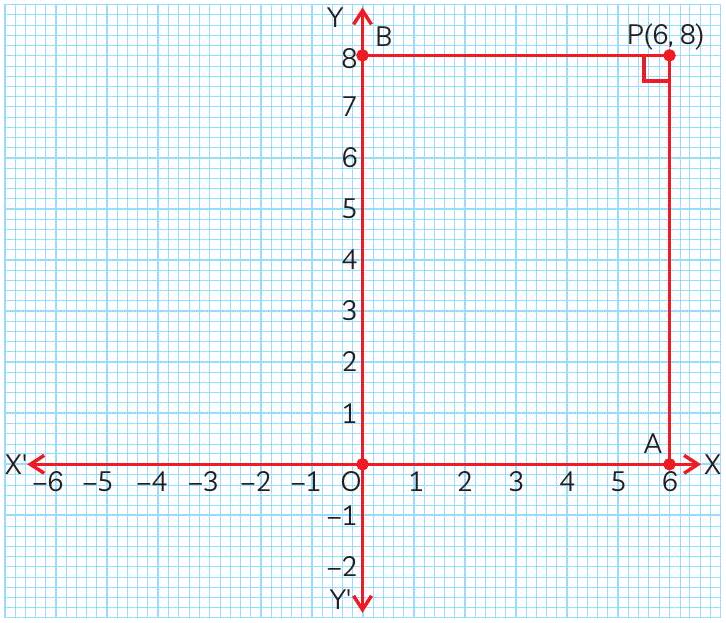
The shortest distance is the straight-line distance \(OP\). Using the Pythagoras theorem,
Answer: D — 10 units.
The coordinate diagram below shows a triangular park \(PQR\) and a square park. Find: (i) the area of \(\triangle PQR\), (ii) the diagonal of the square when its side is 3 units, and (iii) the length \(PR\).
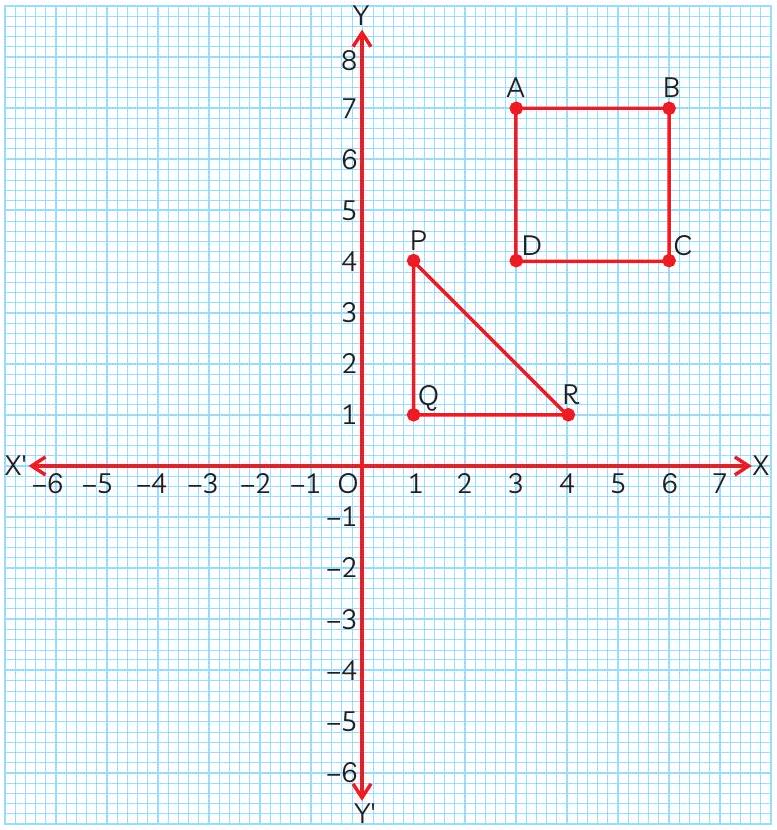
(i) Area of \(\triangle PQR\)
From the diagram, \(QR=3\) units and \(PQ=3\) units.
(ii) Diagonal of the square
(iii) Length \(PR\)
Before applying the distance or midpoint formula, write the coordinates in the same order as \(x_1,y_1,x_2,y_2\). This prevents sign errors, especially when negative coordinates are involved.
Frequently Asked Questions
What is the main idea of Class 9 Maths Chapter 1 Orienting Yourself: The Use of Coordinates?
The chapter develops the idea of locating points using ordered pairs, understanding the coordinate axes and quadrants, and applying distance and midpoint concepts to coordinate-based situations.
How do I identify the quadrant of a point quickly?
Check the signs of the coordinates: Quadrant I is \((+,+)\), Quadrant II is \((-,+)\), Quadrant III is \((-,-)\), and Quadrant IV is \((+,-)\).
What happens if one coordinate of a point is zero?
If \(y=0\), the point lies on the x-axis. If \(x=0\), the point lies on the y-axis. The point \((0,0)\) is the origin and lies on both axes.
Which formula is used to find the distance between two points?
For \(P(x_1,y_1)\) and \(Q(x_2,y_2)\), use \(PQ=\sqrt{(x_2-x_1)^2+(y_2-y_1)^2}\).
How can I improve accuracy in coordinate geometry questions?
Pay close attention to signs, keep the x- and y-coordinates in the correct order, draw a quick coordinate sketch when helpful, and simplify square roots only after substituting correctly into the formula.
You May Also Like
- Class 9 Maths Chapter 1 Important Questions with Solutions – Orienting Yourself: The Use of Coordinates (Ganita Manjari)
- Class 9 Maths Chapter 2 Important Questions with Solutions – Introduction to Linear Polynomials (Ganita Manjari)
- Class 9 Maths Chapter 3 Important Questions with Solutions – The World of Numbers (Ganita Manjari)
- Class 9 Maths Chapter 4 Important Questions with Solutions – Exploring Algebraic Identities (Ganita Manjari)
- Class 9 Maths Chapter 5 Important Questions with Solutions – I’m Up and Down, and Round and Round (Ganita Manjari)
- Class 9 Maths Chapter 6 Important Questions with Solutions – Measuring Space: Perimeter and Area (Ganita Manjari)