

Table of Contents
Last Updated on November 7, 2026 by XAM CONTENT
Practice these Class 9 Maths Chapter 6 Important Questions from Measuring Space: Perimeter and Area in the new NCERT Ganita Manjari. The set covers circumference, arc length, composite perimeters, Heron’s formula, sectors, equal-area triangles, grazing regions and Brahmagupta’s formula.
Class 9 Maths Chapter 6 Important Questions with Solutions
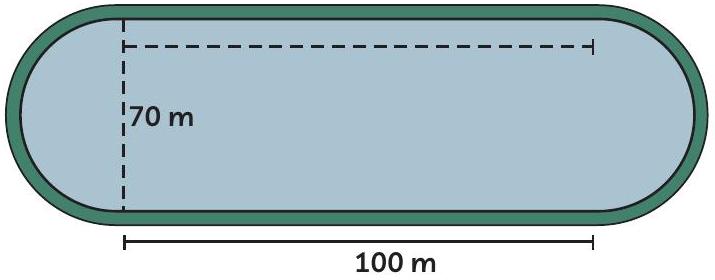
The figure shows a running track shaped like two semicircles joined by a rectangle of length 100 m and breadth 70 m. The total length of the boundary of the running track is:
Ans. (b) \(420 m\)
Explanation: The total length of the boundary = two straight sides of 100 m + two semicircular arcs of diameter 70 m.
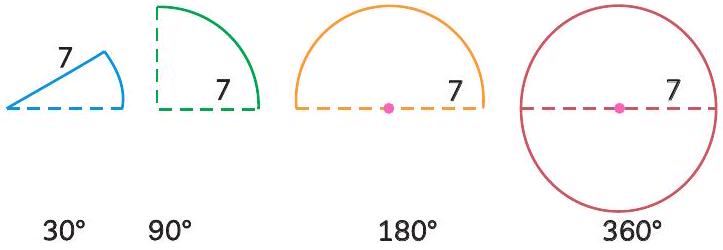
Arcs of a circle of radius 7 cm are drawn with central angles 30°, 90°, 180° and 360° respectively. Which arc has length equal to 11 cm?
Ans. (b) The \(90^{\circ}\) arc.
Explanation: Arc Length \(=\left(\frac{\theta}{360^{\circ}}\right) \times 2 \pi r\).
Here \(r=7 \mathrm{~cm}\) and \(\pi=\frac{22}{7}\).
Circumference \(=2 \times\left(\frac{22}{7}\right) \times 7=44 \mathrm{~cm}\).
For 30° arc: \(\left(\frac{30^{\circ}}{360^{\circ}}\right) \times 44=\frac{11}{3} \mathrm{~cm}\).
For 90° arc: \(\left(\frac{90^{\circ}}{360^{\circ}}\right) \times 44=\left(\frac{1}{4}\right) \times 44=11 \mathrm{~cm}\).
For 180° arc: \(\left(\frac{1}{2}\right) \times 44=22 \mathrm{~cm}\).
For 360° arc: 44 cm.
So, the arc of length 11 cm corresponds to the 90° arc.
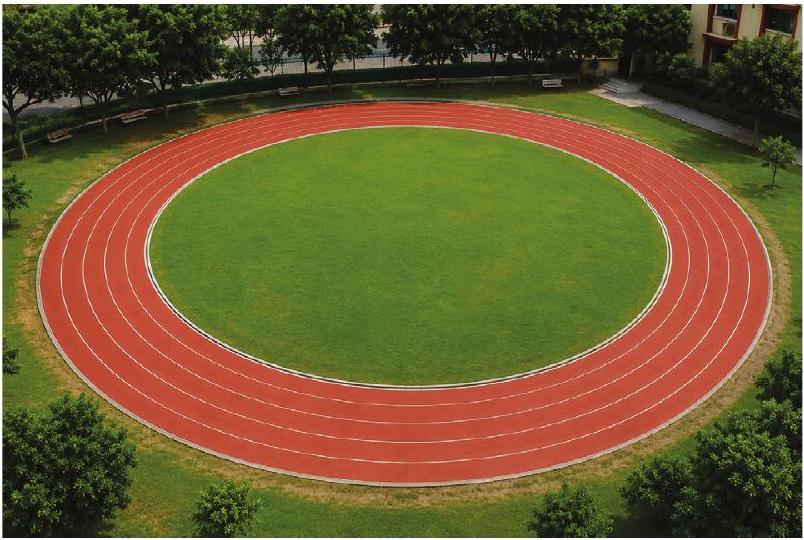
A school is planning to construct a circular jogging track in its playground for the morning fitness programme. The track is shaped like a perfect circle. The Principal wants to display the total length of one complete round of the track on the school notice board. The school’s team measured the diameter of the proposed track and recorded it as 70 m.
Two students, Prakul and Vikul, are asked to help with the calculations.
Prakul says: “We can find the length of one round using the perimeter formula of a circle.”
Vikul adds: “Yes, and we should use \(\pi=\frac{22}{7}\) since the diameter is a multiple of 7.”
Based on the given information, answer the following questions:
(A) Write the formula for the perimeter (circumference) of a circle and identify what each symbol represents.
(B) Calculate the length of one complete round of the jogging track. \(\left(\text{Use }\pi=\frac{22}{7}\right)\)
(C) If a student wants to run a total distance of 4.4 km on this track, how many rounds must they complete? Also state whether 4.4 km is exactly equal to a whole number of rounds or not.
(A) The perimeter (or circumference) of a circle is given by \(\mathrm{P}=2 \pi r\) or equivalently \(\mathrm{P}=\pi d\), where \(r\) is the radius, \(d\) is the diameter, and \(\pi\) is the constant ratio of the circumference of a circle to its diameter.
i.e., \(\pi=\frac{\text { Circumference }}{\text { Diameter }}\).
(B) The length of one complete round of a circular track is its circumference: \(\mathrm{P}=\pi d\).
Given \(d=70 \mathrm{~m}\), so \(\mathrm{P}=\left(\frac{22}{7}\right) \times 70=220 \mathrm{~m}\).
Therefore, the length of one round is 220 m.
(C) Total distance \(=4.4 \mathrm{~km}=4400 \mathrm{~m}\); length of one round \(=220 \mathrm{~m}\).
Number of rounds \(=\frac{4400}{220}=20\).
Hence, the runner completes 20 rounds. Since the answer is a whole number, 4.4 km is exactly equal to 20 complete rounds of the track.
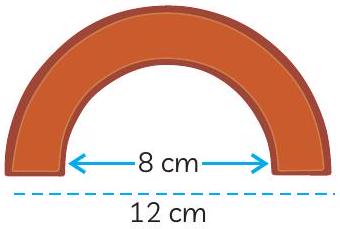
Find the perimeter of the figure formed by a large semicircle of diameter 12 cm with a smaller semicircle of diameter 8 cm cut inward along its diameter.
For a semicircle, arc length \(=\pi r\).
For large semicircle (diameter \(=12 \mathrm{~cm} \Rightarrow\) radius \(=6 \mathrm{~cm}\) ):
Arc length \(=\left(\frac{22}{7}\right) \times 6=\frac{132}{7} \mathrm{~cm}\).
For small semicircle \(($ diameter \(=8 \mathrm{~cm} \Rightarrow\) radius \(=4 \mathrm{~cm})\) :
Arc length \(=\left(\frac{22}{7}\right) \times 4=\frac{88}{7} \mathrm{~cm}\).
Straight segments: total straight length \(=12-8=4 \mathrm{~cm}\).
Total perimeter \(=\frac{132}{7}+\frac{88}{7}+4=\frac{220}{7}+4=\frac{248}{7}\approx35.43 \mathrm{~cm}\).
Therefore, the perimeter of the boundary is \(\frac{248}{7}\approx35.43 \mathrm{~cm}\).
A right triangle has legs 6 cm and 8 cm. A semicircle is drawn outward on each side of the triangle. Find the total perimeter of the resulting figure. (Use \(\pi=3.14\))
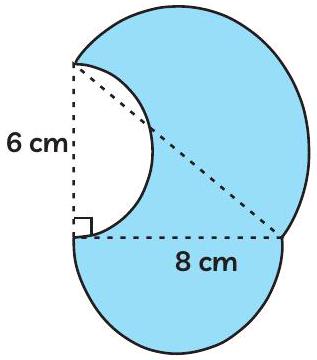
In the right-angled triangle, by Baudhāyana-Pythagoras theorem,
Hypotenuse \({ }^{2}=6^{2}+8^{2}=36+64=100\)
⇒ Hypotenuse \(=10 \mathrm{~cm}\).
For a semicircle, arc length \(=\pi r\).
On side \(6 \mathrm{~cm}: r=3 \mathrm{~cm} \rightarrow\) arc length \(=3 \pi\).
On side \(8 \mathrm{~cm}: r=4 \mathrm{~cm} \rightarrow \operatorname{arc}\) length \(=4 \pi\).
On hypotenuse \(10 \mathrm{~cm}: r=5 \mathrm{~cm} \rightarrow\) arc length \(=5 \pi\).
Total perimeter \(=3 \pi+4 \pi+5 \pi=12 \pi \approx 12 \times 3.14=37.68 \mathrm{~cm}\).
By Heron’s formula, the area of a triangle with sides 13 cm, 14 cm and 15 cm is:
Ans. (a) \(84 \mathrm{~cm}^{2}\)
Explanation: Semi-perimeter \(s=\frac{13+14+15}{2}=21\).
If a sector of a circle has area \(77 \mathrm{~cm}^{2}\) and the radius is 14 cm, the angle of the sector is \(\left(\text{Use }\pi=\frac{22}{7}\right)\) :
Ans. (b) 45°.
Explanation: Area of sector \(=\left(\frac{\theta}{360^{\circ}}\right) \times \pi r^{2}\).
⇒
In a kitchen, a square tile of side 14 cm has a circular emblem of the same diameter as the side of the tile (i.e., a circle inscribed in the square). The corners of the tile (outside the circle) are painted in a contrasting colour.
Based on the given information, answer the following questions:
(A) Find the area of the entire square tile.
(B) Find the area of the inscribed circular emblem.
(C) Find the total area of the four shaded corner regions outside the circle.
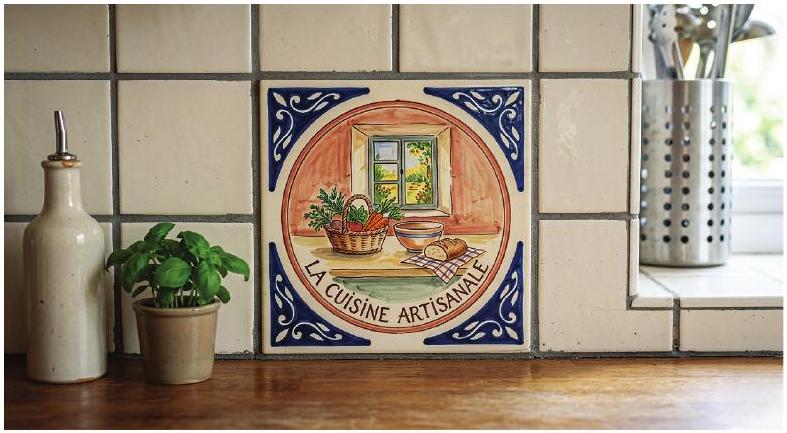
(A) Side of square \(=14 \mathrm{~cm}\).
Area of square \(=14 \times 14=196 \mathrm{~cm}^{2}\).
(B) The inscribed circle has diameter equal to the side of the square, so its radius \(r=\frac{14}{2}=7 \mathrm{~cm}\).
Area of circle \(=\pi r^{2}=\left(\frac{22}{7}\right) \times 49=154 \mathrm{~cm}^{2}\).
(C) Total shaded corner area = Area of square – Area of inscribed circle \(=196-154=42 \mathrm{~cm}^{2}\).
The sides of a triangular plot are in the ratio 3 : 5 : 7 and its perimeter is 300 m. Find the area of the plot.
Let the sides be \(3 k, 5 k, 7 k\). Sum \(=15 k=300 \Rightarrow k=20\).
So sides are 60 m, 100 m and 140 m.
ABCD is a parallelogram and P, Q are any two points on side AB. Compare the areas of triangle PCD and triangle QCD, giving full reasoning.
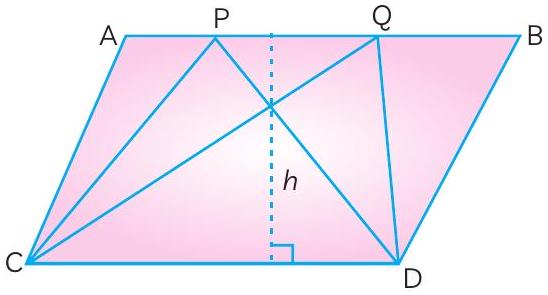
Triangles PCD and QCD share the same base CD.
Both triangles lie between the same pair of parallel lines: CD and AB (since \(\mathrm{AB} \| \mathrm{CD}\) in a parallelogram). So they have the same height the perpendicular distance between the lines AB and CD.
Therefore \(\operatorname{Area}(\Delta \mathrm{PCD})=\left(\frac{1}{2}\right) \times \mathrm{CD} \times h\) and Area \((\Delta \mathrm{QCD})\)
Hence, Area \((\Delta \mathrm{PCD}):\) Area \((\Delta \mathrm{QCD})=1: 1\).
A cow is tied with a rope of length 14 m at one corner (A) of a rectangular field ABCD of dimensions \(20 \mathrm{~m} \times 16 \mathrm{~m}\). Find the area of the field over which the cow can graze. \(\left(\text{Use }\pi=\frac{22}{7}\right)\)
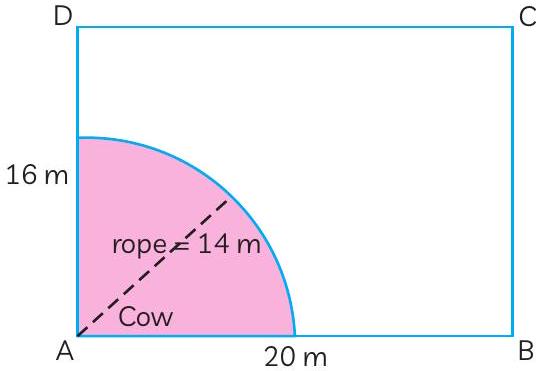
The rope length (14 m) is shorter than both sides of the rectangle (20 m and 16 m), so the cow can graze a quarter-circle ( \(90^{\circ}\) sector) inside the field and cannot reach beyond either adjacent side.
Grazing area \(=\left(\frac{90^{\circ}}{360^{\circ}}\right) \times \pi \times r^{2}=\left(\frac{1}{4}\right) \times\left(\frac{22}{7}\right) \times 14^{2}\)
∴ The cow can graze over an area of \(154 \mathrm{~m}^{2}\).
A cyclic quadrilateral has its four side lengths in order equal to 39 m, 60 m, 52 m and 25 m. Using Brahmagupta’s formula, find the area of this quadrilateral.
Brahmagupta’s formula:
where
Here \(a=39, b=60, c=52, d=25\).
Semi-perimeter
\(s-a=49, s-b=28, s-c=36, s-d=63\).
Before calculating, identify whether the question is asking for boundary length or enclosed area. For composite figures, separate the figure into familiar shapes and include only those arcs or edges that actually form the required boundary.
Class 9 Maths Chapter 6 Important Questions — FAQs
What is the circumference of a circle?
The circumference of a circle is \(2\pi r\), or equivalently \(\pi d\).
What is the formula for the length of an arc?
For a central angle \(\theta^\circ\), the arc length is \(\left(\frac{\theta}{360^\circ}\right)2\pi r\).
When is Heron’s formula used?
Heron’s formula is used to find the area of a triangle when its three side lengths are known.
What is the area of a sector of a circle?
The area of a sector of central angle \(\theta^\circ\) is \(\left(\frac{\theta}{360^\circ}\right)\pi r^2\).
When can Brahmagupta’s formula be used?
Brahmagupta’s formula gives the area of a cyclic quadrilateral when its four side lengths are known.
You May Also Like
- Class 9 Maths Chapter 1 Important Questions with Solutions – Orienting Yourself: The Use of Coordinates (Ganita Manjari)
- Class 9 Maths Chapter 2 Important Questions with Solutions – Introduction to Linear Polynomials (Ganita Manjari)
- Class 9 Maths Chapter 3 Important Questions with Solutions – The World of Numbers (Ganita Manjari)
- Class 9 Maths Chapter 4 Important Questions with Solutions – Exploring Algebraic Identities (Ganita Manjari)
- Class 9 Maths Chapter 5 Important Questions with Solutions – I’m Up and Down, and Round and Round (Ganita Manjari)
- Class 9 Maths Chapter 6 Important Questions with Solutions – Measuring Space: Perimeter and Area (Ganita Manjari)