
Table of Contents
Last Updated on November 7, 2026 by XAM CONTENT
Practice these Class 9 Maths Chapter 7 Important Questions from The Mathematics of Maybe: Introduction to Probability in the new NCERT Ganita Manjari. The set covers random experiments, the probability scale, elementary and compound events, experimental probability, coins, dice, cards and equally likely outcomes.
Class 9 Maths Chapter 7 Important Questions with Solutions
An experiment is called a random experiment if:
Ans. (c) It has more than one possible outcome and the result cannot be predicted in advance
Explanation: A random experiment is a repeatable experiment with more than one possible outcome, where the actual outcome cannot be predicted in advance with certainty.
Look at the probability scale shown below.
Which value cannot be located anywhere on this scale?

Ans. (d) 1.5.
Explanation: The probability scale runs from 0 (impossible) to 1 (certain). No probability can exceed 1, so 1.5 cannot be placed on the scale.
Consider these statements about elementary events.
(I) An elementary event has only one outcome.
(II) A compound event is a collection of two or more elementary events.
(III) The sum of the probabilities of all elementary events of an experiment is 1.
Ans. (d) All I, II and III are true.
Explanation: An elementary event has exactly one outcome.
A compound event contains two or more elementary outcomes.
The probabilities of all elementary events together make up the entire sample space, so their sum is 1.
A survey of 500 families with two children each was conducted in a colony. The following data were recorded:
No boys (both girls): 120 families
Exactly 1 boy: 260 families
Both boys (no girls): 120 families
Based on the given information, answer the following questions:
(A) How many families in the survey have at least one girl?
(B) Find the experimental probability that a randomly selected family has both children as boys.
(C) Let event E be: ‘The selected family has at least one girl’.
(i) Find P(E).
(ii) Interpret the meaning of P(E) in the context of the survey.
Ans. (A) Families having at least one girl include:
Families with both girls \(=120\)
Families with exactly one boy (therefore one girl) = 260
Total families with at least one girl \(=120+260\) \(=380\)
(B) Experimental Probability
Favourable outcomes = Families with both boys = 120
Total families surveyed = 500
Answer: Probability \(=\frac{6}{25}\) (or 0.24)
(C) (i) Event E = ‘The selected family has at least one girl’.
Number of families with at least one girl = 380
Total families = 500
(ii) Interpretation: The probability \(\frac{19}{25}\) (or 0.76) means that there is a 76% chance that a randomly selected family from this survey has at least one girl child. In other words, about 19 out of every 25 families in the colony have at least one girl.
Two coins are tossed simultaneously 100 times. The outcomes recorded are shown below:
| Outcome | Frequency |
|---|---|
| HH | 28 |
| HT | 24 |
| TH | 26 |
| TT | 22 |
(A) Write the sample space of the experiment.
(B) Find the experimental probability of:
(i) getting two heads
(ii) getting exactly one head
(iii) getting no head
(C) Which event is more likely: “exactly one head” or “two heads”? Justify your answer.
(D) Place the event “getting exactly one head” on the probability scale as impossible, unlikely, even chance, likely, or certain.
Ans. (A)
(B)
(i)
(ii)
(iii)
(C)
Since 0.50 > 0.28, the event “exactly one head” is more likely to occur.
(D) The probability of getting exactly one head is 0.50.
A probability of 0.5 represents an even chance.
Therefore, the event “getting exactly one head” is an even-chance event.
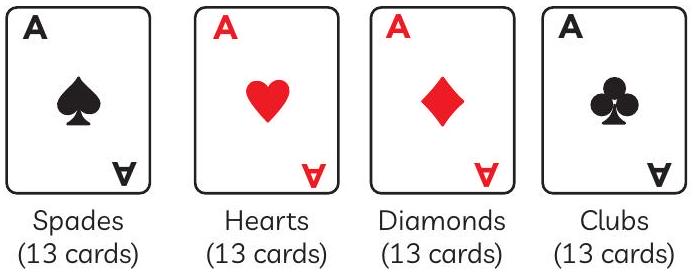
A standard 52-card deck has four suits as shown below.
A card is drawn at random. The probability that it is a red face card is:
Ans. (b) \(\frac{3}{26}\)
Explanation: Red face cards = King, Queen, Jack of Hearts + King, Queen, Jack of Diamonds
Number of favourable outcomes \(=6\)
Total number of outcomes \(=52\)
Three coins are tossed simultaneously. The probability of getting at least two heads is:
Ans. (c) \(\frac{1}{2}\).
Explanation: Sample space \(=\{\mathrm{TTT}\), TTH, THT, HTT, HHH, HHT, HTH, THH\}
Total number of outcomes \(=8\).
Favourable outcomes for “At least two heads” event = \{HHH, HHT, HTH, THH\}
Number of favourable outcomes \(=4\)
All the aces are removed from a deck of 52 cards. A card is drawn at random from the remaining cards. The probability that it is a king is:
Ans. (b) \(\frac{1}{12}\)
Explanation: After removing 4 aces, 48 cards remain in the deck.
Number of favourable outcomes \(=48\)
Number of kings in the deck \(=4\)
Number of favourable outcomes \(=4\)
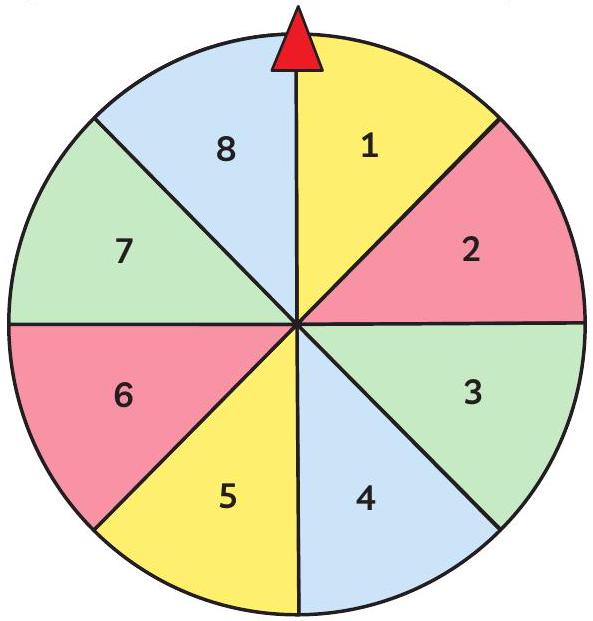
The spinner shown is divided into 8 equal sectors.
The probability that the arrow lands on a number that is greater than 4 and even is:
Ans. (b) \(\frac{1}{4}\).
Explanation: Sample space \(=\{1,2,3, \ldots .8\}\)
Total number of outcomes \(=8\)
Number “Greater than 4 ” = \{5, 6, 7, 8\}.
Among these, even numbers are \{6, 8\}.
Number of favourable outcomes \(=2\)
A box contains 25 cards numbered 1 to 25. One card is drawn at random. Find the probability that the number on the card is a multiple of 3.
Ans. Multiples of 3 between 1 and 25 are 3, 6, 9, 12, 15, 18, 21, 24
A bag contains 5 red, 8 white and 7 black balls. A ball is drawn at random. Find the probability that the ball is:
(A) red,
(B) not black,
(C) red or white.
Ans. Total number of balls in the \(\mathrm{bag}=5+8+7=20\).
(A) \(\mathrm{P}(\mathrm{red})=\frac{5}{20}=\frac{1}{4}\).
(B) Not black balls = red balls + white balls \(=5+8=13\).
(C) Red or white balls \(=5+8=13\).
A card is drawn at random from a deck of 52 cards from which all the spades have been removed. Find the probability that the drawn card is:
(A) a queen,
(B) a face card,
(C) a red card.
Ans. After removing all 13 spades, remaining cards
(A) Remaining Queen cards in the deck : Queen of hearts, diamonds, clubs
Number of favourable outcomes \(=3\)
Required probability,
(B) Remaining Face cards = 3 face cards (K, Q, J) in each of hearts, diamonds, clubs
Number of favourable outcomes \(=9\).
(C) Red cards (all hearts + all diamonds) \(=13+13=26\).
First identify the complete sample space and check whether the outcomes are equally likely. For experimental probability, use the recorded frequency; for theoretical probability, count favourable outcomes from the equally likely sample space.
Class 9 Maths Chapter 7 Important Questions — FAQs
What is a random experiment?
A random experiment is repeatable, has more than one possible outcome, and its actual outcome cannot be predicted in advance with certainty.
What values can probability take?
The probability of an event lies between 0 and 1, inclusive.
What is experimental probability?
Experimental probability is based on observed data and is calculated as the number of times an event occurs divided by the total number of trials.
What is theoretical probability?
For equally likely outcomes, theoretical probability is the number of favourable outcomes divided by the total number of possible outcomes.
What is the probability of a certain event and an impossible event?
A certain event has probability 1, while an impossible event has probability 0.
You May Also Like
- Class 9 Maths Chapter 1 Important Questions with Solutions – Orienting Yourself: The Use of Coordinates (Ganita Manjari)
- Class 9 Maths Chapter 2 Important Questions with Solutions – Introduction to Linear Polynomials (Ganita Manjari)
- Class 9 Maths Chapter 3 Important Questions with Solutions – The World of Numbers (Ganita Manjari)
- Class 9 Maths Chapter 4 Important Questions with Solutions – Exploring Algebraic Identities (Ganita Manjari)
- Class 9 Maths Chapter 5 Important Questions with Solutions – I’m Up and Down, and Round and Round (Ganita Manjari)
- Class 9 Maths Chapter 6 Important Questions with Solutions – Measuring Space: Perimeter and Area (Ganita Manjari)
- Class 9 Maths Chapter 7 Important Questions with Solutions – The Mathematics of Maybe: Introduction to Probability (Ganita Manjari)
- Class 9 Maths Chapter 8 Important Questions with Solutions – Predicting What Comes Next: Exploring Sequences and Progressions (Ganita Manjari)