

Table of Contents
Last Updated on November 7, 2026 by XAM CONTENT
Practice these Class 9 Maths Chapter 5 Important Questions from I’m Up and Down, and Round and Round in the new NCERT Ganita Manjari. The questions cover chords, circumcircles, parallel chords, angles in circles and cyclic quadrilaterals.
Class 9 Maths Chapter 5 Important Questions with Solutions
In the given figure, \(\mathrm{OL} \perp \mathrm{MN}\). If \(\mathrm{OL}=3 \mathrm{~cm}\) and \(\mathrm{OM}=5 \mathrm{~cm}\), then the length of chord MN is:
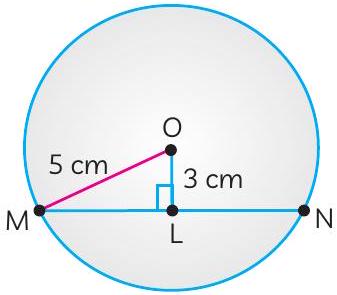
Ans. (c) 8 cm
Explanation: Given,
Distance of the chord from the centre \(d=3 \mathrm{~cm}\)
The length of the chord is given by
Substituting the values:
Therefore, the length of the chord is 8 cm .
In a circle of radius 17 cm, a chord lies at a perpendicular distance of 8 cm from the centre. Find the length of the chord.
Ans. Length of chord at distance 8 cm from centre.
Length of chord \(=30 \mathrm{~cm}\).
In a circle of radius 5 cm, two equal chords of length 6 cm each are drawn on opposite sides of the centre. Find the distance between the two chords.
Ans. Length of each chord = 6 cm
Let the distance of each chord from the centre be \(d\).
Using Pythagoras theorem,
Thus, each chord is at a distance of 4 cm from the centre.
Since the equal parallel chords lie on opposite sides of the centre.
Distance between the chords \(=4+4=8 \mathrm{~cm}\)
Hence, the distance between the two chords is 8 cm.
Draw \(\Delta \mathrm{ABC}\) with \(\mathrm{AB}=5 \mathrm{~cm}, \angle \mathrm{~A}=100^{\circ}, \mathrm{AC}=4 \mathrm{~cm}\). Draw the circumcircle of \(\Delta \mathrm{ABC}\). Is the centre inside or outside the triangle?
Ans. Construction steps:
(1) Draw \(\mathrm{AB}=5 \mathrm{~cm}\).
(2) At A, construct \(\angle \mathrm{A}=100^{\circ}\), and mark C on this ray with \(\mathrm{AC}=4 \mathrm{~cm}\).
(3) Join BC to complete \(\triangle \mathrm{ABC}\).
(4) Draw the perpendicular bisectors of AB and AC; they intersect at point O.
(5) With O as centre and OA as radius, draw the circumcircle.
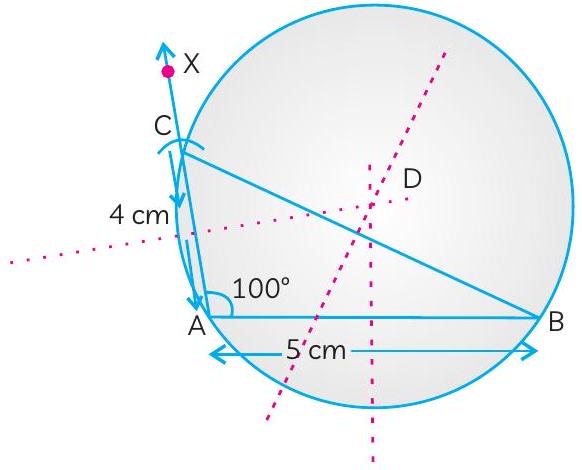
Since \(\angle \mathrm{A}=100^{\circ}>90^{\circ}, \triangle \mathrm{ABC}\) is an obtuse-angled triangle. Therefore, the circumcentre O lies outside the triangle.
In a circle of radius 13 cm, two parallel chords of lengths 24 cm and 10 cm lie on opposite sides of the centre. Find the distance between the chords.
Ans. Length of chord \(\mathrm{AB}=24 \mathrm{~cm}\)
Let the distance of chord AB from the centre be \(d_{1}\).
Using Pythagoras theorem,
Length of chord \(\mathrm{CD}=10 \mathrm{~cm}\)
Let the distance of chord CD from the centre be \(d_{2}\).
Since the parallel chords lie on opposite sides of the centre,
Distance between the chords
Hence, the distance between the two parallel chords is 17 cm.
In a circle of radius 5 cm, two parallel chords of lengths 6 cm and 8 cm lie on opposite sides of the centre.
(A) Find the perpendicular distance of each chord from the centre.
(B) Find the distance between the two chords.
(C) Will the result change if the chords are on the same side of the centre? Justify with a diagram.
Ans. Two parallel chords in a circle of radius 5 cm.
(A) Chord 6 cm: \(\quad d_{1}=\sqrt{(25-9)}=4 \mathrm{~cm}\).
Chord 8 cm: \(\quad d_{2}=\sqrt{(25-16)}=3 \mathrm{~cm}\).
(B) Opposite sides:
(C) Same side:
If the two parallel chords lie on the same side of the centre, then the distance between them is the difference of their perpendicular distances from the centre.
So, the distance between the chords is 1 cm.
Yes, the answer changes, when the chords are on opposite sides of the centre, the distance is \(4+3\) \(=7 \mathrm{~cm}\); and when they are on the same side, the distance is \(4-3=1 \mathrm{~cm}\).
Case A
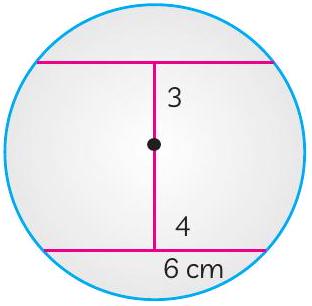
Case A: Opposite Sides →
7 cm apart
Case B
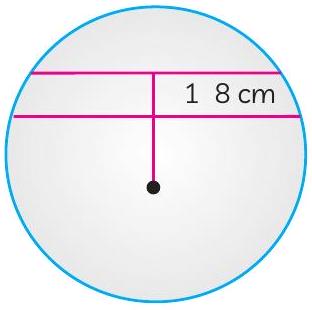
Case B: Same side →
1 cm apart
In the figure, if \(\angle \mathrm{AOB}=100^{\circ}\), then \(\angle \mathrm{APB}\) is:
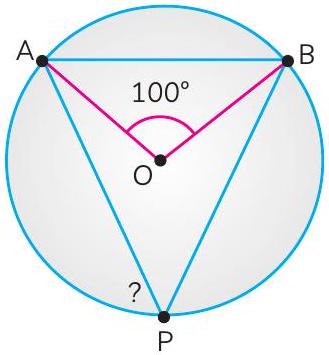
Ans. (a) 50°
Explanation: Using the theorem that the angle subtended at the circumference is half the angle subtended at the centre by the same arc:
In the figure shown below, what is the value of \(x\) ?
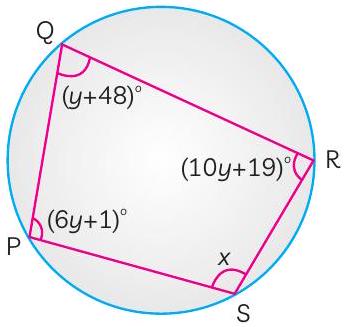
Ans. We know opposite angles of cyclic quadrilateral are supplementary
Now,
⇒
⇒
An artist created a stained glass window as shown in the figure. If \(\angle \mathrm{BEC}=40^{\circ}\) and \(\angle \mathrm{ADB}=44^{\circ}\). What is \(\angle \mathrm{ADC}\) ?
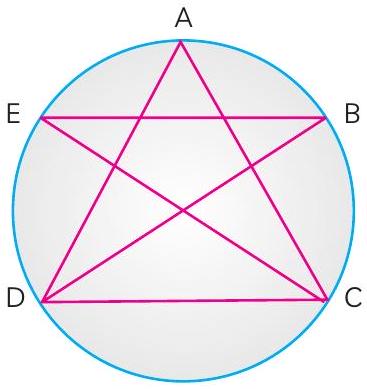
Ans. Given,
[Angles with the same segment are equal]
[Given]
Hence,
ABCD is a cyclic quadrilateral with AB || CD and DC is the diameter of the circle. If \(\angle \mathrm{BCD}=69^{\circ}\), then find \(\angle \mathrm{ADB}\).
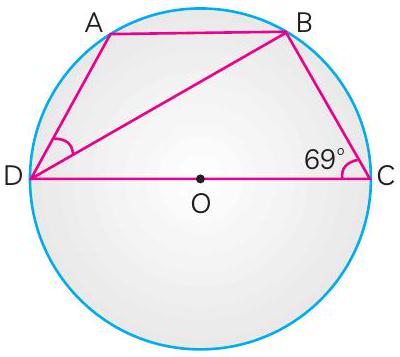
Ans. Given \(\mathrm{AB} \| \mathrm{CD}, \angle \mathrm{BCD}=69^{\circ}\) and DC is the diameter of the circle with centre O.
Join BD
To find: \(\angle \mathrm{ADB}\)
Here,
In \(\triangle \mathrm{BDC}\),
Now,
[Alternate angle]
And,
[ABCD is a cyclic quadrilateral]
Therefore, in \(\triangle \mathrm{ABD}\),
Hence,
In the given figure, \(O\) is the centre of a circle prove that \(\angle \boldsymbol{x}=\angle \boldsymbol{y}+\angle \boldsymbol{z}\).
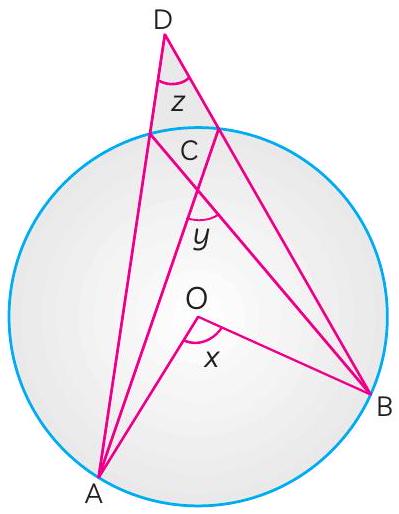
Ans. Given: \(O\) is the centre of circle and \(A, B\) are the points on circumference of the circle.
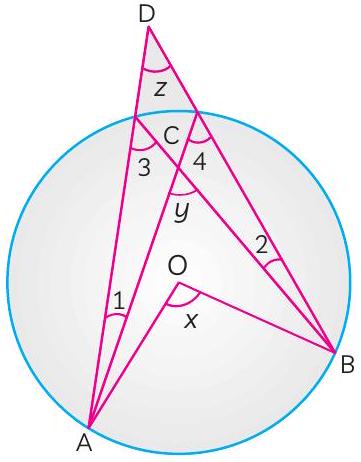
To prove:
\(\angle 4\) and \(\angle 3\) are on same segment
So,
Proof:
[Angle subtended by an arc of a circle at the centre is double the angle subtended by it at any point on the remaining part of the circle]
∴
[Exterior angle is equal to the sum of two opposite interior angles]
[Exterior angle is equal to the sum of two opposite interior angles]
Adding eqs. (ii) and (iii)
From equation (i) and (iv), we have
Hence, proved.
In a circle with centre O, if PQ is diameter and RS is a chord such that \(\angle \mathrm{PQR}=36^{\circ}\) and \(\mathrm{RS}=\mathrm{SQ}\), then what is the measure of \(\angle \mathrm{RQS}\) ?
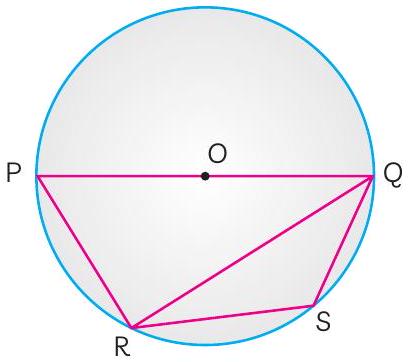
Ans. Here, PQ is diameter and the angle in a semicircle is 90°.
[Given]
In \(\triangle \mathrm{PQR}\),
[Angle sum property]
In cyclic quadrilateral PRSQ,
[The opposite angles of a cyclic quadrilateral is supplementary]
Since,
Therefore,
In \(\triangle \mathrm{RSQ}\),
[From eq. (i)]
While solving circle questions, identify the relevant chord, radius, diameter, arc or cyclic quadrilateral first. Then apply the corresponding theorem before beginning the calculation.
Class 9 Maths Chapter 5 Important Questions — FAQs
What happens when a perpendicular is drawn from the centre of a circle to a chord?
The perpendicular from the centre of a circle to a chord bisects the chord.
Where does the circumcentre of an obtuse triangle lie?
The circumcentre of an obtuse-angled triangle lies outside the triangle.
What is the relation between an angle at the centre and an angle at the circumference on the same arc?
The angle subtended at the centre is twice the angle subtended at the circumference by the same arc.
What is the sum of opposite angles of a cyclic quadrilateral?
Opposite angles of a cyclic quadrilateral are supplementary, so their sum is \(180^\circ\).
What angle does a diameter subtend at a point on the circle?
A diameter subtends a right angle, or \(90^\circ\), at any point on the circle.
You May Also Like
- Class 9 Maths Chapter 1 Important Questions with Solutions – Orienting Yourself: The Use of Coordinates (Ganita Manjari)
- Class 9 Maths Chapter 2 Important Questions with Solutions – Introduction to Linear Polynomials (Ganita Manjari)
- Class 9 Maths Chapter 3 Important Questions with Solutions – The World of Numbers (Ganita Manjari)
- Class 9 Maths Chapter 4 Important Questions with Solutions – Exploring Algebraic Identities (Ganita Manjari)
- Class 9 Maths Chapter 5 Important Questions with Solutions – I’m Up and Down, and Round and Round (Ganita Manjari)
- Class 9 Maths Chapter 6 Important Questions with Solutions – Measuring Space: Perimeter and Area (Ganita Manjari)