

Table of Contents
Last Updated on November 12, 2026 by XAM CONTENT
Practice these Class 9 Science Chapter 7 Important Questions from Work, Energy, and Simple Machines in the new NCERT Exploration. The set covers scientific work, kinetic and potential energy, conservation of energy, power, mechanical advantage, levers, inclined planes and pulleys.
Work transfers energy when a force causes displacement. Energy may change from one form to another, while power tells how quickly work is done. Simple machines make tasks easier by trading force for distance without creating energy.
Class 9 Science Chapter 7 Important Questions with Answers
1 joule of work is done when:
Ans. (a) A force of \(1 N\) moves an object by \(1 m\) in the direction of force.
Explanation: \(1 \mathrm{~J}=1 \mathrm{~N} \times 1 \mathrm{~m}\).
Force in newtons times displacement in metres gives work in joules.
A 2 kg ball moving at \(6 \mathrm{~m} \mathrm{~s}^{-1}\) is brought to rest by a wall. The work done by the wall on the ball is:
Ans. (a) -36 J
Explanation: W = Change in Kinetic energy
The wall does negative work because force is opposite to motion.
A student takes the same staircase up to her classroom on Monday and the elevator on Tuesday. The gain in her gravitational potential energy is:
Ans. (c) Same on both days
Explanation: \(\mathrm{PE}=m g h\) depends only on the change in height, not the path taken. The end height is the same, so PE gain is the same.
A body is falling from a height of \(h\). After it has fallen a height \(\frac{h}{2}\), it will possess:
Ans. (c) half potential and half kinetic energy
Explanation: When a body falls from a height \(\frac{h}{2}\), the potential energy becomes half of the initial and the kinetic energy equals the lost potential energy, which is also half of the initial total energy.
Thus, at \(\frac{h}{2}\), the body will possess equal potential and kinetic energy.
Assertion (A): A weightlifter holding a barbell steady above her head does no work on the barbell.
Reason (R): Although a force is applied, there is no displacement of the barbell.
Ans. (a) Both (A) and (R) are true, and (R) is the correct explanation of (A).
Explanation: She applies a force equal to the barbell’s weight, but \(s=0\),
So, \(\mathrm{W}=\mathrm{F} \times s=0\). She gets tired due to muscle activity, but no scientific work is done on the barbell.
During a school football match, the striker kicks a ball of mass 0.5 kg towards the goal at \(12 \mathrm{~m} \mathrm{~s}^{-1}\). The goalkeeper Priya jumps and stops the ball with her hands. She notices that her hands move BACKWARD by about 0.3 m as she catches the ball. After the match, the science teacher uses this scenario to discuss work, kinetic energy, and the work-energy theorem with the class.
(A) Calculate the kinetic energy of the ball just before it reaches Priya’s hands.
(B) What is the work done by Priya’s hands on the ball in stopping it? Is it positive or negative?
(C) If Priya had kept her hands stiff (without moving them backward), the stopping distance would be only 0.05 m. What force would her hands experience now? What does this suggest about the importance of ‘giving way’ while catching?
Ans. (A)
(B) By work-energy theorem,
It is negative because Priya’s force is opposite to the ball’s direction of motion.
(C)
The same energy of 36 J is absorbed over a much shorter distance, force is 6 × larger, risking injury.
By moving hands back, the same KE is absorbed over a longer distance, reducing the force on the hands.
Evaluate Kinetic energy in terms of momentum.
Ans. Kinetic energy is mathematically expressed as
Momentum is mathematically expressed as:
Where \(m\) is the mass
\(v\) is the velocity
\(p\) is the momentum
Multiply and divide R.H.S by \(m\)
The given equation shows the relationship between the kinetic energy and momentum of a moving object.
Look at the ball roller coaster shown below. The ball is released from rest at A, then rolls through B, C, D, E in sequence but each peak being slightly lower than the previous one.
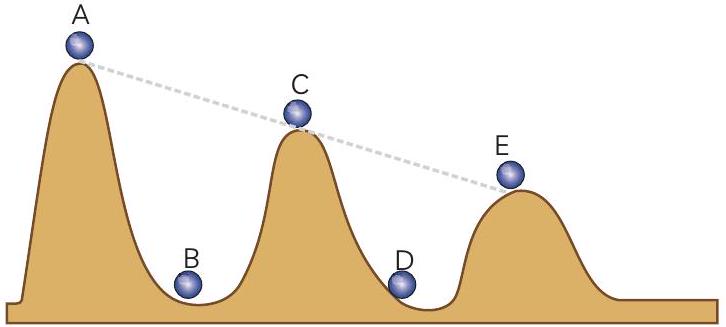
(A) Justify why C is lower than A.
(B) Identify where KE is maximum and where PE is maximum.
(C) Where does the missing mechanical energy go?
Ans. (A) Without friction, by conservation, the ball should reach A again. But friction between the ball and track + air resistance do negative work on the ball, reducing its mechanical energy. So peak C is lower than A. The same applies to E each peak is lower than the previous.
(B) KE is maximum at the lowest points (B, D the troughs) because PE is minimum there. PE is maximum at the highest point A (the start).
(C) The missing mechanical energy is converted into heat (track and ball warm up slightly) and sound (the rolling sound). Total energy is conserved – just not in mechanical form alone.
A worker does 600 J of work in 30 seconds. The power developed is:
Ans. (a) 20 W
Explanation:
Which of the following statements about simple machines is INCORRECT?
Ans. (b) They reduce the total amount of work needed.
Explanation: Simple machines never reduce total work, they only redistribute force and distance.
Which of the following correctly describe a fixed pulley?
(I) \(\mathrm{MA}=1\)
(II) Reduces effort by half
(III) Changes the direction of force
(IV) Effort moves the same distance as the load.
Ans. (b) (I), (III) and (IV)
Explanation: Fixed pulley: \(\mathrm{MA}=1\), it only changes direction of efforts, and effort distance = load distance. It does not reduce effort.
Assertion (A): A 50 kg girl who runs up a flight of stairs has greater power output than a 50 kg girl who walks up the same stairs.
Reason (R): Both girls do the same amount of work against gravity, but the runner takes less time.
Ans. (a) Both (A) and (R) are true, and (R) is the correct explanation of (A).
Explanation: Both girls do \(\mathrm{W}=m g h=\) same work. Runner takes less time i.e., \(\mathrm{P}=\frac{\mathrm{W}}{t}\) is larger thus runner generates more power.
At a construction site, a crane is being used to lift bricks and steel rods to the upper floors of a building. The crane lifts a 500 kg load of bricks to a height of \(12 m\) above the ground in 30 seconds. The crane uses a system of pulleys to multiply force and change the direction of effort. (Take \(g=10 m s^{-2}\).)
(A) What is the work done by the crane in lifting the load?
(B) What is the average power developed by the crane?
(C) If the crane uses a single fixed pulley, What will be the mechanical advantage? What if a movable pulley were used instead of the fixed pulley?
Ans. (A) \(\mathrm{W}=m g h=500 \times 10 \times 12=60,000 \mathrm{~J}\).
(B)
(C) A single fixed pulley does not reduce effort so, effort = load. It only changes the direction of the applied force. This implies \(\mathrm{MA}=1\). A movable pulley has two rope segments supporting the load
But the operator pulls the rope twice as far.
On a seesaw, a child of mass 30 kg sits at 1.5 m from the pivot on one side. At what distance from the pivot must a child of mass 45 kg sit on the other side to balance the seesaw? \(\left(g=10 \mathrm{~m} \mathrm{~s}^{-2}\right)\)
Ans. Balance:
So
So the heavier child (45 kg) must sit closer and only 1.0 m from the pivot, to balance the lighter child sitting at 1.5 m.
Look at the inclined plane shown below. A box of weight 600 N is to be raised to a height of 1.5 m. The length of the inclined plane is 5 m. Find:
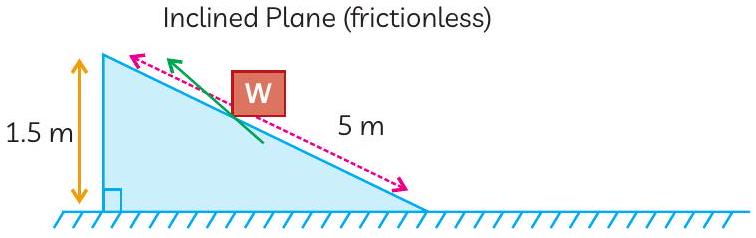
(A) The mechanical advantage,
(B) The effort required, and
(C) The work done by the effort. Compare with the work done in lifting the box vertically.
Ans. Given: Load \(\mathrm{W}=600 \mathrm{~N}\), height \(h=1.5 \mathrm{~m}\), length \(\mathrm{L}=5 \mathrm{~m}\).
(B)
(C) Work done by effort = Effort × L.
Compare with vertical lifting:
Both are equal. The inclined plane reduces effort (600 N to 180 N) but the box travels over a longer distance, so total work is the same.
Before solving, identify whether the question is about work, energy, power or mechanical advantage. Keep the formulas separate: \(W=Fs\), \(KE=\frac12mv^2\), \(PE=mgh\), \(P=W/t\), and \(MA=\text{Load}/\text{Effort}\).
Class 9 Science Chapter 7 Important Questions — FAQs
When is work done in science?
Scientific work is done when a force acts on an object and produces displacement in the direction of the force.
What is the work-energy theorem?
The net work done on an object equals the change in its kinetic energy.
What is the law of conservation of energy?
Energy can neither be created nor destroyed; it can only be transformed from one form to another, so total energy remains conserved.
What is power?
Power is the rate of doing work or transferring energy: \(P=W/t\).
Do simple machines reduce the total work done?
No. Ideal simple machines reduce effort by increasing the distance over which the effort acts, while the total work remains the same.
You May Also Like
- Class 9 Science Chapter 1 Important Questions with Answers – Understanding Science: How to Explore the World? (Exploration)
- Class 9 Science Chapter 2 Important Questions with Answers – Cell: The Building Block of Life (Exploration)
- Class 9 Science Chapter 3 Important Questions with Answers – Tissues (Exploration)
- Class 9 Science Chapter 4 Important Questions with Answers – Describing Motion Around Us (Exploration)
- Class 9 Science Chapter 5 Important Questions with Answers – Exploring Mixtures and their Separation (Exploration)
- Class 9 Science Chapter 6 Important Questions with Answers – How Forces Affect Motion (Exploration)
- Class 9 Science Chapter 7 Important Questions with Answers – Work, Energy, and Simple Machines (Exploration)