
Table of Contents
Last Updated on November 12, 2026 by XAM CONTENT
Practice these Class 9 Science Chapter 3 Important Questions from Tissues in the new NCERT Exploration. The set covers plant tissues, animal tissues, connective and muscular tissues, nervous tissue, joints, the musculoskeletal system and their functions.
In multicellular organisms, specialised cells form tissues that perform specific functions efficiently. Plant and animal tissues differ because plants and animals have different lifestyles, growth patterns and functional needs.
Class 9 Science Chapter 3 Important Questions with Answers
A nail is inserted in the trunk of a tree at a height of 1 metre from the ground level. After 3 years, the nail will:
Ans. (c) remain at the same position
Explanation: Plant growth occurs mainly at apical meristems (root and shoot tips) and cambium (in some plants), which help in elongation and secondary growth. However, the trunk’s existing tissues do not stretch or divide significantly. Since the nail is inserted into a mature, non-growing part of the tree, it remains at the same height even after several years.
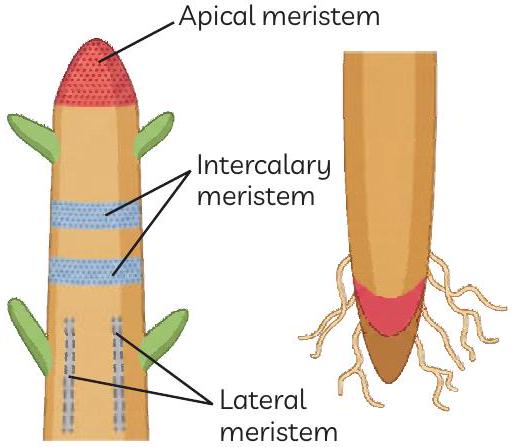
Observe the given figure and answer the question that follows.
What is the main function of meristematic tissue?
Ans. (a) Growth
Explanation: Meristematic tissue is made up of a group of cells that divides continuously to give rise to new cells. The cells of meristematic tissue helps in increasing the length and girth of the plant.
A student prepares a temporary mount of a cross-section of a young stem and observes two types of complex tissues. One has vessels and tracheids, while the other contains sieve tubes and companion cells. Which statement correctly distinguishes their roles?
Ans. (c) Xylem has dead elements (except xylem parenchyma) and conducts unidirectional flow; phloem has living elements and conducts bidirectional flow.
Explanation: Xylem (with vessels and tracheids) consists mainly of dead cells and conducts water and minerals upward from roots to leaves, i.e., a unidirectional flow. Phloem (with sieve tubes and companion cells) is composed of living cells and transports organic nutrients (sucrose) from source to sink, which can be bidirectional.
Belonging to a rural family background, Jaspreet while enjoying coconut water with her friend Seema, told her that it is difficult to pull out the husk of a coconut tree to which Seema replied that it is due to the presence of selerenchyma. Can you support the statement made by Seema by providing a suitable reason?
Ans. Sclerenchyma can be found in the coconut husk. Sclerenchyma is a type of dead-simple permanent plant tissue characterised by thickened lignified cell walls that provide structural support to the plant and make it waterproof. Due to the thickened and lignified nature of its cells, the coconut husk becomes very rigid, making it difficult to separate the husk from these cells.
A tissue that helps in growth of a plant is known as apical meristem.
To check this fact, Neha took two identical potted plants and cut the shoot tip of one of them. She observed if the two plants grew in height after a week.


(A) What was Neha trying to find out about shoot tips through her experiment?
(B) Which of these conditions would have made Neha’s experiment invalid? Circle ‘Yes’ or ‘No’ to mark your responses.
| Would this have made the experiment invalid? | Yes or No |
|---|---|
| (i) Keeping one plant in sunlight and the other in a dark room. | Yes/No |
| (ii) Watering both plants equally. | Yes/No |
| (iii) Adding manure to the soil of plant 1 only. | Yes/No |
(C) What happens to the cells formed by meristematic tissue?
Ans. (A) Neha was trying to find out whether the shoot tip, containing apical meristem, is responsible for the growth of a plant.
(B) (i) Yes, (ii) No, (iii) Yes.
(C) Meristematic tissue take up a specific role and lose the ability to divide. As a result, they form a permanent tissue. This process of taking up a permanent shape, size and function is called differentiation. Cells of meristematic tissue differentiate to form different types of permanent tissue.
What is a permanent tissue? Classify permanent tissue and describe them.
Ans. Permanent tissues are derived from meristematic tissue but unlike meristematic cells, their cells have lost the power of division and have attained their definite forms.
Permanent tissues are classified into the following two types: Simple permanent tissue and complex permanent tissue
Simple permanent tissues: These tissues are composed of cells which are structurally and functionally similar.
Simple permanent tissues are further classified into three types:
(1) Parenchyma: Parenchyma forms the bulk of the plant body. Parenchyma cells are living cells with thin walls. They are generally involved in functions like storage, photosynthesis, and gas exchange.
(2) Collenchyma: Collenchyma tissue is living and provides flexibility and support to growing parts of the plant. It is characterised by the deposition of extra cellulose at the corner of the cells.
(3) Sclerenchyma: Sclerenchyma cells are dead and lack protoplasm. The cell walls of sclerenchyma are largely thickened with the deposition of lignin, which provides structural support and rigidity to the plant.
Complex permanent tissues: Complex tissues consist of more than one type of cells having a common origin. All the cells coordinate to perform a common function.
Complex tissues are of the following two types:
(1) Xylem: Xylem is a vascular and mechanical tissue. It has a conducting function. It is composed of four different types of cells: Tracheids, vessels, xylem parenchyma and xylem sclerenchyma. Except for the xylem parenchyma, all other xylem elements are dead and bounded by thick lignified walls.
(2) Phloem: Like the xylem, the phloem is also vascular but has no mechanical function. It is composed of the following five elements: Sieve cells, sieve tubes, companion cells, phloem parenchyma and phloem fibres. Except phloem fibres, all other phloem elements are living.
Xylem and phloem are both conducting tissues and are also known as vascular tissues; together both of them constitute a vascular bundle.
The tissue that is thin enough to allow diffusion is:
Ans. (b) Simple squamous epithelium
Explanation: Simple squamous epithelium forms a thin, permeable membrane that allows selective exchange of substances. It facilitates diffusion, filtration, absorption, and secretion. This type of epithelium is found in alveoli of lungs, blood vessels (endothelium), and kidney (glomeruli), enabling the efficient exchange of gases and molecules.
A person met with an accident in which two long bones of hand were dislocated. Which among the following may be the possible reason?
Ans. (c) Ligament break
Explanation: Ligaments are strong, elastic connective tissues that connect bones at joints. Their primary role is to stabilise and support joints during movement. A dislocation typically occurs when ligaments are overstretched or torn due to trauma, causing bones to shift from their normal position. Hence, ligament damage is the most probable cause of bone dislocation.
Assertion (A): Yoga exercises enhance physical agility by improving the ability to change body position quickly and efficiently during movement.
Reason (R): Yoga practice develops dynamic balance, coordination, and functional flexibility through weightbearing postures and controlled transitions, which train the body to respond swiftly to changing demands.
Ans. (a) Both (A) and (R) are true, and (R) is the correct explanation of (A).
Explanation: Yoga postures require controlled transitions and weight shifting, which train the neuromuscular system for rapid, efficient movement adjustments. The practice strengthens movement patterns rather than isolating muscles, directly supporting the quick position changes, as described in the assertion.
After completion of the chapter ‘Tissues’, the teacher asked the students to revise the chapter. Next day, she announced a quiz where children have to find the correct answer by listening to the clue given by the teacher.
She said,
Tissue A repairs the injured tissues and fills the spaces within the organs.
Tissue B serves as a fat reservoir and also carries out the function of an insulator.
Tissue C transmits messages within our body.
Tissue D is a muscular tissue that functions throughout life without fatigue.
(A) Identify tissue A.
(a) Adipose
(b) Areolar
(c) Blood
(d) Cartilage
(B) Polar bears living in cold climatic conditions have an excess of one of these tissues. Which tissue is it?
(a) Tissue A
(b) Tissue B
(c) Tissue C
(d) Tissue D
(C) Assertion (A): If we are watching TV, the picture seen by us from our eyes is interpreted by the brain.
Reason (R): The information seen by us from our eyes is transmitted to the brain with the help of nervous tissue.
(a) Both (A) and (R) are true, and (R) is the correct explanation of (A).
(b) Both (A) and (R) are true, and (R) is not the correct explanation of (A).
(c) (A) is true but (R) is false.
(d) (A) is false but (R) is true.
(D) Which of the following are the name and characteristic feature of tissue D?
(a) Cardiac muscle, multinucleate
(b) Smooth muscle, uninucleate
(c) Skeletal muscle, striations present
(d) Cardiac muscle, striations present
OR
(D) Which of the following depicts the difference between tissue A and B?
(a) Tissue A and tissue B connect muscles to skin.
(b) Tissue A connects muscles to skin, tissue B stores fat under the skin.
(c) Tissue A stores fat under the skin; tissue B connects muscles to skin.
(d) Both tissue A and B store fat under the skin.
Ans. (A) (b) Areolar
Explanation: Areolar tissue is a loose connective tissue with a soft, gel-like matrix. It fixes the skin to the underlying muscles, fills spaces inside organs, and supports blood vessels and nerves. It also helps in tissue repair, so it is commonly called the packaging tissue of the body.
(B) (b) Tissue B
Explanation: Polar bears have an excess of adipose tissue, which serves as a fat reservoir and provides insulation against cold temperatures.
(C) (a) Both (A) and (R) are true, and (R) is the correct explanation of (A).
Explanation: Nervous tissue helps in transmitting information from the surroundings to the brain where the information is processed and interpreted.
(D) (d) Cardiac muscle, striations present
Explanation: Cardiac muscle tissue is unique in its striated appearance and its ability to function continuously without fatigue.
OR
(D) (b) Tissue A connects muscles to skin, tissue B stores fat under the skin.
Explanation: Tissue A is areolar tissue which connects muscles to skin, while Tissue B is adipose tissue which stores fat under the skin and provides insulation.
During the Inter-School Athletics Meet, three students-Arjun, Priya, and Kabir suffered different types of physical distress. Read the description of their injuries in the given table and answer the questions that follow.
| Athlete | Nature of Injury/Condition | Symptoms Observed | Primary Tissue Involved |
|---|---|---|---|
| Arjun | Sprain at the ankle while turning. | Swelling; intense pain when moving the joint; no bone break. | Tissue X |
| Priya | Muscle strain in the calf during a sprint. | Sharp pain in the mid-leg; difficulty in pulling the heel up | Tissue Y |
| Kabir | Chronic back pain after long hours of sitting. | Aching in the lower back; poor sitting “hunchback” posture. | Skeletal system and muscles |
(A) Based on your knowledge of animal tissues, identify tissue X and tissue Y.
Tissue X: ____
Tissue Y: ____
(B) What are the functions of tissue X and the tissue Y?
(C) If Arjun’s injury involves internal bleeding (bruising), which connective tissue with a fluid matrix is leaking into the surrounding area?
(a) Cartilage
(b) Blood
(c) Areolar Tissue
(d) Adipose Tissue
Ans. (A) Tissue X – Ligament
Tissue Y – Tendon
(B) Tissue X: Connects bone to bone
Tissue Y: Connects muscle to bone
(C) (b) Blood
Explanation: Blood is a connective tissue with a fluid matrix called plasma. In internal bleeding or bruising, blood leaks from damaged blood vessels into the surrounding tissues.
Compare epithelial tissue and nervous tissue in terms of their structural adaptations.
| Feature | Epithelial Tissue | Nervous Tissue |
|---|---|---|
| Structural organisation | Closely packed cells of various types such as squamous, cuboidal, or columnar | Highly specialised cells called neurons and supporting glial cells |
| Intercellular space | Minimal to none | Present; characterised by specialised gaps called synapses |
| Regeneration power | High; rapidly divides to replace worn-out or damaged surfaces | Very low; once matured, neurons generally lose the ability to divide |
| Key adaptations | May have cilia (for movement) or microvilli (to increase surface area for absorption). | Long, wire-like axons for signal conduction and branched dendrites to receive stimuli. |
The given table lists three types of joints with their movement capabilities. Complete the table by filling in the missing information.
| Joint Type | Example in Human | Type of Movement Allowed |
|---|---|---|
| Ball and socket | (I) ____ | Movement in all directions |
| (II) ____ | Knee joint | (III) ____ |
| (IV) ____ | Skull bones | No movement (immovable) |
Ans. (I) Shoulder joint/Hip joint
(II) Hinge joint
(III) Movement in one plane (flexion/extension)
(IV) Fixed/Fibrous joint
The image shows the microscopic view of a type of muscle.
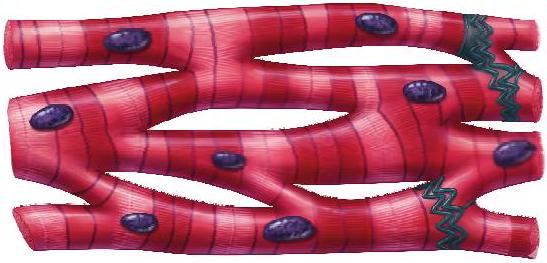
(A) Write two structural features of this tissue.
(B) State the location of this tissue in the human body.
(C) What will happen if these muscles undergo fatigue?
Ans. (A) Uninucleated, striations present, branched
(Any two)
(B) Heart, as they are cardiac muscles.
(C) The heart will stop pumping blood throughout the body.
What is the basic unit of the nervous system? Draw a well-labelled diagram of the unit and describe the function of each of its components.
Ans. The basic unit of the nervous system is the neuron.
Neurons, also known as nerve cells, consist of a cell body that contains a nucleus and cytoplasm, along with long, thin, hair-like extensions. Each neuron has a single long projection called an axon and multiple short, branching structures known as dendrites.
The primary function of neurons is to receive, transmit, and relay signals in the form of electrical impulses throughout the body. These signals help coordinate various bodily functions, including muscle movement.
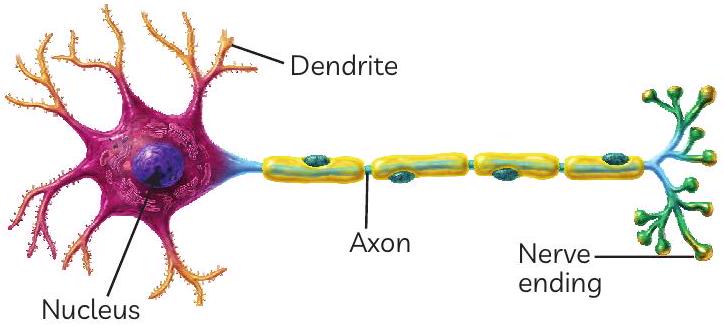
Dendrites: These are branch-like structures that receive and transmit messages from other neurons to the cell body.
Cell body: It contains the nucleus, Golgi body, endoplasmic reticulum, mitochondria, and other essential organelles.
Axon: The axon is a tube-like structure that transports electrical impulses from the cell body to the axon terminals, which then transmit the impulse to other neurons.
For tissue questions, connect structure with function. In plants, identify whether the tissue is meant for growth, support, storage or transport. In animals, first identify whether the function involves protection, support, movement, transport or coordination.
Class 9 Science Chapter 3 Important Questions — FAQs
What is a tissue?
A tissue is a group of cells similar in structure, origin and function that work together to perform a specific physiological function.
What is the difference between meristematic and permanent tissues?
Meristematic tissues contain actively dividing cells responsible for growth, while permanent tissues consist of mature cells that have lost the ability to divide and perform specialised functions.
What are the two complex permanent tissues in plants?
Xylem and phloem are the two complex permanent tissues. Xylem transports water and minerals, while phloem transports food.
What is the difference between a tendon and a ligament?
A tendon connects muscle to bone, while a ligament connects one bone to another at a joint.
What is the basic unit of nervous tissue?
The neuron is the basic structural and functional unit of the nervous system.
You May Also Like
- Class 9 Science Chapter 1 Important Questions with Answers – Understanding Science: How to Explore the World? (Exploration)
- Class 9 Science Chapter 2 Important Questions with Answers – Cell: The Building Block of Life (Exploration)
- Class 9 Science Chapter 3 Important Questions with Answers – Tissues (Exploration)
- Class 9 Science Chapter 4 Important Questions with Answers – Describing Motion Around Us (Exploration)
- Class 9 Science Chapter 5 Important Questions with Answers – Exploring Mixtures and their Separation (Exploration)
- Class 9 Science Chapter 6 Important Questions with Answers – How Forces Affect Motion (Exploration)
- Class 9 Science Chapter 7 Important Questions with Answers – Work, Energy, and Simple Machines (Exploration)