

Table of Contents
Last Updated on November 12, 2026 by XAM CONTENT
Practice these Class 9 Science Chapter 5 Important Questions from Exploring Mixtures and their Separation in the new NCERT Exploration. The set covers homogeneous and heterogeneous mixtures, solutions, colloids, suspensions, solubility, concentration, Tyndall effect and separation techniques.
Mixtures can be classified by composition and particle behaviour, and their components can often be separated by exploiting differences in physical properties such as particle size, solubility, density, boiling point, sublimation and adsorption.
Class 9 Science Chapter 5 Important Questions with Answers
When a beam of light is passed through a colloidal solution, it gets:
Ans. (c) scattered
Explanation: When a light beam passes through a colloidal solution, the colloidal particles scatter the light, allowing us to perceive its direction. As a result, the Tyndall’s effect is observed.
Which of the following is a correct combination of property and type of mixture?
Ans. (c) Light scattering (Tyndall effect): Colloid
Explanation: Homogeneous mixture → uniform composition throughout, no visible boundaries.
Heterogeneous mixture → non-uniform composition, visible boundaries between components.
Colloids → show Tyndall effect (scatter light due to intermediate particle size).
Suspensions → do not show Tyndall effect clearly; particles settle on standing.
Which of the following are homogeneous in nature?
(I) Ice
(II) Wood
(III) Soil
(IV) Air
Ans. (c) (I) and (IV)
Explanation: Ice and air are homogeneous in nature because they have uniform composition throughout; ice is a pure solid form of water, while air is a mixture of gases evenly distributed.
Wood and soil, on the other hand, are heterogeneous because their components are not uniformly distributed and can be separated physically.
What is the correct stability order of following – True solutions, colloidal solution, suspension.
Ans. (a) Solution > Colloidal > Suspension
Explanation: The stability of given items is primarily determined by the particle size, smaller the particle size more is the stability.
Particle size varies as: True solution – smallest (< 1 nm); Colloidal solution – intermediate (1-1000 nm); Suspension – largest (> 1000 nm).
Assertion (A): A student cools a hot saturated solution of sodium thiosulfate carefully without disturbance. If the solution remains clear even below the expected crystallisation temperature, it is a supersaturated solution and this condition is unstable.
Reason (R): The solubility graph shows that as temperature drops, the solubility decreases. A supersaturated solution contains more dissolved solute than what the graph allows at that lower temperature.
Ans. (a) Both (A) and (R) are true, and (R) is the correct explanation of (A).
Explanation: Cooling a saturated solution without disturbance can produce a supersaturated solution, which remains clear but is unstable as a single crystal or tap can trigger rapid crystallisation. The solubility graph defines the equilibrium solubility; at a lower temperature, the graph predicts a lower limit. A supersaturated solution exceeds that limit, but crystallisation is delayed due to the absence of seed crystals or rough surfaces.
Solubility curves are graphs that show how much solute can dissolve in 100 g of water. On all solubility curves, temperature is the independent variable and taken on the \(x\)-axis. The dependent variable that is the solubility is taken on the \(y\)-axis. The solubility is measured as the grams of solute in 100 g of water. (Use the given solubility curve to answer the following questions):
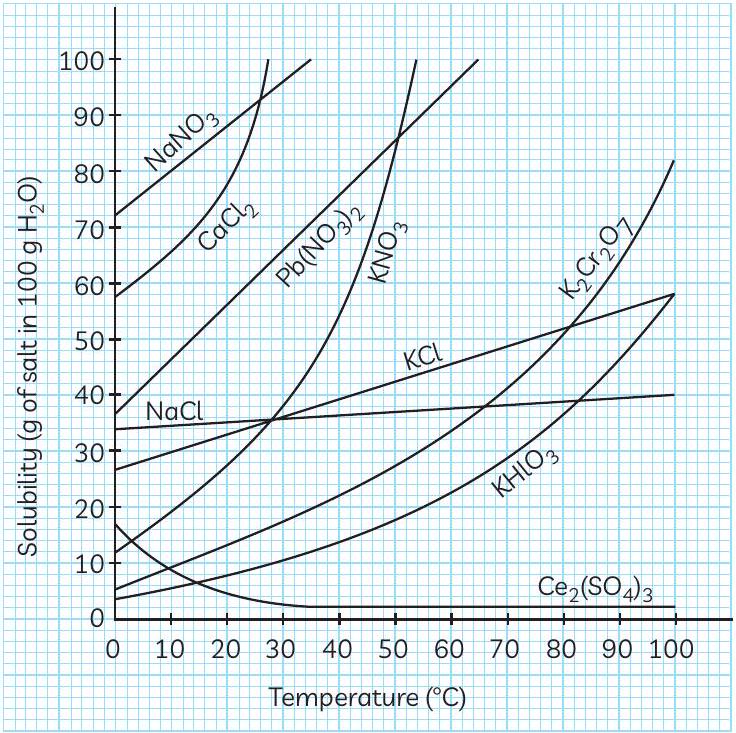
(A) How can an unsaturated solution be converted into saturated solution?
(B) 60 gm KCl is dissolved in the 100 gm of water at 70 °C, would the resulting solution be unsaturated, saturated, or supersaturated?
OR
(B) 10 gm \(\mathrm{KClO}_{3}\) is dissolved in the 100 gm of water at 60 °C, would the resulting solution be unsaturated, saturated, or supersaturated?
(C) Compare the solubility of \(\mathrm{NaNO}_{3}\) with the solubility of \(\mathrm{Ce}_{2}\left(\mathrm{SO}_{4}\right)_{3}\) and explain the solubility curve of later.
Ans. (A) A solution that has dissolved as much solute as it is capable of dissolving, is said to be a saturated solution. If the amount of solute contained in a solution is less than the saturation level, it is called an unsaturated solution. An unsaturated solution be converted into saturated solution by dissolving appropriate amount of solute at the particular temperature.
(B) On the solubility curve, any point that falls on the line or curve for a solute would be a point of saturation. Any point that falls below the line or curve for a solute would represent an unsaturated solution. Any point that falls above the line or curve for a solute would represent a supersaturated solution. So, when 60 gm KCL is dissolved in the 100 gm of water at 70 °C, it would form supersaturated solution.
OR
(B) When \(10 \mathrm{gm} \mathrm{KClO}_{3}\) is dissolved in the 100 gm of water at 60 °C, it would form unsaturated solution.
(C) Comparison of solubilities of \(\mathrm{NaNO}_{3}\) and \(\mathrm{Ce}_{2}\left(\mathrm{SO}_{4}\right)_{3}\).
| Feature | \(\mathrm{NaNO}_{3}\) | \(\mathrm{Ce}_{2}\left(\mathrm{SO}_{4}\right)_{3}\) |
|---|---|---|
| Trend | Solubility increases rapidly with temperature | Solubility decreases as temperature increases |
| At 0°C | Lowest solubility (approx. 72 g) | Highest solubility (approx. 18 g) |
| At 100°C | Off the chart (very high solubility) | Near zero solubility (approx. 2 g) |
Solubility curve of \(\mathrm{Ce}_{2}\left(\mathrm{SO}_{4}\right)_{3}: \mathrm{Ce}_{2}\left(\mathrm{SO}_{4}\right)_{3}\) is sparingly soluble in water and very small amount of it can form saturated solution with large amount of solute remains undissolved. The solubility of \(\mathrm{Ce}_{2}\left(\mathrm{SO}_{4}\right)_{3}\) decreases with increase in temperature, the solubility is highest at 0°C, decreases sharply and after 30°C it becomes nearly constant.
Tina passes light beams through two liquid mixtures in separate glasses. The picture shows Tina’s observations.
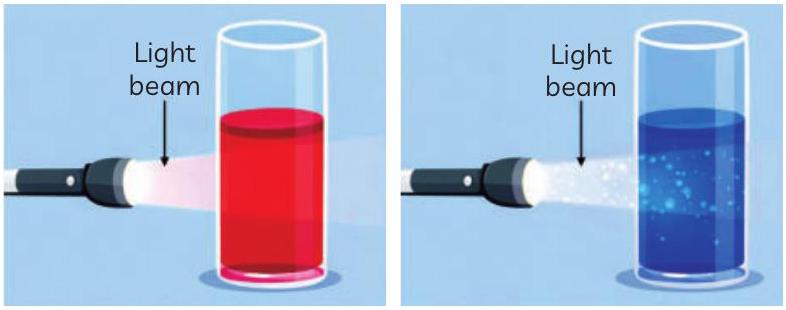
(A) Based on the behaviour of the light beam what are liquids 1 and 2?
| Liquid 1 | Liquid 2 | |
|---|---|---|
| (a) | Solution | Colloid |
| (b) | Colloid | Suspension |
| (c) | Solution | Suspension |
| (d) | Suspension | Colloid |
(B) Which of these is true about the particles in the two liquids?
(a) Particles in both liquids scatter light rays.
(b) Particles in both liquids absorb light rays.
(c) Particles in liquid 1 scatter light rays and particles in liquid 2 absorb light rays.
(d) Particles in liquid 1 absorb light rays and particles in liquid 2 scatter light rays.
(C) Assertion (A): The Tyndall effect is observed when light passes through colloidal particles.
Reason (R): In a colloid, the dispersed phase scatters light, making the path of light visible.
(a) Both (A) and (R) are true, and (R) is the correct explanation of (A).
(b) Both (A) and (R) are true, and (R) is not the correct explanation of (A).
(c) (A) is true but (R) is false.
(d) (A) is false but (R) is true.
(D) Which of the following statements about colloids is incorrect?
(a) Colloids are homogeneous.
(b) Colloids can scatter a beam of light passing through it.
(c) Colloids show Tyndall effect.
(d) Colloids are quite stable.
Ans. (A) (b) Liquid 1: Colloid; Liquid 2: Suspension
Explanation: Liquid 1 is a colloid. A colloid scatters light when a beam passes through it, showing the Tyndall effect. This makes the path of the light visible in the liquid.
Liquid 2 is a suspension. A suspension has larger particles that do not scatter light uniformly. The particles may settle over time, leading to poor light transmission and a blocked or diffused beam.
(B) (a) Particles of both liquids scatter light rays.
Explanation: Both liquids scatter light rays due to the nature of their particles. In liquid 1, which is a colloid, the dispersed particles are small enough to remain suspended and scatter light, causing the Tyndall effect. In liquid 2, which is a suspension, the larger particles also scatter light, although they may settle over time. Thus, the particles in both liquids contribute to the scattering of light rays.
(C) (a) Both (A) and (R) are true, and (R) is the correct explanation of (A).
Explanation: The Tyndall effect is observed when light passes through colloidal particles. It is because in a colloid, the dispersed particles are large enough to scatter light, making the path of light visible.
(D) (a) Colloids are homogeneous.
Explanation: Colloids are heterogeneous mixture, not homogeneous. They consist of dispersed particles in a continuous medium.
Explain why particles of a colloidal solution do not settle down when left undisturbed, while in the case of a suspension they do.
Ans. Colloidal particles are smaller than those in a suspension and move randomly, preventing them from settling when left undisturbed. In contrast, the larger particles in a suspension tend to settle under the influence of gravity.
A group of students took an old shoe box and covered it with black paper from all sides. They fixed a source of light (a torch) at one end of the box by making a hole in it and making another hole on the other side to view the light. They placed a milk sample contained in a beaker/tumbler in the box as shown in the given figure. They were amazed to see that milk taken in the tumbler was illuminated. They tried the same activity by taking a salt solution but found that light simply passed through it.
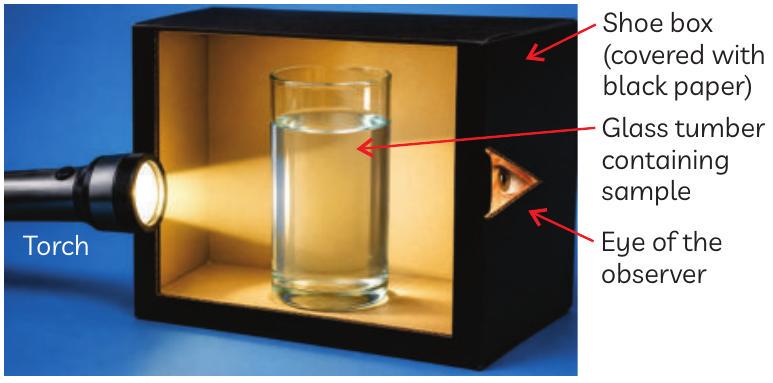
(A) Explain why milk sample was illuminated. Name the phenomenon involved.
(B) Same results were not observed with a salt solution. Explain why?
(C) Can you suggest two more solutions that would show the same effect as shown in the milk solution?
Ans. (A) Milk is a type of colloid. When a light beam is focused on milk sample in a beaker, the path of the light beam is lightened and becomes visible from the other side. The colloidal particles are large enough and light falling on them scatters. We can perceive the course of the light beam because of the scattered light that enters our eyes. The Tyndall effect is the scattering of light by colloidal particles.
(B) A salt solution is a true solution. When a light beam is focused on the salt solution in a dark room, the path of the light beam is not visible inside the solution when viewed from the other side. This is due to the fact that the salt particles in it are so minute that light rays falling on them do not scatter.
(C) Sulphur solution and detergent solution.
“10 percent starch in water by mass” means:
Ans. (b) 10 grams of starch dissolved in 90 grams of water.
Explanation: If a solution is characterised as 10% starch in water by mass, it means that 10 grams of starch is present in 100 grams of solution, or 10 grams of starch is present in \((100-10) \mathrm{g}=90\) grams of water.
You were given there two sets of substance:
Set I: The substances (A) and (B) differ in their solubility in organic solvent.
Set II: The substances (X) and (Y) have different boiling points.
How would you separate the substances given in the Set I and the Set II?
Ans. (a) Crystallisation for Set I and distillation for Set II.
Explanation: When two substances differ in their solubility, they can be separate from each other by the process of crystallisation. Distillation employed difference in boiling point of substances to separate them.
When one component changes directly from solid to gas upon heating, while the other does not, they can be separated by the process of sublimation.
Assertion (A): A mixture of oil and water can be separated using a separating funnel.
Reason (R): Oil and water are immiscible liquids and form two distinct layers due to their different densities.
Ans. (a) Both (A) and (R) are true, and (R) is the correct explanation of (A).
Explanation: Oil and water do not mix with each other; they are immiscible liquids. As oil is less dense than water, it forms a separate upper layer above the water. A separating funnel works on the principle of differences in density between immiscible liquids – the denser liquid (water) is drained out first from the bottom, while the lighter liquid (oil) is collected separately.
The given diagram shows the separation of a mixture of liquids J and K. The mixture is heated at 56 °C and the temperature is recorded on the thermometer. The drops of liquid J fall steadily into the flask.
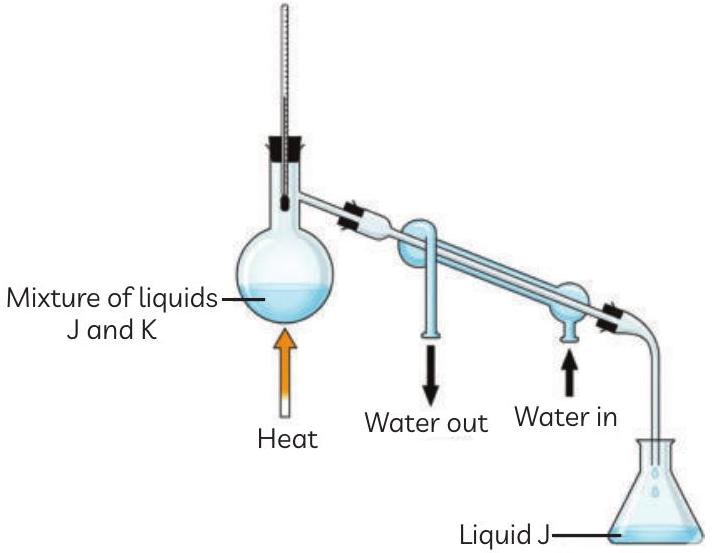
(A) What separation technique is being shown in the diagram?
(B) What conclusions can be drawn about the boiling points of liquids J?
OR
(B) What conclusions can be drawn about the boiling points of liquids K?
(C) Liquid K is an organic compound with the formula \(\mathrm{C}_{4}\mathrm{H}_{8}\mathrm{O}\). Calculate the percentage by mass of carbon in compound K.
Ans. (A) Simple distillation
(B) The boiling point of liquid J is about 56 °C, at this temperature it starts to boil and turned into vapour and condensed.
OR
(B) The boiling point of liquid K is more than 56°C as it remains in flask at 56°C.
(C) The percentage by mass of carbon in compound K \(\left(\mathrm{C}_{4}\mathrm{H}_{8}\mathrm{O}\right)\) is calculated as follows:
Atomic masses: \(\mathrm{C}=12, \mathrm{H}=1, \mathrm{O}=16\)
Molar mass of \(\mathrm{C}_{4}\mathrm{H}_{8}\mathrm{O}=4 \times 12+8 \times 1+16=48+8+16=72 \mathrm{~g/mol}\)
Mass of carbon \(=4 \times 12=48 \mathrm{~g}\)
Mass percentage of carbon \(=\frac{48}{72}\times100=66.67\%\)
A child wanted to separate the mixture of dyes constituting a sample of ink. He marked a line by the ink on the filter paper and placed the filter paper in a glass containing water as shown in. The filter paper was removed when the water moved near the top of the filter paper.
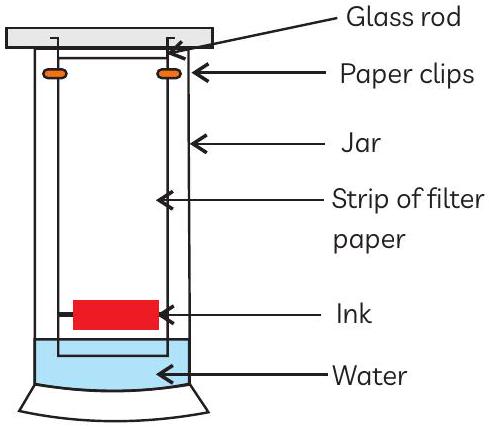
(A) What would you expect to see, if the ink contains three different coloured components?
(B) Name the technique used by the child.
(C) Suggest one more application of this technique.
Ans. (A) One would expect to see three distinct coloured spots or bands on the filter paper at different heights from the original ink line. This happens because different dyes travel at different speeds with the water.
(B) Paper chromatography
(C) (1) To separate pigments present in flower petals or leaves.
(2) To detect adulteration in food colours or to separate colours in a sweat.
(3) Detecting drugs or toxins in blood/urine
(Any one)
The flow chart below shows the steps involved in processing a mixture of sand, salt, and ammonium chloride to obtain each component in its pure form.
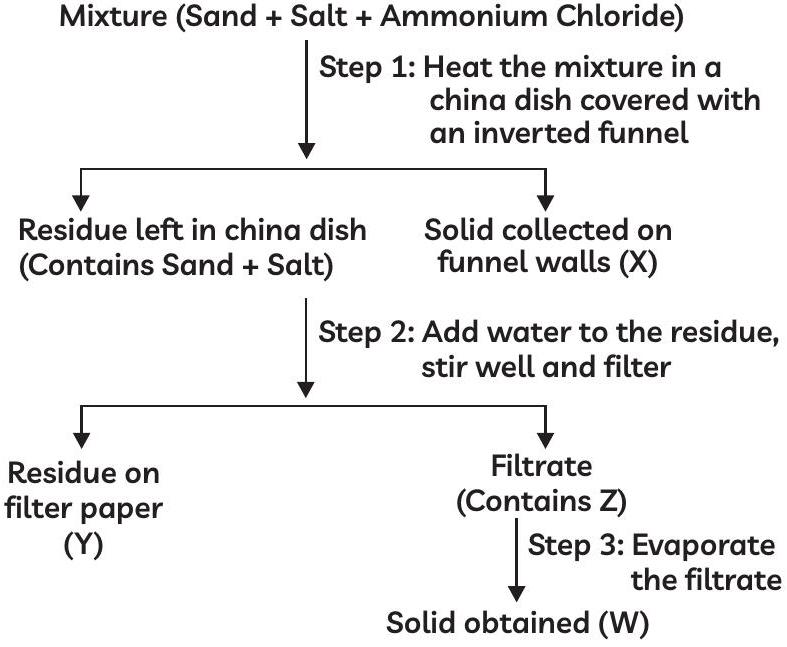
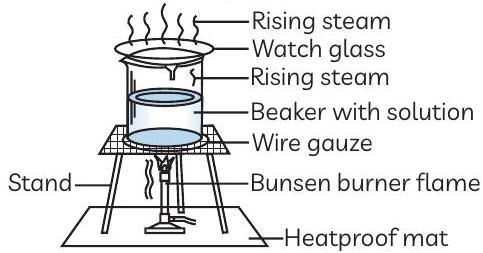
Three diagrams (P, Q, and R) illustrate the key techniques used at different stages of this separation process.
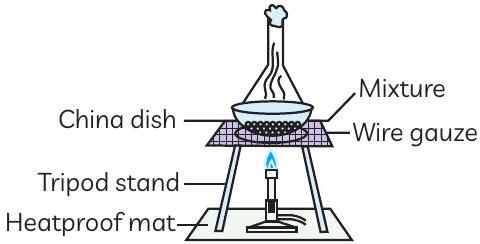
(A) Which diagram (P, Q, or R) corresponds to the technique used in Step 1? Name this technique.
(B) Which diagram (P, Q, or R) corresponds to the technique used in Step 2? Name this technique.
(C) Which diagram (P, Q, or R) corresponds to the technique used in Step 3? Name this technique.
(D) Identify the substances labelled as X, Y, Z, and W in the flow chart.
Ans. (A) Diagram P corresponds to Step 1. Technique – Sublimation.
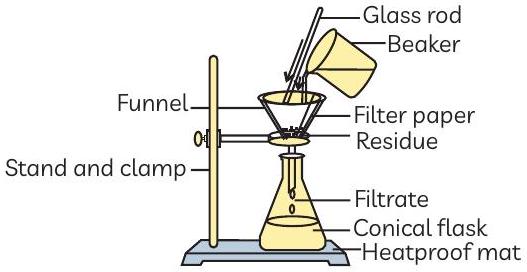
(B) Diagram Q corresponds to Step 2. Technique – Filtration.
(C) Diagram R corresponds to Step 3. Technique – Evaporation.
(D) \(\mathrm{X}=\) Ammonium chloride
Y = Sand
Z = Salt (Sodium chloride) dissolved in water
W = Salt (Sodium chloride)
For separation questions, first identify the physical property in which the components differ—particle size, density, solubility, boiling point, sublimation or adsorption. That property usually points directly to the correct separation technique.
Class 9 Science Chapter 5 Important Questions — FAQs
What is the difference between a homogeneous and heterogeneous mixture?
A homogeneous mixture has a uniform composition throughout, while a heterogeneous mixture has a non-uniform composition with distinguishable components or phases.
What is the Tyndall effect?
The Tyndall effect is the scattering of light by colloidal particles, which makes the path of a light beam visible through a colloid.
What is a saturated solution?
A saturated solution contains the maximum amount of solute that can dissolve in a given amount of solvent at a particular temperature.
When is a separating funnel used?
A separating funnel is used to separate immiscible liquids that form distinct layers because of differences in density.
What is paper chromatography used for?
Paper chromatography is used to separate and identify components of a mixture, such as different dyes in ink or pigments in plant extracts.
You May Also Like
- Class 9 Science Chapter 1 Important Questions with Answers – Understanding Science: How to Explore the World? (Exploration)
- Class 9 Science Chapter 2 Important Questions with Answers – Cell: The Building Block of Life (Exploration)
- Class 9 Science Chapter 3 Important Questions with Answers – Tissues (Exploration)
- Class 9 Science Chapter 4 Important Questions with Answers – Describing Motion Around Us (Exploration)
- Class 9 Science Chapter 5 Important Questions with Answers – Exploring Mixtures and their Separation (Exploration)
- Class 9 Science Chapter 6 Important Questions with Answers – How Forces Affect Motion (Exploration)
- Class 9 Science Chapter 7 Important Questions with Answers – Work, Energy, and Simple Machines (Exploration)