

Last Updated on November 12, 2026 by sanjjeett
Practice the complete ICSE Class 10 Physics 2024 Question Paper with Solutions, including MCQs, numericals, diagrams and answers from Sections A and B. Use this solved paper to revise important concepts, practise board-style questions and strengthen your exam preparation.
Answers to this Paper must be written on the paper provided separately.
You will not be allowed to write during first 15 minutes.
This time is to be spent in reading the question paper.
The time given at the head of this Paper is the time allowed for writing the answers.
Section A is compulsory. Attempt any four questions from Section B.
The intended marks for questions or parts of questions are given in brackets [ ].
SECTION A
Choose the correct answers to the questions from the given options.
(Do not copy the questions, write the correct answers only.)
When a bell fixed on a cycle rings, then the energy conversion that takes place is
Option (b) is correct.
Explanation: Bell fixed on a cycle rings when pressure by finger is applied. So, mechanical energy is converted into sound energy.
A door lock is opened by turning the lever (handle) of length 0.2 m. If the moment of force produced is 1 Nm , then the minimum force required is
Option (a) is correct
Explanation: Moment of a force = Force x perpendicular distance from the line of action of the force
Or,
∴
A force ‘F’ moves a load from A to C as shown in the figure below. For the calculation of the work done, which of these lengths would you use as the displacement?
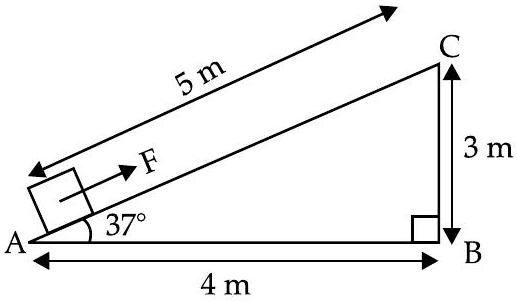
Option (c) is correct.
Explanation: Displacement should be in the direction of force.
A radioactive nucleus containing 128 nucleons emits a \(\beta\)-particle. After \(\beta\)-emission the number of nucleons present in the nucleus will be
Option (a) is correct.
Explanation: Number of nucleons i.e., mass no. does not change due to \(\beta\) emission Only atomic number will increase by 1.
Assertion (A): Ultraviolet radiations are scattered more as compared to the microwave radiations.
Reason (R): Wavelength of ultraviolet radiation is more than the wavelength of microwave radiation.
Option (b) is correct.
Explanation: As wavelength decreases, scattering increases.
Wavelength of ultraviolet is less than the wavelength of microwave.
Hence, scattering of ultraviolet is more than that of microwave.
Hence, the assertion is true but reason is false.
When the stem of vibrating tuning fork is pressed on a table, the tabletop starts vibrating. These vibrations are definitely an example of
Option (c) is correct.
Explanation: When stem of a vibrating tuning fork is pressed on a table, the table top starts vibrating due to the periodic force applied by the tuning fork. This is an example of forced vibration.
Which of the following is a class III lever?
Option (d) is correct.
Explanation: For class III lever force is applied in between the fulcrum and the load.
In human forearm, elbow is the pivot, bicep muscle applies the force and load is placed on the palm. Hence, it is a class III lever.
The specific resistance of a conductor depends on its
Option (b) is correct.
Explanation: Specific resistance is independent of the dimension of the conductor. It depends on the material of the conductor.
Identify the option that displays the correct wiring with correct colour code
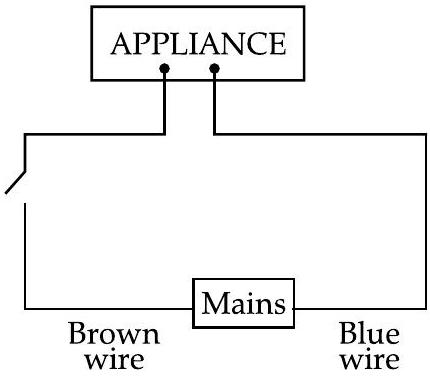
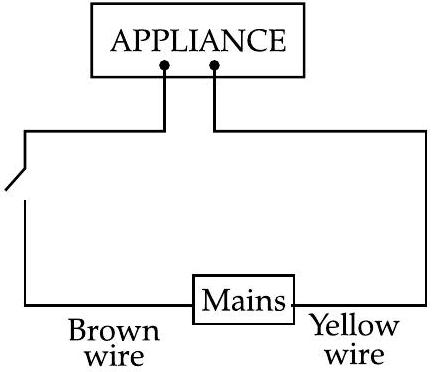
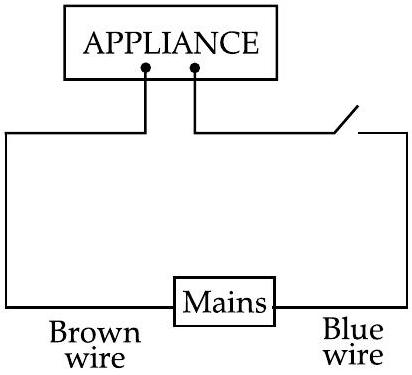
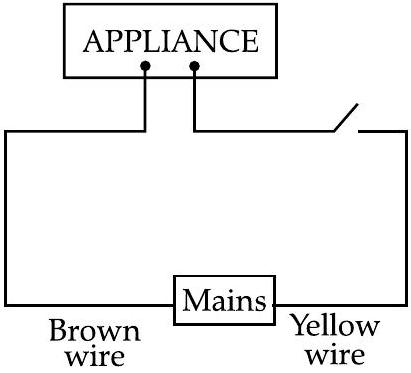
Option (a) is correct.
Explanation: From mains, blue wire (NEUTRAL) should directly reach the appliance and the brown wire (LIVE) should reach the appliance through a switch.
The potential difference between terminals of a cell in a closed electric circuit is
Option (a) is correct.
Explanation: Potential difference between terminals of a cell, in open circuited condition, is termed as electromotive force. Potential difference between terminals of a cell, in closed circuited condition, is termed as terminal voltage.
During melting of ice at 0°C the
Option (b) is correct.
Explanation: During melting, ice requires latent heat (a form of energy) and temperature remains constant at its melting point.
Linear magnification(m) produced by a concave lens is
Option (a) is correct.
Explanation: Concave lens always produces virtual, erect image, smaller than the object. Hence, the magnification is less than 1.
A radioactive element is placed in an evacuated chamber. Then the rate of radioactive decay will
Option (c) is correct.
Explanation: Rate of radioactive elements is determined by the properties of the nucleus of an atom. so, it does not change by environment (external factors).
The graph given below shows heat energy supplied against change in temperature when no energy is lost to the surrounding. The slope of this graph will give
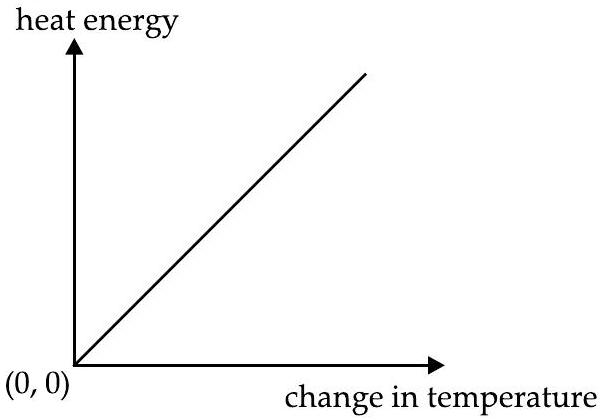
Option (d) is correct.
Explanation: Slope the graph gives the amount of heat required for unit rise of temperature. This is termed as the heat capacity.
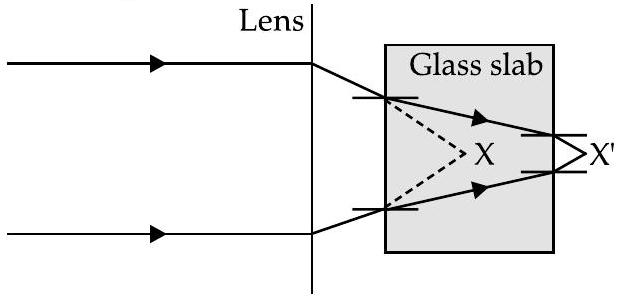
A block of glass is pushed into the path of the light as shown below. Then the converging point X will
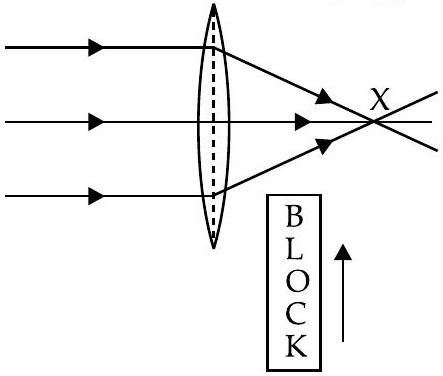
Option (a) is correct.
Explanation: The light passing through glass slab will bend towards the normal and after coming out in the air, the light will converge out at a point away from the glass slab.
(a) In the following atoms, which one is a radioisotope? Give one use of this isotope. \(\mathrm{O}^{16}, \mathrm{C}^{14}, \mathrm{~N}^{14}, \mathrm{He}^{4}\)
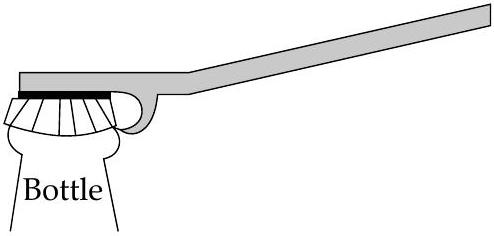
(a) \(\mathrm{C}^{14}\) is a radioisotope because of the instability of the nucleus. Used for carbon dating.
Fill in the blanks: [2]
\_\_\_\_.
(a) Centripetal
A non uniform beam of weight 120 N pivoted at one end is shown in the diagram below.
Calculate the value of F to keep the beam in equilibrium. [2]
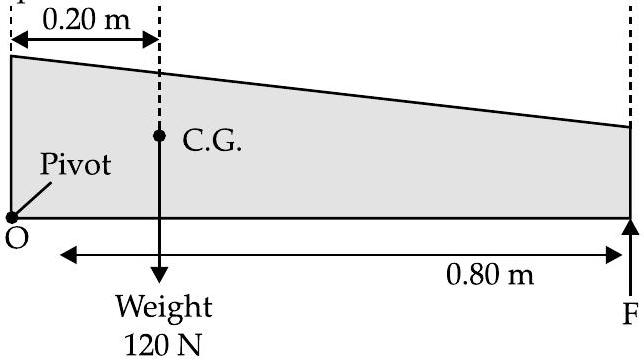
The weight of the beam will produce a clockwise moment and the applied force F will produce a clockwise moment.
Equating the moments of the force,
∴
Meera chose to use a block and tackle system of ‘9’ pulleys instead of a single movable pulley to lift a heavy load. [2]
(a) Mechanical advantage using a block and tackle system of 9 pulleys is 9 whereas the mechanical advantage of a single moveable pulley is 2.
Sumit does 600 J of work in 10 min and Amit does 300 J of work in 20 min. Calculate the ratio of the powers delivered by them. [2]
\(\mathrm{P}_{\text {Sumit }} / \mathrm{P}_{\text {Amit }}=\frac{\frac{\mathrm{W}_{\text {Sumit }}}{t_{\text {Sumit }}}}{\frac{W_{\text {Amit }}}{t_{\text {Amit }}}}=\frac{\frac{600}{10}}{\frac{300}{20}}=4: 1\)
5 bulbs are connected in series in a room. One bulb is fused. It is removed and remaining 4 bulbs are again connected in series to the same circuit. What will be the effect on the following physical quantities? (Increases, Decreases, Remain Same)
(a) Resistance decreases
Rohan conducted experiments on echo in different media. He observed that a minimum distance of ‘ \(x\) ‘ metres is required for the echo to be heard in oxygen and ‘ \(y\) ‘ metres in benzene. Compare ‘ \(x\) ‘ and ‘ \(y\) ‘. Justify your answer.
Speed of sound in oxygen: \(340 \mathrm{~ms}^{-1}\)
Speed of sound in benzene: \(200 \mathrm{~ms}^{-1}\) [2]
Applying the formula
For Oxygen,
So,
(a) In a reading glass what is the position of the object with respect to the convex lens used?
(a) In between optical centre and focus
A fuse is rated 5 A. Can it be used with a geyser rated 1540 W, 220 V. Write Yes or No. Give supporting calculations to justify your answer. [2]
No.
The geyser draws \(\mathrm{I}=\frac{\mathrm{P}}{\mathrm{V}}=\frac{1540}{220}=7 \mathrm{~A}\).
Hence, 5A rated fuse will blow off for the geyser.
State two factors affecting the speed of rotation of the coil in a D.C. motor. [2]
Speed of rotation may be increased by
Increasing the number of turns of the armature.
Increasing the applied battery e.m.f.
How much heat is required to convert 500 g of ice at 0°C to water at 0°C? The latent heat of fusion of ice is \(330 \mathrm{Jg}^{-1}\). [2]
Required heat \(\mathrm{Q}=\mathrm{mL}=500 \times 330=165000 \mathrm{~J}\)
Copy and complete the nuclear reaction by filling in the blanks. [2]
\({ }_{92} \mathrm{U}^{235}+{ }_{0} \mathrm{n}^{1} \rightarrow{ }_{46} \mathrm{Ba}^{(41)}+{ }_{36} \mathrm{Kr}^{92}+3{ }_{0} \mathrm{n}^{1}\)
SECTION B
The image of a candle flame placed at a distance of 36 cm from a spherical lens, is formed on a screen placed at a distance of 72 cm from the lens. Calculate the focal length of the lens and its power. [3]
Using lens formula,
Or,
Or,
∴
Power of the lens \(=\frac{1}{f}=\frac{100}{24}=4.17 \mathrm{D}\)
Below is an incomplete table showing the arrangement of electromagnetic spectrum in the increasing order of their wavelength. Complete the table. [3]
| Gamma ray | X-ray | U V rays | Visible rays | Infrared | A | Radio waves |
(a) Microwave
(a) Why do we use red colour as a danger signal on the top of a skyscraper?
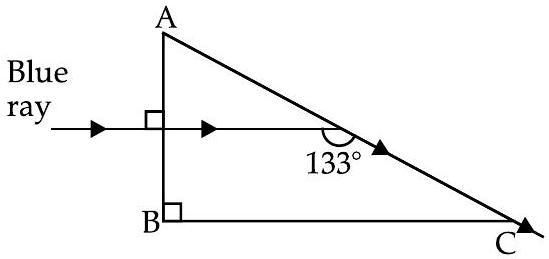
[4]
(a) Red colour is used as danger signal because it is scattered least due to its longest wavelength in visible range. Hence, it is visible from a very long distance.
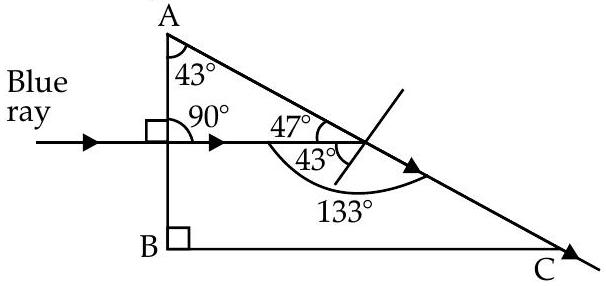
Critical angles for indigo and violets are less than that of blue. Hence, the angle of incidence 43° will be greater than the critical angle and total internal reflection will occur.
(a) Refractive index of glass with respect to water is \(\frac{9}{8}\).
Find the refractive index of water with respect to glass.
(a) Refractive index of glass with respect to water
Hence, the Refractive index of water with respect
Light travels a distance of ‘ \(10 x^{\prime}\) units in time ‘ \(t_{1}\) ‘ in vacuum and it travels a distance of ‘ \(x\) ‘ units in time ‘ \(t_{2}\) ‘ in a denser medium. Using this information answer the question that follows:
(a) The statement is false.
Diamond is a denser medium compared to vacuum. Hence, in it light cannot cover longer distance than that in vacuum.
Speed of light in the medium \(=\frac{x}{t_{2}}\)
So, refractive index of the medium \(=\frac{\frac{10 x}{t_{1}}}{\frac{x}{t_{2}}}\)
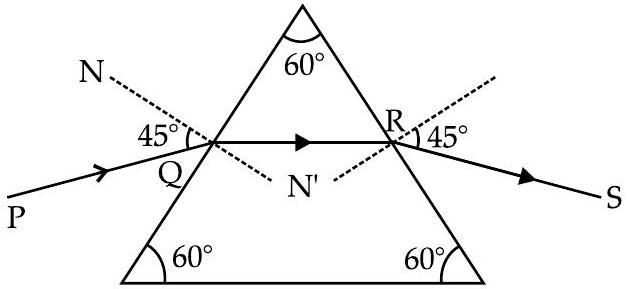
A monochromatic ray of light is incident on an equilateral prism placed at minimum deviation position with an angle of incidence 45° as shown in the diagram.
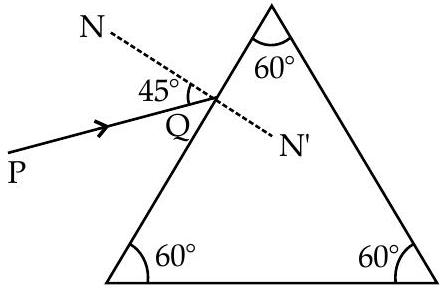
(a)
(a) Define Centre of Gravity. [3]
(a) Centre of gravity: Centre of gravity is the point where the mass of the whole body appears to be concentrated.
2. Yes.
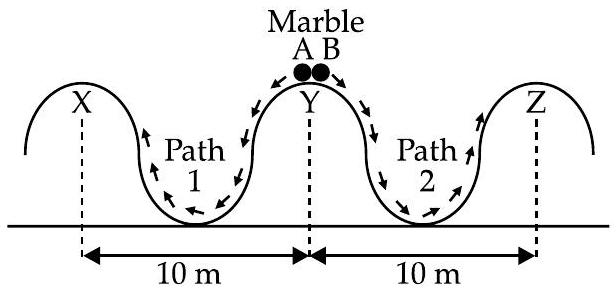
Two identical marbles A and B are rolled down along Path 1 and Path 2 respectively. Path 1 is frictionless and Path 2 is rough.
(a) Marble A
Given are two pulleys. [4]
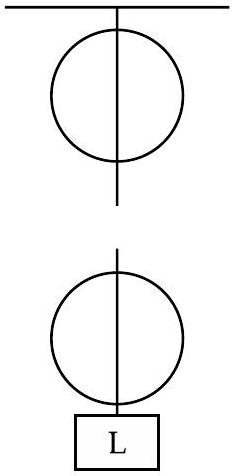
(a)
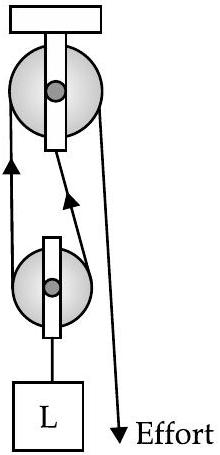
Or,
∴
Or,
∴
(a) Name the waves used in SONAR. [3]
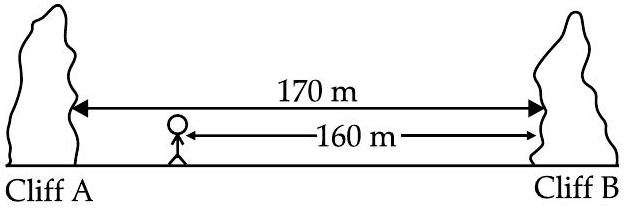
In the above diagram Lata stands between two cliffs and claps her hands.
Determine the time taken by her to hear the first echo.
Speed of sound in air \(320 \mathrm{~ms}^{-1}\).
(a) Ultrasonic wave
So, she will hear the sound reflected from cliff B as \(1^{\text {st }}\) echo.
So, she will hear the \(1^{\text {st }}\) echo after time \(t=\frac{2 d}{v}\) \(=\frac{2 \times 160}{320}=1 \mathrm{~s}\).
(a) Complete the following radioactive reaction:
(a) \({ }_{90}^{234} \mathrm{X} \rightarrow{ }_{88}^{230} \mathrm{Y}+{ }_{2}^{4} \mathrm{He} \rightarrow{ }_{91}^{234} \mathrm{Z}+{ }_{-1}^{0} \mathrm{e}\)
In the given diagram, a vibrating tuning fork is kept near the mouth of a burette filled with water. The length of the air column is adjusted by opening the tap of the burette. At a length of 5 cm of the air column, a loud sound is heard. [4]
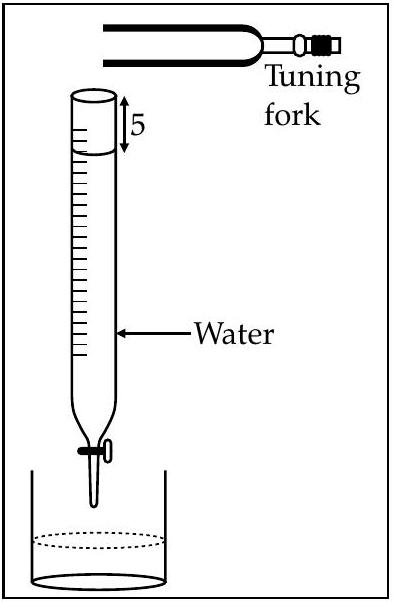
(a) Resonance
The voltage – current readings of a certain material are shown in the table given below: [3]
| Voltage (V) | 10 V | 20 V | 30 V |
| Current (I) | 2 A | 3 A | 4 A |
Study the table.
(a) Non-ohmic
The flow of current through the conductor is directly proportional to the potential difference established across the conductor provide its physical conditions (like, temperature, pressure, density, volume etc.) are constant.
Below is the diagram of a transformer: [3]
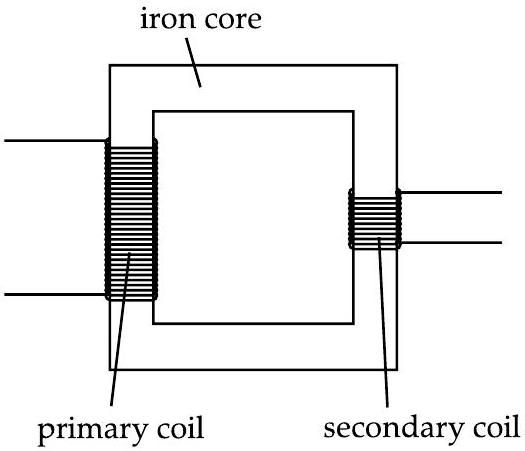
(a) Step down transformer
Study the diagram: [4]
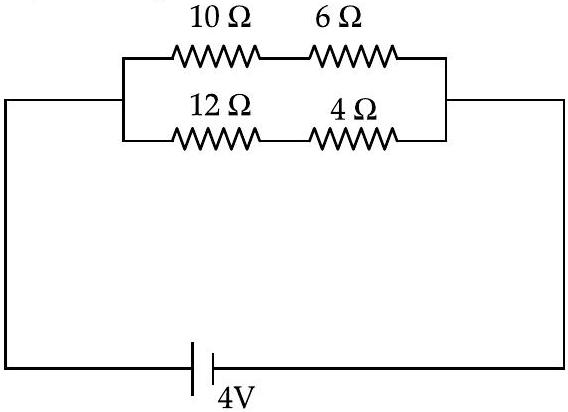
(a) \(10 \Omega\) and \(6 \Omega\) are in series. Hence, equivalent resistance \(R_{1}=16 \Omega\).
\(12 \Omega\) and \(4 \Omega\) are in series. Hence, equivalent resistance \(R_{2}=16 \Omega\).
\(\mathrm{R}_{1}\) and \(\mathrm{R}_{2}\) are in parallel. Hence, the equivalent resistance \(=R_{\mathrm{eq}}=8 \Omega\).
85 g of water at 30°C is cooled to 5°C by adding certain mass of ice. Find the mass of ice required. [3] [Specific heat capacity of water \(=4.2 \mathrm{Jg}^{-1 \circ} \mathrm{C}^{-1}\), Specific latent heat of fusion \(=336 \mathrm{Jg}^{-1}\) ] [3]
Let the amount of ice \(=m\) gram
Heat lost by water \(=85 \times 4.2 \times(30-5)\)
Heat lost by ice \(=m \times 336+m \times 4.2 \times(5-0)\)
Applying principle of calorimetry,
Or,
∴
(a) Why does it become pleasantly warm when the lakes start freezing?
(a) When lake freezes, it released latent heat to the atmosphere which warms the atmosphere. So, the atmosphere becomes pleasantly warm.
Hence, heat energy in 1 g of ice at 0°C has more heat energy than the 1 g water at 0°C.
(a) State one factor that affects the magnitude of induced current in an AC generator.
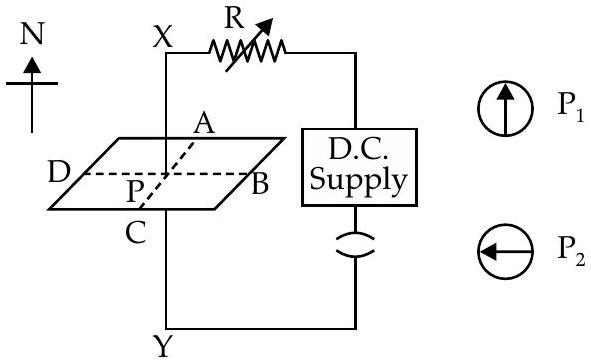
(a) Number of turns in armature may be increased.
ICSE Physics 2024 Paper FAQs
What are the maximum marks for the ICSE Physics 2024 paper?
The maximum marks are 80.
How much time is allowed for the paper?
The time allowed is two hours.
How should Section B be attempted?
Attempt any four questions from Section B.