
ICSE Class 10 Mathematics 2018 Question Paper with Solutions

Reading Time: 34 minutes

Last Updated on November 13, 2026 by sanjjeett

ICSE Class 10 Mathematics PYQ

Practice the complete ICSE Class 10 Mathematics 2018 Question Paper with Solutions, including algebra, geometry, trigonometry, statistics, graphs, constructions and commercial mathematics. Use this solved paper to revise important concepts, practise board-style questions and strengthen your exam preparation.

Year
2018
Maximum Marks
80
Time Allowed
Two hours and a half
📄
Paper Instructions
ICSE Class 10 Mathematics 2018

Attempt all questions from Section A and any four questions from Section B.

All working, including rough work, must be clearly shown and must be done on the same sheet as the rest of the answer.

Omission of essential working will result in loss of marks.

The intended marks for questions or parts of question are given in brackets [ ].

Mathematical tables are provided.

✓
Section A

ICSE Mathematics 2018 — Section A

40 marks • Attempt all questions from this Section.
40
Marks
1
Question 1
ICSE Class 10 Mathematics 2018
a

Find the value of ‘ \(\boldsymbol{x}\) ‘ and ‘ \(\boldsymbol{y}\) ‘ if : [3]

\[ 2\left[\begin{array}{cc} x & 7 \\ 9 & y-5 \end{array}\right]+\left[\begin{array}{cc} 6 & -7 \\ 4 & 5 \end{array}\right]=\left[\begin{array}{cc} 10 & 7 \\ 22 & 15 \end{array}\right] \]
Answer & Solution
\[ \begin{gathered} 2\left[\begin{array}{cc} x & 7 \\ 9 & y-5 \end{array}\right]+\left[\begin{array}{cc} 6 & -7 \\ 4 & 5 \end{array}\right]=\left[\begin{array}{cc} 10 & 7 \\ 22 & 5 \end{array}\right] \\ {\left[\begin{array}{cc} 2 x & 14 \\ 18 & 2 y-10 \end{array}\right]+\left[\begin{array}{cc} 6 & -7 \\ 4 & 5 \end{array}\right]=\left[\begin{array}{cc} 10 & 7 \\ 22 & 15 \end{array}\right]} \end{gathered} \]

or

\[ \left[\begin{array}{cc} 2 x+6 & 7 \\ 22 & 2 y-5 \end{array}\right]=\left[\begin{array}{cc} 10 & 7 \\ 22 & 15 \end{array}\right] \]

By equating \(2 x+6=10\) or \(x=2\)

\[ 2 y-5=15 \text { or } y=10 \]
b

Sonia had a recurring deposit account in a bank and deposited ₹ 600 per month for \(\mathbf{2} \frac{\mathbf{1}}{\mathbf{2}}\) years. If the rate of interest was 10% p.a., find the maturity value of this account. [3]

Answer & Solution
\[ \begin{aligned} p & =\text{₹} 600 \\ n & =2 \frac{1}{2} \text { year }=30 \text { months } \\ r & =10 \% \text { p.a. } \\ \text { M.V. } & =? \\ \text { M.V. } & =p \times n+\frac{p \times n(n+1) \times r}{2,400} \end{aligned} \]
\[ \begin{aligned} & =600 \times 30+\frac{600 \times 30 \times 31 \times 10}{2,400} \\ & =18,000+2,325 \\ & =\text{₹} 20,325 \end{aligned} \]
c

Cards bearing numbers 2, 4, 6, 8, 10, 12, 14, 16, 18 and 20 are kept in a bag. A card is drawn at random from the bag. Find the probability of getting a card which is :

(i) a prime number.

(ii) a number divisible by 4 .

(iii) a number that is a multiple of 6.

(iv) an odd number. [4]

Answer & Solution

(i)

\[ \begin{aligned} \text { Prime number } & =\{2\} \\ \text { No. of favourable cards } & =1 \\ \text { Total number of cards } & =10 \end{aligned} \]

Hence, probability of a getting a prime number card

\[ =\frac{\text { Number of favourable cards }}{\text { Total no. of cards }}=\frac{1}{10} \]

(ii) Number divisible by \(4=\{4,8,12,16,20\}\)

No. of favourable cards \(=5\) Hence, probability of a getting card, where number divisible by 4 .

\[ =\frac{\text { Number of favourable cards }}{\text { Total no. of cards }}=\frac{5}{10}=\frac{1}{2} \]

(iii) Number which are multiple of \(6=\) \{6, 12, 18\}

No. of favourable cards \(=3\) Hence, probability of getting card, which is multiple of 6.

\[ =\frac{\text { Number of favourable cards }}{\text { Total No. of cards }}=\frac{3}{10} \]

(iv) Odd number = 0 (No. odd card)

No. of favourable cards \(=0\) Hence, probability of getting an odd number card

\[ =\frac{\text { Number of favourable cards }}{\text { Total No. of cards }}=\frac{0}{10}=0 \]
2
Question 2
ICSE Class 10 Mathematics 2018
a

The circumference of the base of a cylindrical vessel is 132 cm and its height is 25 cm. Find the

(i) radius of the cylinder

(ii) volume of cylinder. (use \(\pi=\frac{\mathbf{2 2}}{\mathbf{7}}\) ) [3]

Answer & Solution

Given

\[ \begin{aligned} \text { circumference } & =132 \mathrm{~cm} \\ \text { height } & =25 \mathrm{~cm} \end{aligned} \]

(i)

\[ \begin{aligned} \text { circumference } & =2 \pi r \\ 132 & =2 \pi r \\ 132 & =\frac{2 \times 22}{7} \times r \\ r & =\frac{132 \times 7}{2 \times 22}=21 \mathrm{~cm} \end{aligned} \]

Hence, radius of cylinder \(=21 \mathrm{~cm}\).

(ii) volume of cylinder \(=\pi r^{2} h\)

\[ \begin{aligned} & =\frac{22}{7} \times 21 \times 21 \times 25 \\ & =34,650 \mathrm{~cm}^{3} \end{aligned} \]
b

If \((\boldsymbol{k}-\mathbf{3}),(\mathbf{2} \boldsymbol{k}+\mathbf{1})\) and \((\mathbf{4} \boldsymbol{k}+\mathbf{3})\) are three consecutive terms of an A.P., find the value of \(\boldsymbol{k}\). [3]

Answer & Solution

For three consecutive terms of an A.P., the common difference should be same, i.e,.

\[ \begin{aligned} (2 k+1)-(k-3) & =(4 k+3)-(2 k+1) \\ 2 k+1-k+3 & =4 k+3-2 k-1 \\ k+4 & =2 k+2 \\ k & =2 \end{aligned} \]
c

\(P Q R S\) is a cyclic quadrilateral. Given \(\angle Q P S=\) \(73^{\circ}, \angle P Q S=55^{\circ}\) and \(\angle P S R=82^{\circ}\), calculate :

(i) \(\angle Q R S\)

(ii) \(\angle R Q S\)

(iii) \(\angle P R Q\) [4]
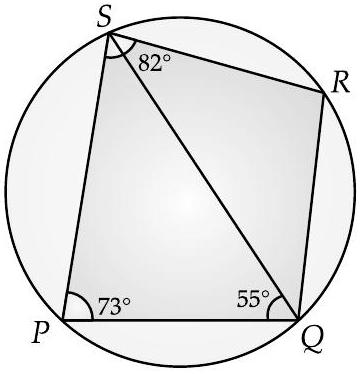
ICSE Class 10 Mathematics 2018 Question 2(c) figure
Answer & Solution

(i) Since, sum of opposite pairs of angles in cyclic quadrilaterals is 180°.

Hence,

\[ \begin{aligned} \angle Q R S+\angle Q P S & =180^{\circ} \\ \angle Q R S+73^{\circ} & =180^{\circ} \\ \angle Q R S & =180^{\circ}-73^{\circ} \\ & =107^{\circ} \end{aligned} \]

(ii)

\[ \angle P Q R+\angle P S R=180^{\circ} \]

(PQRS is a cyclic quadrilateral)

\[ \begin{aligned} \angle P Q R+82^{\circ} & =180^{\circ} \\ \angle P Q R & =180^{\circ}-82 \\ & =98^{\circ} \end{aligned} \]
\(\because \quad \angle P Q S+\angle R Q S=\angle P Q R\)
\[ \begin{aligned} 55^{\circ}+\angle R Q S & =98^{\circ} \\ \angle R Q S & =98^{\circ}-55^{\circ} \\ & =43^{\circ} \end{aligned} \]

(iii) Join \(P\) to \(R\)

In \(\triangle P S Q\),

\[ \begin{aligned} \angle S P Q+\angle P Q S+\angle P S Q & =180^{\circ} \\ 73^{\circ}+55^{\circ}+\angle P S Q & =180^{\circ} \\ \angle P S Q & =180^{\circ}-128^{\circ} \\ & =52^{\circ} \end{aligned} \]

Now, \(\angle P R Q=\angle P S Q(\because\) Angle in same segment \()\)
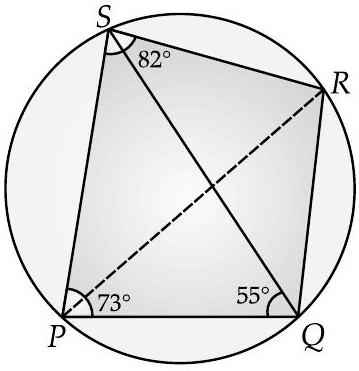
\[ \therefore \quad \angle P R Q=52^{\circ} \]
ICSE Class 10 Mathematics 2018 Question 2(c) solution figure
3
Question 3
ICSE Class 10 Mathematics 2018
a

If \((\boldsymbol{x}+\mathbf{2})\) and \((\boldsymbol{x}+\mathbf{3})\) are factors of \(\boldsymbol{x}^{\mathbf{3}}+\boldsymbol{a} \boldsymbol{x}+\boldsymbol{b}\), find the values of ‘ \(\boldsymbol{a}\) ‘ and ‘ \(\boldsymbol{b}\) ‘. [3]

Answer & Solution
\(x^{3}+a x+b\)

\((x+2)\) is a factor of given polynomial then \(x=-2\) will satisfy the polynomial

\[ \begin{aligned} (-2)^{3}+a(-2)+b & =0 \\ -8-2 a+b & =0 \\ b-2 a & =8 \qquad \text{…(i)} \end{aligned} \]

\((x+3)\) is also a factor of given polynomial then \(x=-3\) will satisfy the polynomial

\[ \begin{aligned} (-3)^{3}+a(-3)+b & =0 \\ -27-3 a+b & =0 \\ b-3 a & =27 \qquad \text{…(ii)} \end{aligned} \]

On solving (i) and (ii), we get

\[ a=-19, b=-30 \]
b

Prove that \(\sqrt{\boldsymbol{\operatorname { s e c }}^{\mathbf{2}} \theta+\boldsymbol{\operatorname { c o s e c }}^{\mathbf{2}} \theta}=\boldsymbol{\operatorname { t a n }} \theta+\boldsymbol{\operatorname { c o t }} \theta\) [3]

Answer & Solution
\[ \begin{aligned} \text { L.H.S. } & =\sqrt{\sec ^{2} \theta+\operatorname{cosec}^{2} \theta} \\ & =\sqrt{1+\tan ^{2} \theta+1+\cot ^{2} \theta} \end{aligned} \]

[Since, \(1+\tan ^{2} \theta=\sec ^{2} \theta\) and \(1+\cot ^{2} \theta=\operatorname{cosec}^{2} \theta\) ]

\[ \begin{aligned} & =\sqrt{\tan ^{2} \theta+\cot ^{2} \theta+2} \\ & =\sqrt{\tan ^{2} \theta+\cot ^{2} \theta+2 \tan \theta \cdot \cot \theta} \\ & \quad \quad[\because \tan \theta \cdot \cot \theta=1] \\ & =\sqrt{(\tan \theta+\cot \theta)^{2}} \\ & =\tan \theta+\cot \theta=\text { R.H.S. } \end{aligned} \]
c

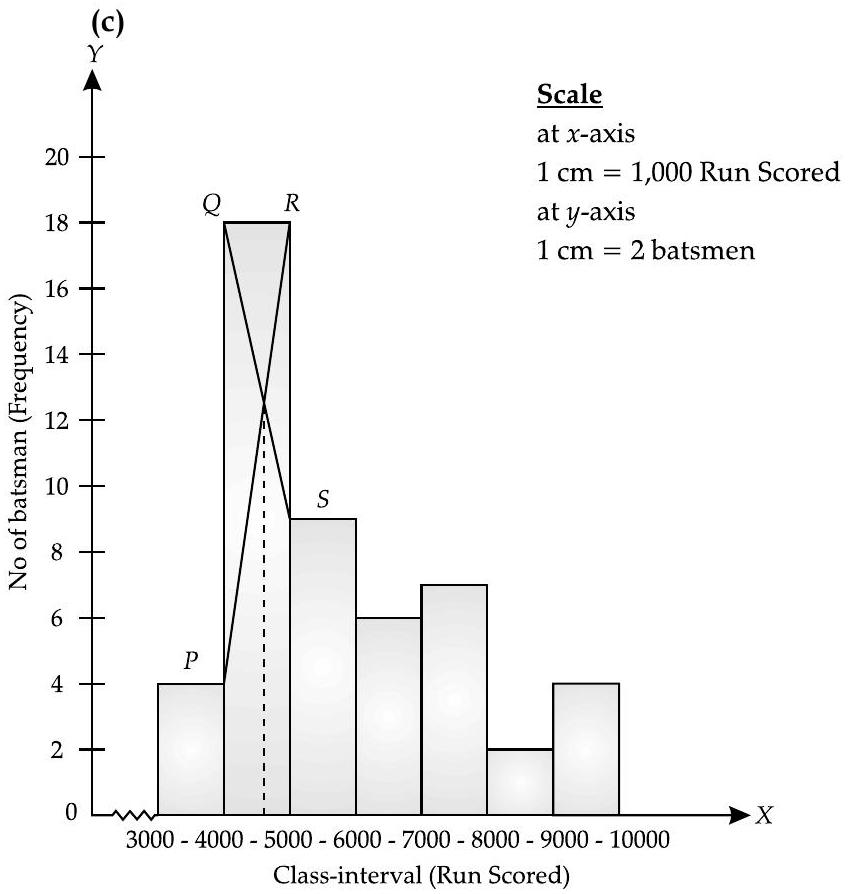
Using a graph paper draw a histogram for the given distribution showing the number of runs scored by 50 batsmen. Estimate the mode of the data : [4]

Runs scored3000-40004000-50005000-60006000-70007000-80008000-90009000-10000
No. of batsmen41896724
Answer & Solution
ICSE Class 10 Mathematics 2018 Question 3(c) solution figure
\[ \text { Mode = } 4600 \]
4
Question 4
ICSE Class 10 Mathematics 2018
a

Solve the following inequation, write down the solution set and represent it on the real number line : [3]

\[ -2+10 x \leq 13 x+10<24+10 x, x \in Z \]
Answer & Solution

or

\[ \begin{aligned} -2+10 x & \leq 13 x+10<24+10 x \\ -2 & \leq 3 x+10<24 \end{aligned} \]

or

\[ -12 \leq 3 x<14 \]

or

\[ -4 \leq x<\frac{14}{3} \]

or

\[ -4 \leq x<4 \frac{2}{3} \]

∴ The solution set is \(x \in[-4,4]\) and \(x \in Z\)

ICSE Class 10 Mathematics 2018 Question 4(a) solution figure
b

If the straight lines \(\mathbf{3} \boldsymbol{x}-\mathbf{5} \boldsymbol{y}=\mathbf{7}\) and \(\mathbf{4} \boldsymbol{x}+\boldsymbol{a} \boldsymbol{y}+\) \(\mathbf{9}=\mathbf{0}\) are perpendicular to one another, find value of \(\boldsymbol{a}\). [3]

Answer & Solution

Eqn. (i)

\[ \begin{aligned} 3 x-5 y & =7 \\ y & =\frac{3}{5} x-\frac{7}{5} \end{aligned} \]

∴

\[ m_{1}=\frac{3}{5} \]

Eqn. (ii)

\[ \begin{aligned} 4 x+a y+9 & =0 \\ y & =\frac{-4}{a} x-\frac{9}{a} \end{aligned} \]

∴

\[ m_{2}=\frac{-4}{a} \]

Both lines are perpendicular to each other. ∴

\[ m_{1} \times m_{2}=-1 \]

or

\[ \frac{3}{5} \times\left(\frac{-4}{a}\right)=-1 \]

or

\[ \begin{aligned} \frac{-12}{5 a} & =-1 \\ a & =\frac{12}{5} \end{aligned} \]
c

Solve \(\boldsymbol{x}^{\mathbf{2}}+\mathbf{7} \boldsymbol{x}=\mathbf{7}\) and give your answer correct to two decimal places. [4]

Answer & Solution
\[ \begin{array}{r} x^{2}+7 x=7 \\ x^{2}+7 x-7=0 \end{array} \]

Compare the equation to

\[ \begin{aligned} a x^{2}+b x+c & =0 \\ a & =1, b=7, c=-7 \\ D & =b^{2}-4 a c \\ & =(7)^{2}-4 \times 1 \times(-7) \\ & =49+28 \\ & =77 \end{aligned} \]

Roots are real, different and irrational number, or

\[ x=\frac{-b \pm \sqrt{D}}{2 a} \]

or

\[ \begin{aligned} & x=\frac{-7 \pm \sqrt{77}}{2} \\ & x=\frac{-7 \pm 8.7749}{2} \end{aligned} \]

Taking (+) sign

\[ \begin{aligned} x & =\frac{-7+8.7749}{2} \\ & =\frac{1.7749}{2}=0.89 \end{aligned} \]

Taking (-) sign

\[ \begin{aligned} x & =\frac{-7-8.7749}{2} \\ & =-\frac{15.7749}{2} \\ & =-7.89 \end{aligned} \]

40 Marks

✍️
Section B

ICSE Mathematics 2018 — Section B

40 marks • Attempt any four questions from this Section.
40
Marks to Attempt
5
Question 5
ICSE Class 10 Mathematics 2018
a

The \(\mathbf{4}^{\text {th }}\) term of a G.P. is 16 and the \(\mathbf{7}^{\text {th }}\) term is 128. Find the first term and common ratio of the series. [3]

Answer & Solution

Given,

\[ T_{4}=16 \text { and } T_{7}=128 \]

Let first term of G.P. be a and common ratio be \(r\). so

\[ \begin{aligned} & T_{4}=a r^{3}=16 \qquad \text{…(i)}\\ & T_{7}=a r^{6}=128 \qquad \text{…(ii)} \end{aligned} \]

Dividing (ii) by (i), we get

\[ \begin{aligned} \frac{a r^{6}}{a r^{3}} & =\frac{128}{16} \\ r^{3} & =8=2^{3} \\ r & =2 \end{aligned} \]

From (i)

\[ \begin{aligned} a .(2)^{3} & =16 \\ a \times 8 & =16 \\ a & =2 \end{aligned} \]
b

A man invests ₹ 22,500 in ₹ 50 shares available at 10% discount. If the dividend paid by the company is 12%, calculate :

(i) The number of shares purchased.

(ii) The annual dividend received.

(iii) The rate of return he gets on his investment. Give your answer correct to the nearest whole number. [3]

Answer & Solution

Given, Total investment \(=\text{₹} 22,500\), Face value \(=\text{₹} 50\)

\[ \text { Market value }=\text{₹}\left(50-\frac{10}{100} \times 50\right)=\text{₹} 45 \]

( \(\because 10 \%\) discount) Dividend \(=12 \%\) (i)

\[ \text { No. of shares }=\frac{\text { Investment }}{\text { Market value of share }} \]
\[ =\frac{22500}{45}=500 \]

(ii) Annual dividend =No. of shares × Nominal value of share × dividend rate

\[ \begin{aligned} & =500 \times 50 \times \frac{12}{100} \\ & =\text{₹} 3,000 \end{aligned} \]

(iii) Return percentage

\[ \begin{aligned} & =\frac{\text { Total dividend }}{\text { Total investment }} \times 100 \\ & =\frac{3,000}{22,500} \times 100 \\ & =13.33 \%=13 \% \end{aligned} \]
c

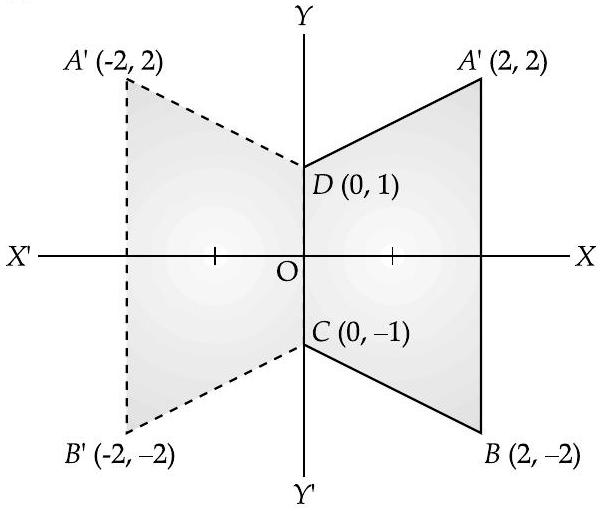
Use graph paper for this question (Take 2 cm \(=\mathbf{1}\) unit along both \(\boldsymbol{x}\) and \(\boldsymbol{y}\) axis). \(A B C D\) is a quadrilateral whose vertices are \(A(2,2), B(2,-2), C(0-1)\) and \(D(0,1)\)

(i) Reflect quadrilateral \(A B C D\) on the \(y\)-axis and name it as \(A^{\prime} B^{\prime} C D\).

(ii) Write down the coordinates of \(A^{\prime}\) and \(B^{\prime}\).

(iii) Name two points which are invariant under the above reflection.

(iv) Name the polygon \(A^{\prime} B^{\prime} C D\). [4]

Answer & Solution

(i)

ICSE Class 10 Mathematics 2018 Question 5(c) solution figure

(ii) Co-ordinates of \(A^{\prime} \rightarrow(-2,2)\)

Co-ordinates of \(B^{\prime} \rightarrow(-2,-2)\)

(iii) Two invariant points are \(C(0,-1)\) and \(D(0,1)\)

(iv) \(A^{\prime} B^{\prime} C D\) is a trapezium quadrilateral

6
Question 6
ICSE Class 10 Mathematics 2018
a

Using properties of proportion, solve for \(\boldsymbol{x}\). Given that \(\boldsymbol{x}\) is positive : [3]

\[ \frac{2 x+\sqrt{4 x^{2}-1}}{2 x-\sqrt{4 x^{2}-1}}=4 \]
Answer & Solution
\[ \frac{2 x+\sqrt{4 x^{2}-1}}{2 x-\sqrt{4 x^{2}-1}}=4 \]

Applying componendo \& dividendo

\[ \begin{aligned} \frac{2 x+\sqrt{4 x^{2}-1}+2 x-\sqrt{4 x^{2}-1}}{2 x+\sqrt{4 x^{2}-1}-2 x+\sqrt{4 x^{2}-1}} & =\frac{4+1}{4-1} \\ \frac{4 x}{2 \sqrt{4 x^{2}-1}} & =\frac{5}{3} \\ 12 x & =10 \sqrt{4 x^{2}-1} \end{aligned} \]

Squaring both sides,

\[ \begin{aligned} 144 x^{2} & =100\left(4 x^{2}-1\right) \\ 36 x^{2} & =25\left(4 x^{2}-1\right) \\ 36 x^{2} & =100 x^{2}-25 \\ 100 x^{2}-36 x^{2} & =25 \\ 64 x^{2} & =25 \\ x^{2} & =\frac{25}{64} \\ x & = \pm \frac{5}{8} \end{aligned} \]

∵ x is positive, hence \(x=\frac{5}{8}\)

b

If \(A=\left[\begin{array}{cc}2 & 3 \\ 5 & 7\end{array}\right], B=\left[\begin{array}{cc}0 & 4 \\ -1 & 7\end{array}\right]\), and \(C=\left[\begin{array}{cc}1 & 0 \\ -1 & 4\end{array}\right]\), find \(\boldsymbol{A} \boldsymbol{C}+\boldsymbol{B}^{\mathbf{2}}-\mathbf{1 0} \boldsymbol{C}\). [3]

Answer & Solution
\[ \text { (b) } \begin{aligned} & A C=\left[\begin{array}{ll} 2 & 3 \\ 5 & 7 \end{array}\right]\left[\begin{array}{cc} 1 & 0 \\ -1 & 4 \end{array}\right] \\ &=\left[\begin{array}{ll} 2 \times 1+3 \times-1 & 2 \times 0+3 \times 4 \\ 5 \times 1+7 \times-1 & 5 \times 0+7 \times 4 \end{array}\right] \\ &=\left[\begin{array}{ll} 2-3 & 0+12 \\ 5-7 & 0+28 \end{array}\right]=\left[\begin{array}{ll} -1 & 12 \\ -2 & 28 \end{array}\right] \\ & B^{2}=\left[\begin{array}{cc} 0 & 4 \\ -1 & 7 \end{array}\right]\left[\begin{array}{cc} 0 & 4 \\ -1 & 7 \end{array}\right] \\ &=\left[\begin{array}{cc} 0 \times 0+4 \times-1 & 0 \times 4+4 \times 7 \\ -1 \times 0+7 \times-1 & -1 \times 4+7 \times 7 \end{array}\right] \\ &=\left[\begin{array}{cc} 0-4 & 0+28 \\ 0-7 & -4+49 \end{array}\right]=\left[\begin{array}{cc} -4 & 28 \\ -7 & 45 \end{array}\right] \\ & 10 C=10\left[\begin{array}{cc} 1 & 0 \\ -1 & 4 \end{array}\right]=\left[\begin{array}{cc} 10 & 0 \\ -10 & 40 \end{array}\right] \\ & \therefore A C+B^{2}-10 C=\left[\begin{array}{cc} -1 & 12 \\ -2 & 28 \end{array}\right]+\left[\begin{array}{cc} -4 & 28 \\ -7 & 45 \end{array}\right]-\left[\begin{array}{cc} 10 & 0 \\ -10 & 40 \end{array}\right] \\ &=\left[\begin{array}{cc} -1-4-10 & 12+28-0 \\ -2-7+10 & 28+45-40 \end{array}\right] \\ &=\left[\begin{array}{cc} -15 & 40 \\ 1 & 33 \end{array}\right] \end{aligned} \]
c

Prove that \((\mathbf{1}+\boldsymbol{\operatorname { c o t }} \theta-\boldsymbol{\operatorname { c o s e c }} \theta)(\mathbf{1}+\boldsymbol{\operatorname { t a n }} \theta+\) \(\boldsymbol{\operatorname { s e c }} \theta)=\mathbf{2}\) [4]

Answer & Solution

L.H.S. \(=(1+\cot \theta-\operatorname{cosec} \theta)(1+\tan \theta+\sec \theta)\)

\[ \begin{aligned} & =\left(1+\frac{\cos \theta}{\sin \theta}-\frac{1}{\sin \theta}\right)\left(1+\frac{\sin \theta}{\cos \theta}+\frac{1}{\cos \theta}\right) \\ & =\left(\frac{\sin \theta+\cos \theta-1}{\sin \theta}\right)\left(\frac{\cos \theta+\sin \theta+1}{\cos \theta}\right) \\ & =\frac{(\sin \theta+\cos \theta-1)(\sin \theta+\cos \theta+1)}{\sin \theta \cos \theta} \\ & =\frac{(\sin \theta+\cos \theta)^{2}-(1)^{2}}{\sin \theta \cos \theta} \\ & {\left[\because a^{2}-b^{2}=(a-b)(a+b)\right]} \\ & =\frac{\left(\sin ^{2} \theta+\cos ^{2} \theta+2 \sin \theta \cos \theta\right)-1}{\sin \theta \cdot \cos \theta} \end{aligned} \]
\[ \begin{aligned} & =\frac{(1+2 \sin \theta \cos \theta)-1}{\sin \theta \cdot \cos \theta} \\ & =\frac{2 \sin \theta \cos \theta}{\sin \theta \cos \theta}=2=\text { R.H.S.Hence proved } \end{aligned} \]
7
Question 7
ICSE Class 10 Mathematics 2018
a

Find the value of \(\boldsymbol{k}\) for which the following equation has equal roots. [3]

\[ x^{2}+4 k x+\left(k^{2}-k+2\right)=0 \]
Answer & Solution
\[ x^{2}+4 k x+\left(k^{2}-k+2\right)=0 \]

Compare the equation to

\[ a=1, b=4 k, c=k^{2}-k+2 \]

Since, roots of the equation are equal

\[ \begin{aligned} b^{2}-4 a c & =0 \\ (4 k)^{2}-4 \times 1 \times\left(k^{2}-k+2\right) & =0 \\ 16 k^{2}-4 k^{2}+4 k-8 & =0 \\ 12 k^{2}+4 k-8 & =0 \\ 3 k^{2}+k-2 & =0 \\ 3 k^{2}+3 k-2 k-2 & =0 \\ 3 k(k+1)-2(k+1) & =0 \\ (k+1)(3 k-2) & =0 \\ k & =-1, k=2 / 3 \end{aligned} \]
b

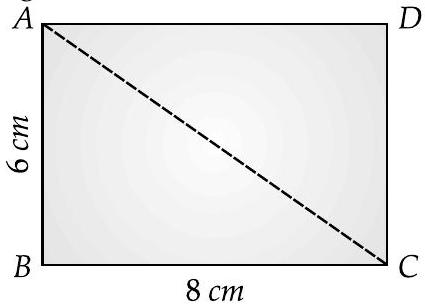
One map drawn to a scale of 1 : 50,000, a rectangular plot of land \(\boldsymbol{A} \boldsymbol{B} \boldsymbol{C} \boldsymbol{D}\) has the following dimensions. \(\boldsymbol{A} \boldsymbol{B}=\mathbf{6 ~ c m} ; \boldsymbol{B} \boldsymbol{C}=\mathbf{8 ~ c m}\) and all angles are right angles. Find :

(i) the actual length of the diagonal distance \(\boldsymbol{A} \boldsymbol{C}\) of the plot in km.

(ii) the actual area of the plot in sq km. [3]

Answer & Solution

(i) Since,

\[ \begin{aligned} & A B=6 \mathrm{~cm} \\ & B C=8 \mathrm{~cm} \end{aligned} \]

By Pythagorean theorem

\[ \text { Diagonal } \begin{aligned} A C & =\sqrt{\mathrm{AB}^{2}+\mathrm{BC}^{2}} \\ & =\sqrt{(6)^{2}+(8)^{2}} \\ & =\sqrt{100}=10 \mathrm{~cm} \end{aligned} \]

Since, it is given that

\[ \begin{array}{rlrl} & & 1 \mathrm{~cm} & =50,000 \mathrm{~cm} \\ \therefore & 10 \mathrm{~cm} & =5,00,000 \mathrm{~cm} \end{array} \]

Diagonal \(A C=5 \mathrm{~km}\)

ICSE Class 10 Mathematics 2018 Question 7(b) solution figure

(ii)

\[ \begin{aligned} \text { Area } & =A B \times B C \\ & =6 \times 8 \end{aligned} \]
\[ \begin{aligned} & =48 \mathrm{~cm}^{2} \\ & =48 \times(50,000 \times 50,000) \\ & =1,20,00,00,00,000 \mathrm{~cm}^{2} \\ & =12 \mathrm{sq} . \mathrm{km} \\ {[1} & \left.\mathrm{km}^{2}=10,00,00,00,000 \mathrm{~cm}^{2}\right] \end{aligned} \]
c

\(\boldsymbol{A}(\mathbf{2}, \mathbf{5}), \boldsymbol{B}(-\mathbf{1}, \mathbf{2})\) and \(\boldsymbol{C}(\mathbf{5}, \mathbf{8})\) are the vertices of a triangle \(\boldsymbol{A} \boldsymbol{B} \boldsymbol{C}\), ‘ \(\boldsymbol{M}\) ‘ is a point on \(\boldsymbol{A} \boldsymbol{B}\) such that \(A M: M B=1: 2\). Find the co-ordinates of ‘ \(M\) ‘. Hence find the equation of the line passing through the points \(\boldsymbol{C}\) and \(\boldsymbol{M}\). [4]

Answer & Solution

Let \(M\left(x_{1}, y_{1}\right)\) be the point which divides the line segment \(A B\) in the ratio 1 : 2. Hence, Coordinate of \(M\) are

\[ \begin{aligned} M\left(x_{1}, y_{1}\right) & =\frac{m_{1} x_{2}+m_{2} x_{1}}{m_{1}+m_{2}}, \frac{m_{1} y_{2}+m_{2} y_{1}}{m_{1}+m_{2}} \\ M\left(x_{1}, y_{1}\right) & =\left(\frac{1 \times(-1)+2 \times 2}{1+2}, \frac{1 \times 2+2 \times 5}{1+2}\right) \\ & =\left(\frac{-1+4}{3}, \frac{2+10}{3}\right) \\ & =(1,4) \end{aligned} \]

Coordinates of \(M\) are (1, 4). Now equation of line passing through \(C(5,8)\) and M(1, 4) is

\[ \begin{aligned} y-8 & =\frac{4-8}{1-5}(x-5) \\ y-8 & =\frac{-4}{-4}(x-5) \\ y-8 & =x-5 \\ y & =x+3 \end{aligned} \]
8
Question 8
ICSE Class 10 Mathematics 2018
a

₹ 7500 were divided equally among a certain number of children. Had there been 20 less children, each would have received ₹ 100 more. Find the original number of children. [3]

Answer & Solution

Let the number of children be \(x\) and ₹ \(y\) is given to each children then

\[ x . y=7,500 \qquad \text{…(i)} \]

and

\[ (x-20)(y+100)=7,500 \]
\(x y+100 x-20 y-2,000=7,500\) \(7,500+100 x-20 y-2,000=7,500\) \([\because x y=7,500]\)
\[ \begin{array}{r} 100 x-20 y-2,000=0 \\ 100 x-20 \times \frac{7,500}{x}-2,000=0 \end{array} \]
\[ \text { [From (i) } y=\frac{7,500}{x} \text { ] } \]
\[ \begin{aligned} 100 x^{2}-1,50,000-2,000 x & =0 \\ x^{2}-20 x-1,500 & =0 \\ x^{2}-50 x+30 x-1,500 & =0 \\ x(x-50)+30(x-50) & =0 \\ (x-50)(x+30) & =0 \\ x & =50,-30 \end{aligned} \]

The number of children can not be – ve.

\[ x=50 \]

∴ Number of children \(=50\)

b

If the mean of the following distribution is 24, find the value of ‘ \(a\) ‘. [3]

Marks0-1010-2020-3030-4040-50
Number of students7\(a\)8105
Answer & Solution
Marks\(\operatorname{Mid} x_{i}\)\(f_{i}\)\(f_{i} x_{i}\)
0-105735
10-2015\(a\)\(15 a\)
20-30258200
30-403510350
40-50455225
\(30+a\)\(810+15 a\)
\[ \begin{aligned} \bar{x} & =\frac{\Sigma f_{i} x_{i}}{\Sigma f_{i}} \\ 24 & =\frac{810+15 a}{30+a} \\ 720+24 a & =810+15 a \\ 24 a-15 a & =810-720 \\ 9 a & =90 \\ a & =10 \end{aligned} \]
c

Using ruler and compass only, construct a \(\triangle A B C\) such that \(B C=5 \mathrm{~cm}\) and \(A B=6.5 \mathrm{~cm}\) and \(\angle A B C=\mathbf{1 2 0}^{\circ}\).

(i) Construct a circum-circle of \(\triangle A B C\).

(ii) Construct a cyclic quadrilateral \(A B C D\), such that \(D\) is equidistant from \(A B\) and \(B C\). [4]

Answer & Solution

(a) Steps of construction :

(i) Draw a line segment \(B C=5 \mathrm{~cm}\).

(ii) Construct \(\angle A B C=120^{\circ}\).

(iii) Cut \(B A=6.5 \mathrm{~cm}\)

(iv) Join \(A\) to \(C\).

(v) Construct perpendicular bisectors of \(A B\) and \(B C\), intersecting at \(O\). Join \(A O\).

(vi) Taking \(O\) as centre, and \(O A\) as radius draw a circle, passing through \(A, B\) and \(C\).

(b) (i) Draw the bisector of \(\angle A B C\) such that it touches the circle at point \(D\).

(ii) Join \(A\) to \(D\) and \(C\) to \(D\).

(iii) \(A B C D\) is required cyclic quadrilateral.
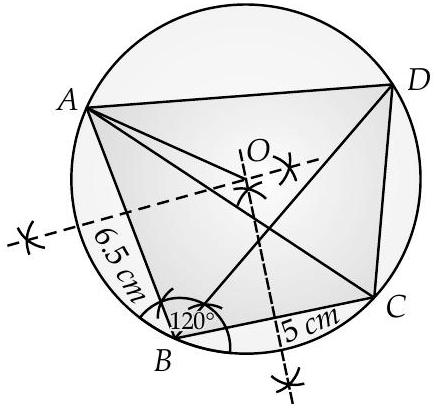
ICSE Class 10 Mathematics 2018 Question 8(c) solution figure
9
Question 9
ICSE Class 10 Mathematics 2018
a

Priyanka has a recurring deposit account of ₹ 1,000 per month at 10% per annum. If she gets ₹ 5,550 as interest at the time of maturity, find the total time for which the account was held. [3]

Answer & Solution

\(P=\text{₹} 1,000, R=10 \%\), p.a., S.I. \(=\text{₹} 5,550\)

\[ \begin{gathered} n=? \\ \mathrm{SI}=\frac{\operatorname{Pn}(n+1)}{2} \times \frac{1}{12} \times \frac{R}{100} \\ 5,550=\frac{1000 \times n(n+1) \times 10}{2 \times 12 \times 100} \\ n(n+1)=1332 \\ n^{2}+n-1332=0 \\ n^{2}+37 n-36 n-1332=0 \\ n(n+37)-36(n+37)=0 \\ (n+37)(n-36)=0 \\ n=36,-37 \end{gathered} \]

The value of time cannot be – ve. Hence

\[ n=36 \text { months } \]

or \(n=3\) years

b

In \(\triangle P Q R, M N\) is parallel to \(Q R\) and

\[ \frac{P M}{M Q}=\frac{2}{3} \]

(i) Find \(\frac{M N}{Q R}\).

(ii) Prove that \(\triangle O M N\) and \(\triangle O R Q\) are similar.

(iii) Find, area of \(\triangle O M N\) : Area of \(\triangle O R Q\). [3]
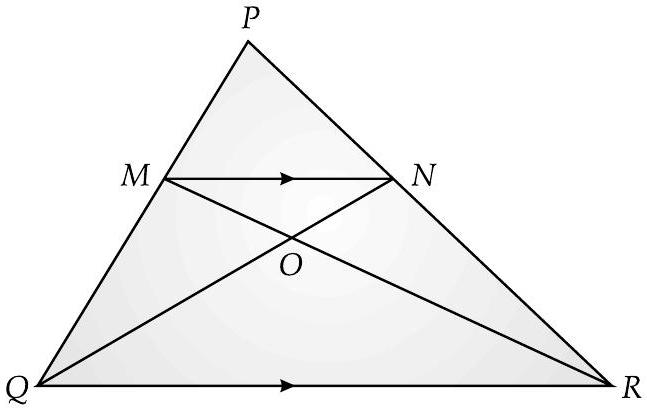
ICSE Class 10 Mathematics 2018 Question 9(b) figure
Answer & Solution

(i) Given \(M N \| Q R\), then

or ∴

\[ \frac{P M}{P Q}=\frac{M N}{Q R} \text { (By Thales theorem) } \]

or

\[ \frac{P M}{P M+M Q}=\frac{M N}{Q R} \]

or

\[ \frac{2}{2+3}=\frac{M N}{Q R} \]

⇒

\[ \frac{M N}{Q R}=\frac{2}{5} \]

(ii) \(M N \| Q R\) (Given)

\(\angle O M N=\angle O R Q\) (Alternate angle) \(\angle O N M=\angle O Q R\) (Alternate angle) \(\angle M O N=\angle R O Q \quad(\) Vert. Opp. angles) \(\therefore \triangle O M N \sim \triangle O R Q\) (by AAA similarity)

(iii) ∵ \(\triangle O M N\) and \(\triangle O R Q\) are similar triangle.

We know that ratio of the areas of two similar triangle is equal to ratio of the squares of the corres-ponding sides.

\[ \begin{aligned} \therefore \quad \frac{\operatorname{ar}(\triangle O M N)}{\operatorname{ar}(\triangle O R Q)} & =\frac{M N^{2}}{Q R^{2}} \\ & =\left(\frac{M N}{Q R}\right)^{2}=\left(\frac{2}{5}\right)^{2} \\ & =\frac{4}{25} \end{aligned} \]

Hence, \(\operatorname{ar}(\triangle O M N): \operatorname{ar}(\triangle O R Q)=4: 25\)

c

The following figure represents a solid consisting of a right circular cylinder with a hemisphere at one end and a cone at the other. Their common radius is 7 cm. The height of the cylinder and cone are each of 4 cm. Find volume of the solid. [4]

ICSE Class 10 Mathematics 2018 Question 9(c) figure
Answer & Solution

Common radius \((r)=7 \mathrm{~cm}\) Height of cylinder=Height of cone

\[ =h=4 \mathrm{~cm} \]

Volume of solid =volume of hemisphere + volume of cylinder + volume of cone

\[ \begin{aligned} & =\frac{2}{3} \pi r^{3}+\pi r^{2} h+\frac{1}{3} \pi r^{2} h \\ & =\frac{2}{3} \pi \times 7 \times 7 \times 7+\pi \times 7 \times 7 \times 4+\frac{1}{3} \times \pi \times 7 \times 7 \times 4 \\ & =\frac{686 \pi}{3}+196 \pi+\frac{196 \pi}{3} \\ & =\frac{686 \pi+588 \pi+196 \pi}{3} \\ & =\frac{1,470 \pi}{3}=490 \pi \mathrm{~cm}^{3} \\ & =\frac{490 \times 22}{7}=1540 \mathrm{~cm}^{3} \end{aligned} \]
10
Question 10
ICSE Class 10 Mathematics 2018
a

Use Remainder theorem to factorize the following polynomial : [3]

\[ 2 x^{3}+3 x^{2}-9 x-10 \]
Answer & Solution

Let

\[ f(x)=2 x^{3}+3 x^{2}-9 x-10 \]

The factors of the constant terms are ± 1, ± 2, ± 5 and ± 10. We have

\[ \begin{aligned} & f(-1)=2(-1)^{3}+3(-1)^{2}-9(-1)-10 \\ & \quad=-2+3+9-10=0 \end{aligned} \]

So, \((x+1)\) is a factor of \(f(x)\). We now divide \(f(x)=2 x^{3}+3 x^{2}-9 x-10\) by \((x+1)\) to get the other factor of \(f(x)\).

\[ \begin{aligned} & 2 x^{2}+x-10 \\ & x + 1 \longdiv { 2 x ^ { 3 } + 3 x ^ { 2 } – 9 x – 1 0 } \\ & 2 x^{3}+2 x^{2} \\ & \frac{-\quad-}{x^{2}-9 x}-10 \\ & x^{2}+x \\ & \frac{-\quad-}{-10 x-10} \\ & -10 x-10 \\ & +\quad+ \\ & 0 \end{aligned} \]
\[ \therefore \quad \begin{aligned} & 2 x^{3}+3 x^{2}-9 x-10=(x+1)\left(2 x^{2}+x-10\right) \\ & =(x+1)\left[2 x^{2}+5 x-4 x-10\right] \\ & =(x+1)[x(2 x+5)-2(2 x+5)] \\ & =(x+1)(x-2)(2 x+5) \end{aligned} \]
b

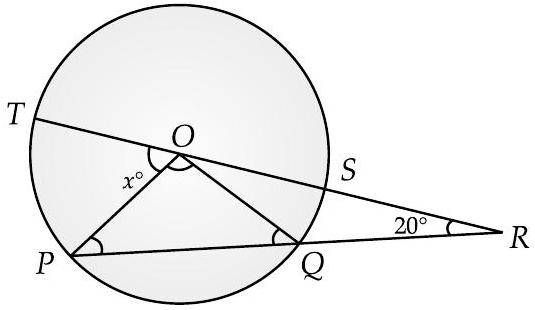
In the figure given below ‘ \(O\) ‘ is the centre of the circle. If \(Q R=O P\) and \(\angle O R P=20^{\circ}\). Find the value of ‘ \(\boldsymbol{x}\) ‘ giving reasons. [3]

ICSE Class 10 Mathematics 2018 Question 10(b) figure
Answer & Solution

Given

\[ Q R=O P \qquad \text{…(i)} \]

and

\[ \angle O R P=20^{\circ} \]

∵

\[ \angle O R Q=\angle O R P=20^{\circ} \]

∵

\[ O P=O Q \]

(Radius of the circle) ∴

\[ Q R=O Q \]

(From (i)) In \(\triangle O Q R\),

\[ \because \quad O Q=Q R \]

∴

\[ \begin{aligned} \angle Q O R & =\angle O R Q \\ & =20^{\circ} \end{aligned} \]
ICSE Class 10 Mathematics 2018 Question 10(b) solution figure

Now

\[ \angle O Q R+\angle O R Q+\angle Q O R=180^{\circ} \]

(By angle sums property)

\[ \begin{aligned} \angle O Q R+20^{\circ}+20^{\circ} & =180^{\circ} \\ \angle O Q R & =180^{\circ}-40^{\circ} \\ & =140^{\circ} \end{aligned} \]

Now \(\angle O Q R+\angle O Q P=180^{\circ}\) (By linear pair)

\[ \begin{aligned} 140^{\circ}+\angle O Q P & =180^{\circ} \\ \angle O Q P & =180^{\circ}-140^{\circ}=40^{\circ} \end{aligned} \]

In \(\triangle P O Q\),

\[ \begin{aligned} \because & & O P=O Q \\ \therefore & & \angle O P R=\angle O Q P=40^{\circ} \end{aligned} \]

Now

\[ \angle P O Q+\angle O P R+\angle O Q P=180^{\circ} \]

(By angle sum property)

\[ \begin{aligned} \angle P O Q+40^{\circ}+40^{\circ} & =180^{\circ} \\ \angle P O Q & =180^{\circ}-80^{\circ}=100^{\circ} \end{aligned} \]

Now

\[ \begin{aligned} \angle R O Q+\angle P O Q+x & =180^{\circ} \quad \text { (By linear pair) } \\ 20^{\circ}+100^{\circ}+x & =180^{\circ} \\ x & =180^{\circ}-120^{\circ} \\ x & =60^{\circ} \end{aligned} \]
c

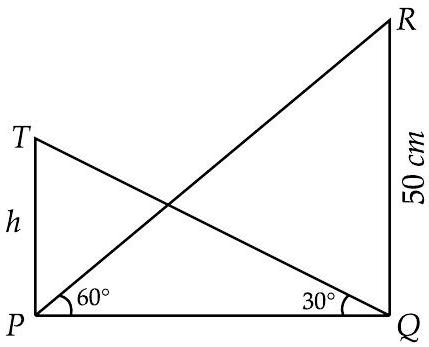
The angle of elevation from a point \(\boldsymbol{P}\) of the top of a tower \(Q R, 50 \mathrm{~m}\) high is \(60^{\circ}\) and that of the tower \(P T\) from a point \(Q\) is \(30^{\circ}\). Find the height of the tower \(\boldsymbol{P} \boldsymbol{T}\), correct to the nearest metre. [4]
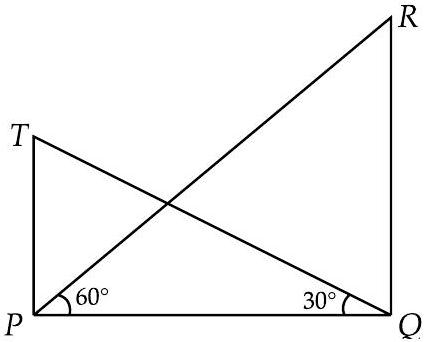
ICSE Class 10 Mathematics 2018 Question 10(c) figure
Answer & Solution

Let the height of the tower \(P T\) be \(h\) and distance \(P Q=x \mathrm{~m}\) In \(\triangle P R Q\),

\[ \begin{aligned} \tan 60^{\circ} & =\frac{R Q}{P Q} \\ \sqrt{3} & =\frac{50}{x} \end{aligned} \]

or

\[ x=\frac{50}{\sqrt{3}} \]

In right \(\triangle P T Q\),

\[ \begin{aligned} \tan 30^{\circ} & =\frac{P T}{P Q}=\frac{h}{x} \\ \frac{1}{\sqrt{3}} & =\frac{h}{50 / \sqrt{3}} \end{aligned} \]
ICSE Class 10 Mathematics 2018 Question 10(c) solution figure
\[ \begin{aligned} 3 h & =50 \\ h & =\frac{50}{3}=16.66=17 \mathrm{~m} \end{aligned} \]
11
Question 11
ICSE Class 10 Mathematics 2018
a

The \(\mathbf{4}^{\text {th }}\) term of an A.P. is 22 and \(\mathbf{1 5}^{\text {th }}\) term is 66. Find the first term and the common difference. Hence find the sum of the series to 8 terms. [4]

Answer & Solution

Let first term be a and common difference be \(d\).

\[ \begin{aligned} & T_{4}=a+3 d=22 \qquad \text{…(i)}\\ & T_{15}=a+14 d=66 \qquad \text{…(ii)} \end{aligned} \]

Subtracting (ii) from (i)

\[ \begin{aligned} a+14 d-a-3 d & =66-22 \\ 11 d & =44 \\ d & =4 \end{aligned} \]

From (i)

\[ \begin{aligned} a+3 \times 4 & =22 \\ a & =22-12 \\ & =10 \end{aligned} \]

Thus,

\[ \begin{aligned} S_{8} & =\frac{8}{2}[2 \times 10+(8-1) 4] \\ & =4[20+28] \\ & =4 \times 48=192 \end{aligned} \]
b

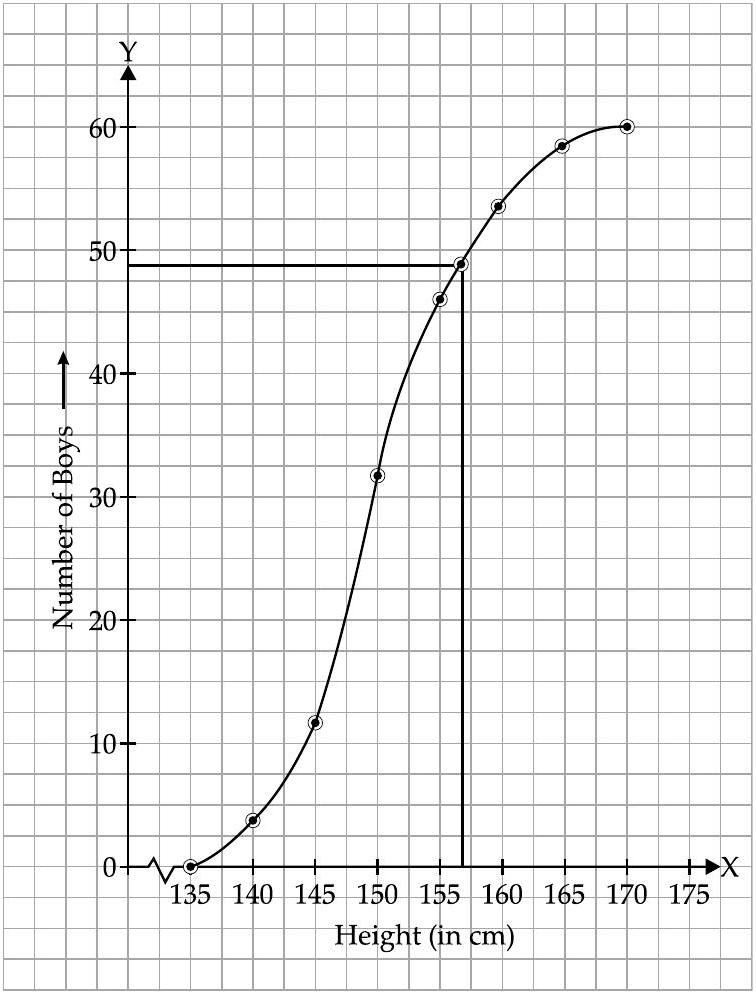
Use Graph paper for this question. A survey regarding height (in cm) of 60 boys belonging to Class 10 of a school was conducted. The following data was recorded :

Height in cm135140140145145150150155155160160165165-170
No. of boys482014761

Taking \(\mathbf{2 ~ c m}=\) height of \(\mathbf{1 0 ~ c m}\) along one axis and \(\mathbf{2} \mathbf{~ c m}=\mathbf{1 0}\) boys along the other axis draw an ogive of the above distribution. Use the graph to estimate the following :

(i) the median

(ii) lower quartile

(iii) if above 158 cm is considered as the tall boys of the class. Find the number of boys in the class who are tall. [6]

Answer & Solution
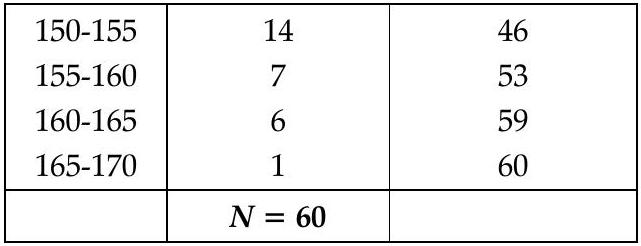
Height (in cm)Frequency \(\boldsymbol{(} \boldsymbol{f} \boldsymbol{)}\)Cumulative Frequency (c. f.)
135-14044
140-145812
145-1502032
ICSE Class 10 Mathematics 2018 Question 11(b) solution figure

Here, \(n=60\)

(i) Median = \(\frac{60}{2}\) th term = 30th term = 149.5

(ii) Lower quartile \(=\frac{60}{4}\) th term \(=15\) th term = 145.5

(iii) Through mark of 158 on \(x\)-axis, draw a vertical line which meets the graph at a point on the ogive. Then through that point, draw a horizontal line which meets the \(y\)-axis at the mark of 48. Therefore, number of boys in the class who are tall \(=60-48=12\).
ICSE Class 10 Mathematics 2018 Question 11(b) solution figure

Leave a Comment

Your email address will not be published. Required fields are marked *

Scroll to Top