

Last Updated on November 13, 2026 by sanjjeett
Practice the complete ICSE Class 10 Mathematics 2019 Question Paper with Solutions, including algebra, geometry, trigonometry, statistics, graphs, constructions and commercial mathematics. Use this solved paper to revise important concepts, practise board-style questions and strengthen your exam preparation.
Attempt all questions from Section A and any four questions from Section B.
All working, including rough work, must be clearly shown and must be done on the same sheet as the rest of the answer.
Omission of essential working will result in loss of marks.
The intended marks for questions or parts of question are given in brackets [ ].
Mathematical tables are provided.
ICSE Mathematics 2019 — Section A
Solve the following inequation and write down the solution set:
Represent the solution on a real number line. [3]
| \(11 x-4<15 x+4\) | \(15 x+4 \leq 13 x+14\) |
| \(11 x-15 x<4+4\) | \(15 x-13 x \leq 14-4\) |
| \(-4 x<8\) | \(2 x \leq 10\) |
| \(x>\frac{8}{-4}\) | \(x \leq \frac{10}{2}\) |
| \(x>-2\) | \(x \leq 5\) |
| \(-2<x \leq 5\) |
But \(x \in W\), therefore required solution set is \{0, 1, 2, 3, 4, 5\}. The solution set on real number line is shown below.

A man invests ₹ 4500 in shares of a company which is paying 7.5% dividend. If ₹ 100 shares are available at a discount of 10%. Find:
(i) Number of shares he purchases.
(ii) His annual income. [3]
Investment \(=\text{₹} 4500\), Face value of shares \(=\text{₹} 100\) Rate of dividend \(=7.5 \%, \quad\) Discount \(=10 \%\)
(i) Market value of 1 share \(=100-10 \%=100-10\) = ₹ 90
Number of shares he purchases \(=50\)
(ii) Annual Income = Rate of Dividend × Face value of 1 share × no. of shares
In a class of 40 students, marks obtained by the students in a class test (out of 10) are given below:
| Marks | 1 | 2 | 3 | 4 | 5 | 6 | 7 | 8 | 9 | 10 |
|---|---|---|---|---|---|---|---|---|---|---|
| Number of students | 1 | 2 | 3 | 3 | 6 | 10 | 5 | 4 | 3 | 3 |
Calculate the following for the given distribution:
(i) Median
(ii) Mode [4]
| Marks ( \(\boldsymbol{x}\) ) | Number of students (f) | c.f. |
| 1 | 1 | 1 |
| 2 | 2 | 3 |
| 3 | 3 | 6 |
| 4 | 3 | 9 |
| 5 | 6 | 15 |
| 6 | 10 | 25 |
| 7 | 5 | 30 |
| 8 | 4 | 34 |
| 9 | 3 | 37 |
| 10 | 3 | 40 |
As, \(n\) is even. ∴ Median \(=\frac{\left(\frac{n}{2}\right)^{\text {th }}+\left(\frac{n}{2}+1\right)^{\text {th }}}{2}\) term
Here, maximum frequency is 10 whose value is 6
Using the factor theorem, show that \((\boldsymbol{x}-\mathbf{2})\) is a factor of \(x^{3}+x^{2}-4 x-4\). Hence, factorise the polynomial completely. [3]
Let \(f(x)=x^{3}+x^{2}-4 x-4\) Put \(x-2=0\)
∴
Remainder \(=f(2)=0\) \(\therefore \quad(x-2)\) is a factor of \(f(x)=x^{3}+x^{2}-4 x-4\) Now, \(f(x)=x^{3}+x^{2}-4 x-4\)
Alternative Method: As, \((x-2)\) is a factor of \(x^{3}+x^{2}-4 x-4\).
| \(x^{2}+3 x+2\) | |
| \(x-2\) | |
| \(x^{3}+x^{2}-4 x-4\) | |
| \(x^{3}-2 x^{2}\) | |
| \((-) \quad(+)\) | |
| \(3 x^{2}-4 x-4\) | |
| \(3 x^{2}-6 x\) | |
| \((-) \quad(+)\) |
| \(2 x-4\) |
| \(2 x-4\) |
| (-) (+) |
| × |
Prove that: [3]
In an Arithmetic Progression (A.P.) the fourth and sixth terms are 8 and 14 respectively. Find the:
(i) first term
(ii) common difference
(iii) sum of the first 20 terms. [4]
Let the first term of an A.P. be ‘ \(a\) ‘ and common difference be ‘ \(d\) ‘. Now \(a_{4}=8\)
By subtracting eq. (i) from eq. (ii)
From eq. (i)
(i) Hence, First term of an A.P. \(=-1\)
(ii) Common difference of an A.P. \(=3\)
(iii) Sum of first 20 terms = 550
Simplify [3]
M and N are two points on the X axis and Y axis respectively. P(3, 2) divides the line segment MN in the ratio 2 : 3. Find:
(i) the coordinates of M and N.
(ii) slope of the line MN. [3]
Let the coordinate of the points M and N be \((x, 0)\) and \((0, y)\) respectively. \(\mathrm{MP}=2\) units and \(\mathrm{PN}=3\) units (given)
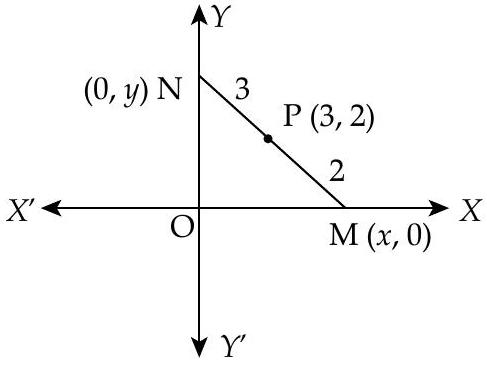
(i)
Hence, coordinate of point M is (5, 0).
Hence, coordinate of the point N is (0, 5).
(ii) Slope of line MN
∴ Slope of line \(\mathrm{MN}=-1\)
A solid metallic sphere of radius 6 cm is melted and made into a solid cylinder of height 32 cm. Find the:
(i) radius of the cylinder.
(ii) curved surface area of the cylinder. [Take \(\pi=3.1\) ] [4]
Radius of sphere \((R)=6 \mathrm{~cm}\) Height of cylinder \((h)=32 \mathrm{~cm}\) Given, \(\pi=3.1\)
(i) Volume of cylinder = Volume of sphere
Radius of cylinder \(=3 \mathrm{~cm}\)
(ii) Curved surface area of cylinder \(=2 \pi r h\)
∴ C.S.A. of cylinder \(=595.2 \mathrm{~cm}^{2}\)
The following numbers, \(\boldsymbol{k}+\mathbf{3}, \boldsymbol{k}+\mathbf{2 , 3} \boldsymbol{k}-\mathbf{7}\) and \(\mathbf{2} \boldsymbol{k}-\mathbf{3}\) are in proportion. Find \(\boldsymbol{k}\). [3]
\((k+3),(k+2),(3 k-7)\) and \((2 k-3)\) are in proportion.
Solve for \(\boldsymbol{x}\) the quadratic equation \(\boldsymbol{x}^{\mathbf{2}}-\mathbf{4} \boldsymbol{x}-\mathbf{8}=\) 0. Give your answer correct to three significant figures. [3]
\(x-2= \pm \sqrt{12}\) [Taking square root on both sides]
Use ruler and compass only for answering this question. Draw a circle of radius 4 cm. Mark the centre as O. Mark a point P outside the circle at a distance of 7 cm from the centre. Construct two tangents to the circle from the external point P. Measure and write down the length of any one tangent. [4]
Steps of construction
(i) Firstly, draw a circle of 4 cm having centre O.
(ii) Draw a line segment \(\mathrm{OP}=7 \mathrm{~cm}\).
(iii) Draw a perpendicular bisector on OP which intersect at C.
(vi) With C as centre and OC as radius, draw a circle. This circle intersect the given circle at points D and E.
(v) Join PD and PE, which are the required tangents.
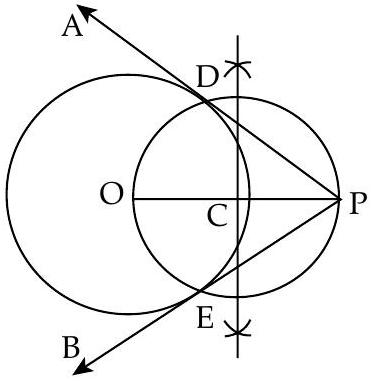
(vi) \(\mathrm{PD}=5.7 \mathrm{~cm}\)
ICSE Mathematics 2019 — Section B
There are 25 discs numbered 1 to 25. They are put in a closed box and shaken thoroughly.A disc is drawn at random from the box. Find the probability that the number on the disc is:
(i) an odd number.
(ii) divisible by 2 and 3 both.
(iii) a number less than 16. [3]
Total number of discs, \(n(S)=25\)
(i) An odd number on disc
\(=\{1,3,5,7,9,11,13,15,17,19,21,23,25\}\) \(n(E)=13\) Probability of getting odd number on disc
(ii) Number on disc, which is divisible by 2 and 3 both \(=\{6,12,18,24\}\)
Probability of a number divisible by 2 and 3
(iii) Number of disc having a number less than 16,
Rekha opened a recurring deposit account for 20 months. The rate of interest is 9% per annum and Rekha receives ₹ 441 as interest at the time of maturity. Find the amount Rekha deposited each month. [4]
Interest on recurring deposit account
where \(P=\) Amount deposit in each month \(n=\) number of months \(=20\) months \(r=\) Rate of Interest \(=9 \%\)
Hence, Rekha deposited each month of amount ₹ 280.
Use a graph sheet for this question. Take \(\mathbf{1 ~ c m}=\mathbf{1}\) unit along both \(\boldsymbol{x}\) and \(\boldsymbol{y}\) axis.
(i) Plot the following points:
A(0, 5), B(3, 0), C(1, 0) and D(1, -5)
(ii) Reflect the points B, C and D on the y axis and name them as B’, C’ and D’ respectively.
(iii) Write down the coordinates of B’, C’ and D’.
(iv) Join the points A, B, C, D, D’, C’, B’, A in order and give a name to the closed figure ABCDD’CB’A. [4]
(i) Plot the given points on graph paper.
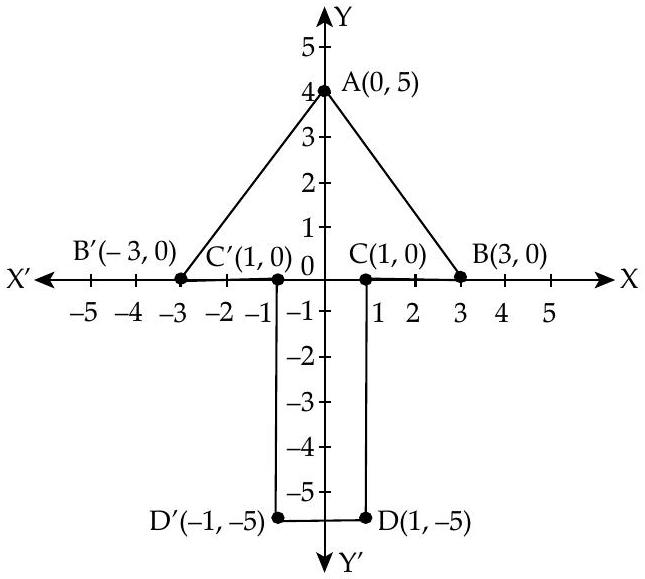
(ii) The reflection of the points B, C and D on \(y\)-axis are B’, C’ and D’ are shown in the figure.
(iii) B'(-3,0), C'(-1,0) and D'(-1,-5)
(iv) Arrow
In the given figure, \(\angle \mathbf{P Q R}=\angle \mathbf{P S T}=\mathbf{9 0}^{\circ}, \mathbf{P Q}\) \(=5 \mathrm{~cm}\) and \(\mathrm{PS}=2 \mathrm{~cm}\).
(i) Prove that \(\triangle \mathrm{PQR} \sim \Delta \mathrm{PST}\).
(ii) Find Area of \(\triangle \mathrm{PQR}\) : Area of quadrilateral SRQT. [3]

(i) In \(\triangle \mathrm{PQR}\) and △PST,
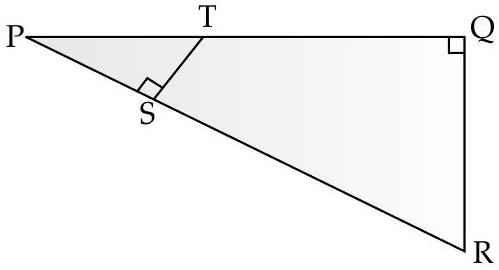
(ii)
\(\operatorname{ar} \Delta \mathrm{PQR}=25 k\) and ar \(\Delta \mathrm{PST}=4 k\) (where \(k \neq 0\) ) Area of quad. SRQT \(=\operatorname{ar} \triangle \mathrm{PQR}-\operatorname{ar} \triangle \mathrm{PST}\)
The first and last term of a Geometrical Progression (G.P.) are 3 and 96 respectively. If the common ratio is 2, find:
(i) ‘ \(\boldsymbol{n}\) ‘ the number of terms of the G.P.
(ii) Sum of the \(\boldsymbol{n}\) terms. [3]
First term of G.P. \((a)=3\) last term of G.P. \(\left(a_{n}\right)=96\) and common ratio \(r=2\)
(i) Let the number in G.P. be \(n\), then
Comparing the powers, we get
Number of terms in G.P. \(=6\) (ii)
Sum of \(n\) terms of G.P. \(=189\)
A hemispherical and a conical hole is scooped out of a solid wooden cylinder. Find the volume of the remaining solid where the measurements are as follows: The height of the solid cylinder is 7 cm, radius of each of hemisphere, cone and cylinder is 3 cm. Height of cone is 3 cm. Give your answer correct to the nearest whole number. \(\mid\) Take \(\left.\pi=\frac{22}{7} \right\rvert\,\). [4]
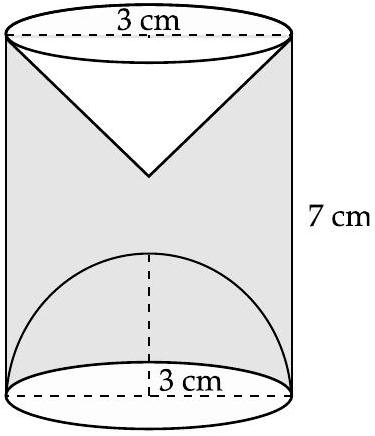
Given, height of cylinder \((H)=7 \mathrm{~cm}\) Radius of hemisphere \((r)=3 \mathrm{~cm}\) Height of cone \((h)=3 \mathrm{~cm}\)
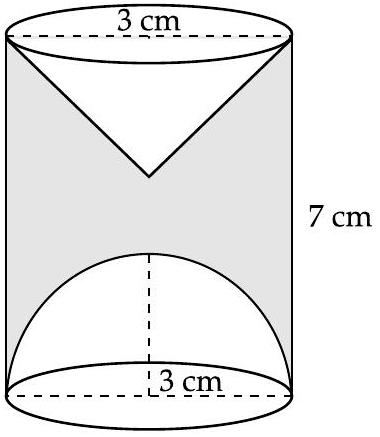
Volume of remaining figure = (Volume of cylinder – Volume of cone – Volume of hemisphere)
∴ Volume of remaining solid \(=113 \frac{1}{7} \mathrm{~cm}^{3}\)
In the given figure AC is a tangent to the circle with centre O. If \(\angle \mathbf{A D B}=\mathbf{5 5}^{\circ}\), find \(\boldsymbol{x}\) and \(\boldsymbol{y}\). Give reasons for your answers. [3]
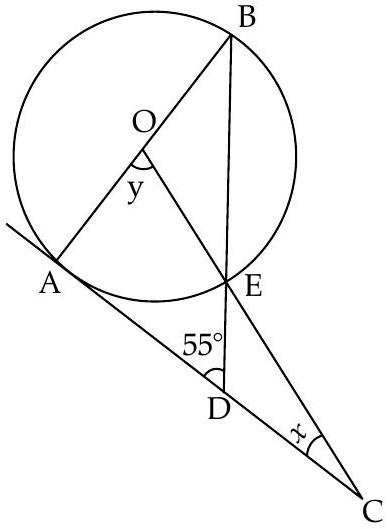
In \(\triangle \mathrm{ABD}\),
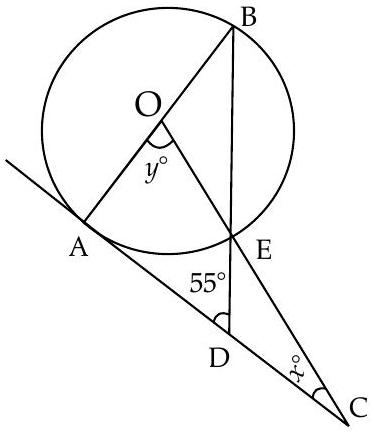
(AC is the tangent of circle)
(same arc make angles at center and circumference)
The model of a building is constructed with the scale factor 1 : 30.
(i) If the height of the model is 80 cm, find the actual height of the building in meters.
(ii) If the actual volume of a tank at the top of the building is \(\mathbf{2 7} \mathbf{~ m}^{\mathbf{3}}\), find the volume of the tank on the top of the model. [3]
(i) \(\frac{\text { Height of model }}{\text { Actual height of the building }}=\frac{1}{30}\)
Actual height of the building \(=80 \times 30 \mathrm{~cm}\)
(ii)
Volume of the tank on the top of model \(=\frac{27}{27000}\)
Given \(\left|\begin{array}{cc}\mathbf{4} & \mathbf{2} \\ -\mathbf{1} & \mathbf{1}\end{array}\right|\), where M is a matrix and I is unit matrix of order 2×2.
(i) State the order of matrix M.
(ii) Find the matrix M. [4]
Given, \(\left[\begin{array}{cc}4 & 2 \\ -1 & 1\end{array}\right] \mathrm{M}=6 \mathrm{I}\)
(i) \(\left[\begin{array}{cc}4 & 2 \\ -1 & 1\end{array}\right]\) is the order of \(2 \times 2\)
and I is also the order of 2 × 2 ∴ M will be order of 2 × 2.
(ii) Let \(\mathrm{M}=\left[\begin{array}{cc}a & b \\ c & d\end{array}\right]\)
From (i) and (iii)
From (ii) and (iv)
The sum of the first three terms of an Arithmetic Progression (A.P.) is 42 and the product of the first and third term is 52. Find the first term and the common difference. [3]
Let the first three terms be \((a-d), a\) and \((a+d)\). Sum of the first three terms \(=42\)
∴
Product of the first and third term \(=52\)
\(\therefore \quad\) First term \(=2\) and common difference \(= \pm 12\)
The vertices of a \(\triangle \mathrm{ABC}\) are A(3, 8), B(-1, 2) and C(6, -6), Find:
(i) Slope of BC.
(ii) Equation of a line perpendicular to BC and passing through A. [3]
(i) Slope of \(\mathrm{BC}=\frac{y_{2}-y_{1}}{x_{2}-x_{1}}=\frac{-6-2}{6+1}\)
Slope of \(\mathrm{BC}=\frac{-8}{7}\)
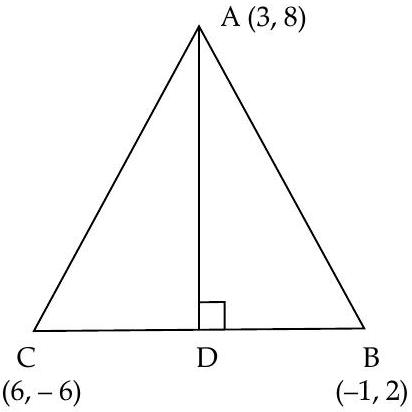
(ii) Slope of \(\mathrm{BC} \times\) Slope of \(\mathrm{AD}=-1 \quad(\mathrm{BC} \perp \mathrm{AD})\)
\(\frac{-8}{7} \times\) Slope of \(\mathrm{AD}(m)=-1\)
Equation of line perpendicular to BD i.e,. AD is
Using ruler and a compass only construct a semi-circle with diameter \(\mathbf{B C}=\mathbf{7 ~ c m}\). Locate a point A on the circumference of the semicircle such that A is equidistant from B and C. Complete the cyclic quadrilateral ABCD, such that D is equidistant from AB and BC. Measure ∠ADC and write it down. [4]
Firstly, draw a semicircle of radius 3.5 cm having centre O.
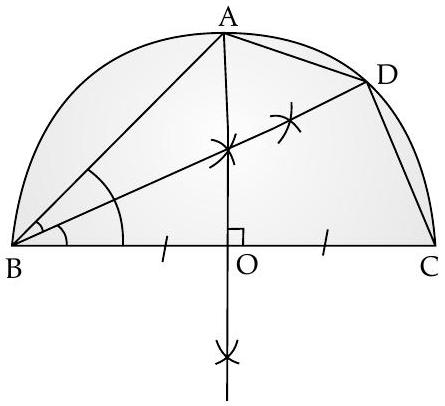
Justification : A is the equidistant from the point B and C. ∴ A is lying on perpendicular bisector of BC. D is the equidistant from the side AB and BC. In \(\triangle \mathrm{AOB}\),
In cyclic quadrilateral ABCD, \(\angle \mathrm{ABC}+\angle \mathrm{ADC}=180^{\circ}\) (Opposite angles of cyclic quadrilateral)
The data on the number of patients attending a hospital in a month are given below. Find the average (mean) number of patients attending the hospital in a month by using the shortcut method. Take the assumed mean as 45. Give your answer correct to 2 decimal places. [3]
| Number of patients | \(10-20\) | \(20-30\) | \(30-40\) | \(40-50\) | \(50-60\) | \(60-70\) |
| Number of days | 5 | 2 | 7 | 9 | 2 | 5 |
Here class width \(h=10\),
| Number of patients | Number of days \(\boldsymbol{(} \boldsymbol{f} \boldsymbol{)}\) | \(x\) | \(d=\frac{\boldsymbol{x}-\boldsymbol{A}}{\boldsymbol{h}}\) | \(f d\) |
| \(10-20\) | 5 | 15 | -3 | -15 |
| \(20-30\) | 2 | 25 | -2 | -4 |
| \(30-40\) | 7 | 35 | -1 | -7 |
| \(40-50\) | 9 | \(45=A\) | 0 | 0 |
| \(50-60\) | 2 | 55 | 1 | 2 |
| \(60-70\) | 5 | 65 | 2 | 10 |
| \(\Sigma f=30\) | \(\Sigma f d=-14\) |
Using properties of proportion solve for \(\boldsymbol{x}\), given [3]
By componendo-dividendo
Sachin invests ₹ 8500 in 10%, ₹ 100 shares at ₹ 170. He sells the shares when the price of each share rises by ₹ 30. He invests the proceeds in 12%, ₹ 100 shares at ₹ 125. Find:
(i) the sale proceeds.
(ii) the number of ₹ 125 shares he buys.
(iii) the change in his annual income. [4]
Total investment \(=\text{₹} 8500\) Market value of each share \(=\text{₹} 170\) Number of shares purchased \(=\frac{8500}{170}=50\) Dividend received \(=\text{₹}\left(\frac{10}{100}\right) \times 50 \times 100=\) ₹500 Now, market value of each share \(=\text{₹}(170+30)\) = ₹ 200 Amount received on selling \(=\text{₹}(50 \times 200)=\) ₹10000 Market value of new shares \(=\text{₹} 125\) each Number of shares purchased \(=\frac{10000}{125}=80\) Dividend received \(=\left(\frac{12}{100}\right) \times 80 \times 100=\text{₹} 960\) Change in income \(=\text{₹}(960-500)=\text{₹} 460\) Selling price of these shares = Market value of one share × Number of shares
The change in his Annual Income \(=\text{₹}(960-\) 500) = ₹ 460
(i) Sale proceeds \(=\text{₹} 10000\)
(ii) Number of ₹ 125 shares = 80
(iii) Change in his annual Income \(=\text{₹} 460\)
Use graph paper for this question. The marks obtained by 120 students in an English test are given below:
| Marks | \(0-10\) | \(10-20\) | \(20-30\) | \(30-40\) | \(40-50\) | \(50-60\) | \(60-70\) | \(70-80\) | \(80-90\) | \(90-100\) |
| No. of students | 5 | 9 | 16 | 22 | 26 | 18 | 11 | 6 | 4 | 3 |
Draw the ogive and hence, estimate:
(i) the median marks.
(ii) the number of students who did not pass the test if the pass percentage was 50.
(iii) the upper quartile marks. [6]
| Marks | No. of students | Less than | c.f. Less Than Type |
|---|---|---|---|
| \(0-10\) | 5 | 10 | 5 |
| \(10-20\) | 9 | 20 | 14 |
| \(20-30\) | 16 | 30 | 30 |
| \(30-40\) | 22 | 40 | 52 |
| \(40-50\) | 26 | 50 | 78 |
| \(50-60\) | 18 | 60 | 96 |
| \(60-70\) | 11 | 70 | 107 |
| \(70-80\) | 6 | 80 | 113 |
| \(80-90\) | 4 | 90 | 117 |
| \(90-100\) | 3 | 100 | 120 |
| 120 |

Here, \(\mathrm{N}=120\)
(i) Median = 42 marks
(ii) The number of student who did not pass the test if the pass percentage was 50 is 78.
(iii) The upper quartile marks is 57.
A man observes the angle of elevation of the top of the tower to be 45°. He walks towards it in a horizontal line through its base. On covering 20 m the angle of elevation changes to 60°. Find the height of the tower correct to 2 significant figures. [4]
Let the height of tower be \(h \mathrm{~m}\). Angle of elevation of the top of tower is 45° and 60° from the points A and B respectively.
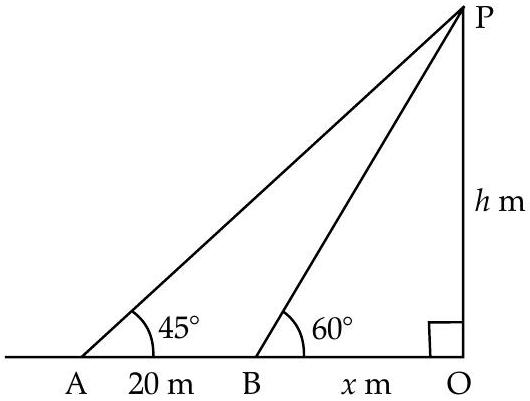
Let OB be \(x \mathrm{~m}\), and OP is the tower having height \(=h \mathrm{~m}\).
from eq. (i) and (ii)
∴ Height of the tower \(=47 \mathrm{~m}\)
Using the Remainder Theorem, find the remainders obtained when \(\boldsymbol{x}^{\mathbf{3}}+(\mathbf{R} \boldsymbol{x}+\mathbf{8}) \boldsymbol{x}+\mathbf{R}\) is divided by \(\boldsymbol{x}+\mathbf{1}\) and \(\boldsymbol{x – 2}\). Hence, find \(\boldsymbol{k}\) if the sum of the two remainders is 1. [3]
Let \(\mathrm{R}_{1}\) and \(\mathrm{R}_{2}\) are remainders when given polynomial is divided by \((x+1)\) and \((x-2)\) respectively. Let \(P(x)=x 3+(k x+8) \mathrm{x}+8\) Remainder
Remainder
(Given)
The product of two consecutive natural numbers which are multiples of 3 is equal to 810. Find the two numbers. [3]
Let the two consecutive natural numbers that are multiple of 3 be \(3 x\) and \(3 x+3\). Given : Product of two consecutive numbers = 810
If, \(x+10=0 \Rightarrow x=-10\) It is not natural number
∴ Numbers are \(3 x=3 \times 9=27\) and \(3 x+3=27+3=30\)
In the given figure, ABCDE is a pentagon inscribed in a circle such that AC is a diameter and side \(\mathbf{B C}\left|\mid \mathbf{A E}\right.\). If \(\angle \mathbf{B A C}=\mathbf{5 0}^{\circ}\), find giving reasons:
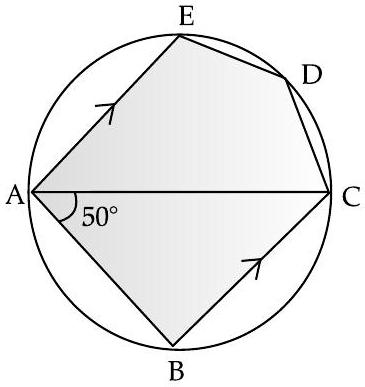
(i) \(\angle \mathrm{ACB}\)
(ii) ∠EDC
(iii) ∠BEC
Hence, prove that BE is also a diameter. [4]
(i) AC is a diameter of circle.
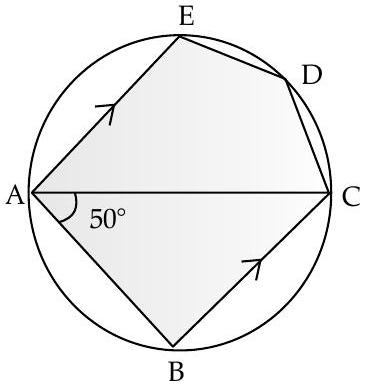
In \(\triangle \mathrm{ABC}\),
(sum of angles of \(\Delta\) )
(ii) BC||AE
\(\therefore \angle \mathrm{EAC}=\angle \mathrm{ACB}\) (Alternative angles)
Since, ACDE is a cyclic quadrilateral.
\(\therefore \quad \angle \mathrm{EAC}+\angle \mathrm{EDC}=180^{\circ}\)(Sum of opposite angles of cyclic quadrilateral is 180°)
\(\therefore \angle \mathrm{EDC}=180^{\circ}-40^{\circ}\)(iii) \(\angle \mathrm{BEC}=\angle \mathrm{BAC}\) (same arc (BC))
∴ BE is a diameter, as the angle subtended by a diameter on any point of circle is 90°.