

Last Updated on November 13, 2026 by sanjjeett
Practice the complete ICSE Class 10 Mathematics 2020 Question Paper with Solutions, including algebra, geometry, trigonometry, statistics, graphs, constructions and commercial mathematics. Use this solved paper to revise important concepts, practise board-style questions and strengthen your exam preparation.
Attempt all questions from Section A and any four questions from Section B.
All working, including rough work, must be clearly shown and must be done on the same sheet as the rest of the answer.
Omission of essential working will result in loss of marks.
The intended marks for questions or parts of question are given in brackets [ ].
Mathematical tables are provided.
ICSE Mathematics 2020 — Section A
Solve the following Quadratic Equation :
Give your answer correct to two decimal places. [3]
Compare the equation by \(a x^{2}+b x+c=0\) then, \(a=1, b=-7\) and \(c=3\)
∴
and
Hence, \(x=6.54\) (Approx.) and \(x=0.46\) (Approx).
\(\quad\) Given \(\mathbf{A}=\left[\begin{array}{cc}\boldsymbol{x} & \mathbf{3} \\ \boldsymbol{y} & \mathbf{3}\end{array}\right]\) If \(\boldsymbol{A}^{\mathbf{2}}=\mathbf{3} \boldsymbol{I}\), where \(\boldsymbol{I}\) is the identity matrix of order 2, find \(x\) and \(y\). [3]
Comparing the elements of matrices
Using ruler and compass construct a triangle \(\boldsymbol{A} \boldsymbol{B} \boldsymbol{C}\) where \(\boldsymbol{A} \boldsymbol{B}=\mathbf{3 ~ c m}, \boldsymbol{B} \boldsymbol{C}=\mathbf{4 ~ c m}\) and \(\angle \boldsymbol{A} \boldsymbol{B} \boldsymbol{C}\) \(=90^{\circ}\). Hence construct a circle circumscribing triangle \(A B C\). Measure and write down the radius of the circle. [4]
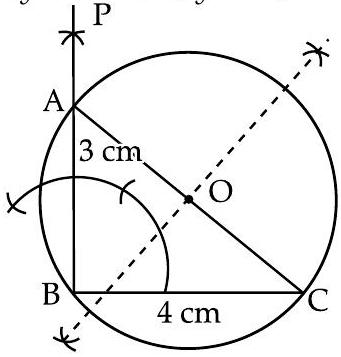
Steps of construction
(i) Draw \(B C=4 \mathrm{~cm}\)
(ii) Make \(\angle P B C=90^{\circ}\)
(iii) Taking centre \(B\) and radius 3 cm draw an arc which intersect BP at the point A.
(iv) Join \(A C, \triangle A B C\) is required triangle. \(\angle B=90^{\circ}\) \(\therefore A C\) is the diameter of circle.
(v) Draw perpendicular bisector of \(A C\).
(vi) Taking centre \(O\) and radius equal to \(B O\) draw a circle which passes through vertex \(A, B\) and \(C\). Radius of circumscribe circle \(=2.5 \mathrm{~cm}\).
Use factor theorem to factorise \(\mathbf{6} \boldsymbol{x}^{\mathbf{3}}+\mathbf{1 7} \boldsymbol{x}^{\mathbf{2}}+\mathbf{4} \boldsymbol{x}-\) 12 completely. [3]
\(\therefore(x+2)\) is a factor of given polynomial \(p(x)\)
Solve the following inequation and represent the solution set on the number line. [3]

Draw a Histogram for the given data, using a graph paper :
| Weekly Wages (in ₹) | No. of People |
|---|---|
| 3000-4000 | 4 |
| 4000-5000 | 9 |
| 5000-6000 | 18 |
| 6000-7000 | 6 |
| 7000-8000 | 7 |
| 8000-9000 | 2 |
| 9000-10000 | 4 |
Estimate the mode from the graph. [4]
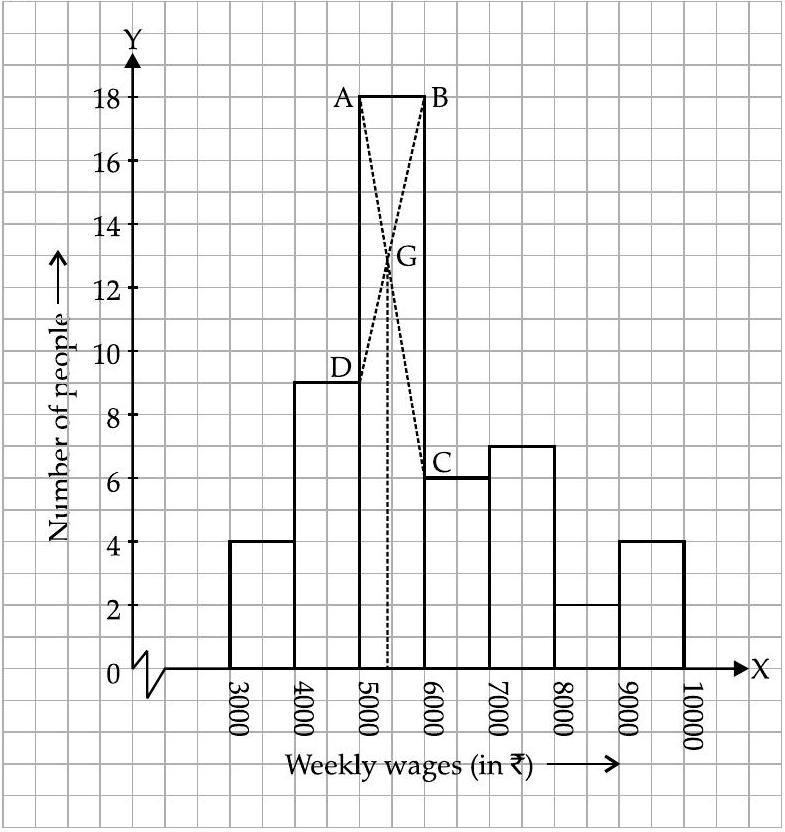
= Mode -5400 (approx)
In the figure given below, O is the centre of the circle and \(A B\) is a diameter. If \(\boldsymbol{A} \boldsymbol{C}=\boldsymbol{B} \boldsymbol{D}\) and \(\angle \boldsymbol{A} \boldsymbol{O} \boldsymbol{C}=\mathbf{7 2} \boldsymbol{°}^{\boldsymbol{\circ}}\). Find:
(i) \(\angle \mathrm{ABC}\)
(ii) ∠BAD
(iii) ∠ABD [3]
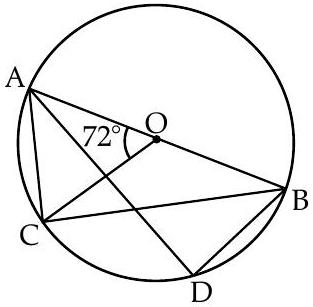
\(A B\) is the diameter of circle (i)
(same arc angles at circumference and centres)
(ii)
(iii) In \(\triangle A B D\)
(sum of all angles of \(\Delta\) )
Prove that : [3]
In what ratio is the line joining \(\boldsymbol{P}(\mathbf{5}, \mathbf{3})\) and \(Q(-5,3)\) divided by the \(y\)-axis ? Also find the coordinates of the point of intersection. [4]
Let the line joining the \((5,3)\) and (-5, 3) divided by the \(y\)-axis in the ratio \(k: 1\). (-5, 3)
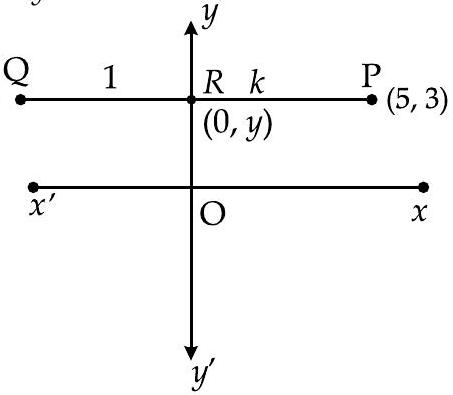
Let the coordinate of the point of intersection \(R\) be \((0, y)\).
Point of intersection of the line (0, 3).
A solid spherical ball of radius 6 cm is melted and recast into 64 identical spherical marbles. Find the radius of each marble. [3]
Volume of solid spherical ball \(=\frac{4}{3} \pi r^{3}\)
Let the radius of spherical marble be \(R\) cm. Then 64 × volume of spherical marbles = volume of spherical ball
∴ Radius of spherical marble is 1.5 cm.
Each of the letters of the word ‘AUTHORIZES’ is written on identical circular discs and put in a bag. They are well shuffled. If a disc is drawn at random from the bag, what is the probability that the letter is :
(i) a vowel ?
(ii) one of the first 9 letters of the English alphabet which appears in the given word ?
(iii) one of the last 9 letters of the English alphabet which appears in the given word ? [3]
‘AUTHORIZES’ Total number of disc \(n(\mathrm{~S})=10\)
(i) Number of discs a letter of vowel = 5
(A, U, O, I, E) \(\therefore n(\mathrm{E})=5\) Probability of a disc is vowel
(ii) One of the first 9 letter in english alphabet \(=4(A, E, H, \mathrm{I})\)
∴
Probability of a disc is drawn is written one of first 9 letters of english alphabet
(iii) One of the last \(9(R, S, T, U, Z)\) letters of english alphabet
Probability of a disc is drawn is written one of the last 9 letters of english alphabet
Mr. Bedi visits the market and buys the following articles : Medicines costing ₹ 950, GST @ 5% A Pair of shoes costing ₹ 3000, GST @ 18% A Laptop bag costing ₹ 1000 with a discount of 30% GST @ 18%
(i) Calculate the total amount of GST paid.
(ii) The total bill amount including GST paid by Mr. Bedi. [4]
Medicine costing \(=\text{₹} 950\)
A pair of shoes costing \(=\text{₹} 3000\)
Laptop bag costing ₹ 1000 with a discount of 30%
GST @ \(18 \%=\frac{18}{100} \times 700=\text{₹} 126\)
(i) Total amount of GST = ₹ 47.50 + 540 + 126
(ii) Total bill amount including GST
ICSE Mathematics 2020 — Section B
A company with 500 shares of nominal value ₹ 120 declares an annual dividend of \(15 \%\). Calculate :
(i) the total amount of dividend paid by the company.
(ii) annual income of Mr. Sharma who holds 80 shares of the company.
If the return percent of Mr. Sharma from his shares is 10%. Find the market value of each share. [3]
Number of shares \(=500\)
(i) Total amount of dividend paid by the company = Rate of dividend × Nominal value of share × Number of share
∴ Total amount paid by the company = ₹ 9000
(ii) Mr sharma’s Annual Income = Rate of dividend × Nominal value of share × Number of share
∴ Mr sharma’s Annual Income \(=\text{₹} 1440\)
\(\therefore \quad\) Investment \(=\frac{144000}{10}=\text{₹} 14400\)
∴ Market value of share \(=\text{₹} 180\)
The mean of the following data is 16. Calculate the value of \(\boldsymbol{f}\). [3]
| Marks | 5 | 10 | 15 | 20 | 25 |
|---|---|---|---|---|---|
| No. of Students | 3 | 7 | \(f\) | 9 | 6 |
| Marks | No. of Students | |
|---|---|---|
| \((x)\) | (f) | \(f \times x\) |
| 5 | 3 | 15 |
| 10 | 7 | 70 |
| 15 | \(f\) | \(15 f\) |
| 20 | 9 | 180 |
| 25 | 6 | 150 |
| \(25+f\) | \(415+15 f\) |
∴
The \(\mathbf{4}^{\text {th }}, \mathbf{6}^{\text {th }}\) and the last term of a geometric progression are 10, 40 and 640 respectively. If the common ratio is positive, find the first term, common ratio and the number of terms of the series. [4]
Let the first term of G.P. be \(a\), common ratio be \(r\) and number of terms be \(n\).
Again,
From eqs. (i) \& (ii)
( \(r>0\) ) From eq. (i)
Again,
Comparing the power
∴ First term of G.P. \(=\frac{5}{4}\), common ratio \(=2\) and number of terms \(=10\)
If \(\boldsymbol{A}=\left[\begin{array}{ll}\mathbf{3} & \mathbf{0} \\ \mathbf{5} & \mathbf{1}\end{array}\right]\) and \(\boldsymbol{B}=\left[\begin{array}{cc}-\mathbf{4} & \mathbf{2} \\ \mathbf{1} & \mathbf{0}\end{array}\right]\) Find \(A^{2}-2 A B+B^{2}\). [3]
\(A=\left[\begin{array}{ll}3 & 0 \\ 5 & 1\end{array}\right]\) and \(B=\left[\begin{array}{cc}-4 & 2 \\ 1 & 0\end{array}\right]\)
In the given figure \(\boldsymbol{A} \boldsymbol{B}=\mathbf{9 ~ c m}, \boldsymbol{P} \boldsymbol{A}=\mathbf{7 . 5 ~ c m}\) and \(P C=5 \mathrm{~cm}\). Chords \(\boldsymbol{A} \boldsymbol{D}\) and \(\boldsymbol{B} \boldsymbol{C}\) intersect at \(\boldsymbol{P}\).
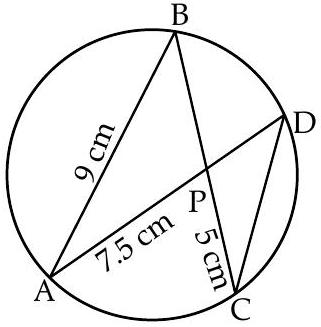
(i) Prove that \(\triangle P A B \sim \triangle P C D\).
(ii) Find the length of \(C D\).
(iii) Find area of \(\triangle P A B\) : area of \(\triangle P C D\). [3]
(i) \(\triangle P A B\) and \(\triangle P C D\)
(Vertically opposite angle)
(same arc \(\stackrel{\triangle}{\text { AC }}\) angles)
(AA similarly test)
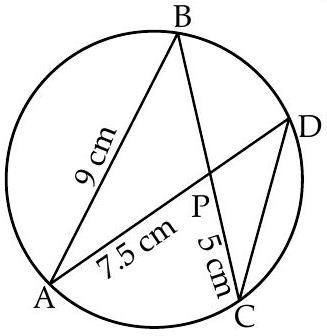
(ii)
(Property of similar triangle)
∴
∴
(iii)
From the top of a cliff, the angle of depression of the top and bottom of a tower are observed to be 45° and 60° respectively. If the height of the tower is 20 m. Find :
(i) the height of the cliff.
(ii) the distance between the cliff and the tower. [4]
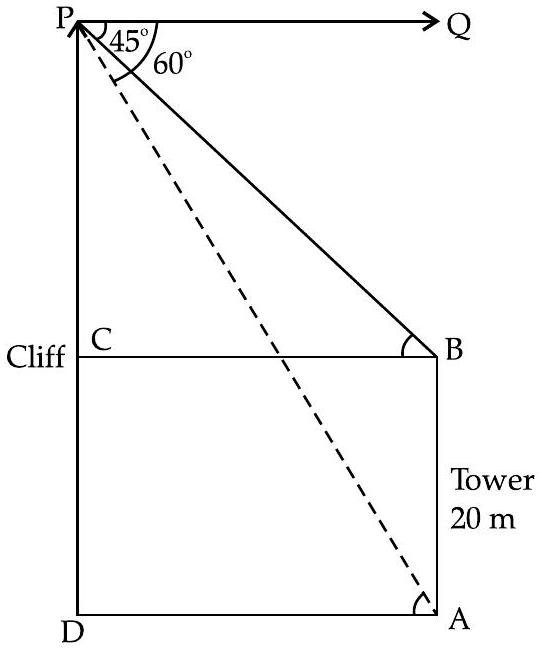
\(O P\) is the cliff and \(A B\) is the tower. In \(\triangle P B C\),
∴
In \(\triangle O A P\),
(i) height of the cliff
∴ Height of the cliff \(=47.32 \mathrm{~m}\)
(ii) Distance between the cliff and the tower
Find the value of ‘ \(\boldsymbol{p}\) ‘ if the lines, \(\mathbf{5} \boldsymbol{x}-\mathbf{3} \boldsymbol{y}+\mathbf{2}=\mathbf{0}\) and \(6 x-p y+7=0\) are perpendicular to each other. Hence, find the equation of a line passing through (-2, -1) and parallel to \(\mathbf{6} \boldsymbol{x}-\boldsymbol{p} \boldsymbol{y}+\mathbf{7}=\) 0. [3]
Slope of line \(5 x-3 y+2=0\) is
Slope of line \(6 x-p y+7=0\) is \(=\frac{-6}{-p}=\frac{6}{p}\) Lines are perpendicular each other ∴ Product of slopes = -1
∴
Given line \(6 x-p y+7=0\) is \(6 x+10 y+7=0\) Equation of the line, parallel to \(6 x+10 y+7=0\) is \(6 x+10 y+k=0\) Since, line passes through (-2,-1),
Equation of the line parallel to \(6 x+10 y+7\) is \(6 x+10 y+22=0\) or \(3 x+5 y+11=0\)
Using properties of proportion find \(x: y\), given : [3]
(using compodendo dividendo \(\frac{a}{b}=\frac{c}{d}\)
(using compodendo – dividendo)
∴
In the given figure \(\boldsymbol{T} \boldsymbol{P}\) and \(\boldsymbol{T} \boldsymbol{Q}\) are two tangents to the circle with centre \(\boldsymbol{O}\), touching at \(\boldsymbol{A}\) and \(\boldsymbol{C}\) respectively. If \(\angle B C Q=55^{\circ}\) and \(\angle B A P=60^{\circ}\), find :
(i) \(\angle O B A\) and \(\angle O B C\)
(ii) \(\angle A O C\)
(iii) \(\angle A T C\) [4]
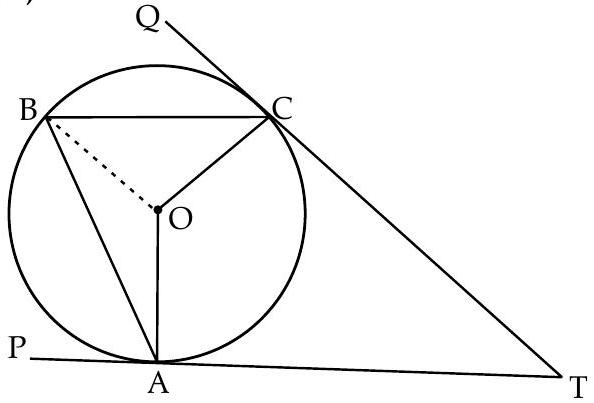
Given, \(\angle B C Q=55^{\circ}\) and \(\angle B A P=60^{\circ}\)
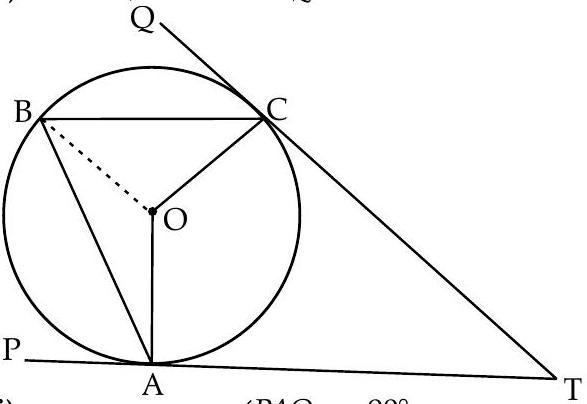
(i) ∵
(As PAT is the tangent) ∴
In \(\triangle O A B, O A=O B\) (radii of circle)
Similarly
(As QCT is the tangent) ∴
In \(\triangle O C B, O C=O B\) (radii of circle)
(ii) Now,
Again, \(\angle A O C=2 \angle A B C=2 \times 65^{\circ}=130^{\circ}\) ( ∵ Angle subtended at the center of the circle by an arc is twice the angle subtended at the circle) (iii)
What must be added to the polynomial \(\mathbf{2} \boldsymbol{x}^{\mathbf{3}}-\) \(\mathbf{3} \boldsymbol{x}^{\mathbf{2}}-\mathbf{8} \boldsymbol{x}\), so that it leaves a remainder 10 when divided by \(\mathbf{2} \boldsymbol{x}+\mathbf{1}\) ? [3]
Let \(k\) be added to get remainder 10 when divided by \((2 x+1)\).
Hence, 7 be added to get remainder 10 when divided by \(2 x+1\) to given polynomial.
Mr. Sona has a recurring deposit account and deposits ₹ 750 per month for 2 years. If he gets ₹ 19125 at the time of maturity, find the rate of interest. [3]
Maturity amount (M.A.) = ₹ 19125 Monthly deposit (P)= ₹ 750 Time \((n)=2\) years \(=24\) months
Use graph paper for this question. Take \(\mathbf{1 ~ c m}=\mathbf{1}\) unit on both \(\boldsymbol{x}\) and \(\boldsymbol{y}\) axes.
(i) Plot the following points on your graph sheets. \(A(-4,0), B(-3,2), C(0,4), D(4,1)\) and E \((7,3)\)
(ii) Reflect the points \(B, C, D\) and \(E\) on the \(x\)-axis and name them as \(\boldsymbol{B}^{\prime}, \boldsymbol{C}^{\prime}, \boldsymbol{D}^{\prime}\) and \(\boldsymbol{E}^{\prime}\) respectively.
(iii) Join the points \(\boldsymbol{A}, \boldsymbol{B}, \boldsymbol{C}, \boldsymbol{D}, \boldsymbol{E}, \boldsymbol{E}^{\prime}, \boldsymbol{D}^{\prime}, \boldsymbol{C}^{\prime}, \boldsymbol{B}^{\prime}\) and \(\boldsymbol{A}\) in order.
(iv) Name the closed figure formed. [4]
(i)
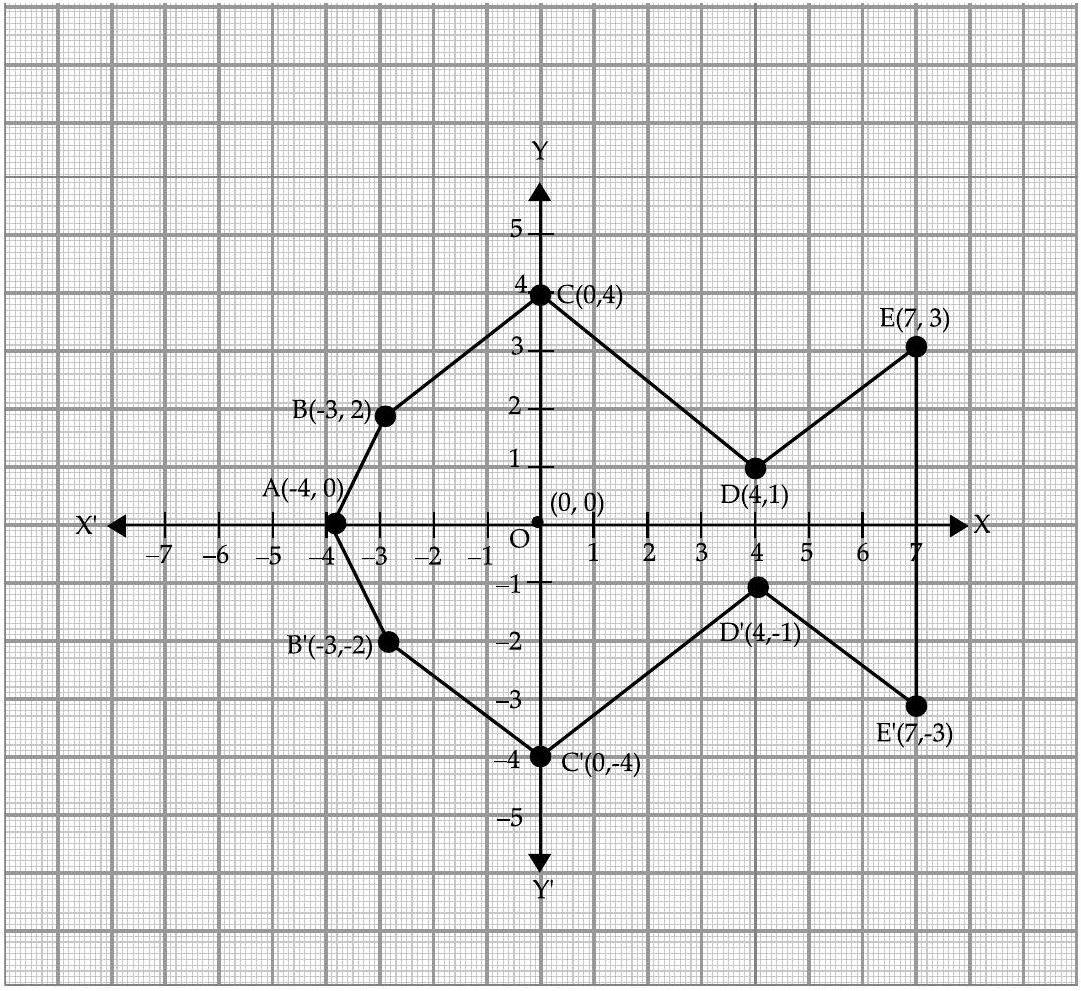
(ii) B'(-3, -2), C'(0, -4), D'(4, -1) and E'(7, -3) respectively are the reflected points through the x-axis.
(iii) On joining the points A, B, C, D, E, E’, D’, C’, B’ and A in order, we get a closed figure.
(iv) Closed figure formed is nine sided polygon or nonagon, polygon fish or kite.
40 Students enter for a game of shot-put competition. The distance thrown (in metres) is recorded below :
| Distance in \(\boldsymbol{m}\) | 12-13 | 13-14 | 14-15 | 15-16 | 16-17 | 17-18 | 18-19 |
|---|---|---|---|---|---|---|---|
| Number of Students | 3 | 9 | 12 | 9 | 4 | 2 | 1 |
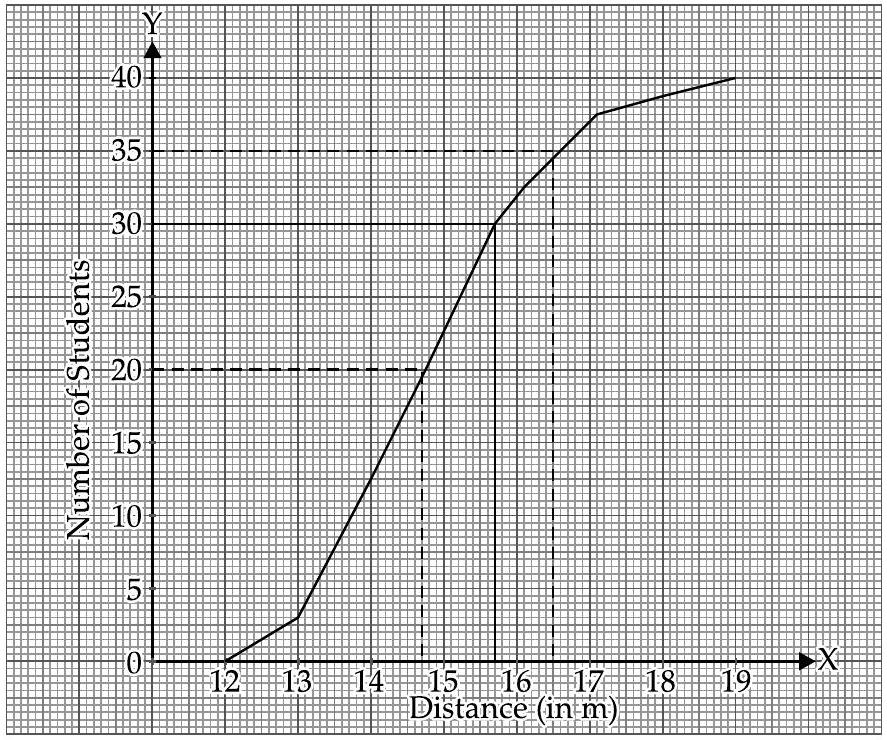
Use a graph paper to draw an ogive for the above distribution. Use a scale of \(2 \mathrm{~cm}=1 \mathrm{~m}\) on one axis and 2 cm \(=5\) students on the other axis. Hence, using your graph find :
(iii) number of students who cover a distance which is above \(\mathbf{1 6} \frac{\mathbf{1}}{\mathbf{2}} \mathrm{m}\).
(i) the median.
(ii) upper qartile. [6]
| Distance in ( \(\boldsymbol{m}\) ) | Number of students | Less than | Cumulative frequency |
|---|---|---|---|
| 12-13 | 3 | 13 | 3 |
| 13-14 | 9 | 14 | 12 |
| 14-15 | 12 | 15 | 24 |
| 15-16 | 9 | 16 | 33 |
| 16-17 | 4 | 17 | 37 |
| 17-18 | 2 | 18 | 39 |
| 18-19 | 1 | 19 | 40 |
(i) Median = 14.6± 0.2
(ii) Upper quartile \(=15.75 \pm 0.2\)
(iii) Number of students above \(16 \frac{1}{2} \mathrm{~m}=40-35=5\)
[4]
(Apply compodendo-dividendo \(\frac{A}{B}=\frac{C}{D}\)
Squaring both sides
Apply compodendo – dividendo
If the \(\mathbf{6}^{\text {th }}\) term of an A.P. is equal to four times its first term and the sum of fist six terms is 75, find the first term and the common difference. [3]
Let the first term of an A.P. be \(a\) and common difference be \(d\) respectively
From equation (i)
First term of an A.P. \(=5\) and common difference = 3
The difference of two natural numbers is 7 and their product is 450. Find the numbers. [3]
Let the numbers be \(x\) and \(y\). According the given condition
From (i) \& (ii)
If \(x+18=0 \Rightarrow x=-18\) it is not a natural number.
Thus, numbers 25 and 18.
Use ruler and compass for this question. Construct a circle of radius 4.5 cm . Draw a chord \(\boldsymbol{A} \boldsymbol{B}=\mathbf{6 ~ c m}\).
(i) Find the locus of points equidistant from \(\boldsymbol{A}\) and \(\boldsymbol{B}\).
Mark the point where it meets the circle as \(\boldsymbol{D}\).
(ii) Join \(\boldsymbol{A} \boldsymbol{D}\) and find the locus of points which are equidistant from \(A D\) and \(A B\). Mark the point where it meets the circle as \(\boldsymbol{C}\).
(iii) Join \(\boldsymbol{B} \boldsymbol{C}\) and \(\boldsymbol{C} \boldsymbol{D}\), Mesuare and write down the length of side \(\boldsymbol{C} \boldsymbol{D}\) of the quadrilateral \(\boldsymbol{A} \boldsymbol{B} \boldsymbol{C} \boldsymbol{D}\). [4]
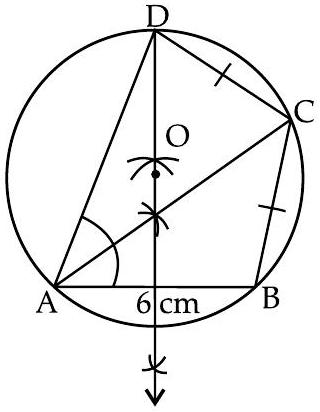
\(B C=C D=5.1 \mathrm{~cm}\) (Approx.)
A model of a high rise building is made to a scale of 1 : 50.
(i) If the height of the model is 0.8 m, find the height of the actual building.
(ii) If the floor area of a flat in the building is \(\mathbf{2 0 ~ \mathbf { m } ^ { 2 }}\), find the floor area of that in the model. [3]
Scale \(=1: 50\) Height of the model 0.8 m ∴ Height of the building \(=0.8 \times 50 \mathrm{~m}=40 \mathrm{~m}\) Floor area of building \(=20 \mathrm{~m}^{2}\) Floor area of the model \(=\frac{20}{50 \times 50} \mathrm{~m}^{2}\)
∴ Floor area of the model
From a solid wooden cylinder of height 28 cm and diameter 6 cm, two conical cavities are hollowed out. The diameters of the cones are also of 6 cm and height 10.5 cm. Taking \(\pi=\frac{22}{7}\) find the volume of the remaining solid. [3]
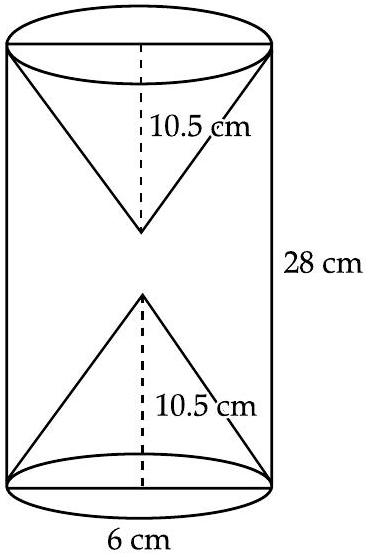
Dimension of cylinder Height \((h)=28 \mathrm{~cm}\) Diameter \((2 r)=6 \mathrm{~cm}\)
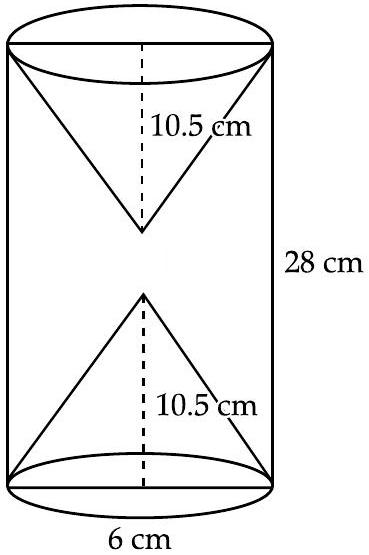
Dimension of conical cavities Height \((\mathrm{H})=10.5 \mathrm{~cm}\) diameter \((2 r)=6 \mathrm{~cm}\) Volume of remaining solid = Volume of cylinder – 2 × Volume of cavity
Hence, volume of remaining solid \(=594 \mathrm{~cm}^{3}\)
Prove the identity [4]
= R.H.S. Hence proved. \(\square\)