
Last Updated on November 13, 2026 by sanjjeett
Practice the complete ICSE Class 10 Mathematics 2022 Semester 2 Question Paper with Solutions, including MCQs, algebra, geometry, trigonometry, statistics, probability, graphs and mensuration. Use this solved paper to revise important concepts, practise board-style questions and strengthen your exam preparation.
Attempt all questions from Section A and any three questions from Section B.
The marks intended for questions are given in brackets [ ].
Mathematical tables are provided.
Question 1 — Multiple Choice Questions
The probability of getting a number divisible by 3 in throwing a dice is: [1]
Option (b) is correct.
Explanation: All possible out comes of a dice \(=\{1,2,3,4,5,6\}\)
Favourable outcomes (divisible by 3 )
Probability of getting a number divisible by 3
The volume of a conical tent is \(\mathbf{4 6 2} \mathbf{~ m}^{\mathbf{3}}\) and the area of the base is \(\mathbf{1 5 4} \mathbf{~ m}^{\mathbf{2}}\). The height of the cone is: [1]
Option (c) is correct.
Explanation: Given, Volume of conical tent \(=462 \mathrm{~m}^{3}\) and Area of the base \(=154 \mathrm{~m}^{2}\) We know that
⇒
⇒
The median class for the given distribution is: [1]
| Class Interval | 0-10 | 10-20 | 20-30 | 30-40 |
|---|---|---|---|---|
| Frequency | 2 | 4 | 3 | 5 |
Option (c) is correct.
Explanation:
| C. I. | Frequency | c. f. |
|---|---|---|
| 0-10 | 2 | 2 |
| 10-20 | 4 | \(2+4=6\) |
| 20-30 | 3 (f) | \(6+3=9\) |
| 30-40 | 5 | \(9+5=14\) |
| 14 |
We can see that cumulative frequency just greater than 7 is 9, which is lie in the class interval 20-30. So, the median class is 20-30.
If two lines are perpendicular to one another then the relation between their slopes \(\boldsymbol{m}_{\mathbf{1}}\) and \(\boldsymbol{m}_{\mathbf{2}}\) is: [1]
Option (d) is correct.
Explanation: If two lines, having slopes \(m_{1}\) and \(m_{2}\), perpendicular to one another, then \(m_{1}\) \(\times m_{2}=-1\)
A lighthouse is 80 m high. The angle of elevation of its top from a point 80 m away from its foot along the same horizontal line is: [1]
Option (b) is correct.
Explanation: Height of the light house \(=80 \mathrm{~m}\) Distance of the point from the foot of the light house \(=80 \mathrm{~m}\) Let the angle of elevation be \(\theta\), then \(\tan \theta\)
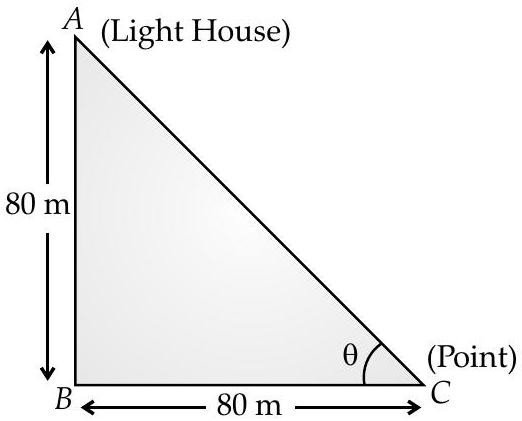
So, \(\theta=45^{\circ}\)
The modal class of a given distribution always corresponds to the: [1]
Option (a) is correct.
The coordinates of the point P(-3, 5) on reflecting on the X axis are: [1]
Option (b) is correct.
Explanation: Given point (-3, 5) lies in II \({ }^{\text {nd }}\) quadrant. So, after reflection sign of Y-coordinate will invert and sign of X-coordinate remain same. Reflection of this point will be in \(I I \mathrm{II}^{\text {rd }}\)-quadrant, i.e., (-3, -5).
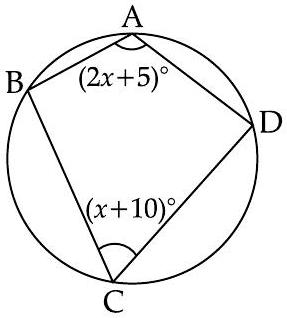
ABCD is a cyclic quadrilateral. If \(\angle \mathbf{B A D}=\) \((\mathbf{2} \boldsymbol{x}+\mathbf{5})^{\circ}\) and \(\angle \mathbf{B C D}=(\boldsymbol{x}+\mathbf{1 0})^{\circ}\) then \(\boldsymbol{x}\) is equal to: [1]
Option (c) is correct.
Explanation: Given, \(\angle \mathrm{BAD}=(2 x+5)^{\circ}\) and
So,
(Sum of opposite angles of a cyclic quadrilateral are supplementary)
A(1, 4), B \((4,1)\) and C \((x, 4)\) are the vertices of \(\triangle \mathrm{ABC}\). If the centroid of the triangle is G \((4,3)\) then \(x\) is equal to [1]
Option (c) is correct.
Explanation: Coordinates of centroid of a triangle is given by
So, coordinates of the centroid of triangle ABC is given by \(\left(\frac{1+4+x}{3}, \frac{4+1+4}{3}\right)\) or \(\left(\frac{5+x}{3}, 3\right)\)
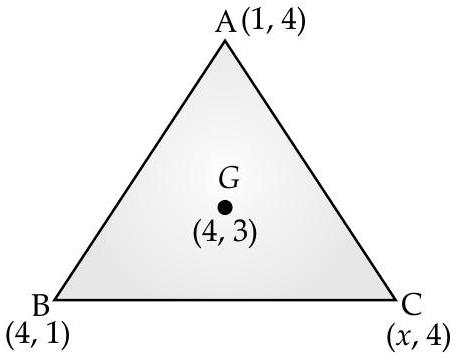
Also, coordinates of centroid of \(\Delta \mathrm{ABC}(4,3)\) So, \(4=\frac{5+x}{3} \Rightarrow 12=5+x \Rightarrow x=7\)
The radius of a roller 100 cm long is 14 cm. The curved surface area of the roller is: (Take \(\pi=\frac{22}{7}\) ) [1]
Option (d) is correct.
Explanation: We have, radius of a roller \(=14 \mathrm{~cm}\) height of the roller \(=100 \mathrm{~cm}\) Now, C.S.A. of roller \((\) Cylinder \()=2 \pi r h\) \(=2 \times \frac{22}{7} \times 14 \times 100=8800 \mathrm{~cm}^{2}\) (Attempt any three questions from this Section.)
Descriptive and Numerical Questions
Prove that [2]
L.H.S.
Hence Proved.
Find ‘ \(a\) ‘ if \(\mathbf{A}(2 a+2,3), \mathbf{B}(7,4)\) and C ( \(\mathbf{2} \boldsymbol{a}+\mathbf{5}, \mathbf{2}\) ) are collinear. [2]
Given A \((2 a+2,3), \mathrm{B}(7,4)\) and C \((2 a+5,2)\) are collinear. When three points are colliner, then
or \(x_{1}\left(y_{2}-y_{3}\right)+x_{2}\left(y_{3}-y_{1}\right)+x_{3}\left(y_{1}-y_{2}\right)=0\) We have
Calculate the mean of the following frequency distribution [3]
| Class Interval | 5-15 | 15-25 | 25-35 | 35-45 | 45-55 |
|---|---|---|---|---|---|
| Frequency | 2 | 6 | 4 | 8 | 4 |
| C. I. | Class mark ( \(\boldsymbol{x}\) ) | Frequency (f) | \(f \times x\) |
|---|---|---|---|
| 5-15 | 10 | 2 | 20 |
| 15-25 | 20 | 6 | 120 |
| 25-35 | 30 | 4 | 120 |
| 35-45 | 40 | 8 | 320 |
| 45-55 | 50 | 4 | 200 |
| Total | 24 | 780 |
We know, Mean \((\bar{x})=\frac{\sum f x}{\sum f}\)
In the given figure O is the centre of the circle. \(\mathbf{P Q}\) and \(\mathbf{P R}\) are tangents and \(\angle \mathbf{Q P R}=\) 70° Calculate:
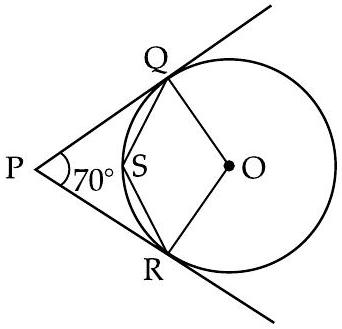
(a) \(\angle \mathrm{QOR}\)
(b) \(\angle \mathrm{QSR}\) [3]
PQOR is a quadrilateral.
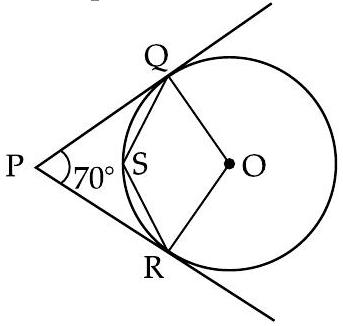
(a)
(supplementary angles)
(b)
( ∵ The angle subtended by an arc at the centre is double the angle subtended by it on the remaining part of the circle.)
A bag contains 5 white, 2 red and 3 black balls. A ball is drawn at random. What is the probability that the ball drawn is a red ball? [2]
Given, No. of white balls= 5 No. of red balls \(=2\) No. of black balls \(=3\) Total no. of balls \(=5+2+3\)
Probability of getting a red ball
A solid cone of radius 5 cm and height 9 cm is melted and made into small cylinders of radius of 0.5 cm and height 1.5 cm. Find the number of cylinders so formed. [2]
Given, For cone, Radius \((\mathrm{R})=5 \mathrm{~cm}\), Height \((\mathrm{H})=9 \mathrm{~cm}\) For cylinder, Radius \((r)=0.5 \mathrm{~cm}\), Height \((h)=1.5 \mathrm{~cm}\) No. of cylinders \(=\frac{\text { Volume of Cone }}{\text { Volume of cylinder }}\)
Two lamp posts AB and CD each of height 100 m are on either side of the road. P is a point on the road between the two lamp posts. The angles of elevation of the top of the lamp posts from the point P are 60°and 30°. Find the distances PB and PD. [3]
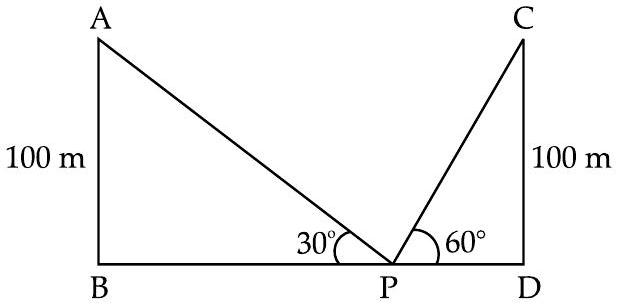
Given, Heights of the lamp posts \(\mathrm{AB}=\mathrm{CD}=100 \mathrm{~m}\) and
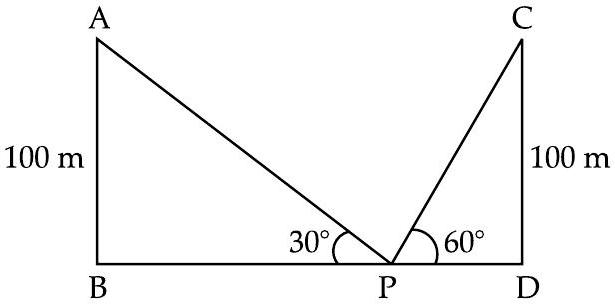
Now, in \(\triangle \mathrm{APR}\)
Correction-In this question paper \(\angle \mathrm{APB}=\) 40° is given, which should be 30° to solve it. Now, In \(\triangle \mathrm{PCD}\)
⇒
Marks obtained by 100 students in an examination are given below.
| Marks | 0-10 | 10-20 | 20-30 | 30-40 | 40-50 | 50-60 |
|---|---|---|---|---|---|---|
| No of students | 5 | 15 | 20 | 28 | 20 | 12 |
Draw a histogram for the given data using a graph paper and find the mode. Take \(2 \mathrm{~cm}=10\) marks along one axis and \(\mathbf{2 ~ c m}=\mathbf{1 0}\) students along the other axis. [3]
Mode = 35 Marks
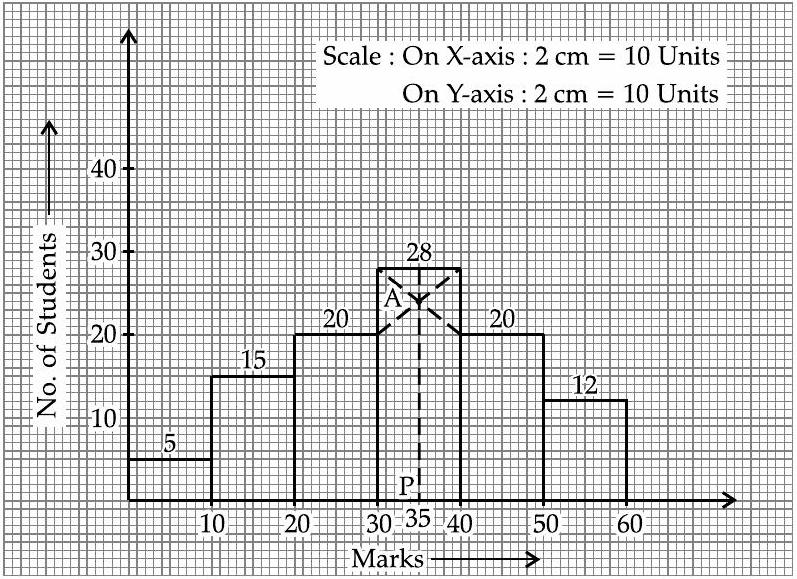
To find mode, (i) First identify the rectangle with highest frequency (Modal class); here 30-40. (ii) Join the top corners of the modal rectangle with immediate next corners of the adjacent rectangles. (iii) Let the point where the joining lines cut each other (here A). Draw a perpendicular from A to \(X\)-axis. The point ‘P’, where the perpendicular meet the X-axis will give the mode.
Find a point P which divides internally the line segment joining the points A (-3, 9) and B (1, -3) in the ratio 1 : 3. [2]
Given points are
and

Let \(\mathrm{P}(x, y)\) divides the line segment AB in the ratio 1:3. Then by using section formula,
A letter of the word ‘SECONDARY’ is selected at random. What is the probability that the letter selected is not a vowel? [2]
Given word is ‘SECONDARY’
Probability of not selecting a vowel = Probability of selecting a consonant
Use a graph paper for this question. Take 2 cm – 1 unit along both the axes.
(a) Plot the points A (0, 4), B (2, 2), C(5, 2) and D \((4,0), \mathrm{E}(0,0)\) is the origin.
(b) Reflect B, C, D on the Y-axis and name them as B’, C’ and D’ respectively.
(c) Join the points ABCDD’C’B’ and A in order and give a geometrical name to the closed figure. [3]
(a) See graph
(b) Reflected points are : B’ (-2, 2), C'(-5, 2) and D’ (-4, 0)
(c) On joining the points ABCDD’C’B’A, the shape obtain is not proper geometrical shape, but collection of a quadrilateral and triangle.

A solid wooden cylinder is of radius 6 cm and height 16 cm. Two cones each of radius 2 cm and height 6 cm are drilled out of the cylinder. Find the volume of the remaining solid. [3]
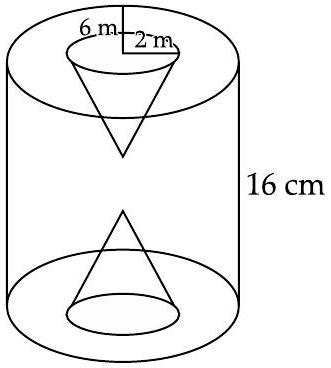
Given: For Cylinder,
We know,
For cone,
We know,
Remaining Volume = Volume of cylinder – 2 × Volume of a cone
Two chords AB and CD of a circle intersect externally at \(\mathbf{E}\). If \(\mathbf{E C}=\mathbf{2 ~ c m}, \mathbf{E A}=\mathbf{3 ~ c m}\) and \(\mathbf{A B}=\mathbf{5 ~ c m}\), find the length of CD. [2]
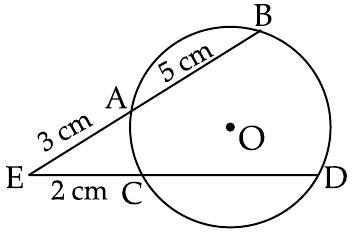
From the given figure,

We have \(\mathrm{EA}=3 \mathrm{~cm}\),
When two chords intersect externally, then (from figure)
or
⇒
Line AB is perpendicular to CD coordinates of B, C and D respectively (4, 0), (0, -1) and (4, 3).

Find
(a) Slope of CD
(b) Equation of AB [2]
(a) Slope of line CD is given by
(b) Slope of line AB, Which is perpendicular to CD given by
Now, equation of a line (AB), when slope and a coordinates is given
where
So,
Prove that: [3]
L.H.S.
The mean of the following distribution is 50. Find the unknown frequency. [3]
| Class Interval | Frequency |
|---|---|
| 0-20 | 6 |
| 20-40 | \(f\) |
| 40-60 | 8 |
| 60-80 | 12 |
| 80-100 | 8 |
| C. I. | Class mark ( \(\boldsymbol{x}\) ) | Frequency (f) | \(f \times x\) |
|---|---|---|---|
| 0-20 | 10 | 6 | 60 |
| 20-40 | 30 | \(f\) | 30f |
| 40-60 | 50 | 8 | 400 |
| 60-80 | 70 | 12 | 840 |
| 80-100 | 90 | 8 | 720 |
| Total | \(34+f\) | 2020 + 30f |
We know, Mean \((\bar{x})=\frac{\sum f x}{\sum f}\)
(given)
Prove that: [2]
L.H.S.
In the given figure A, B, C and D are points on the circle with centre O. Given \(\angle \mathbf{A B C}=\) 62°. Find:
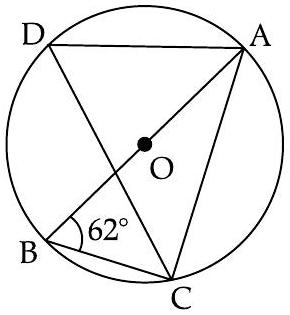
(a) \(\angle \mathrm{ADC}\)
(b) ∠CAB [2]
(a) Given, \(\angle \mathrm{ABC}=62^{\circ}\)
(∵ Angles in the same segment are equal)
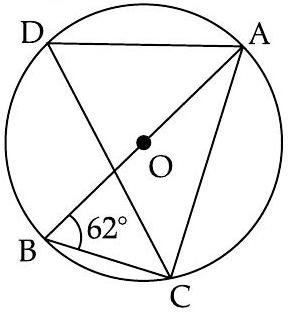
(b) In \(\triangle \mathrm{ABC}\),
(∵ Angles in a semicircle is a right angle) Now,
(Angle sum property)
Find the equation of a line parallel to the line \(2 \boldsymbol{x}+\boldsymbol{y}-\mathbf{7}=\mathbf{0}\) and passing through the intersection of the lines \(\boldsymbol{x}+\boldsymbol{y}-\mathbf{4}=\mathbf{0}\) and \(\mathbf{2} \boldsymbol{x}\) \(-y=8\). [3]
Given,
and
On solving above two equations we get the intersection points as (4, 0). Now, equation of line parallel to \(2 \mathrm{x}+\mathrm{y}-7=\) 0 is given by
which is passing through \((4,0)\) So,
So,the required equation of the line is 2x + y \(=8\) or,
Marks obtained by 40 students in an examination are given below.
| Marks | 10-20 | 20-30 | 30-40 | 40-50 | 50-60 | 60-70 |
|---|---|---|---|---|---|---|
| No of students | 3 | 8 | 14 | 9 | 4 | 2 |
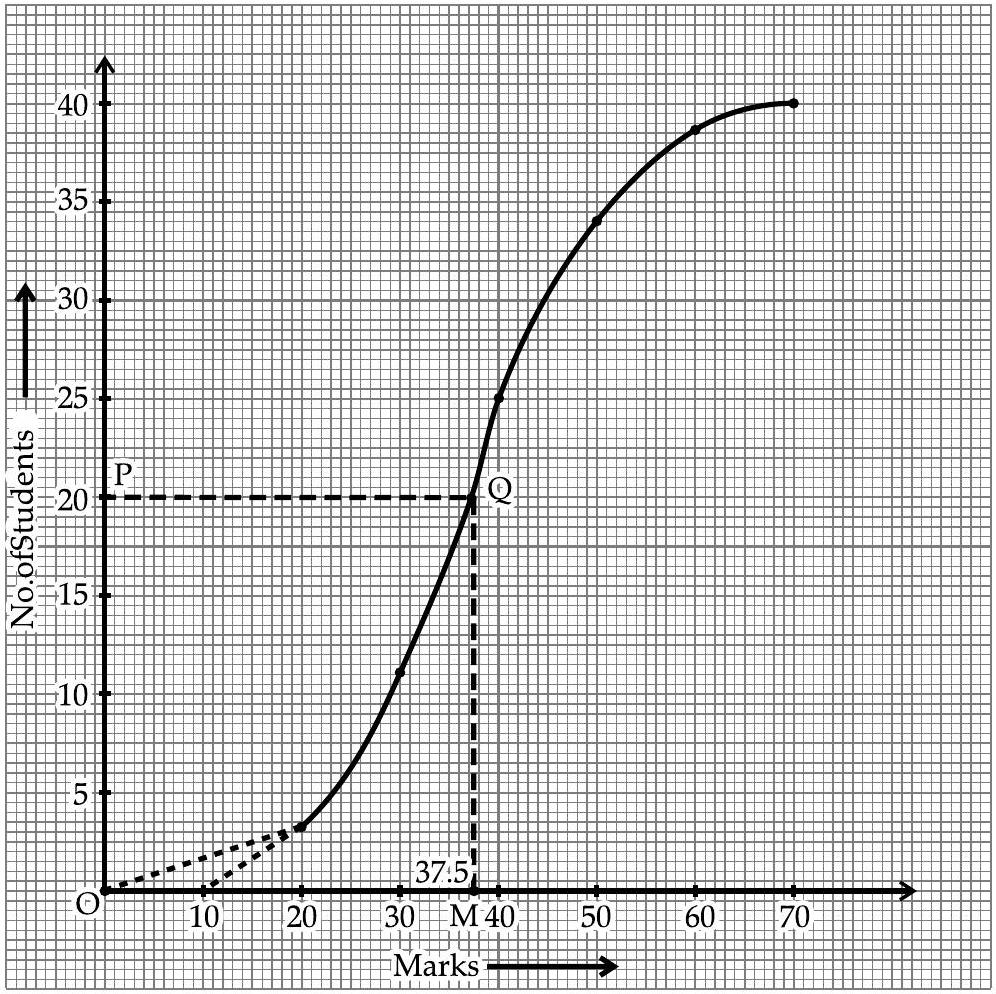
Using graph paper draw an ogive and estimate the median marks. Take \(\mathbf{2 ~ c m}=\mathbf{1 0}\) marks along one axis and \(\mathbf{2 c m}=\mathbf{5}\) students along the other axis. [3]
| Marks | No. of students | Marks less than | Cumulative frequency |
|---|---|---|---|
| 10-20 | 3 | 20 | 3 |
| 20-30 | 8 | 30 | 11 |
| 30-40 | 14 | 40 | 25 |
| 40-50 | 9 | 50 | 34 |
| 50-60 | 4 | 60 | 38 |
| 60-70 | 2 | 70 | 40 |
Other than the given class intervals, we assume a class interval 0-10 prior the first class with zero frequency. Now, plot the points (10, 0), (20, 3), (30, 11), (40, 25), (50, 34), (60, 38), \((70,40)\) on the graph paper. In order to obtain ogive, we draw a smooth curve passing through these points. In order to find the median, we first locate the point \(\frac{\mathrm{N}}{2}=\frac{40}{2}=20\) on Y-axis. Let the point P from this draw a line parallel to X-axis cutting the curve at Q. From Q draw a line parallel to \(Y\)-axis meeting the X-axis at point M. The coordinate of M is 37.5. Hence, the median is 37.5. Now, plot the points (10, 0), (20, 3), (30, 11), (40, 25), (50, 34), (60, 38), \((70,40)\) on the graph paper. In order to obtain ogive, we draw a smooth curve passing through these, points.