

Last Updated on November 13, 2026 by sanjjeett
Practice the complete ICSE Class 10 Mathematics 2022 Semester 1 Question Paper with Solutions. This 40-mark objective paper includes algebra, commercial mathematics, matrices, arithmetic progression, similarity, recurring deposits and linear inequations with expandable explanations for focused board-exam revision.
All questions are compulsory.
The marks intended for questions are given in brackets [ ].
Select the correct option for each of the following questions.
ICSE Mathematics 2022 Semester 1 Questions with Solutions
If \((\boldsymbol{x}+\mathbf{2})\) is a factor of the polynomial \(\boldsymbol{x}^{\mathbf{3}}-\boldsymbol{k} \boldsymbol{x}^{\mathbf{2}}-\mathbf{5} \boldsymbol{x}\) + 6 then the value of \(\boldsymbol{k}\) is [1]
Ans. Option (b) is correct.
Explanation:
Remainder \(=p(-2)=0\)
The solution set of the inequation \(\boldsymbol{x}-\mathbf{3} \geq-\mathbf{5}, \boldsymbol{x} \in \boldsymbol{R}\) is [1]
Ans. Option (c) is correct.
Explanation: \(x-3 \geq-5\)
The product \(\boldsymbol{A} \boldsymbol{B}\) of two matrices \(\boldsymbol{A}\) and \(\boldsymbol{B}\) is possible if [1]
Ans. Option (b) is correct.
Explanation: The product of \(A B\) of two matrices \(A\) and \(B\) is possible if the number of column in \(A\) is equal to the number of rows in \(B\).
If 70, 75, 80, 85 are the first four terms of an Arithmetic Progression, then the \(\mathbf{1 0}^{\text {th }}\) term is [1]
Ans. Option (c) is correct.
Explanation: \(a=70, d=75-70=5\)
The selling price of a shirt excluding GST is ₹ 800. If the rate of GST is 12% then the total price of the shirt is [1]
Ans. Option (c) is correct.
Explanation: \(\mathrm{SP}=\text{₹} 800, \mathrm{GST}=12 \%\)
Which of the following quadratic equations has 2 and 3 as its roots? [1]
Ans. Option (a) is correct.
Explanation: \(\because \quad x^{2}-(\) sum of roots \() x-(\) product of roots \()=0\)
If \(\boldsymbol{x}\), 5.4, 5, 9 are in proportion then \(\boldsymbol{x}\) is [1]
Ans. Option (a) is correct.
Explanation: Numbers are in proportion (given)
Mohit opened a Recurring deposit account in a bank for 2 years. He deposits ₹1000 every month and receives ₹25500 on maturity. The interest he earned in 2 years is [1]
Ans. Option (d) is correct.
Explanation:
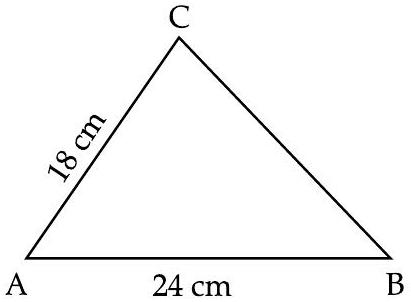
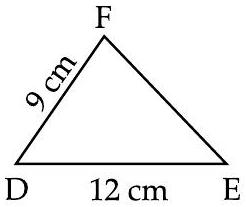
In the given figure \(\boldsymbol{A} \boldsymbol{B}=\mathbf{2 4 ~ c m}, \boldsymbol{A} \boldsymbol{C}=\mathbf{1 8 ~ c m}\), \(\boldsymbol{D E}=\mathbf{1 2 ~ c m}, \boldsymbol{D F}=\mathbf{9 ~ c m}\) and \(\angle \boldsymbol{B} A C=\angle E D F\). Then \(\triangle A B C \sim \triangle D E F\) by the condition [1]
Ans. Option (b) is correct.
Explanation: In \(\triangle D E F\) \& \(\triangle A B C\),
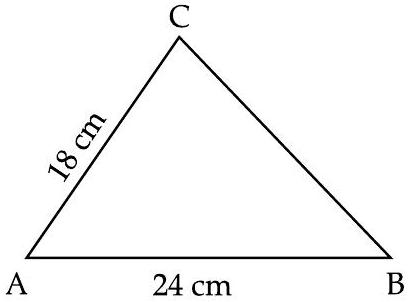
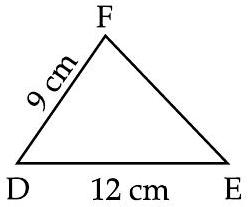
Hence, \(\triangle A B C \sim \triangle D E F\) (by SAS criterion)
If \(\boldsymbol{A}=\left[\begin{array}{cc}5 & 10 \\ 3 & -4\end{array}\right]\) and \(\boldsymbol{I}=\left[\begin{array}{ll}1 & 0 \\ 0 & 1\end{array}\right]\) then \(\boldsymbol{A} \boldsymbol{I}\) is equal to [1]
Ans. Option (c) is correct.
Explanation: \(A \times I=A\)
The polynomial \(\boldsymbol{x}^{\mathbf{3}}-\mathbf{2} \boldsymbol{x}^{\mathbf{2}}+\boldsymbol{a} \boldsymbol{x}+\mathbf{1 2}\) when divided by \((x+1)\) leaves, remainder 20, then ‘ \(a\) ‘ is equal to [1]
Ans. Option (d) is correct.
Explanation:
Remainder \(=p(-1)\) Let
Now, \(p(-1)=20\)
In an Arithmetic Progression (A.P.) if first term is 5, common difference is – 3 and the \(\boldsymbol{n}^{\text {th }}\) term is – 7, then \(\boldsymbol{n}\) is equal to [1]
Ans. Option (a) is correct.
Explanation: Given, \(a=5, d=-3\) and \(a_{n}=-7\)
In the given figure \(\boldsymbol{P} \boldsymbol{Q}\) is parallel to \(\boldsymbol{T} \boldsymbol{R}\), then by using condition of similarity [1]
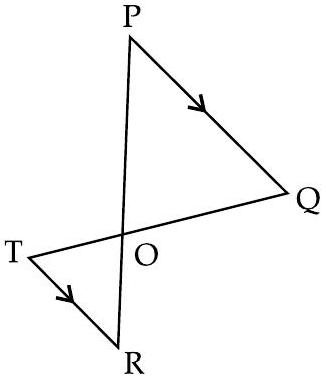
Ans. Option (b) is correct.
Explanation: \(P Q \| T R, P R\) is transversal,
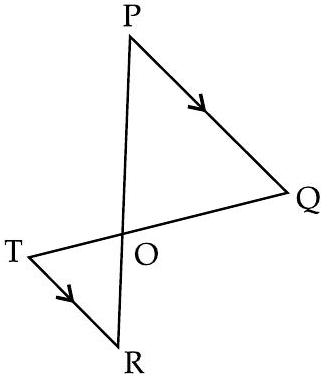
Also, \(Q T\) is transversal,
∴
(by C.P. C.T.)
If \(\boldsymbol{a}, \boldsymbol{b}, \boldsymbol{c}\), and \(\boldsymbol{d}\) are proportional then \(\frac{\boldsymbol{a}+\boldsymbol{b}}{\boldsymbol{a}-\boldsymbol{b}}\) is equal to [1]
Ans. Option (d) is correct.
Explanation: Given,
By compodendo-dividendo
The first four terms of an Arithmetic Progression (A. P.), whose first term is 4 and common difference is -6, are [1]
Ans. Option (c) is correct.
Explanation: \(a=4 ; d=-6\) First four terms of an A.P. are:
One of the roots of the quadratic equation \(\boldsymbol{x}^{\mathbf{2}}\) – \(8 x+5=0\) is 7.3166. The root of the equation correct to 4 significant figures is [1]
Ans. Option (b) is correct.
Explanation: Correct to 4 significant figures is 7.317.
\((x+2)\) and \((x+3)\) are two factors of the polynomial \(\boldsymbol{x}^{\mathbf{3}}+\mathbf{6} \boldsymbol{x}^{\mathbf{2}}+\mathbf{1 1} \boldsymbol{x}+\mathbf{6}\). If this polynomial is completely factorised the result is [2]
Ans. Option (d) is correct.
Explanation: Let
If
then
Now,
Hence, \((x+1)\) is a third factor.
The sum of the first 20 terms of the Arithmetic Progression 2, 4, 6, 8, ____ is [2]
Ans. Option (c) is correct.
Explanation: \(S_{n}=\frac{n}{2}[2 a+(n-1) d]\) Here, \(a=2, d=4-2=2\) and \(n=20\) ∴
The solution set on the number line of the linear inequation [2]




Ans. Option (b) is correct.
Explanation:
and,
So,
If \(\boldsymbol{x}, \boldsymbol{y}, \boldsymbol{z}\) are in continued proportion then \(\left(\boldsymbol{y}^{\mathbf{2}}+\boldsymbol{z}^{\mathbf{2}}\right)\) : \(\left(x^{2}+y^{2}\right)\) is equal to [2]
Ans. Option (a) is correct.
Explanation: \(x, y, z\) are in proportion
∴
i.e.,
The marked price of an article is ₹ 5000. The shopkeeper gives a discount of 10%. If the rate of GST is 12%, then the amount paid by the customer including GST is [2]
Ans. Option (a) is correct.
Explanation:
Total amount paid \(=4500+540=\text{₹} 5040\)
If \(\boldsymbol{A}=\left[\begin{array}{ll}3 & 5 \\ 1 & 4\end{array}\right], \boldsymbol{B}=\left[\begin{array}{ll}2 & 4 \\ 0 & 3\end{array}\right]\) and \(\boldsymbol{C}=\left[\begin{array}{cc}1 & -1 \\ 2 & 1\end{array}\right]\), then \(\mathbf{5} \boldsymbol{A}-\boldsymbol{B} \boldsymbol{C}\) is equal to [2]
Ans. Option (d) is correct.
Explanation:
In the given figure \(A B C D\) is a trapezium in which \(D C\) is parallel to \(A B\). \(A B=\mathbf{1 6 ~ c m}\) and \(D C=\mathbf{8 ~ c m}, O D=\mathbf{5 ~ c m}\), \(O B=(\boldsymbol{y}+\mathbf{3}) \mathbf{~ c m}, \boldsymbol{O} \boldsymbol{A}=\mathbf{1 1 ~ c m}\) and \(O C=(\boldsymbol{x}-\mathbf{1}) \mathbf{c m}\). Using the given information answer the following questions.
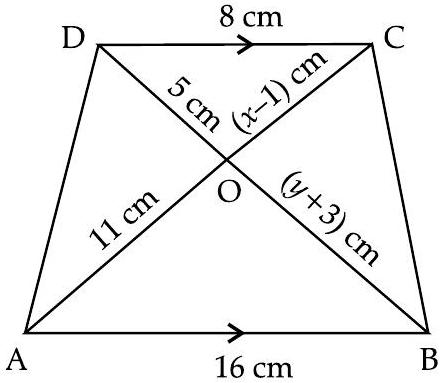
From the given figure name the pair of similar triangles [1]

Option (b) is correct.
Explanation: \(D C \| A B\) (given)
The corresponding proportional sides with respect to the pair of similar triangles obtained in (i) [1]
Option (a) is correct.
Explanation:
∴
The ratio of the sides of the pair of similar triangles is [1]
Option (b) is correct.
Explanation:
Using the ratio of sides of the pair of similar triangles the values of \(\boldsymbol{x}\) and \(\boldsymbol{y}\) are respectively [1]
Option (c) is correct.
Explanation: Here, \(\frac{x-1}{11}=\frac{5}{y+3}=\frac{1}{2}\)
Two cars X and Y use 1 litre of diesel to travel \(\boldsymbol{x} \mathbf{~ k m}\) and \((\boldsymbol{x}+\mathbf{3}) \mathbf{k m}\) respectively. If both the cars covered a distance of 72 km, then:
The number of litres of diesel used by car X is [1]
Option (c) is correct.
Explanation:
The number of litres of diesel used by car Y is [1]
Option (b) is correct.
Explanation:
If car X used 4 litres of diesel more than car Y in the journey, then [1]
Option (c) is correct.
Explanation: Since, given car X used 4 litres of diesel more than car Y. Therefore,
The amount of diesel used by the car X is [1]
Option (b) is correct.
Explanation: We have, \(\frac{72}{x}-\frac{72}{x+3}=4\)
∴ Amount of diesel used by car X is \(\frac{72}{6}=12\) litres
Joseph has a recurring deposit account in a bank for two years at the rate of 8%per annum simple interest.
If at the time of maturity Joseph receives ₹ 2000 as interest then the monthly installment is [1]
Option (c) is correct.
Explanation: Given, \(R=8 \% ; I=\text{₹} 2000, n=24\)
The total amount deposited in the bank [1]
Option (b) is correct.
The amount Joseph receives on maturity is [1]
Option (c) is correct.
Explanation:
If the monthly installment is ₹ 100 and the rate of interest is 8%, in how many months Joseph will receive ₹ 52 as interest? [1]
Option (c) is correct.
Explanation: \(R=8 \% ; I=\text{₹} 52, P=\text{₹} 100\)