

Last Updated on November 12, 2026 by sanjjeett
Practice the complete ICSE Class 10 Physics 2019 Question Paper with Solutions, including numericals, diagrams and detailed answers from Sections I and II. Use this solved paper to revise important concepts, practise board-style questions and strengthen your exam preparation.
Section I is compulsory. Attempt any four questions from Section II.
The intended marks for questions or parts of questions are given in brackets [ ].
SECTION I
The diagram below shows a claw hammer used to remove a nail: (i) To which class of lever does it belong?
(ii) Give one more example of the same class of lever mentioned by you in (i) for which the mechanical advantage is greater than one. [2]
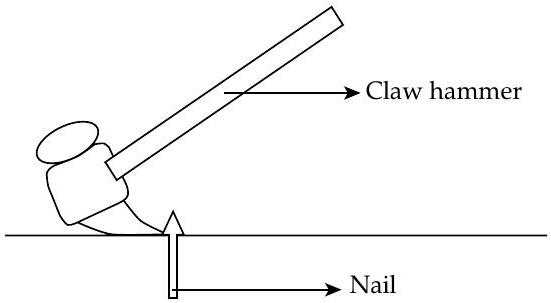
Ans. (i) This claw hammer and nail arrangement belongs to first class of lever. Here, the fulcrum (hammer rests at this point) is closer to the output force than to the input force (force applied by the user).
(ii) Example of class 1 lever where mechanical advantage is greater than one is bottle opener. A small force applied on the bottle opener, exerts a larger force on the cap.
Two bodies A and B have masses in the ratio 5:1 and their kinetic energies are in the ratio 125:9. Find the ratio of their velocities. [2]
Ans. (b) Given, ratio of masses of bodies \(m_{A}: m_{B}=5: 1\) Ratio of their kinetic energies, \(K_{A}: K_{B}=125: 9\) The formula for kinetic energy \(K=\frac{1}{2} m v^{2}\) Using the formula for bodies A snd B, we get
Dividing \(\mathrm{K}_{\mathrm{A}}\) by \(\mathrm{K}_{\mathrm{B}}\), we get
Now using the data given above, we get
Thus the ratio of velocities \(\mathrm{v}_{\mathrm{A}}: \mathrm{v}_{\mathrm{B}}=5: 3\).
(i) Name the physical quantity which is measured in calories. (ii) How is calorie related to the S.I unit of that quantity? [2]
Ans. (i) Heat energy is measured in calories.
(ii) S.I unit of the quality is Joule and the relation between them is
(i) Define couple. (ii) State the S.I. unit of moment of couple. [2]
Ans. (i) Couple: Couple is the set of two equal and opposite forces having different line of action. A couple produces rotation without translation. Forces are separated by a distance.
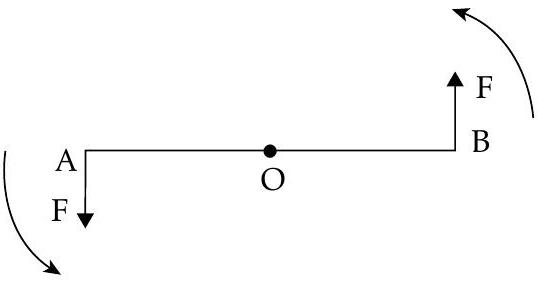
(ii) S.I unit of the moment of couple is Newton meter (Nm).
(i) Define critical angle. (ii) State one important factor which affects the critical angle of a given medium. [2]
Ans. (i) Critical Angle: When the angle of incidence of a light ray in a denser medium is such that the angle of refraction becomes 90°, the angle of incidence is called the critical angle. The basic condition for this is to occur light to be incident from denser to rarer medium.
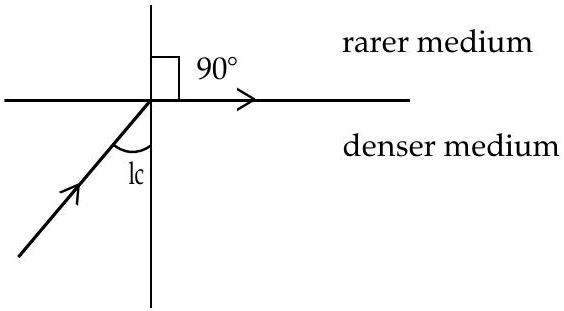
(ii) Important factor which affects the critical angle is the ratio of the refraction indices of the two media.
An electromagnetic radiation is used for photography in fog. (i) Identify the radiation.
(ii) Why is this radiation mentioned by you, ideal for this purpose? [2]
Ans. (i) Radiation used for photography in fog is infrared radiation.
(ii) Infra-red radiation is a long wavelength and low frequency radiation. Hence, the energy associated with them is also low, so they can penetrate deep into the fog.
(i) What is the relation between the refractive index of water with respect to air \(\left({ }_{\mathbf{a}} \mu_{\mathbf{w}}\right)\) and the refractive index of air with respect to water ( \({ }_{\mathrm{w}} \mu_{\mathrm{a}}\) ). (ii) If the refractive index of water with respect to air \(\left({ }_{\mathbf{a}} \mu_{\mathbf{w}}\right)\) is \(\frac{5}{3}\). Calculate the refractive index of air with respect to water \(\left({ }_{\mathbf{w}} \boldsymbol{\mu}_{\mathbf{a}}\right)\). [2]
Ans. (i)
(ii) Given, refractive index of water, with respect to air \({ }_{\mathrm{a}} \mu_{\mathrm{w}}=\frac{5}{3}\)
∴ refractive index of air with respect to water
The specific heat capacity of a substance A is \(\mathbf{3 , 8 0 0} \mathbf{J ~ k g}^{\boldsymbol{-} \mathbf{1}} \mathbf{K}^{\boldsymbol{-} \mathbf{1}}\) and that of a substance B is \(400 \mathrm{~J} \mathrm{~kg}^{-\mathbf{1}} \mathrm{K}^{1}\). Which of the two substances is a good conductor of heat? Give a reason for your answer. [2]
Ans. From definition, specific heat capacity of a substance is defined as the amount of heat that raises the temperature of 1 kg substance through 1K. Given specific heat capacity of substance A \(=3800 \mathrm{~J} \mathrm{~kg}^{-1} \mathrm{~K}^{-1}\) and specific heat capacity of substance \(\mathrm{B}=400 \mathrm{~J} \mathrm{~kg}^{-1} \mathrm{~K}^{-1}\). Thus, the amount of heat required to raise the temperature of substance A is much more than that required for substance B. The substance B is a good conductor of heat.
A man playing a flute is able to produce notes of different frequencies. If he closes the holes near his mouth, will the pitch of the note produced, increase or decrease? Give a reason. [2]
Ans. When a flute is played, the pitch of the note is determined by the length of tube between the mouthpiece and the first open hole. Opening holes to shorten the tube makes the pitch rise, and closing holes to lengthen the tube makes the pitch fall.
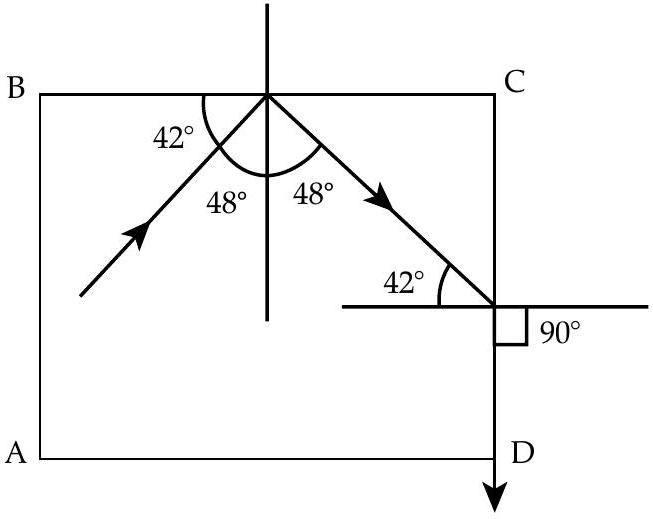
The diagram below shows a light source P embedded in a rectangular glass block ABCD of critical angle 42°. Complete the path of the ray PQ till it emerges out of the block. [Write necessary angles.] [2]
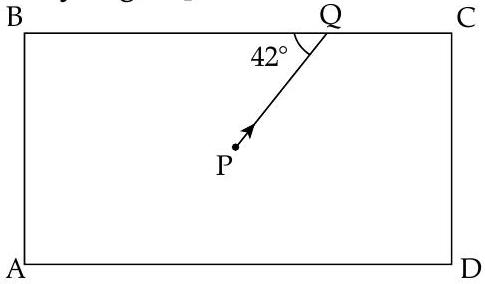
Ans. Incidence angle is the angle that incident ray make with the normal to the surface.
(i) If the lens is placed in water instead of air, how does its focal length change? (ii) Which lens, thick or thin has greater focal length? [2]
Ans. (i) Let \(f_{a}\) be the focal length of lens in air and has the refractive index \({ }_{w} \mu_{g}\). Apply lens maker formula,
Let \(f_{w}\) be the focal length of lens in water when emerged in water where in the refractive index is \({ }_{w} \mu_{g}\)
From equation (i) and (ii)
Since, \(\left({ }_{a} \mu_{g}-1\right)>\left({ }_{w} \mu_{g}-1\right)\) So, \(f_{w}>f_{a}\) Hence , the focal length will be more in water than in air.
(ii) Thin lens has greater focal length.
Two waves of the same pitch have amplitudes in the ratio 1:3. What will be the ratio of their: (i) intensities and
(ii) frequencies? [2]
Ans. (i) The amplitude ratio of two waves
As intensity I:A \({ }^{2}\)
\(\therefore \quad I_{1}: I_{2}=1: 9\)
(ii) Ratio of frequencies \(=1: 1\)
How does an increase in the temperature affect the specific resistance of a: (i) Metal and
(ii) Semiconductor? [2]
Ans. With the increase in temperature, the specific resistance
(i) of metals increases.
(ii) of semiconductors decreases.
(i) Define resonant vibrations. (ii) Which characteristic of sound, makes it possible to recognize a person by his voice without seeing him? [2]
Ans. (i) Each and every object in universe has its natural frequency. If any external object is made to vibrate at the same frequency of the given object then the amplitude of vibration becomes large and the system is said to be in resonance. These are known as resonant vibrations and the frequency is called resonant frequency.
(ii) Frequency makes it possible for us to recognise a person by his voice without seeing him.
Is it possible for a hydrogen \(\left(\begin{array}{l}1 \\ 1\end{array} \mathrm{H}\right)\) nucleus to emit an alpha particle? Give a reason for your answer. [2]
Ans. Since, \(\alpha\)-particles has \({ }_{2} \mathrm{He}^{4}\) nuclei. Thus the \(\alpha\)-particles contain two protons and two neutrons. Hence, emission of \(\alpha\)-particle reduces the atomic number by two and atomic weight by four. Thus, \(\left({ }_{1}^{1} \mathrm{H}\right)\) hydrogen nucleus cannot emit an \(\alpha\)-particle
Calculate the effective resistance across AB: [2]
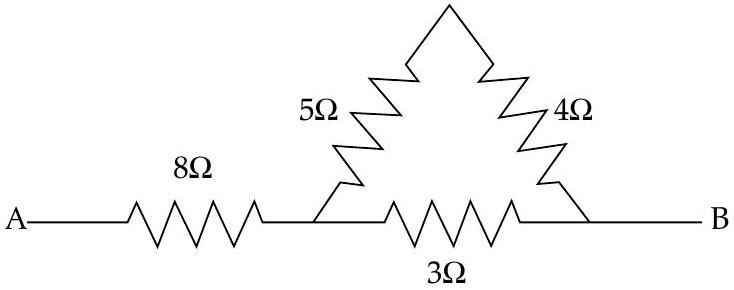
Ans. Equivalent network
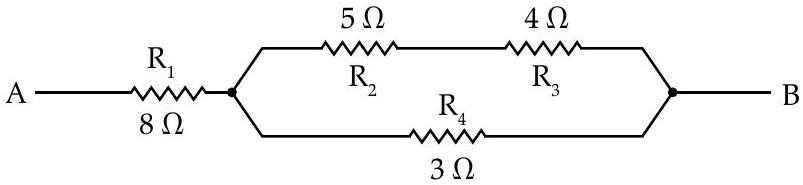
Since, \(R_{2}\) and \(R_{3}\) are in series, sot their equivalent resistance \(R_{23}=R_{2}+R_{3}\)
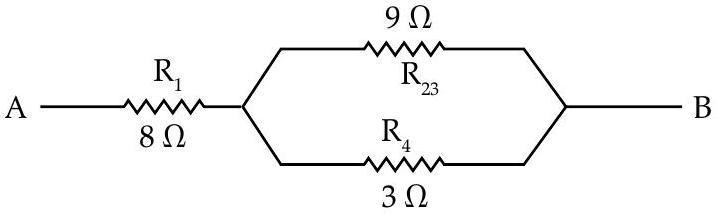
Again \(R_{2,3} \| R_{4}\), so their equivalent resistance \(R^{\prime}\)
or
Finally \(R_{1}\) and \(R^{\prime}\) are in series.

So, their equivalent resistance \(R\) in given as
(i) State whether the specific heat capacity of a substance remains the same when its state changes from solid to liquid. (ii) Give one example to support your answer. [2]
Ans. (i) Specific heat capacity of a substance changes when its state changes from solid to liquid.
(ii) Specific heat capacity tells you how much energy one must put in per unit mass in order to
raise temperature by 1°C. When you come out of shower you often feel cold. This is because the water on you is evaporating, for this heat flows from your body to the body droplets in order to change their phase from water to gas. You are losing heat and thus feel cold.
A magnet kept at the centre of two coils A and B is moved to and fro as shown in the diagram. The two galvanometers show deflection.
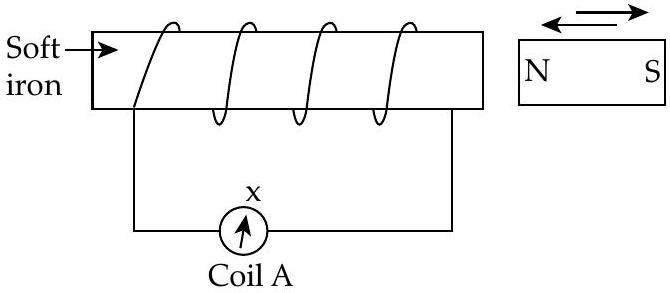
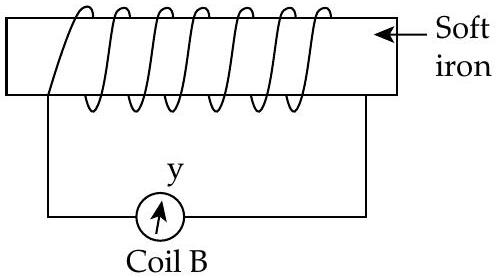
State with a reason whether: \(x>y\) or \(x
Ans. \(x
(i) Why is a nuclear fusion reaction called a thermo nuclear reaction? (ii) Complete the reaction: [2]
Ans. (i) In nuclear fusion reaction, the fusion of two light atomic nuclei into a single heavier nuclei by the collision of two interacting particles at extremely high temperatures, with the consequent release of a relatively large amount of energy which defines the thermo nuclear reaction.
(ii) \({ }^{3} \mathrm{He}_{2}+{ }^{2} \mathrm{H}_{1} \rightarrow{ }^{4} \mathrm{He}_{2}+{ }^{1} \mathrm{H}_{1}+\) energy
State two ways to increase the speed of rotation of a D.C. motor. [2]
Ans. Speed of D.C. motor can be increased by
1. varying the flux and by varying the current through field winding.
2. varying supply voltage.
SECTION II
A body of mass 10 Kg is kept at a height of 5 m. It is allowed to fall and reach the ground. (i) What is the total mechanical energy possessed by the body at the height of 2 m assuming it is a frictionless medium?
(ii) What is the kinetic energy possessed by the body just before hitting the ground? Take g = \(\mathbf{1 0 ~ m} / \mathbf{s}^{\mathbf{2}}\). [3]
Ans. (i) Total mechanical energy (M.E.) of the body is conserved that is constant throughout to fall the given height.
Since, the mechanical energy is constant at every point. Hence, the mechanical energy at height 2 m will be \((M E)_{\mathrm{B}}=500 \mathrm{~J}\)
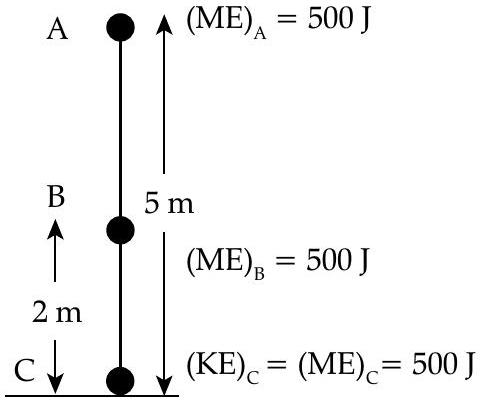
(ii) Just before hitting the ground, its kinetic energy will be maximum and potential energy will be zero.
\(\therefore K . E .=500 \mathrm{~J}\). (as whole of its P.E. has been converted into K.E.)
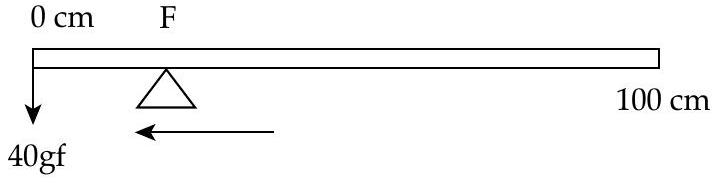
A uniform meter scale is in equilibrium as shown in the diagram:

(i) Calculate the weight of the meter scale.
(ii) Which of the following options is correct to keep the ruler in equilibrium when 40 gf wt is shifted to \(\mathbf{0 ~ c m}\) mark? F is shifted towards 0 cm. or F is shifted towards 100 cm. [3]
Ans. (i)
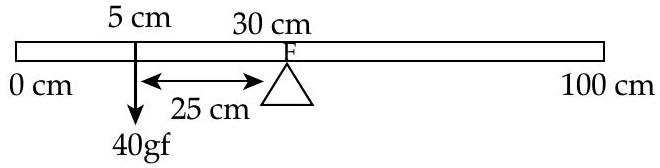
The sum of the moments of the masses is always zero about the centre of mass. Let weight of the rode be \(m g f\)
or \(m \times 40=40 \times 25 \Rightarrow m=25 g f\) ∴ mass of rod = 25gf
(ii) If 40gf wt is shifted towards 0 mark
F is shifted towards 0 mark to make the system in equilibrium.
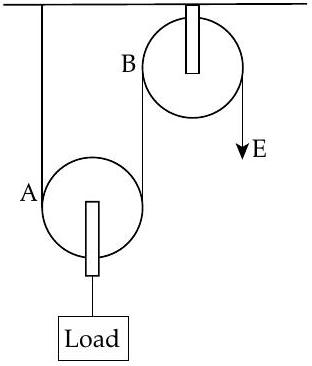
The diagram below shows a pulley arrangement: (i) Copy the diagram and mark the direction of tension on each strand of the string.
(ii) What is the velocity ratio of the arrangement?
(iii) If the tension acting on the string is T, then what is the relationship between . T and effort E?
(iv) If the free end of the string moves through a distance x, find the distance by which the load is raised. [4]
Ans. (i) \(T=\) tension force by which rope affects \(E\) \(T^{\prime}=T^{\prime \prime}=\) tension forces by which rope affects the load W
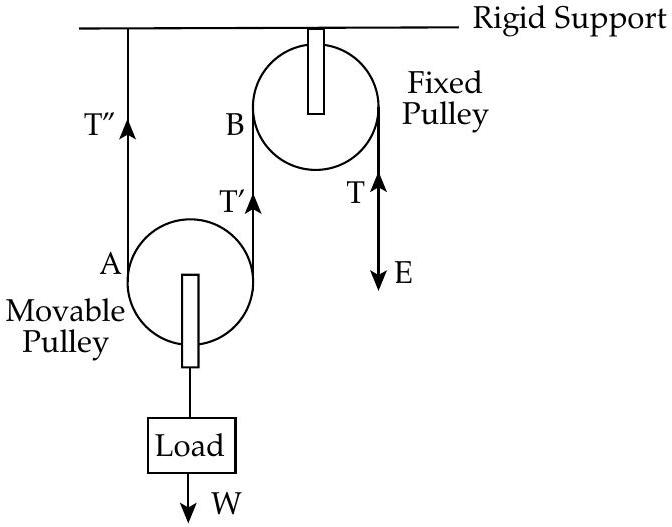
(ii) Velocity ratio of this pulley system is 2.
(iii) If the load is not moving, in that case \(T=E\).
(iv) If the free end of rope moves by a distance \(x\), Load moves by a distance \(=\frac{\text { Effort arm }}{\text { MA }}=\frac{x}{2}\)
How does the angle of deviation formed by a prism change with the increase in the angle of incidence? Draw a graph showing the variation in the angle of deviation with the angle of incidence at a prism surface. [3]
Ans. \(i=\) angle of incidence \(\delta=\) angle of deviation As the angle of incidence is increased, the angle of deviation also increases.
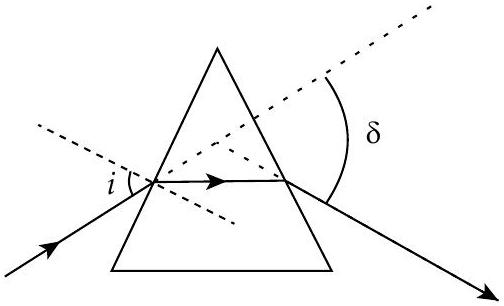
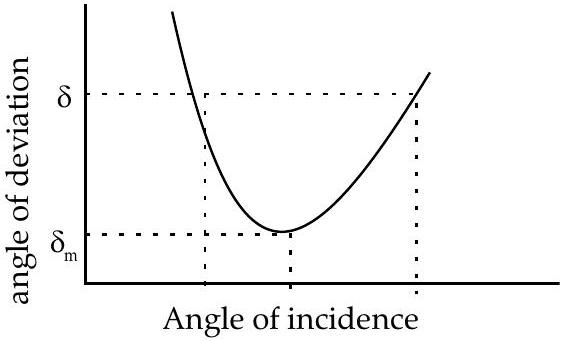
\(\delta_{m}=\) angle of minimum deviation
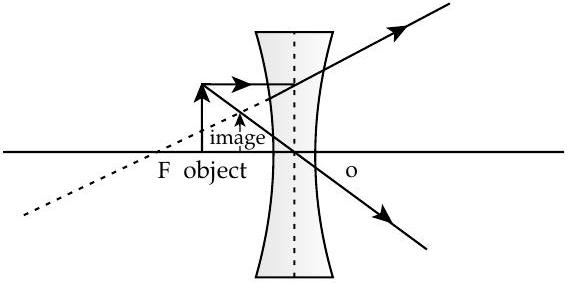
A virtual, diminished image is formed when an Object is placed between the optical centre and the principal focus of a lens. (i) Name the type of lens which forms the above image.
(ii) Draw a ray diagram to show the formation of the image with the above stated characteristics. [3]
Ans. (i) This type of image formation takes place due to concave lens. (ii)
An object is placed at a distance 24 cm in front of a convex lens of focal length 8 cm. (i) What is the nature of the image so formed?
(ii) Calculate the distance of the image from the lens.
(iii) Calculate the magnification of the image. [4]
Ans. Given, object distance \(\boldsymbol{u}=\mathbf{- 2 4 ~ c m}\) focal length, \(f=8 \mathrm{~cm}\)
(i) Since, \(u>f\), hence nature of image so formed, will be (i) real, (ii) inverted (iii) diminished
(ii) To find image distance \(v=\) ?
Using lens formula,
or \(\frac{1}{v}=\frac{1}{8}-\frac{1}{24}=\frac{3-1}{24}=\frac{2}{24}=\frac{1}{2}\) or \(v=12 \mathrm{~cm}\)
(iii) magnification, \(m=\frac{v}{u}=\frac{12 \mathrm{~cm}}{-24 \mathrm{~cm}}=-0.5\) negative sign indicates, inverted image.
It is observed that during march-past we hear a base drum distinctly from a distance compared to the side drums. (i) Name the characteristic of sound associated with the above observation.
(ii) Give a reason for the above observation. [3]
Ans. (i) It is the pitch (or frequency) of sound which makes us listen to base drum distinctly from a distance.
(ii) The base drums have greater amplitude of vibration, so the intensity of sound is high, so it becomes audible at larger distance and its frequency distinguishes it from side drums.
A pendulum has a frequency of 4 vibrations per second. An observer starts the pendulum and fires a gun simultaneously. He hears the echo from the cliff after 6 vibrations of the pendulum. If the velocity of sound in air is 340 m/s, find the distance between the cliff and the observer. [3]
Ans. Frequency of pendulum \(=4\) vibrations per second ∴ Time elapsed in 4 vibration \(=1 \mathrm{~s}\) ∴ Time elapsed after 6 vibrations \(=\frac{1}{4} \times 6=\frac{3}{2} \mathrm{~s}\) This means observer hears the echo after 1.5 s. Given speed of sound \(=340 \mathrm{~m} / \mathrm{s}\). ∴ Distance between cliff and the observer
Two pendulums C and D are suspended from a wire as shown in the figure given below. Pendulum C is made to oscillate by displacing it from its mean Position. It is seen that D also starts oscillating.
(i) Name the type of oscillation, C will execute.
(ii) Name the type of oscillation, D will execute.
(iii) If the length of D is made equal to C then what difference will you notice in the oscillations of D?
(iv) What is the name of the phenomenon when the length of D is made equal to C? [4]
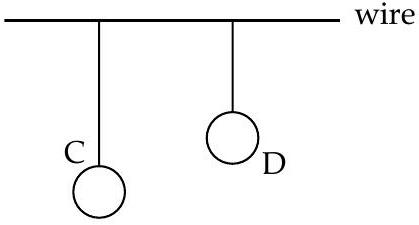
Ans. (i) Pendulum C executes simple harmonic oscillations.
(ii) Pendulum D will also execute force vibrations in phase with first one.
(iii) When the length of pendulum D is increased the oscillations of D will increase.
(iv) Resonance.
(i) Write one advantage of connecting electrical appliances in parallel combination. (ii) What characteristics should a fuse wire have?
(iii) Which wire in a power circuit is connected to the metallic body of the appliance? [3]
Ans. (i) If one of the devices in parallel combination fuses then the other devices keep working without being affected.
(ii) Characteristics of a fuse wire are:
(1) it should have low melting point,
(2) high conductivity
(3) low resistance
(iii) Earth wire is connected to the metallic body of the appliances in a power circuit.
The diagram below shows a dual control switch circuit connected to a bulb. (i) Copy the diagram and complete it so that the bulb is switched ON.
(ii) Out of A & B which one is the live wire and which one is the neutral wire? [3]
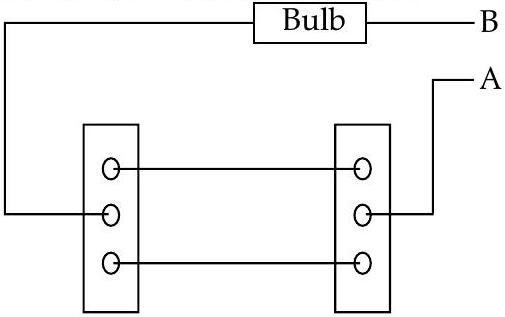
Ans. (i)
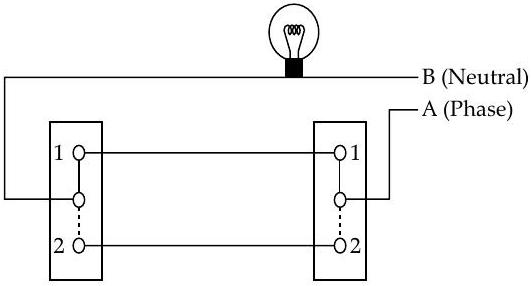
(ii) B is neutral and A is live
The diagram above shows a circuit with the key k open. Calculate:
(i) the resistance of the circuit when the key k is open.
(ii) the current drawn from the cell when the key k is open.
(iii) the resistance of the circuit when the key k is closed.
(iv) the current drawn from the cell when the key k is closed. [4]
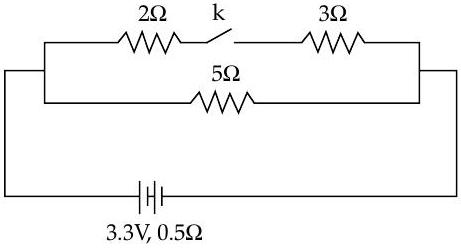
Ans. (i) When the key k is open resistance of circuit, \(R=(5+0.5)=5.5 \Omega\)
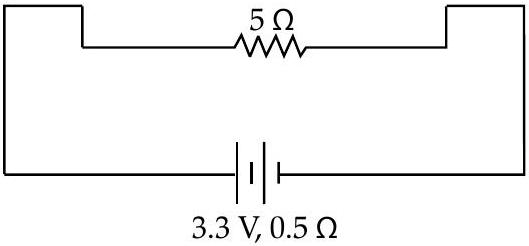
(ii) Current drawn from the cell when the key k is open is
(iii) When the key k is closed, then \(2 \Omega\) and \(3 \Omega\) will be in series and further their equivalent will be in parallel to \(5 \Omega\) as shown in diagram.
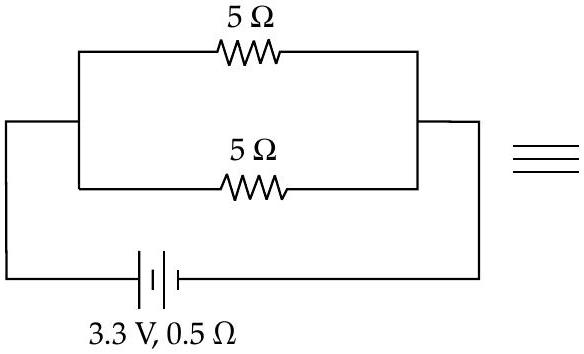
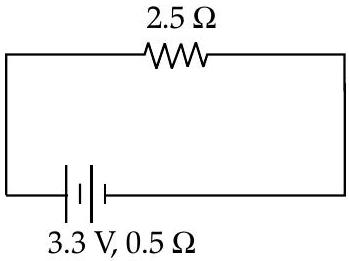
∴ resistance of circuit, \(R^{\prime}=2.5+0 . .5=3.0 \Omega\)
(iv) current drawn from the cell,when key is closed , \(I^{\prime}=\frac{E}{R+r}=\frac{3.3}{3}=1.1 A\)
(i) Define Calorimetry. (ii) Name the material used for making a Calorimeter.
(iii) Why is a Calorimeter made up of thin sheets of the above material answered in (ii)? [3]
Ans. (i) Calorimetry is the process of measuring the amount of heat released or absorbed during a chemical reaction.
(ii) Colorimeter is made of copper as it is a good conductor of heat with low specific heat capacity . So small amount of heat is absorbed or liberated during heat exchange.
(iii) Calorimeter is made of thin sheets of copper because it decreases the heat capacity of box, thus ensuring small amount of absorption or release of heat during heat exchange.
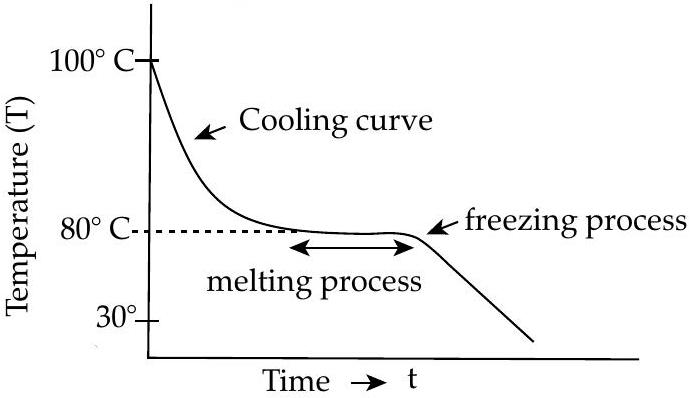
The melting point of naphthalene is 80°C and the room temperature is 30°C. A sample of liquid naphthalene at 100°C is cooled down to the room temperature. Draw a temperature time graph to represent this cooling. In the graph, mark the region which corresponds to the freezing process. [3]
Ans.
104 g of water at 30°C is taken in a calorimeter made of copper of mass 42 g. When a certain mass of ice at 0°C is added to it, the final steady temperature of the mixture after the ice has melted, was found to be 10°C. Find the mass of ice added. [Specific heat capacity of water = \(4.2 \mathrm{~J} \mathrm{~g}^{-\mathbf{1}}{ }^{\circ} \mathbf{C}^{-\mathbf{1}}\); Specific latent heat of fusion of ice \(=336 \mathrm{Jg}^{-\mathbf{1}}\); Specific heat capacity of copper \(=0.4 \mathrm{~J} \mathrm{~g}^{-1}{ }^{\circ} \mathrm{C}^{-1}\) ] [4]
Ans. Here, we will use principle of calorimetry. Heat lost by initial water, calorimeter is equal to the heat absorbed by ‘the added ice. Thus equations becomes
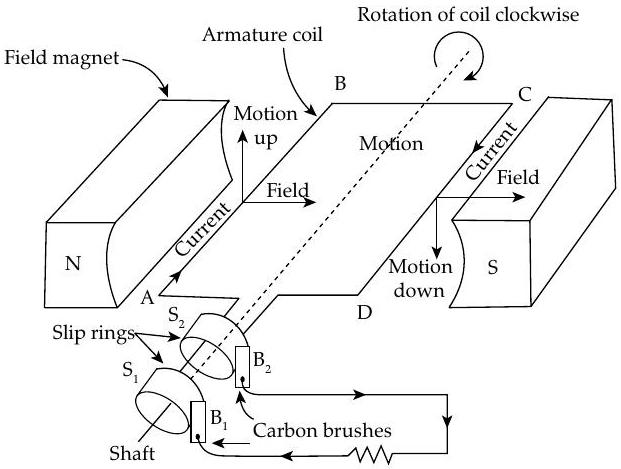
Draw a neat labelled diagram of an A.C. generator. [3]
Ans.
(i) Define nuclear fission. (ii) Rewrite and complete the following nuclear reaction by filling in the atomic number of Ba and mass number of Kr: [3]
Ans. (i) Nuclear fission : It is a type of nuclear reaction in which a heavy nucleus splits up into two lighter nuclei of comparable size. During this reaction tremendous amount of energy is released.
(ii) \({ }_{92}^{235} \mathrm{U}+{ }_{0}^{1} \mathrm{n} \rightarrow{ }_{56}^{144} \mathrm{Ba}+{ }_{36} \mathrm{Kr}^{89}+3{ }_{0}^{1} \mathrm{n}+\) Energy
In the balanced nuclear reaction atomic number should be equal on left and right side So, \(92(\mathrm{U})+0(\mathrm{n})=x(\mathrm{Ba})+36 \mathrm{Kr}+0(\mathrm{n})\)
Similarly, for mass no.
The diagram below shows a magnetic needle kept just below the conductor AB which is kept in North South direction. (i) In which direction will the needle deflect when the key is closed?
(ii) Why is the deflection produced?
(iii) What will be the change in the deflection if the magnetic needle is taken just above the conductor AB?
(iv) Name one device which works on this principle. [4]
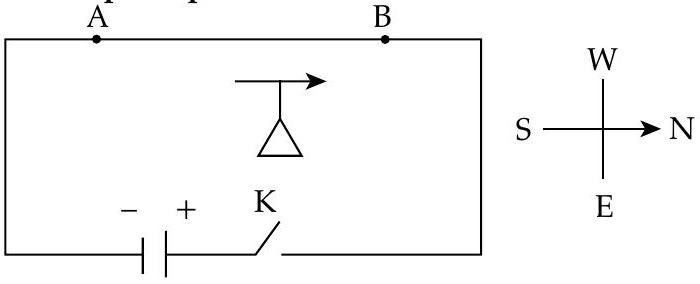
Ans. (i) In first case when a magnetic needle is kept just below the conductor, when the key is closed the current flows from B to A. So, applying Right Hand Thumb Rule just below the conductor, the direction of magnetic field is towards East. So, needle will deflect towards East.
(ii) The deflection is produced due to magnetic field when current is passed through the wire.
(iii) In second case when a magnetic needle is kept just above the conductor, when the key is closed, the current flows from B to A. So, applying Right Hand Thumb Rule just above the conductor, the direction of magnetic field is towards West. So, needle will deflect towards West.
(iv) The device which works on this principle is magnetic sensor, solenoid etc.