
Last Updated on November 13, 2026 by sanjjeett
Practice the complete ICSE Class 10 Mathematics 2023 Question Paper with Solutions, including MCQs, algebra, geometry, trigonometry, statistics, graphs and constructions. Use this solved paper to revise important concepts, practise board-style questions and strengthen your exam preparation.
Attempt all questions from Section A and any four questions from Section B.
All working, including rough work, must be clearly shown, and must be done on the same sheet as the rest of the answer.
Omission of essential working will result in loss of marks.
The intended marks for questions or parts of questions are given in brackets [ ].
Mathematical tables and graph papers are provided.
ICSE Mathematics 2023 — Section A
If \(\left[\begin{array}{ll}2 & 0 \\ 0 & 4\end{array}\right]\left[\begin{array}{l}x \\ y\end{array}\right]=\left[\begin{array}{c}2 \\ -8\end{array}\right]\), the value of \(\boldsymbol{x}\) and \(\boldsymbol{y}\) respectively are: [1]
Option (a) is correct.
Explanation: \(\left[\begin{array}{ll}2 & 0 \\ 0 & 4\end{array}\right]\left[\begin{array}{c}x \\ y\end{array}\right]=\left[\begin{array}{c}2 \\ -8\end{array}\right]\)
If \(\boldsymbol{x}-\mathbf{2}\) is a factor of \(\boldsymbol{x}^{\mathbf{3}}-\boldsymbol{k} \boldsymbol{x}-\mathbf{1 2}\), then the value of \(\boldsymbol{k}\) is: [1]
Option (c) is correct.
Explanation: \((x-2)\) is a factor of \(f(x)\) ∴
In the given diagram RT is a tangent touching the circle at \(\mathbf{S}\). If \(\angle \mathbf{P S T}=\mathbf{3 0}^{\boldsymbol{\circ}}\) and \(\angle \mathbf{S P Q}=\mathbf{6 0}^{\boldsymbol{\circ}}\) then \(\angle \mathrm{PSQ}\) is equal to: [1]
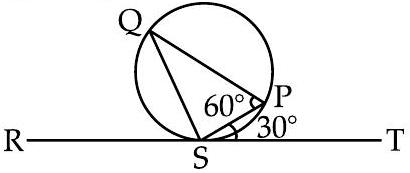
Option (d) is correct.
Explanation:
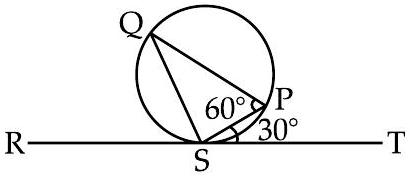
(alternate segment angle) In \(\triangle \mathrm{PSQ}\),
(Sum of all angles of a triangle)
A letter is chosen at random from all the letters of the English alphabets. The probability that the letter chosen is a vowel, is: [1]
Option (b) is correct.
Explanation: Total no. of letters in English alphabets, \(n(\mathrm{~S})=26\) Total no. of vowels in English alphabets, \(n(\mathrm{E})=05\) ∴ Required probability \(\mathrm{P}(\mathrm{E})=\frac{5}{26}\)
If 3 is a root of the quadratic equation \(\boldsymbol{x}^{\mathbf{2}}-\boldsymbol{p} \boldsymbol{x}+\) \(\boldsymbol{3}=\mathbf{0}\) then \(\boldsymbol{p}\) is equal to: [1]
Option (a) is correct.
Explanation: \(f(x)=x^{2}-p x+3=0\) 3 is a root of \(f(x)\) ∴
∴
In the given figure \(\angle \mathbf{B A P}=\angle \mathbf{D C P}=\mathbf{7 0}{ }^{\circ}, \mathbf{P C}=\) \(\mathbf{6 c m}\) and \(\mathbf{C A}=\mathbf{4 c m}\), then PD : DB is: [1]
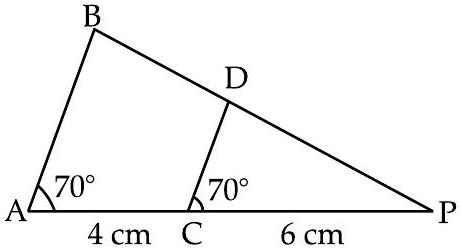
Option (c) is correct.
Explanation:
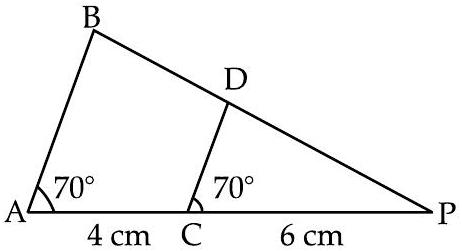
(Given) These are corresponding angles
\(\therefore D C \| B A\)∴
(Basic proportional Theorem)
The printed price of an article is ₹3080. If the rate of GST is 10% then the GST charged is: [1]
Option (b) is correct.
Explanation: G.S.T. \(=\%\) Rate × printed price
Therefore, the GST charged on the article is (rupees symbol) 308.
\((\mathbf{1}+\boldsymbol{\operatorname { s i n }} \mathbf{A})(\mathbf{1}-\sin \mathbf{A})\) is equal to: [1]
Option (d) is correct.
Explanation: \((1+\sin \mathrm{A})(1-\sin \mathrm{A})\)
The coordinates of the vertices of \(\boldsymbol{\triangle} \mathbf{A B C}\) are respectively (-4, -2), \((6,2)\) and \((4,6)\). The centroid G of \(\triangle \mathrm{ABC}\) is: [1]
Option (a) is correct.
Explanation: \(G\left(\frac{x_{1}+x_{2}+x_{3}}{3}, \frac{y_{1}+y_{2}+y_{3}}{3}\right)\)
The \(\mathbf{n}^{\text {th }}\) term an Arithmetic Progression (A.P.) is \(\mathbf{2} \boldsymbol{n}+\mathbf{5}\). The \(\mathbf{1 0}^{\text {th }}\) term is: [1]
Option (c) is correct.
Explanation:
The mean proportional between 4 and 9 is: [1]
Option (b) is correct.
Explanation: Mean proportional \(=\sqrt{4 \times 9}=6\)
Which of the following cannot be determined graphically for a grouped frequency distribution? [1]
Option (d) is correct.
Explanation: Mean is a numerical measure that requires the individual data values, which cannot be determined graphically for a grouped frequency distribution.
Volume of a cylinder of height 3 cm is \(\mathbf{4 8} \pi \mathbf{~ c m}^{\mathbf{3}}\). Radius of the cylinder is: [1]
Option (c) is correct.
Explanation: Vol. of cylinder \(=48 \pi \mathrm{~cm}^{3}\)
Naveen deposits ₹800 every month in a recurring deposit account for 6 months. If he receives ₹4884 at the time of maturity, then the interest he earns is: [1]
Option (a) is correct.
Explanation: Amount = Principle + Interest
∴
The solution set for the inequation \(\mathbf{2} \boldsymbol{x}+\mathbf{4} \leq \mathbf{1 4}\), \(x \varepsilon \mathbf{W}\) is: [1]
Option (b) is correct.
Explanation:
∴ Solution set \(\{0,1,2,3,4,5\}\)
Find the value of ‘ \(\boldsymbol{a}\) ‘ if \(\boldsymbol{x}-\boldsymbol{a}\) is a factor of the polynomial \(3 x^{3}+x^{2}-a x-81\). [4]
\((x-a)\) is a factor of \(p(x)\)
Salman deposits ₹1000 every month in a recurring deposit account for 2 years. If he receives ₹26000 on maturity, find:
(a) the total interest Salman earns.
(b) the rate of interest. [4]
\(\mathrm{P}=\text{₹} 1000, n=2\), years \(=24\) months, \(r=\) rate of interest
…(ii)
(a) Salman earns interest as ₹2000
From (i) and (ii)
∴ (b) rate of interest is 8%
In the given figure O, is the centre of the circle. CE is a tangent to the circle at \(\mathbf{A}\). If \(\angle \mathbf{A B D}=\mathbf{2 6}^{\boldsymbol{\circ}}\), then find:
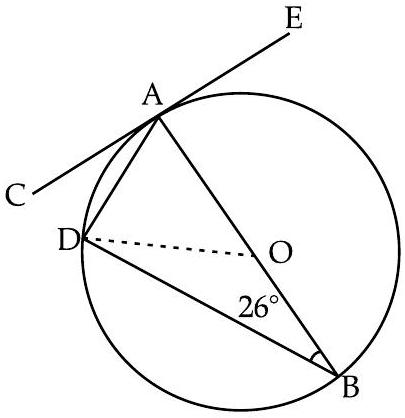
(a) ∠BDA
(b) ∠BAD
(c) ∠CAD
(d) ∠ODB [4]
(a)
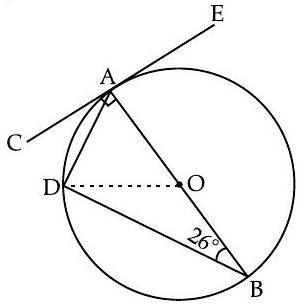
(b) In \(\triangle B A D\)
(Sum of all angles of \(\Delta\) )
(c)
(alternate segment angle) (d)
(Angles opposite to equal sides of a triangle are equal)
Solve the following quadratic equation:
Give your answer correct to one decimal place. (Use mathematical tables if necessary.) [4]
Compare the equation \(a x^{2}+b x+c=0\) ∴
∴ Roots are real and distinct
and
Prove the following identity: [4]
Use graph sheet to answer this question. Take 2 cm \(=1\) unit along both the axes.
(a) Plot A, B, C where A(0, 4), B(1, 1) and C(4, 0)
(b) Reflect A and B on the \(\boldsymbol{x}\)-axis and name them as E and D respectively.
(c) Reflect B through the origin and name if F. Write down the coordinates of F.
(d) Reflect B and C on the \(\boldsymbol{y}\)-axis and name them as H and G respectively.
(e) Join points A, B, C, D, E, F, G, H and A in order and name the closed figure formed. [5]
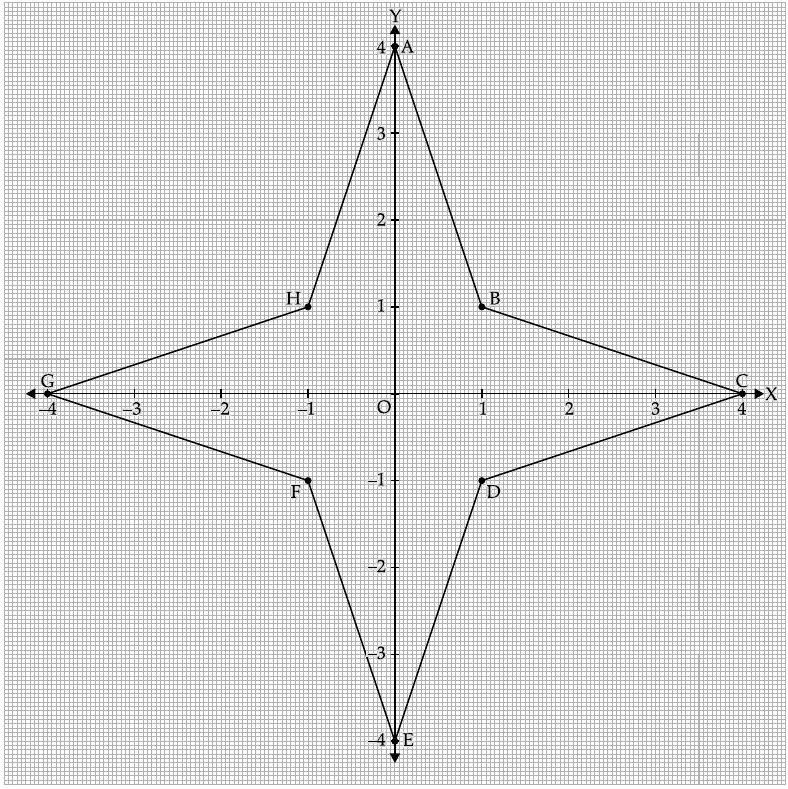
(c) F(-1, -1)
(e) Star
ICSE Mathematics 2023 — Section B
If \(\boldsymbol{A}=\left[\begin{array}{ll}1 & 3 \\ 2 & 4\end{array}\right], \boldsymbol{B}=\left[\begin{array}{ll}1 & 2 \\ 2 & 4\end{array}\right], \boldsymbol{C}=\left[\begin{array}{ll}4 & 1 \\ 1 & 5\end{array}\right]\) and \(\boldsymbol{I}=\) \(\left[\begin{array}{ll}1 & 0 \\ 0 & 1\end{array}\right]\). Find \(\boldsymbol{A}(\boldsymbol{B}+\boldsymbol{C})-\mathbf{1 4} \boldsymbol{I}\) [3]
ABC is a triangle whose vertices are A(1, -1), B(0, 4) and C(-6, 4). D is the midpoint of BC. Find the:
(a) coordinates of D.
(b) equation of the median AD. [3]
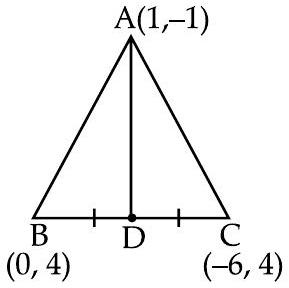
(a)
therefore coordinates of D is (-3, 4)
Equation of the AD
⇒
In the given figure, O is the centre of the circle. PQ is a tangent to the circle at T. Chord AB produced meets the tangent at P.
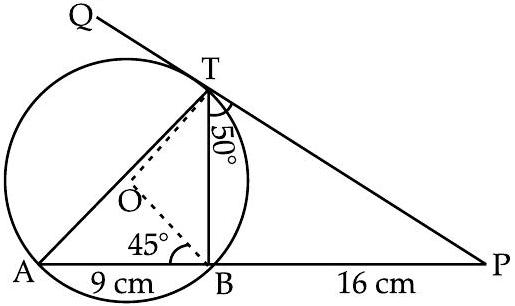
Find:
(a) length of PT
(b) ∠BAT
(c) ∠BOT
(d) ∠ABT [4]
(a)
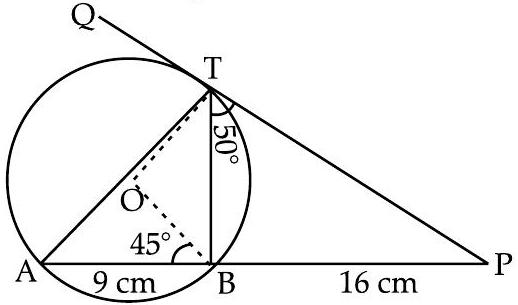
∴
(b)
(alternate segment angle) (c)
(Degree measure theorem)
(d) In \(\triangle \mathrm{OBT}\)
(Sum of all angles of \(\Delta\) )
(angles opposite to equal sides of a triangle are equal)
∴
Mrs. Arora bought the following articles from a departmental store:
| S.No. | Item | Price | Rate of GST | Discount |
|---|---|---|---|---|
| 1. | Hair oil | ₹1200 | 18% | ₹100 |
| 2. | Cashew nuts | ₹600 | 12% | – |
Find the:
(a) Total GST paid.
(b) Total bill amount including GST. [3]
Mrs Arora paid for
1. Hair oil \(\text{₹}(1200-100)=\text{₹} 1100\)
2. Cashew nuts
(a) Total G.S.T. paid \(=\text{₹} 198+72=\text{₹} 270\)
(b) Total Bill Amount including G.S.T.
Solve the following inequation. Write down the solution set and represent it on the real number line. [3]
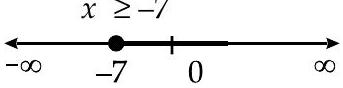
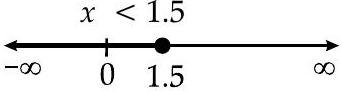
Solution set

In the given figure, AC || DE || BF. If \(\mathbf{A C}=\mathbf{2 4 ~ c m}, \mathbf{E G}=\mathbf{8 ~ c m}, \mathbf{G B}=\mathbf{1 6 ~ c m}, \mathbf{B F}=\mathbf{3 0 ~ c m}\).
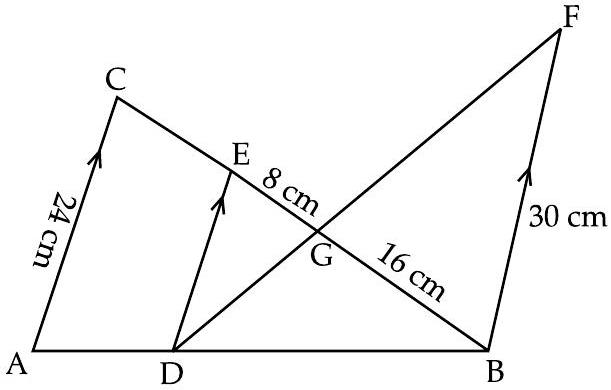
(a) Prove \(\Delta \mathrm{GED}-\triangle \mathrm{GBF}\)
(b) Find DE
(c) DB : AB [4]
(a)
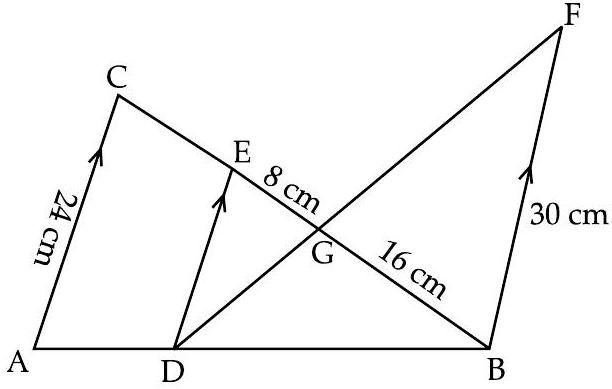
In \(\triangle G E D\) and \(\triangle G B F\)
(Vertically opposite angles)
(Alternative angles \(D E \| B F\) )
\(\therefore \quad \triangle G E D \sim \triangle G B F\)(AA Similarity Criterion) Hence Proved. (b)
(Proved)
(c) In \(\triangle A B C, D E \| A C\)
and
by AA Similarity criterion, triangle \(B D E \sim\) triangle \(B A C\).
∴
The following distribution gives the daily wages of 60 workers of a factory.
| Daily income ₹ | Number of worker (f) |
|---|---|
| 200-300 | 6 |
| 300-400 | 10 |
| 400-500 | 14 |
| 500-600 | 16 |
| 600-700 | 10 |
| 700-800 | 4 |
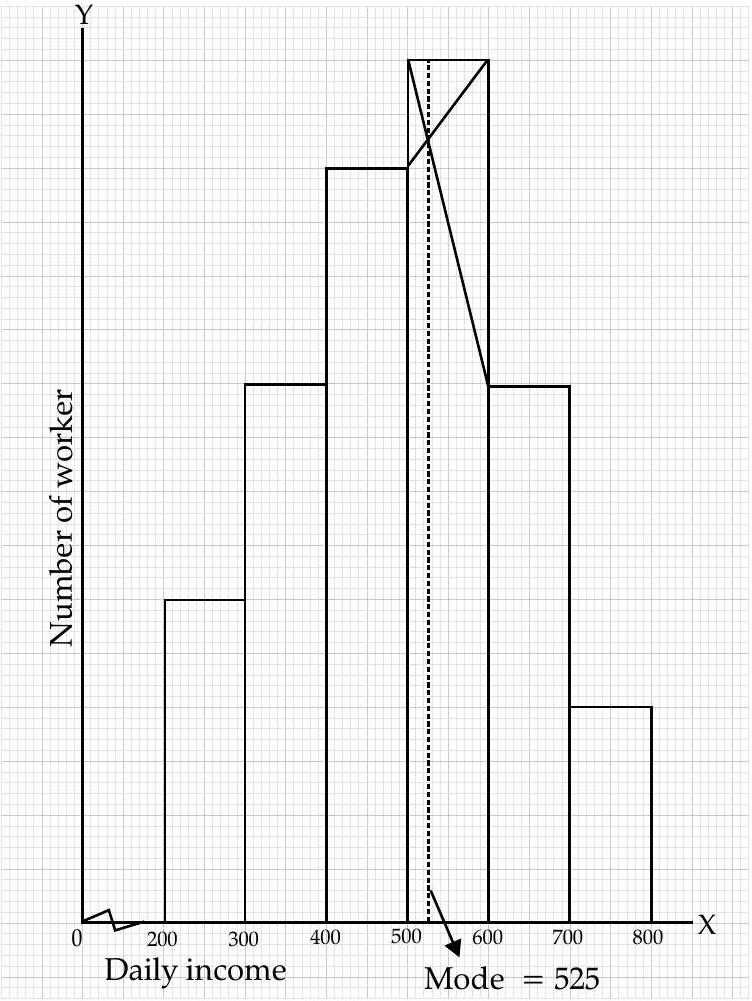
Use graph paper to answer this question. Take \(2 \mathrm{~cm}=\text{₹} 100\) along one axis and \(2 \mathrm{~cm}=2\) workers along the other axis. Draw a histogram and hence find the mode of the given distribution. [3]
The \(\mathbf{5}^{\text {th }}\) term and the \(\mathbf{9}^{\text {th }}\) term of an Arithmetic Progression are 4 and -12 respectively. Find:
(a) the first term
(b) common difference
(c) sum of 16 terms of the AP. [3]
Given,
Let the first term be \(a\) and common difference be \(d\) respectively
Similarly, \(a+8 d=-12\) …(ii) from (i) and (ii)
(a) first term is 20
(b) Common difference \(=-4\)
(c)
∴ Sum of 16 terms is -160
A and B are two points on the \(\boldsymbol{x}\)-axis and \(\boldsymbol{y}\)-axis respectively.
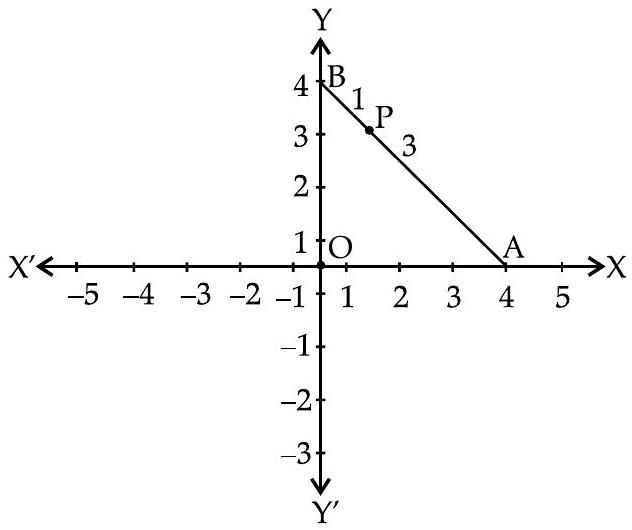
(a) Write down the coordinates of A and B.
(b) P is a point on AB such that \(\mathbf{A P}: \mathbf{P B}=\mathbf{3}: \mathbf{1}\). Using section formula find the coordinates of point P.
(c) Find the equation of a line passing through P and perpendicular to AB. [4]
(a)
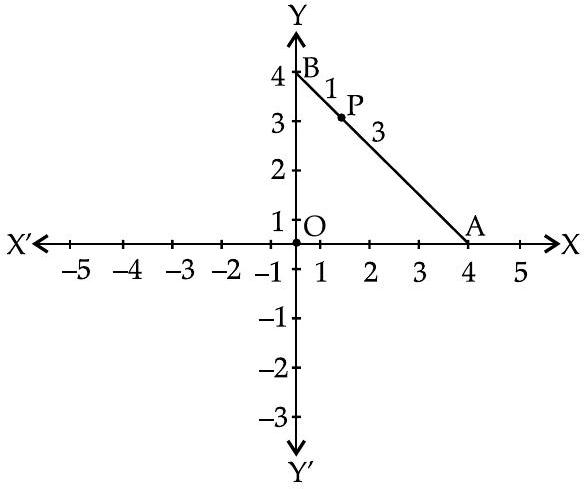
Coordinates of A(4, 0) Coordinates of B(0, 4) (b)
(c) Slope of line \(A B=\frac{4-0}{0-4}=-1\)
∴ Slope of perpendicular line \(A B=1\)
A bag contains 25 cards, numbered through 1 to 25. A card is drawn at random. What is the probability that the number on the card drawn is:
(a) multiple of 5
(b) a perfect square
(c) a prime number? [3]
∴
(a) multiple of 5
(b) Perfect square \(=(1,4,9,16,25)\)
(c) a prime number \{2, 3, 5, 7, 11, 13, 17, 19, 23\}
A man covers a distance of 100 km, travelling with a uniform speed of \(\boldsymbol{x}\) km/hr, had the speed been 5 km/hr more it would have taken 1 hour less. Find \(\boldsymbol{x}\) the original speed. [3]
Let the original speed be \(x\) km/h
If \(x+25=0 \Rightarrow x=-25\) it is not possible because speed can not be negative if \(x-20=0\)
∴ original speed be 20 km/h
A solid in the shape of a hemisphere of radius 7 cm, surmounted by a cone of height 4 cm. The solid is immersed completely in a cylindrical container filled with water to a certain height. If the radius of the cylinder is 14 cm, find the rise in the water level. [4]
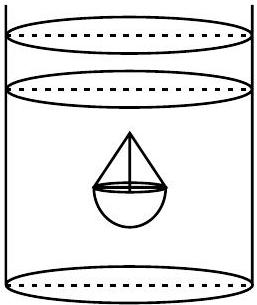
Volume of solid = Vol. of hemisphere + Vol. of Cone.
Let the level of water rise in cylinder be \(x \mathrm{~cm}\) ∴ Rise in Vol. of water \(=294 \pi\)
∴ level of water rise in cylinder \(=1.5 \mathrm{~cm}\)
The following table gives the marks scored by a set of students in an examination. Calculate the mean of the distribution by using the short cut method. [3]
| Marks | Number of Students ( \(\boldsymbol{f}\) ) |
|---|---|
| 0-10 | 3 |
| 10-20 | 8 |
| 20-30 | 14 |
| 30-40 | 9 |
| 40-50 | 4 |
| 50-60 | 2 |
| Marks | Number of Students (f) | \(x\) | \(d=\) \(x-\mathrm{A}\) | \(\boldsymbol{f} \boldsymbol{d}\) |
|---|---|---|---|---|
| 0-10 | 3 | 5 | -20 | -60 |
| 10-20 | 8 | 15 | -10 | -80 |
| 20-30 | 14 | 25 = A | 0 | 0 |
| 30-40 | 9 | 35 | 10 | 90 |
| 40-50 | 4 | 45 | 20 | 80 |
| 50-60 | 2 | 55 | 30 | 60 |
| 40 | 90 |
What number must be added to each of the numbers 4, 6, 8, 11 in order to get the four numbers in proportion? [3]
Let \(x\) be added to get the four numbers in proportion
∴ 4 should be added to get the four numbers in proportion
Using ruler and compass construct a triangle ABC in which \(\mathbf{A B}=\mathbf{6 ~ c m}, \angle \mathbf{B A C}=\mathbf{1 2 0}^{\circ}\) and \(\mathbf{A C}=\mathbf{5}\) cm. Construct a circle passing through A, B and C. Measure and write down the radius of the circle. [4]
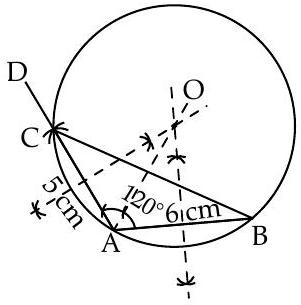
Step of construction:
(a) Draw \(A B=6 \mathrm{~cm}\)
(b) Make \(\angle B A D=120^{\circ}\)
(c) Taking centre A and radius of \(A C 5\) cm draw an arc which intersect at the point \(C\)
(d) join \(B C\). triangle \(A B C\) is required triangle
(e) Draw perpendicular bisectors of side \(A B\) and \(A C\) respectively which intersect at the point \(O\)
(f) Taking \(O\) as centre and \(O A\) as radius draw a circle which passes through the points \(A, B\) and C respectively.
Now, measured the radius \(O A=5.5 \mathrm{~cm}\)
Using Componendo and Dividendo solve for \(\boldsymbol{x}\). [3]
Applying componendo and dividendo
squaring both sides
Which term of the Arithmetic Progression (A.P.) 15, 30, 45, 60 … is 300? Hence find the sum of the terms of the Arithmetic Progression (A.P.) [3]
15, 30, 45, 60, …………….. 300
\(20^{\text {th }}\) term is 300
From the top of a tower 100 m high a man observes the angles of depression of two ships A and B, on opposite sides of the lower as 45° and 38° respectively. If the foot of the tower and the ships are in the same horizontal line find the distance between the two ships A and B to the nearest metre. (Use Mathematical Tables for this question.) [4]
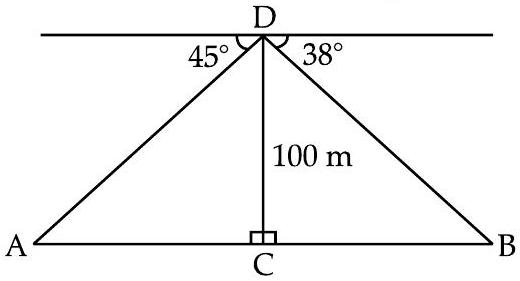
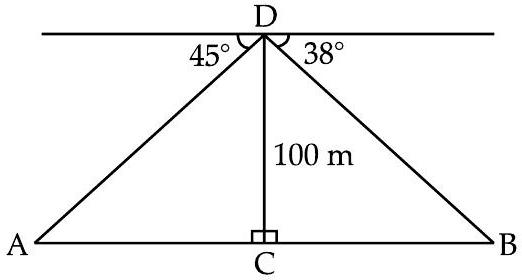
In \(\triangle A C D\)
In \(\triangle B C D\)
Distance between two ships \(=A C+B C\)
Factorize completely using factor theorem: [4]
Put
\(\therefore(x+2)\) is a factor of polynomial
Use graph paper to answer this question. During a medical checkup of 60 students in a school, weights were recorded as follows:
| Weight (in kg) | Number of Students |
|---|---|
| 28-30 | 2 |
| 30-32 | 4 |
| 32-34 | 10 |
| 34-36 | 13 |
| 36-38 | 15 |
| 38-40 | 9 |
| 40-42 | 5 |
| 42-44 | 2 |
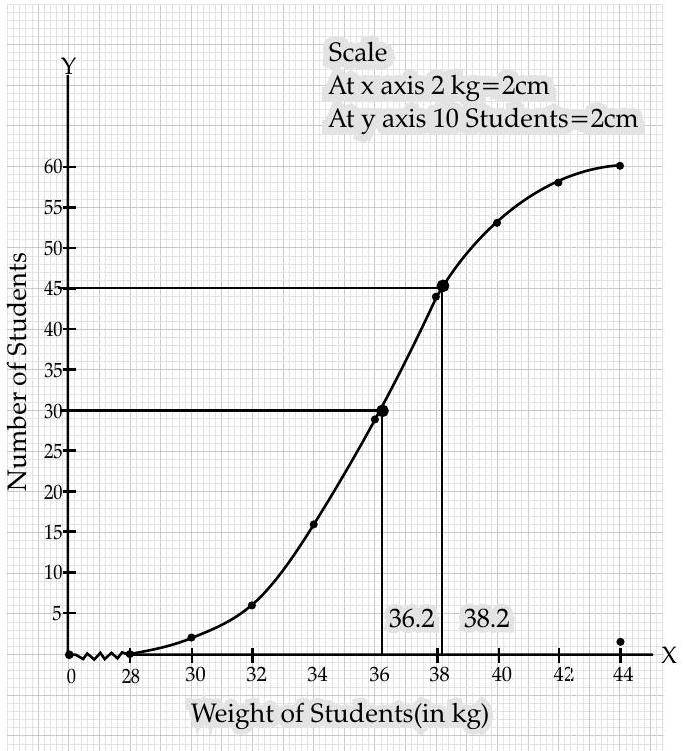
Taking \(\mathbf{2} \mathbf{~ c m}=\mathbf{2 ~ k g}\) along one axis and \(\mathbf{2 ~ c m}=\mathbf{1 0}\) students along the other axis draw an ogive. Use your graph to find the:
(a) median
(b) upper Quartile
(c) number of students whose weight is above 37 kg [6]
| Weight (in kg) | Number of Students (f) | Cumulative frequency (cf) |
|---|---|---|
| 28-30 | 2 | 2 |
| 30-32 | 4 | 6 |
| 32-34 | 10 | 16 |
| 34-36 | 13 | 29 |
| 36-38 | 15 | 44 |
| 38-40 | 9 | 53 |
| 40-42 | 5 | 58 |
| 42-44 | 2 | 60 |
| Weight in kgs. (less than) | Number of Students |
|---|---|
| 28 | 0 |
| 30 | 2 |
| 32 | 6 |
| 34 | 16 |
| 36 | 29 |
| 38 | 44 |
| 40 | 53 |
| 42 | 58 |
| 44 | 60 |
(a) median \(=36.2 \mathrm{~kg}\)
(b) upper quartile \(=38.2 \mathrm{~kg}\)
(c) Number of students where weight is above \(37 \mathrm{~kg}=60-37=23\) students