

Last Updated on November 12, 2026 by sanjjeett
Practice the complete ICSE Class 10 Physics 2018 Question Paper with Solutions, including numericals, diagrams and detailed answers from Sections I and II. Use this solved paper to revise important concepts, practise board-style questions and strengthen your exam preparation.
Section I is compulsory. Attempt any four questions from Section II.
The intended marks for questions or parts of questions are given in brackets [ ].
SECTION I
(i) State and define the S.I. unit of power.
(ii) How is the unit horse power related to the S.I. unit of power? [2]
Ans. (i) The rate at which work is done by a force is called the power i.e, \(P=\frac{W}{t}\) The S.I. unit of power is watt (W), 1 Watt is defined as 1 Joule/second
(ii) Another unit of power is horse power (H.P) 1 horse power = 746 Watt
State the energy changes in the following cases while in use: (i) An electric iron.
(ii) A ceiling fan. [2]
Ans. (i) In electric iron, the electrical energy changes into heat energy.
(ii) In ceiling fan, the electrical energy changes into mechanical energy of rotation.
The diagram below shows a lever in use:
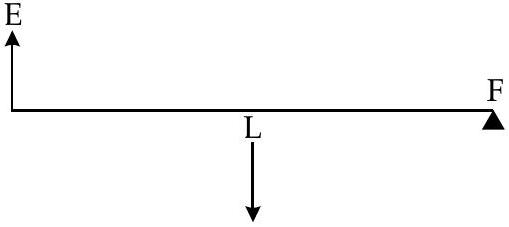
(i) To which class of lever does it belong?
(ii) Without changing the dimensions of the lever, if the load is shifted towards the fulcrum what happens to the mechanical advantage of the lever? [2]
Ans. (i) Lever shown in figure is Class 2 lever as Load L is in between Effort E and Fulcrum F.
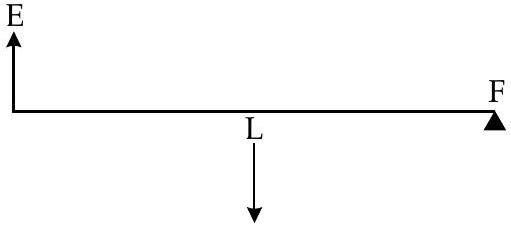
(ii) If load is shifted towards fulcrum, Then mechanical advantage increases as mechanical advantages is defined as the ratio of effort Arm to Load Arm i.e.,
(i) Why is the ratio of the velocities of light of wavelengths \(4000 \AA\) and \(8000 \AA\) in Vacuum 1:1?
(ii) Which of the above wave lengths has a higher frequency? [2]
Ans. (i) Ratio of velocity of light \(\lambda=4000 \AA\) & \(8000 \AA\) in vacuum is in ratio of 1:1, because velocity does not depend on \(\lambda\).
(ii) Since, we have \(v=\int \lambda \Rightarrow \int=\frac{v}{\lambda}\)
⇒ Smaller \(\lambda\) have higher frequency \(\Rightarrow \lambda=4000 \AA\) have higher frequency
(i) Why is the motion of a body moving with a constant speed around a circular path said to be accelerated?
(ii) Name the unit of physical quantity obtained by the formula \(\frac{2 k}{v^{2}}\).
Where, K: Kinetic energy, V: Linear velocity. [2]
Ans. (i) Motion around the circular path is said to be accelerated because there is a acceleration in motion as velocity changes in direction with constant speed.
(ii) If \(K \rightarrow\) kinetic energy, \(v \rightarrow\) Linear Velocity then unit of \(\frac{2 K}{\mathrm{v}^{2}}=\frac{\not 2 \frac{1}{\not 2} m \not y^{2}}{\not y^{2}}=m\) (mass) i.e., obtained physical quantity in mass has SI uint in Kg
The power of a lens is -5D (i) Find its focal length.
(ii) Name the type of lens. [2]
Ans. (a) Given Power \(P=-5 \mathrm{D}\)
(i) Focal length \(F=\frac{1}{p}=-\frac{1}{5}\) metre \(=-20 \mathrm{~cm}\)
(ii) Since, power is -ve , the lens is diverging lens.
State the position of the object in front of a converging lens if: (i) It produces a real and same size image of the object.
(ii) It is used as a magnifying lens. [2]
Ans. (i) When object is placed at \(2 f\), then converging lens produce real and same size image
(ii) When object is placed in between \(f & \mathrm{O}\) of lens then converging lens is used as magnifying lens.
(i) State the relation between the critical angle and the absolute refractive index of a medium. (ii) Which colour of light has a higher critical angle? Red light or Green light. [2]
Ans. (i) If critical angle is \(i_{\mathrm{c}}\) and refractive index is \(\mu\) then from law of refraction \(\frac{n}{l} \mu \sin i_{c}=1 . \sin 90^{\circ}\)
(∴ for Total internal reflection \(r=90^{\circ}\) )
(ii) Since, the velocity of light for red is more than green. So, refractive index of red will be smaller (as \(\mu \alpha \frac{1}{\nu}\) ).
Again critical angle for green will be smaller than red because sin \(i_{c}=\frac{1}{\mu}\) ie, \(\mu_{R}<\mu_{g}\) \(\Rightarrow i_{R}>i_{c g}\). Hence, critical angle for red light will be greater than green light.
(i) Define scattering. (ii) The smoke from a fire looks white.
Which of the following statements is true?
1. Molecules of the smoke are bigger than the wavelength of light.
2. Molecules of the smoke are smaller than the wavelength of light. [2]
Ans. (i) Scattering: The phenomenon of bending of light at the corners of small object and aparatures is called scattering . It is determine by Rayleigh’s law of scattering , defined by \(I_{\lambda} \propto \frac{1}{\lambda^{4}}\) where size of obstacle / aperture is
(ii) Smoke from fire looks white due to scattering from smoke molecules therefore for scattering molecule of smoke are bigger than \(\lambda\) of light, so option (1) is true.
The following diagram shows are 60°, 30°, 90° glass prism of critical angle 42°. Copy the diagram and complete the path of incident ray AB emerging out of the prism marking the angle of incidence on each surface. [2]
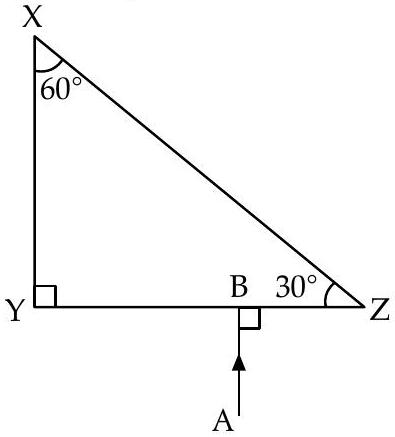
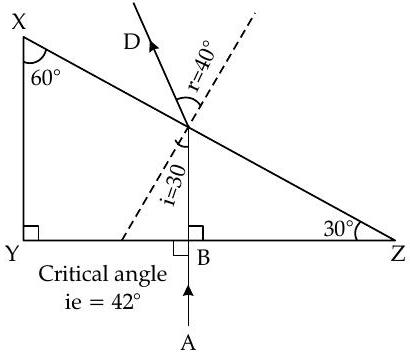
Ans. Since ,critical angle of prism \(i_{\mathrm{c}}=42^{\circ}\), for given ray AB the incidence angle is 30, therefore ray AB incident on surface YZ at angle of incidence of 30° and refracted out from prism \(\left(\because \mu=\frac{1}{\sin i_{c}}\right)\). The angle of refraction is given by
Displacement distance graph of two sound waves A and B, travelling in a medium, are shown in the diagram below. Displacement (cm)
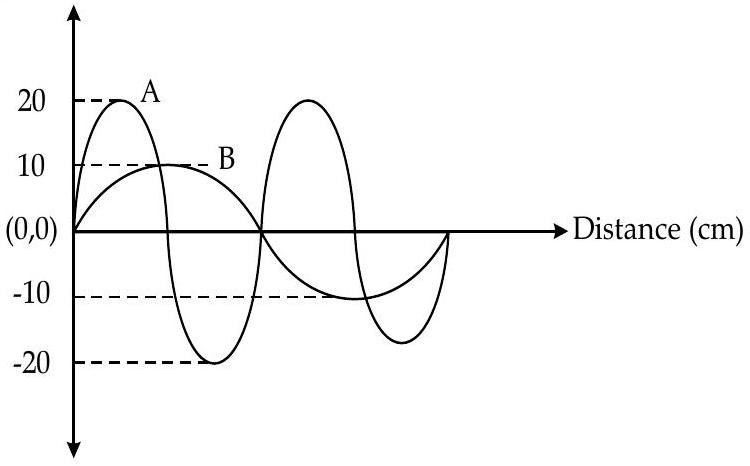
Study the two sound waves and compare their :
(i) Amplitudes
(ii) Wavelengths [2]
Ans. (i) Amplitude of Sound A is larger than Sound B because Amplitude of \(A=20 \mathrm{~cm}>\) Amplitude of \(B\) \(=10 \mathrm{~cm}\)
(ii) Wavelength of Sound A and B is given by \(\lambda_{B}=\) \(2 \lambda_{A}\)
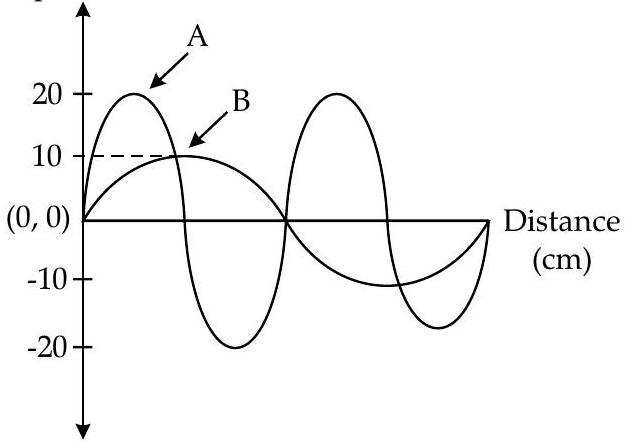
Displacement
You have three resistors of values \(\mathbf{2} \boldsymbol{\Omega}, \mathbf{3} \boldsymbol{\Omega}\) and \(\mathbf{5} \boldsymbol{\Omega}\). How will you join them so that the total resistance is more than \(\mathbf{7} \boldsymbol{\Omega}\) ? (i) Draw a diagram for the arrangement.
(ii) Calculate the equivalent resistance. [2]
Ans. (i)

(ii) \(R_{\text {equivalent }}=R_{1}+R_{2}+R_{2}=2+3+5=10 \Omega\)
(i) What do you understand by the term nuclear fusion? (ii) Nuclear power plants use nuclear fission reaction to produce electricity. What is the advantage of producing electricity by fusion reaction? [2]
Ans. (i) Nuclear fusion : When two or more smaller nuclei produce the bigger nuclei by releasing large amount of energy, the process is called Nuclear fusion. e.g.,
(ii) Advantages on producing electricity by Nulcear fusion are:
(1) No toxic waste are produced.
(2) No radioactive radiation produced.
(3) Nuclear fusion power plant can be located near the populated areas.
(4) We produce large amount of energy by consuming simple Hydrogen gas.
(i) What do you understand by free vibrations of body? (ii) Why does the amplitude of a vibrating body continuously decrease during damped vibrations? [2]
Ans. (i) When a body is vibrating freely with constant amplitude of oscillation is called free vibration of a body.
(ii) When there is a damping force acting on vibrating body, then amplitude of vibration decreases due to damping force such vibration is called damped vibration.
(i) How is the e.m.f. across primary and secondary coils of a transformer related with the number of turns of coil in them? (ii) On which type of current do transformers work? [2]
Ans. (i) If \(\mathrm{N}_{\mathrm{p}}\) and \(\mathrm{N}_{\mathrm{s}}\) are number of turns in primary and secondary coil of transformer and \(\mathrm{E}_{\mathrm{p}}\) and \(\mathrm{E}_{\mathrm{s}}\) are the emf is primary and secondary coils than we have
(ii) We use alternating current A.C. in Transformers.
(i) How can a temperature in degree Celsius be converted into S.I. unit of temperature? (ii) A liquid X has the maximum specific heat capacity and is used as a coolant in Car radiators. Name the liquid X. [2]
Ans. (i) The S.I. unit of Temperature is K. We convert °C to K by adding 273.
(ii) The liquid X is water used as coolant in car.
A solid metal weighing 150 g melts at its melting point of 800°C by providing heat at the rate of 100 W. The time taken for it to completely melt at the same temperature is 4 min. What is the specific latent heat of fusion of the metal? [2]
Ans. Given \(m=150 \mathrm{~g}=0.15 \mathrm{~kg}\), Heat Rate \(R=100 \mathrm{~W}\) time \(t=4 \mathrm{~min}=4 \times 60 \mathrm{~s}=240 \mathrm{~s}\). Let L is the latent heat of metal, we know that
Identify the following wires used in a household circuit: (i) The wire is also called as the phase wire.
(ii) The wire is connected to the top terminal of a three pin socket. [2]
Ans. (i) Red wire is used as phase wire
(ii) Green earth wire is connected to top of three pin plug.
(i) What are isobars? (ii) Give one example of isobars. [2]
Ans. (i) Isobar : The atoms which have same mass number A but different atomic number Z is called Isobars.
(ii) Example of Isobar
State any two advantages of electromagnets over permanent magnets. [2]
Ans. Two advantages of electromagnet over permanent magnets are :
(i) Electromagnet can be easily ON and OFF
(ii) Magnetic field B can be controlled by controlling the current flowing in electromagnet.
(iii) These can be used in medical science.
SECTION II
(i) Derive a relationship between S.I. and C.G.S. unit of work. (ii) A force acts on body and displaces it by a distances S in a direction at an angle \(\theta\) with the direction of force. What should be the to get the value of \(\theta\) to get the maximum positive work? [3]
Ans. (i) Work done = force × displacement The S.I. unit of work is Joule or Newton x meter and CGS unit of work is erg or dyne x cm.
(ii) We know work done \(W=F S \cos \theta\)
To get maximum the work done, \(\theta\) is 0 (zero) → angle b/w force and displacement \(\theta\) is zero.
A half metre rod is pivoted at the centre with two weights of 20 gf and 12 gf suspended at a perpendicular distance of 6 cm and 10 cm from the pivot respectively as shown below.
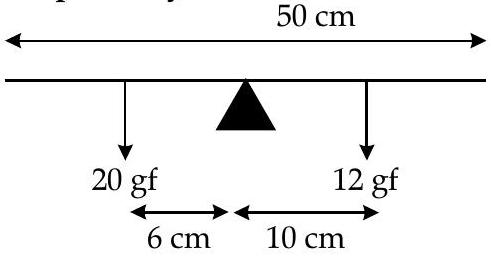
(i) Which of the two forces acting on the rigid rod causes clockwise moment?
(ii) Is the rod in equilibrium?
(iii) The direction of 20 kgf force is reversed. What is the magnitude of the resultant moment of the forces on the rod? [3]
Ans. (i) 12gf force produce clockwise 50 cm motion.
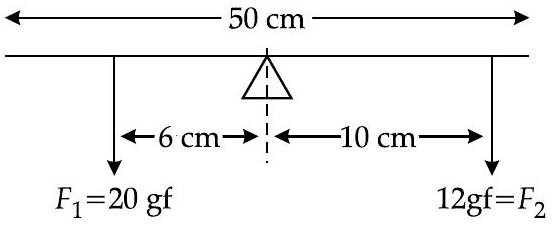
(ii) Moment of \(F_{1}=20 \mathrm{gf} \times 6 \mathrm{~cm}\)
Moment of \(F_{2}=12 \mathrm{gf} \times 10 \mathrm{~cm}=120 \mathrm{gfcm}\) Since, moment of \(F_{1}=\) moment of \(F_{2}\) → rod is in equilibrium
(iii) If direction of 20gf is reverse, the resultant moment of force on rod is
(i) Draw a diagram to show a block and and tackle pulley system having a velocity ratio of 3 marking the direction of load (L), effort (E) and tension (T). (ii) The pulley system drawn lifts a load of 150 N when an effort of 60 N is applied. Find its mechanical advantage.
(iii) Is the above pulley system an ideal machine or not? [4]
Ans. (i) Pulley system diagram is shown in figure. Labelled tension T, load L and effort E.
(ii) The mechanical advantage of pulley system is given by load/effort
Given load \(L=150 \mathrm{~N}\), Effort \(E=60 \mathrm{~N}\)
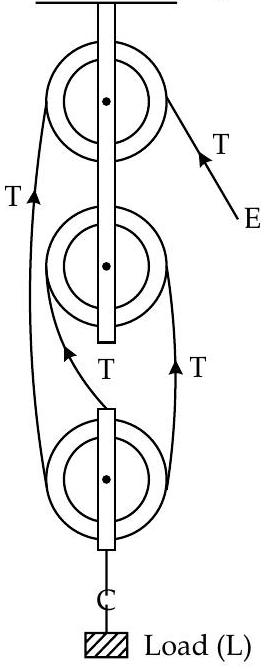
(iii) The above pulley system is not an ideal machine because there must be some friction.
A ray of light XY passes through a right angled isosceles prisms as shown below.
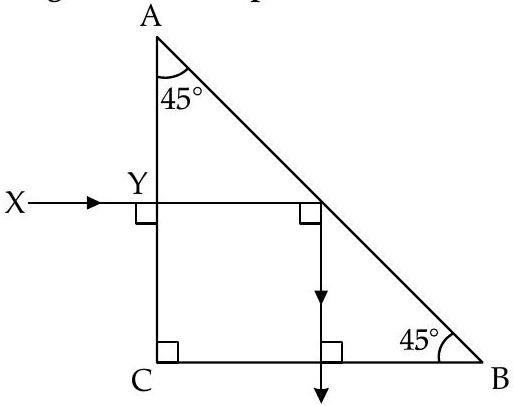
(i) What is the angle through which the incident ray deviates and emerges out of the prism?
(ii) Name the instrument where this action of prism is put into use.
(iii) Which prism surface will behave as a mirror? [3]
Ans. (i) The angle of deviation between incident and emerging out ray from prism is \(S=90^{\circ}\)
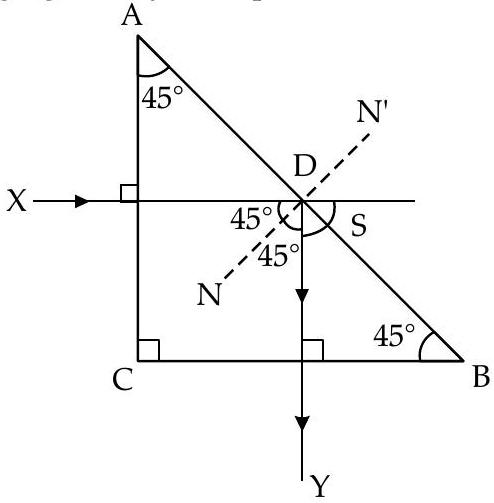
(ii) This action of prism is used as a perfect reflector and the instrument is called the periscope.
(iii) The Prism Surface AB act is mirror.
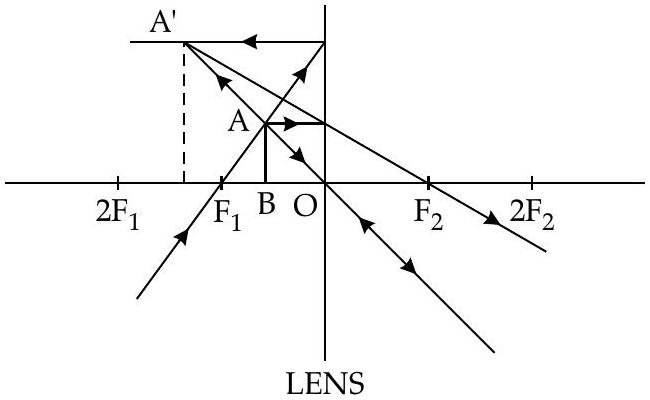
An object AB is placed between O and \(\mathrm{F}_{1}\) on the principal axis of a converging lens as shown in the diagram.
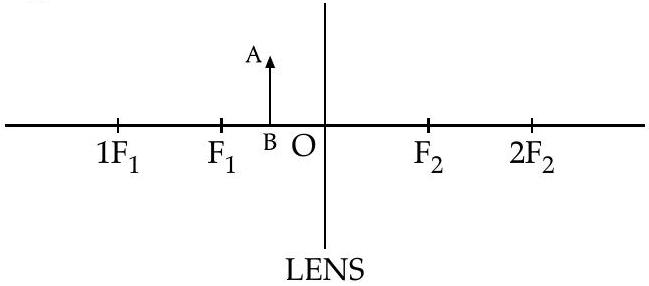
Copy the diagram and by using three standard rays starting from point A, obtain an image of the object AB. [3]
Ans. (i) Fig. shows the ray diagram using three rays started from point. A, we get the image A’B’
An object is placed at a distance of 12 cm from a convex lens of focal length 8 cm. Find: (i) the position of the image.
(ii) nature of the image [4]
Ans. Given object distance \(u=-12 \mathrm{~cm}\), Focal length \(f=8 \mathrm{~cm}\). We know lense formula \(\frac{1}{f}=\frac{1}{v}-\frac{1}{u}\) or, \(\frac{1}{v}=\frac{1}{f}+\frac{1}{u}=\frac{1}{8}-\frac{1}{12}=\frac{3-2}{24}=\frac{1}{24}\) or, \(v=+24 \mathrm{~cm}\)
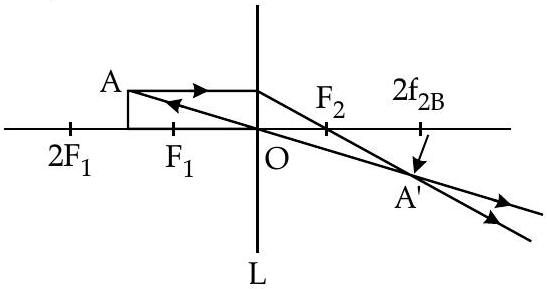
(i) Position of image \(V=+24 \mathrm{~cm}\)., Right side of lense
(ii) Nature of image is Real, inverted and magnified.
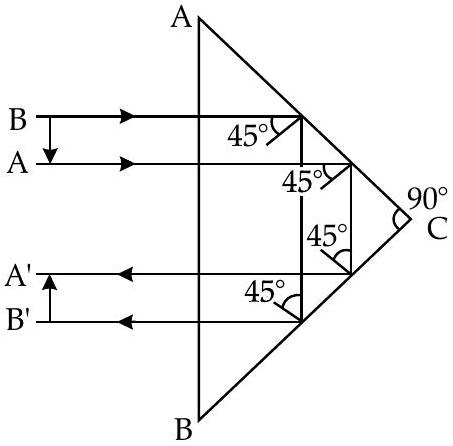
Draw the diagram of a right angled isosceles prism which is used to make an inverted erect image. [3]
Ans. Diagram is shown in figure for inverted erect image by Right angle isosceles prism.
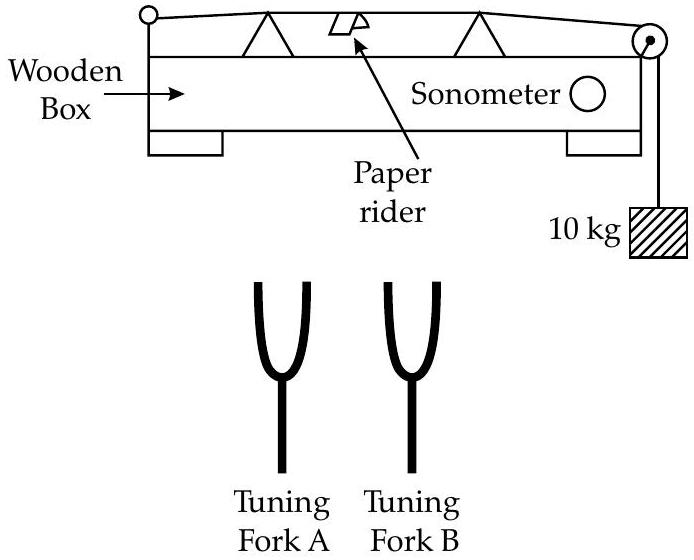
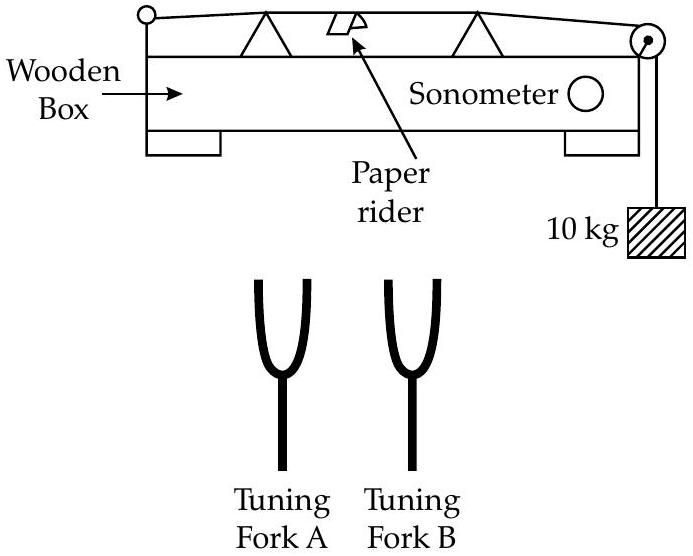
The diagram above shows a wire stretched over a sonometer. Stems of two vibrating tuning forks A and B are touched to the wooden box of the sonometer. It is observed that the paper rider (a small piece of paper folded at the centre) present on the wire flies off when the stem of vibrating tuning fork B is touched to the wooden box.
(i) Name the phenomenon when the paper rider just vibrates.
(ii) Name the phenomenon when the paper rider flies off.
(iii) Why does the paper rider fly off when the stem of tuning fork B is touched to the box? [3]
Ans. (i) When paper just vibrate on the wire of sonometer then phenomenon is called \(1{ }^{\text {st }}\) overtone or \(2^{\text {nd }}\) harmonics.
(ii) When paper flies off, then we have fundamental mode or first harmonics.
(iii) Paper files off by Tuning Fork B, because it produce fundamental mode or first harmonics in wire.
A person is standing at the sea shore. An observer on the ship which is anchored in between a vertical cliff and the person on the shore fires a gun. The person on the shore hears two sounds, 2 seconds and 3 seconds after seeing the smoke of the fired gun. If the speed of sound in the air is \(320 \mathbf{~ m s}^{\boldsymbol{-} \mathbf{1}}\) then calculate: (i) The distance between the observer on the ship and the person on the shore.
(ii) The distance between the cliff and the observer on the ship. [4]
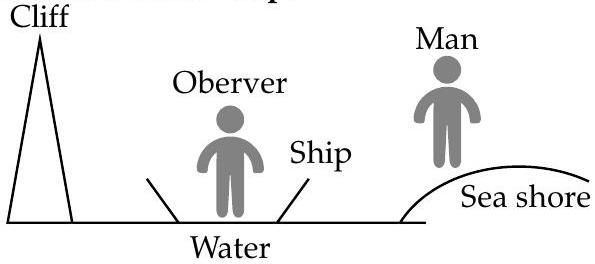
Ans. Given \(V=320 \mathrm{~ms}^{-1}\) Sea Shore man listen two sounds in \(t_{1}=2 \mathrm{sec}\) and \(t_{2}=3 \mathrm{sec}\) after seeing smoke.
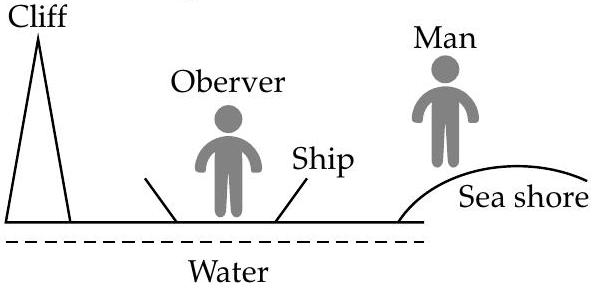
(i) Since, sea shore man listen one sound in 2 Sec which comes back from observer, so distance between observer and man on shore is \(\frac{320 \times 2}{2} \mathrm{~m}\),
(ii) Since, Sea Shore man listen other sound in 3 second by reflecting from cliff. So, distance b/w cliff and sea shore man is
Thus the distance b/w cliff F observer on ship is \(d=d_{2}-d_{1}=480-320=160 \mathrm{~m}\)
(i) A fuse is rated 8 A. Can it be used with an electrical appliance rated 5 KW, 200 V? Give a reason. (ii) Name two safety devices which are connected to the live wire of household electric circuit. [3]
Ans. (i) For given appliance \(P=5 \mathrm{KW}, V=200 \mathrm{~V}\)
Since, given fuse is rated \(I\) fuse \(=8 \mathrm{~A}\) which is less than 25 A, thus we can not use this fuse in given appliance.
(ii) Two safety device used in live wire are :
(1) Switches
(2) Fuse
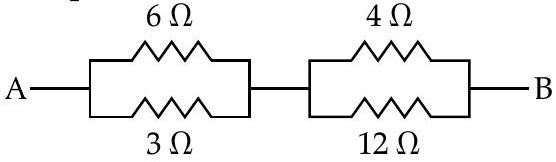
(i) Find the equivalent resistance between A and B.
(ii) State whether the resistivity of a wire changes with the change in the thickness of the wire. [3]
Ans. (i)
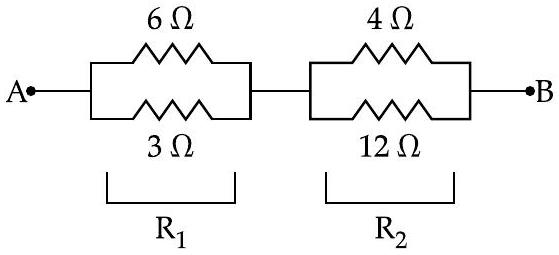
again
(ii) Resistivity \(\rho\) does not changes with thickness of wire, since it is independent of dimension of wire but it depends on material only.
An electric iron is rated 220V, 2KW. (i) If the iron is used for 2h daily find the cost of running it for one week if it costs ₹4.25 per kWh.
(ii) Why is the fuse absolutely necessary in a power circuit? [4]
Ans. (i) Given electric irons rated 220 V, 2 KW daily uses 2 hr, Cost \(=₹ 4.25 / \mathrm{kWh}\) ⇒ Cost of power used by Iron for one week
(ii) Fuse is necessary in electrical circuit because if there is a flow of high current or voltage in the circuit, then fuse is blown off by melting and as a result the power circuit of OFF and our appliance are safe and they are protected.
(i) Heat supplied to a solid changes it into liquid. What is this change in phase called? (ii) During the phase change does the average kinetic energy of the molecules of the substance increase?
(iii) What is the energy absorbed during the phase change called? [3]
Ans. (i) When solid changed into liquid by supply heat, this change in phase is called melting.
(ii) During this phase change K.E. of molecules of substance increases.
(iii) The energy observed during this phase change is called latent heat of solid.
(i) State two differences between “Heat Capacity” and “Specific Heat Capacity”. (ii) Give a mathematical relation between Heat Capacity and Specific Heat Capacity. [3]
Ans. (i) Difference between heat capacity and specific heat capacity
(1) Heat capacity \(c=\frac{Q}{\Delta T}\),
Specific heat capacity \(s=\frac{Q}{m \Delta T}\)
(2) Unit of heat capacity is J/°C while of specific heat capacity is J/kg°C
(ii) Since, heat capacity \(c=\frac{Q}{\Delta T}\),
Sp. Heat Capacity \(s=\frac{Q}{m \Delta T}\)
(heat capacity) ⇒ heat capacity = mass × specific heat capacity
The temperature of 170g of water 50°C is lowed to 5°C by adding certain amount of ice to it. Find the mass if ice added. Given : Specific heat capacity of water \(=\mathbf{4 2 0 0 ~ k g}^{-\mathbf{1}}{ }^{\circ} \mathbf{C}^{-\mathbf{1}}\) and Specific latent heat of ice \(=\mathbf{3 3 6 0 0 0} \mathbf{~ J ~ k g}^{\boldsymbol{-} \mathbf{1}}\) [4]
Ans. Given mass of water \(=170 \mathrm{~g}=0.17 \mathrm{~kg}\)
specific heat capacity of water \(=4200 \mathrm{~J} \mathrm{~kg}^{-1}{ }^{\circ} \mathrm{C}^{-1}\) Sp. Latent heat of ice \(=336000 \mathrm{~J} \mathrm{~kg}^{-1}\) Let mass of ice added be x then we have heat lost by water = Heat used by ice. ⇒ water at 50°C to 5°C = ice at °C to water at °C + water at 0°C to 5°C
or,
⇒ we should add 90 g of ice to water.
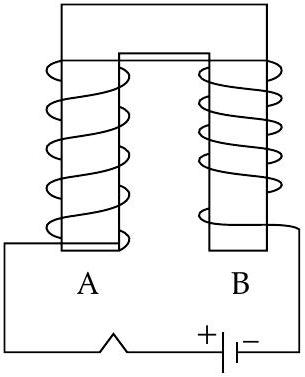
The diagram shows a coil wound around a U shape soft iron bar AB.
(i) What is the polarity induced at the ends A and B when the switch is pressed?
(ii) Suggest one way to strengthen the magnetic field in the electromagnet.
(iii) What will be the polarities at A and B if the direction of current is reversed in the circuit? [3]
Ans. (i) Fig. shows U shaped soft iron bar AB when switch is pressed, current flows in coils and soft iron becomes electromagnet, From Right hand thumb rule, the polarity of A and B be South Pole (S)
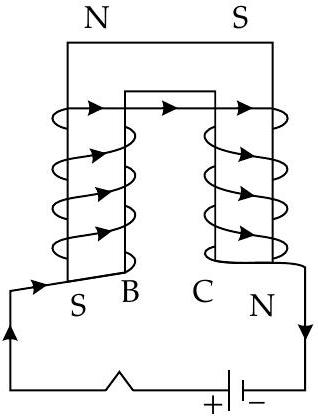
(ii) To strengthen the \(\vec{B}\) in electromagnet , we use the cross wire in bar A and B or by increasing the current in coils. Fig. Shows coils .
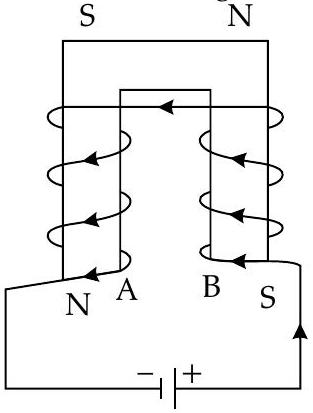
(iii) If direction of current is reverse in arrangement (i) the ends A and B will act as North Pole (N).
The ore of Uranium found in nature contains \({ }^{\mathbf{9 2}} \mathbf{U}_{\mathbf{2 3 8}}\) and \({ }^{\mathbf{9 2}} \mathbf{U}_{\mathbf{2 3 5}}\). Although both the Isotopes are fissionable, it is found out experimentally that one of the two isotopes is more easily fissionable. (i) Name the isotope of Uranium which is easily fissionable.
(ii) Give a reason for your answer.
(iii) Write a nuclear reaction when Uranium 238 emits an alpha particle to form a Thorium (Th) nucleus. [3]
Ans. (i) The isotope \({ }_{92} \mathrm{U}^{235}\) is more easily fissionable.
(ii) Because this nuclei \({ }_{92} \mathrm{U}^{235}\) is fissioned by thermal neutrons and converted to \({ }_{92} \mathrm{U}^{236}\) Example \({ }_{92} \mathrm{U}^{235}+{ }_{0} \mathrm{n}^{1} \rightarrow{ }_{92} \mathrm{U}^{236} \rightarrow{ }_{56} \mathrm{Ba}^{144}+\) \({ }_{36} \mathrm{Kr}^{89}+3{ }_{0} \mathrm{n}^{1}+200 \mathrm{MeV}\). Breaks up to Ba and Kr and neutron and release large amount of energy.
(iii) Nuclear reaction of \({ }_{92} \mathrm{U}^{238}\) emits \(\alpha\) particle as
Radiations given out from a source when subjected to an electric field in a direction perpendicular to their path are shown below in the diagram. The arrows show the path of the radiation A, B and C. Answer the following questions in terms of A, B and C.
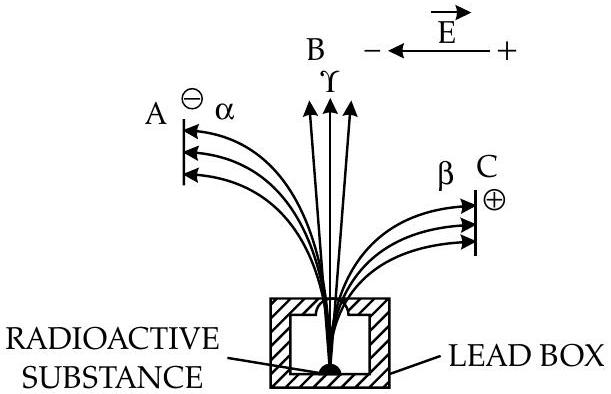
(i) Name the radiation B which is unaffected by the electronic field.
(ii) Why does the radiation C deflect more than A?
(iii) Which among the three causes the least biological damage externally?
(iv) Name the radiation which is used in carbon dating. [4]
Ans. (i) Radiation B is \(\gamma\) – Ray, which is indeflected in electric field.
(ii) The Radiation C is deflected more than A because they have light mass ( \(\beta\) particle) then the particle A (He nucleus)
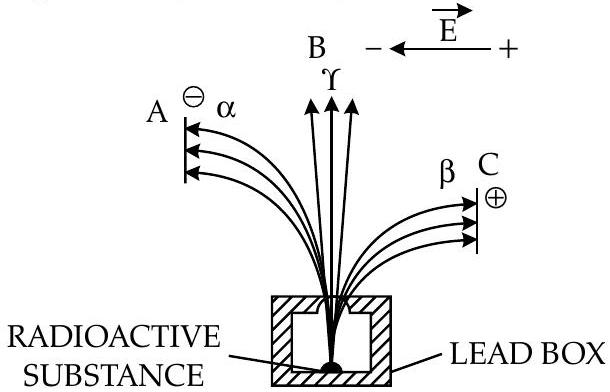
(iii) A particle causes least biological damage because they are loosely penetrating particle.
(iv) \(\beta\) particle or radiation is used in carbon dating.