

Last Updated on November 12, 2026 by sanjjeett
Practice the complete ICSE Class 10 Physics 2023 Question Paper with Solutions, including MCQs, numericals, diagrams and answers from Sections A and B. Use this solved paper to revise important concepts, practise board-style questions and strengthen your exam preparation.
Section A is compulsory. Attempt any four questions from Section B.
The intended marks for questions or parts of questions are given in brackets [ ].
SECTION A
Choose the correct answers to the questions from the given options.
(Do not copy the questions, write the correct answer only).
[15]
Clockwise moment produced by a force bout a fulcrum is considered to be:
Option (b) is correct
Explanation: By convention, anticlockwise moment is considered positive and clockwise moment is considered negative.
When the speed of a moving object is doubled, then its kinetic energy.
Option (d) is correct
Explanation: Kinetic energy \(=\frac{1}{2} m v^{2}\)
So, kinetic energy will be four limes, if the speed ( \(v\) ) is doubled.
The energy conversion in a washing machine is from ____.
Option (b) is correct
Explanation: In washing machine, there is a motor which converts electrical energy into mechanical energy.
Which of the following radiations suffer maximum deflection in a magnetic field?
Option (b) is correct
Explanation: \(\beta\) particles are fast moving negatively charged particle (electrons) with very high e/m ratio.
Speed of blue light in water is:
Option (c) is correct
Explanation: Refractive index of a medium for blue light is less than that of a violet light.
Since,
So, velocity of blue light is more than that of violet light.
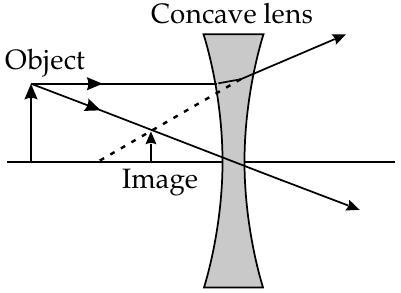
A concave lens produces only ____ image.
Option (c) is correct
Explanation: Since, concave lens diverges incident ray, hence the refracted rays do not meet.
So, virtual image is formed.
When a body vibrates under a periodic force, then vibrations of the body are always:
Option (c) is correct
Two notes are produced form two different musical instruments, such that they have same loudness and same pitch. The produced notes differ in their.
Option (a) is correct
Explanation: The produced notes can be determined by the qualities that are governed by waveform.
When a current I flows through a wire of resistance \(\boldsymbol{R}\) for time \(\boldsymbol{t}\) then the electrical energy produced is given by:
Option (a) is correct
Explanation: It follows from Joule’s law of heating. \(I^{2} R t\)
Choose the correct relation for e.m.f. ( \(\varepsilon\) ) and terminal voltage V:
Option (c) is correct
Explanation: \(\varepsilon=V+i R\)
When \(i \neq 0, \varepsilon>V\)
When \(i=0, \varepsilon=V\)
If the strength of the current flowing through a wire is increased, the strength of the magnetic field produced by it:
Option (b) is correct
Explanation: Strength of current \(\propto\) Magnetic field strength produced.
Specific latent heat of a substance:
Option (c) is correct
Specific heat capacity of a substance X is 1900 \(\mathbf{J k g}^{-\mathbf{1}}{ }^{\boldsymbol{\circ}} \mathbf{C}^{\mathbf{- 1}}\) means:
Option (b) is correct
Explanation: It is clear from the magnitude and the unit of specific heat capacity that 1900 Joule heat is required to rise the temperature of 1 kg substance by 1°C.
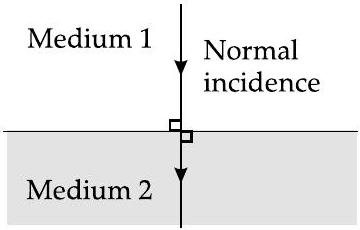
When a ray of light travels normal to the given surface, then the angle of refraction is:
Option (c) is correct
Explanation: The ray travels undeviated. Hence angle of incidence = angle of refraction = 0°.
Small air bubbles rising up a fish tank appear silvery when viewed from some particular angle is due to the:
Option (d) is correct
Explanation: Air is there inside bubble. When light travelling through water (denser than air) is incident on the bubble (inside the bubble the medium is rarer) at a suitable angle (more than critical angle), the total internal reflection takes place and the bubble appears silvery.
(a) When does the nucleus of an atom tend to become radioactive?
(b) Name a single pulley in which displacement of load and effort is not the same.
(c) State one advantage of this pulley. [3]
(a) When the number of neutrons become much greater than the number of protons \(\left(\frac{n}{p}>1\right)\) then the nucleus tend to become radioactive.
(b) In single movable pulley the displacement of load is not equal to the displacement of effort.
In this pulley, displacement of effort \(=2 \mathrm{x}\) displacement of load.
(c) Advantage of single movable pulley:
Its mechanical advantage is 2 i.e. the load can be lifted by applying an effort equal to half the load.
(a) What is the position of centre of gravity of a triangular lamina?
(b) When this triangular lamina is suspended freely from any one vertex, what is the moment of force produced by its own weight in its rest position? [2]
(a) The position of intersections of the medians i.e. the centroid is the triangle is the centre of gravity of triangular media.
(b) Algebraic sum of the moments will be zero since the line of action coincides with the axis of rotation.
The diagram shows wheel O pivoted at point A. Three equal force \(\mathbf{F}_{\mathbf{1}}, \mathbf{F}_{\mathbf{2}}\) and \(\mathbf{F}_{\mathbf{3}}\) act at point B on the wheel.
(a) Which force will produce maximum moment about A?
(b) Give a reason for your answer in (a). [2]
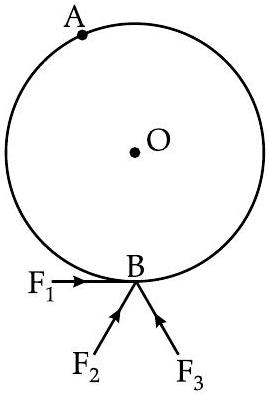
(a) Force \(\mathrm{F}_{1}\) will produce maximum moment about A.
(b) Perpendicular distance of \(\mathrm{F}_{1}\) is maximum.
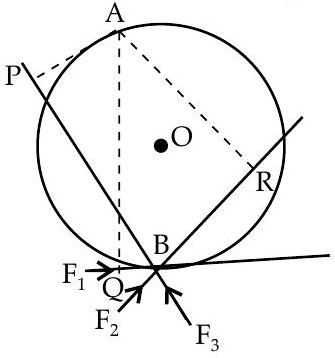
Perpendicular distance of \(\mathrm{F}_{1}\) from A is AQ.
Perpendicular distance of \(\mathrm{F}_{2}\) from A is AR.
Perpendicular distance of \(\mathrm{F}_{3}\) from A is AP.
Hence, the Force \(\mathrm{F}_{1}\) will produce maximum moment about point A.
(a) What should be the angle between the direction of force and the directions of displacement, for work to be negative?
(b) Name the physical quantity obtained using the formula \(\frac{U}{h}\), where \(U\) is the potential energy and \(h\) is the height. [2]
(a) The angle should be 180°.
Work done \(=\mathrm{FS} \cos \theta\).
When \(\theta=180^{\circ}\left(\cos 180^{\circ}=-1\right)\), the work done is – FS i.e., negative work done.
Here, F is the applied force and S is the displacement.
Calculate the power spent by a crane while lifting a load of mass 2000 kg, at velocity of 1.5 \(\mathbf{m s}^{-\mathbf{1}} .\left(\mathbf{g}=\mathbf{1 0} \mathbf{m s}^{-\mathbf{2}}\right)\) [2]
Power= Force × velocity
A metal foot ruler is held at the edge of a table. It is pressed at its free end and then released. It vibrates.
(a) Name the vibrations produced.
(b) State one way to increase the frequency of these vibrations. [2]
(a) Damped vibration, since the amplitude will decrease with time.
(b) Length may be reduced to increase the frequency.
‘A geyser is rated 240 W – 220 V’. Explain the meaning of this statement. [2]
When the geyser is connected to 220V supply and it will consume 240 Joule energy per second.
(a) Is it possible for a concave lens to form an image of size two times that of the object? Write Yes or No.
(b) What will happen to the focal length of the lens if a part of the lens is covered with an opaque paper? [2]
(a) No. Concave lens always process virtual image of smaller size.
(b) There will be no change in focal length. Since, the refractive index and the radius of curvature do not change. Only intensity of light will change.
(a) Which electrical component protects the electric circuit in case of excess current and which can also be used as a switch?
(b) Name the wire to which this electrical component is connected in an electric circuit. [2]
(a) Electrical component will be fuse. Miniature Circuit breaker (MCB) can be used as a switch.
(b) Live wire.
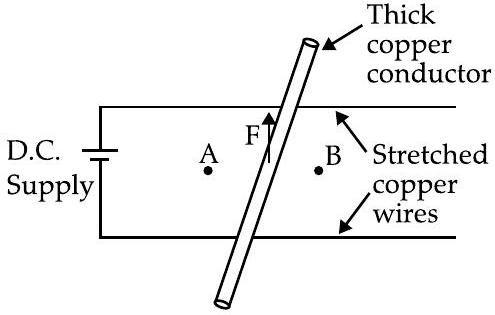
A copper conductor is placed over two stretched copper wires whose ends are connected to a D.C. supply as shown in the diagram.
(a) What should be the magnetic poles at the points A and B lying on either side of the conductor to experience the force in the upward direction?
(b) Name the law used to find these polarities.
[2]
(a) North pole at A and south pole at B.
(b) Fleming’s left hand rule.
Thermal capacities of substances A and B are same. If mass of A is more than mass of B then:
(a) Which substance will have more specific heat capacity?
(b) Which substance will show greater rise in temperature if the same amount of heat is supplied to both? [2]
(a) Since, specific heat capacity \(\propto 1 /\) mass.
The specific heat capacity of B will be more than that of A.
(b) Thermal capacities is being same, both A and B will show same rise of temperature.
How is the radioactivity of a radio isotope affected if it undergoes a chemical change? Give a reason for your answer. [2]
There will be no change.
Reason: Radioactivity is a nuclear phenomenon that will not be affected by any chemical change.
In chemical change, electrons take part.
SECTION B
The diagram below shows the ray OP travelling through an equilateral prism of a certain material.
(a) Calculate the value of \(\boldsymbol{i}_{\mathbf{2}}\), if the angle of deviation is 43°.
(b) What is the ray QS called? [3]
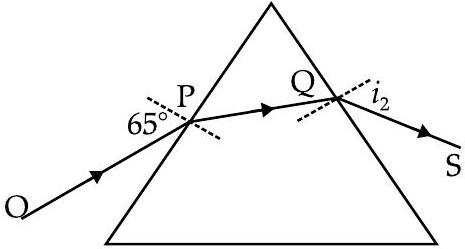
(a) Deviation \(=\delta=i_{1}+i_{2}-\mathrm{A}\)
(b) QS is called emergent ray.
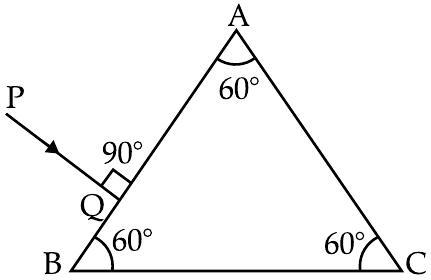
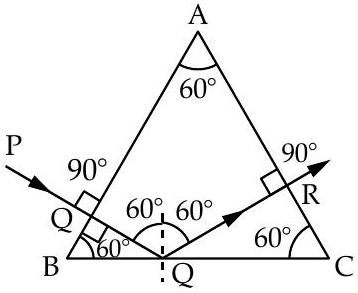
Copy the diagram given below and complete the path of the light ray PQ, as it emerges out of the prism by marking necessary angles. The critical angle of glass is 42°. [3]
The diagram below shows two parallel rays A (Orange) & B (Blue) incident from air, on airglass boundary.
(a) Copy and complete the path of the rays A and B.
(b) How do the speeds of these rays differ in glass?
(c) Are the two refracted rays in glass parallel? Give a reason. [3]
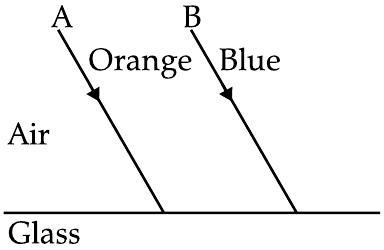
(a) Deviation of blue will be more than that of orange.
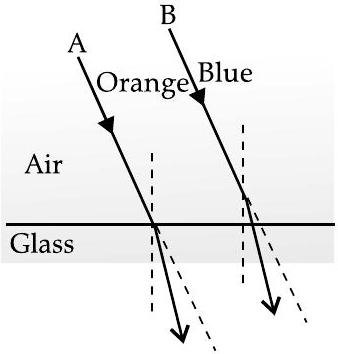
(b) Speed of blue is less than that of orange because the wavelength of blue is less than the orange.
(c) Refracted rays in the glass are not parallel because of different wavelength.
A convex lens of focal length 10 cm is placed at a distance of 60 cm from a screen. How far from the lens should an object be placed so as to obtain a real image on the screen? [3]
(a) Applying lens formula,
Or,
Or,
∴
So, the object should be placed at a distance 12 cm in front of the lens.
(a) A coin kept inside water \(\left[\mu=\frac{4}{3}\right]\) when viewed from air in a vertical direction appears to be raised by 3.0 mm. Find the depth of the coin in water.
(b) How is the critical angle related to the refractive index of a medium? [3]
(a)
or,
or,
or,
∴ Apparent depth \(=9 \mathrm{~mm}\)
∴ Real depth \(=9 \mathrm{~mm}+3 \mathrm{~mm}=12 \mathrm{~mm}\)
(b) \(\mu=\frac{1}{\sin \theta_{c}}\)
Here, all alphabets are in their usual meaning
(a) Infrared radiations are used in warfare. Explain with reason, why.
(b) A ray of light is incident at 45° on an equilateral prism in the diagram below.
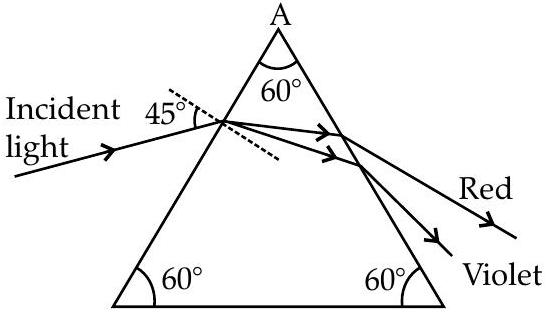
1. Name the phenomenon exhibited by the ray of light when it enters and emerges out of the prism.
2. State the cause of the above phenomenon mentioned by you. [4]
(a) Since infrared radiation provides night vision, it is used in warfare.
(b) (1) When ray enters in the prism, the phenomena exhibited are refraction, dispersion of light. When the ray emerges from the prism the phenomena exhibited are refraction and deviation.
(2) The reason of the above mentioned phenomenon is due to the difference of speed of different colours of light in a medium.
A block and tackle system of pulleys has velocity ratio 4.
(a) Draw a labelled diagram of the system indicating clearly, the direction of the load and the effort.
(b) What is the value of the mechanical advantage of the given pulley system if it is an ideal pulley system? [3]
(a)
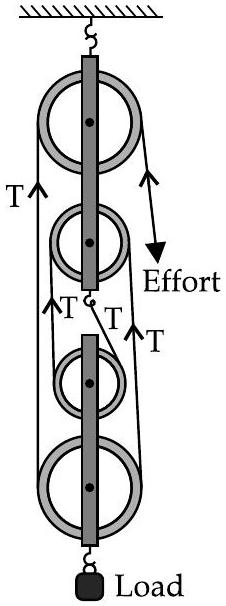
(b) Mechanical advantage \(=\frac{4 T}{T}=4\)
A metre scale of weight 50 gf can be balanced at 40 cm mark without any weight suspended on it.
(a) If this ruler is cut at its centre then state which part [0 to 50 cm or 50 to 100 cm] of the ruler will weigh more than 25 gf.

(b) What minimum weight placed on this metre ruler can balance this ruler when it is pivoted at its centre? [3]
(a) 0-50 cm part will weigh more because its balanced point is at 40 cm.
(b) When the ruler is pivoted at centre, then
( \(x\) is the minimum weight)
So,
A car of mass 120 kg is moving at a speed 18 km/h and it accelerates to attain a speed of 54 km/h in 5 seconds. Calculate:
(a) the work done by the engine.
(b) the power of the engine.
(a) Work done = Change in kinetic energy.
(b) Power \(=\frac{\text { Work done }}{\text { time }}=\frac{12000}{5}=2400 \mathrm{~W}\) [4]
(a) Which characteristic of sound is affected due to the larger surface of a school bell?
(b) Calculate the distance covered by the Ultrasonic wave having a velocity of 1.5 \(\mathbf{k m s}^{-\mathbf{1}}\) in 14 s, when it is received after reflection by the receiver of the SONAR.
[3]
(a) Amplitude or loudness is affected due to larger surface area.
(b) Distance covered \(=\frac{\text { velocity × time }}{2}\)
Or, Distance covered \(=\frac{1.5 \times 14}{2}\)
∴ Distance covered \(=1.5 \times 7=10.5 \mathrm{~km}\)
(a) Complete the following nuclear changes:
(b) Name the nuclear radiation which has the highest ionizing power. [3]
(a) \({ }_{92}^{238} \mathrm{P} \rightarrow{ }_{90}^{234} \mathrm{Q}+{ }_{2}^{4} \mathrm{He} \rightarrow{ }_{91}^{234} \mathrm{R}+{ }_{-1}^{0} \mathrm{e}\)
Alpha particle has the highest ionising power.
We are able to see the T.V. channels clearly when we set T.V. on auto-tuning.
(a) Which phenomenon led to the clear visibility of the channels, due to auto tuning?
(b) Define the above phenomenon mentioned by you.
(c) Give any one more example of this phenomenon. [4]
(a) Resonance.
(b) Resonance: The phenomenon when a body vibrates with increased amplitude under the influence of external periodic force exactly equal to the natural frequency of vibration of the body.
(c) Air in sound box vibrates with higher amplitude due to vibrating string of musical instruments. This is an example of resonance.
(a) Define specific resistance.
(b) What happens to the specific resistance of a conductor if its length is doubled?
(c) Name a substance whose specific resistance remains almost uncharged with the increase in its temperature. [3]
(a) Specific resistance: Resistance offered by a conductor of unit length and unit cross section.
(b) Specifies resistance does not change with change of length. It depends on the material and the temperature.
(c) Constantan, Manganin etc.
(a) Which nuclear radiation will travel undeviated in an electric field?
(b) How can one stop the radiations escaping from a nuclear reactor in a nuclear power plant?
(c) Name one internal source of background radiations. [3]
(a) \(\gamma\) radiation. It is made of photons having no charge.
(b) To stop radiation escaping from nuclear reactor, the power plant may be shielded with thick steel or lead wall.
(c) Biggest source of background radiation is airborne radon.
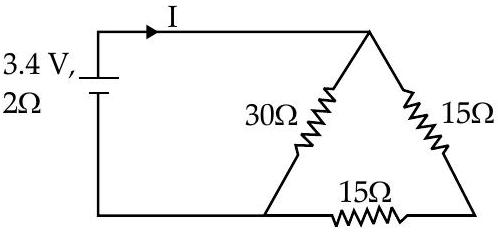
Find the value of current I drawn from the cell.
(a) Calculate the current I.
(b) Calculate the terminal voltage. [4]
(a) Two \(15 \Omega\) resistors are in series. So, their equivalent resistance (R’) is \(30 \Omega\).
Now another \(30 \Omega\) is in parallel with the combination.
So, the equivalent resistance (R”) is \(15 \Omega\).
So, the current \(=\mathrm{I}=\frac{E}{R^{\prime \prime}+r}=\frac{3.4}{15+2}=0.2 \mathrm{~A}\)
(b) Terminal voltage \(=E-I r=3.4-0.2 \times 2=3 \mathrm{~V}\)
Calculate the total amount of heat energy required to melt 200 g of ice at \(0^{\circ} \mathrm{C}\) to water at 100°C.
(Specific latent heat of ice \(=336 \mathrm{~J} \mathrm{~g}^{-\mathbf{1}}\), specific heat capacity of water \(=4.2 \mathrm{~J} \mathrm{~g}^{-1} \mathbf{o}^{-\mathbf{1}}\) ) [3]
Heat energy required for
(1) Ice at 0°C to water at 0°C conversion
(2) Water at 0°C to water at 100°C conversion
(3)
(a) State the principle of calorimetry.
(b) Name the material used for making a calorimeter.
(c) Write one characteristic property of the material chosen for making a calorimeter.
[3]
(a) Principle of calorimetry: When two or more bodies at different temperatures are brought in contact, then heat lost by a hot body is equal to the heat gained by the cold body, provided there is no heat loss in the environment.
(b) Copper is generally use for calorimeter.
(c) The material used for calorimeter should have a very low specific heat capacity.
The diagram below shows a cardboard on which iron filings are kept. A wire bent in the form of a loop is seen passing through the cardboard. When current flows through it the iron filings arrange themselves as shown below.
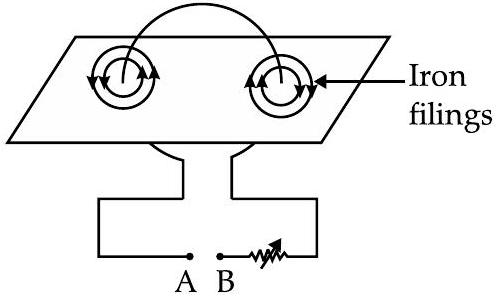
(a) State the polarities of the battery at A and B.
(b) State the effect on the magnetic field if an iron rod is held along the axis of the coil.
(c) State one way to:
1.
Change the polarity of the coil.
2. Decrease the strength of the magnetic field around the coil. [4]
(a) Since at the left side of the loop, the lines of force are anti clockwise, so the current is going upward. So, terminal A should be positive and B should be negative.
(b) If an iron rod is held along the axis, magnetic field strength will increase.
(c) 1. To change the polarity, the direction of the current is to be reversed.
2. To decrease the magnetic field strength, the current strength is to be decreased.