

Table of Contents
Last Updated on November 12, 2026 by XAM CONTENT
Practice these Class 9 Science Chapter 6 Important Questions from How Forces Affect Motion in the new NCERT Exploration. The set covers force and friction, balanced and unbalanced forces, inertia, momentum and Newton’s three laws of motion.
A force can change an object’s state of motion, speed, direction or shape. Newton’s laws connect force with inertia, momentum and acceleration, while friction is an important contact force in everyday motion.
Class 9 Science Chapter 6 Important Questions with Answers
Read the following two statements about force carefully:
Statement (I): A force always changes the state of motion of an object on which it acts.
Statement (II): Force can change the speed, direction of motion, or shape of an object.
Choose the correct option:
Ans. (c) Statement (I) is incorrect but Statement (II) is correct.
Explanation: A force does not always change the state of motion. If applied force is balanced by another (e.g., friction), the object stays at rest – the force has no effect on motion.
Force can change speed (push a ball harder), direction (deflect with a hockey stick), or shape (squeeze a rubber ball).
Hence Statement (I) is incorrect, Statement (II) is correct.
A wooden block is pulled by a spring balance across four different surfaces. The reading on the balance at the moment the block just starts to move is recorded:
| Surface | Spring balance reading (N) |
|---|---|
| Polished marble floor | 2.5 |
| Laminated table top | 4.0 |
| Wooden plank | 6.5 |
| Cemented floor | 9.0 |
From the data, on which surface is the force of friction the largest?
Ans. (d) Cemented floor
Explanation: The spring balance reading at the moment the block just starts moving equals the maximum static friction force.
Largest reading = Largest friction.
From the table, cemented floor has the highest reading (9.0 N). Hence, largest friction.
Polished marble (2.5 N) has the smallest friction, the block would slide most easily there.
Two situations of a tug-of-war are shown below:
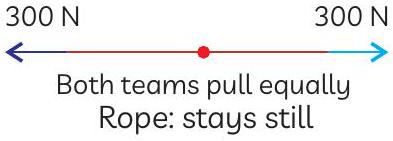
Both teams pull equally
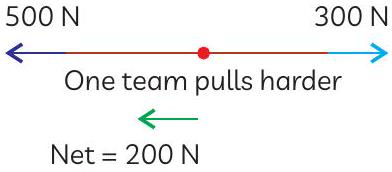
Which of the following correctly describes the two situations?
Ans. (a) (I) is balanced (rope still); (II) is unbalanced (net force \(=200 \mathrm{~N}\) to the left).
Explanation: In (I), both teams pull with equal magnitude (300 N each) in opposite directions applies net force \(=0\). Forces are balanced and rope stays still.
In (II), the left team pulls with 500 N, the right team with \(300 \mathrm{~N} \rightarrow\) net force \(=500-300=200 \mathrm{~N}\) to the left (in the direction of the larger force).
Study the figure below and answer:
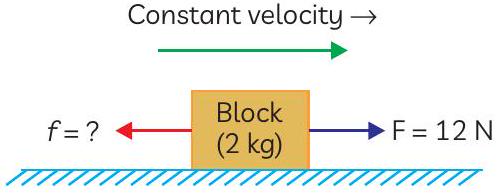
(A) What is the magnitude of the friction force \(\boldsymbol{f}\) acting on the block?
(B) How did you reach this conclusion?
Ans. (A) Since the block is moving with constant velocity, its acceleration is zero. The net force on it must be zero. So friction must exactly balance the applied force,
directed opposite to motion (i.e., to the left)
(B) Constant velocity means there is no net force, thus friction must equal the applied force in magnitude (and oppose it in direction).
“Friction is a necessary evil.” Justify this statement by giving one example each of (A) a situation where friction is helpful and necessary, and (B) a situation where friction is harmful or wasteful. In each case, briefly explain why?
Ans. (A) Helpful and necessary, example: walking.
When we walk, our foot pushes the ground backward; friction between the foot and the ground pushes us forward. Without friction, our feet would slip and we could not walk. So here, friction is essential.
(B) Harmful and wasteful, example: wear of machine parts.
In machines, friction between moving parts causes them to wear out and produces heat.
Which of the following statements correctly describe inertia?
(i) Inertia is the resistance of an object to change in its state of rest or uniform motion.
(ii) The greater the mass, the greater the inertia.
(iii) Inertia is a force that acts on an object.
(iv) Mass is the measure of inertia.
Ans. (b) (i), (ii) and (iv) only
Explanation: Statements (i), (ii) and (iv) are all correct: inertia is the resistance to change of state, and mass is its measure. Statement (iii) is incorrect beacuse inertia is a property of matter, not a force.
A cricket fielder pulls his hands backwards while catching a fast-moving ball. The most appropriate scientific reason is:
Ans. (a) It increases the time during which the ball’s momentum decreases, reducing the force on the hands.
Explanation: By Newton’s Second Law, force = rate of change of momentum. The change in momentum is fixed (the ball’s velocity must drop to zero). By increasing time period (pulling hands back), the force on the hands is reduced so that less force, less injury risk.
Match each real-life observation in Column A with the law of motion that explains it best in Column B.
| Column A (Observation) | Column B (Law) |
|---|---|
| (P) Tablecloth pulled out from under dishes | (1) Newton’s First Law |
| (Q) Pushing a heavier object needs more force on rough surface | (2) Newton’s Third Law |
| (R) A gun recoils when fired | (3) Newton’s Second Law |
| (S) Pushing moving cart increase velocity | (4) Friction |
Ans. (b) (P)-(1), (Q)-(4), (R)-(2), (S)-(3)
Explanation: Tablecloth trick shows objects resisting change in rest. Pushing harder of heavy object due to more friction, Recoil of a gun is action-reaction. Pushing moving cart gain velocity due to change in momentum due to applied force.
Assertion (A): In a long jump, an athlete is provided with a heap of sand on ground to prevent him/her from being hurt.
Reason (R): The heap of sand increases the momentum of the athlete.
Ans. (c) (A) is true but (R) is false.
Explanation: The heap of sand helps reduce the impact force on the athlete by increasing the time taken to come to rest. According to Newton’s second law of motion, force is inversely proportional to time. The sand allows the athlete’s motion to slow down gradually, reducing the force exerted on their body and preventing injury.
On 14 July 2023, ISRO launched the Chandrayaan-3 mission to the Moon. The launch vehicle (LVM3) lifted off from Sriharikota with a thunderous roar, leaving behind a thick column of hot exhaust gases.
Aanya watched the launch on TV with her father. She asked, “How can the rocket lift off when there’s nothing solid under it to push against?” Her father, an engineer, replied, “The rocket doesn’t need anything to push against, Aanya. It pushes the Exhaust gases, and the gases push back on the rocket. Newton’s Third Law.”
Later, when Chandrayaan-3 was approaching the Moon, the Vikram lander fired its engine in the same direction as its motion. This slowed the lander down, allowing it to attempt a soft landing near the lunar south pole making India the first country to do so.
(A) Identify the law of motion responsible for the liftoff of the rocket. State the action and reaction forces in this case.
(B) Aanya was confused: “If the rocket pushes gases down with the same force as the gases push the rocket up, then shouldn’t the two forces cancel and nothing should move?” Resolve her confusion.
(C) When Vikram fired its engine in the same direction as its motion, why did this slow down the lander? Use Newton’s Third Law to explain.
OR
(C) A common myth in old science fiction stories is that a rocket cannot move in outer space because there is “nothing for it to push against.” Use Newton’s Third Law to refute this myth, and use the Chandrayaan-3 example to support your reasoning.
Ans. (A) Newton’s Third Law of Motion.
(B) The two forces do not cancel because they act on two different objects.
(C) Vikram pushed exhaust gases forward (in its direction of motion); the gases pushed Vikram backward with an equal force which help in decelerating it.
OR
(C) The myth is false. By Newton’s Third Law, when a rocket ejects hot gases backward, the gases push the rocket forward with an equal and opposite force – so it needs no air to push against. Chandrayaan-3 proved this by travelling through the vacuum of space and landing on the Moon’s South Pole in 2023 using its onboard thrusters.
During a school cricket match, Aarav is fielding at deep midwicket. The batsman hits a powerful shot and the ball comes flying towards Aarav at a speed of \(25 m s^{-1}\). The mass of the cricket ball is 0.16 kg.
Aarav remembers what his coach told him: “Always pull your hands backwards while catching a fast ball.” He follows the advice, and brings the ball to rest by pulling his hands backward over a time of 0.5 seconds.
His friend Meera, watching from the boundary, asks Aarav why he pulled his hands backward when catching. “The ball was already slowing down by itself!” she says. Aarav smiles and replies, “Newton’s Second Law, Meera. More time → less force.”
(A) What is the initial momentum of the ball just before Aarav catches it?
(B) What is the change in momentum of the ball as Aarav catches it?
(C) What is the average force exerted by Aarav on the ball during the catch?
OR
(C) Suppose Aarav had not pulled his hands back, and the ball came to rest in just 0.05 seconds. What would the new average force be?
Ans. (A) Use \(p=m \times v\) with the values given.
(B) Change in momentum = final – initial.
(C) Use
OR
(C) Same change in momentum \(=4.0 \mathrm{~kg} \mathrm{~ms}^{-1}\), but time taken is now 0.05 s instead of 0.5 s (10 × shorter).
Force is inversely proportional to time: shorter time period results in larger F. This is why pulling hands back reduces force from 80 N to just 8 N which is a 10-fold reduction.
A football of mass 0.4 kg is moving at \(15 \mathrm{~ms}^{-1}\) towards a wall. After hitting the wall, it bounces back along the same line at \(9 \mathrm{~ms}^{-1}\). Calculate the change in momentum of the ball.
“If action and reaction forces are equal and opposite, they should cancel each other and nothing should ever move.” Why is this argument incorrect? Explain with an example.
Ans. Two forces can only cancel each other when they act on the same object. Action and reaction forces, by Newton’s Third Law, always act on different objects – each force has its own effect on its own object.
Example: When you kick a football, your foot exerts a forward force on the ball (action). The ball exerts an equal backward force on your foot (reaction).
The velocity-time graph below is for a 1500 kg sports car moving along a straight road. Using the graph, calculate the force acting on the car during the time intervals (A) 0-5 s, (B) 5-10 s, and (C) 10-15 s.
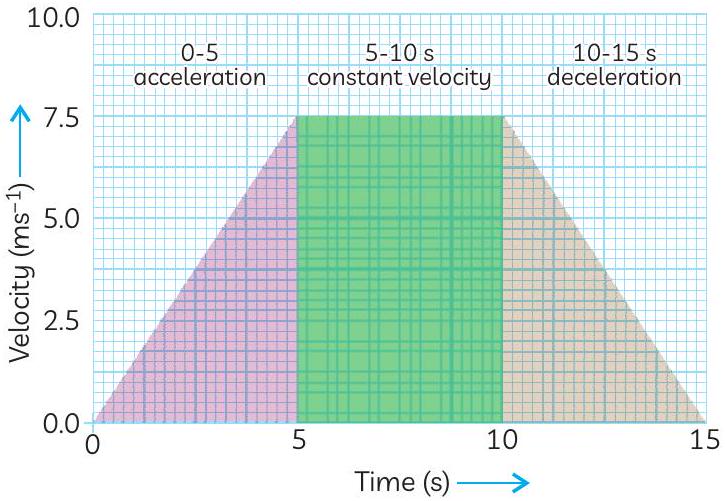
Ans. Read acceleration from the slope of each segment of the \(v-t\) graph, then use \(\mathrm{F}=m a\).
(A) 0-5 s: \(v\) goes \(0 \rightarrow 10 \mathrm{~ms}^{-1}\)
(B) 5-10 s: constant velocity
(C) 10-15 s: \(v\) goes 10 → 0
Support the statement: “Newton’s First Law of Motion gives a qualitative definition of force; Newton’s Second Law gives a quantitative measure.” Explain with examples.
Ans. First Law (Qualitative): An object remains at rest or in uniform motion unless an external force acts on it. This define force as “that which changes the state of motion of an object”, but it does not tell us how much force is needed for a given change.
Second Law (Quantitative): \(\mathrm{F}=m a\). This measure force in terms of mass and acceleration.
Example: To accelerate a 10 kg object at \(2 \mathrm{~ms}^{-2}\), we need exactly \(\mathrm{F}=10 \times 2=20 \mathrm{~N}\).
The \(1^{\text {st }}\) Law alone cannot give this number but only the \(2^{\text {nd }}\) Law can.
Hence the two laws together form a complete picture: the \(1^{\text {st }}\) Law identifies force qualitatively, and the \(2^{\text {nd }}\) Law quantifies it. The \(1^{\text {st }}\) Law is actually a special case of the \(2^{\text {nd }}\) Law (when \(\mathrm{F}=0, a=0\) ).
In force questions, first identify the object whose motion you are analysing and draw attention to the forces acting on that object. For Newton’s third law, remember that action and reaction act on different bodies; for Newton’s second law, keep the direction or sign of momentum and acceleration consistent.
Class 9 Science Chapter 6 Important Questions — FAQs
What is a force?
A force is a push or pull that can change the state of rest or motion, speed, direction or shape of an object.
What is the difference between balanced and unbalanced forces?
Balanced forces produce zero net force and do not change an object’s state of motion, while unbalanced forces produce a non-zero net force and cause acceleration.
What is inertia?
Inertia is the tendency of an object to resist a change in its state of rest or uniform motion. Mass is a measure of inertia.
What is momentum?
Momentum is the product of mass and velocity: \(p=mv\).
Why do action and reaction forces not cancel each other?
They act on two different objects. Forces cancel only when equal and opposite forces act on the same object.
You May Also Like
- Class 9 Science Chapter 1 Important Questions with Answers – Understanding Science: How to Explore the World? (Exploration)
- Class 9 Science Chapter 2 Important Questions with Answers – Cell: The Building Block of Life (Exploration)
- Class 9 Science Chapter 3 Important Questions with Answers – Tissues (Exploration)
- Class 9 Science Chapter 4 Important Questions with Answers – Describing Motion Around Us (Exploration)
- Class 9 Science Chapter 5 Important Questions with Answers – Exploring Mixtures and their Separation (Exploration)
- Class 9 Science Chapter 6 Important Questions with Answers – How Forces Affect Motion (Exploration)
- Class 9 Science Chapter 7 Important Questions with Answers – Work, Energy, and Simple Machines (Exploration)