

Table of Contents
Last Updated on November 12, 2026 by XAM CONTENT
Practice these Class 9 Science Chapter 4 Important Questions from Describing Motion Around Us in the new NCERT Exploration. The set covers distance and displacement, speed and velocity, acceleration, circular motion, motion graphs and equations of motion.
Motion is described relative to a reference point using quantities such as distance, displacement, speed, velocity and acceleration. Graphs and equations help us analyse how these quantities change with time.
Class 9 Science Chapter 4 Important Questions with Answers
For a moving object, the numerical ratio of displacement to distance is:
Ans. (d) equal or less than 1.
Explanation: Displacement is the shortest distance between the initial and final position whereas distance is the actual length of the path travelled by an object. For a moving object, distance is always more than or equal to displacement. Thus, the ratio of displacement to distance is equal to or less than 1.
Aruna runs one complete round on a circular race track. Which of the following statements are correct about her motion?
(i) Displacement is zero
(ii) Distance covered is zero
(iii) Velocity remains constant throughout
(iv) Motion is accelerated
(v) Direction of motion changes continuously
Ans. (b) (i), (iv) and (v)
Explanation: After one complete round, Aruna returns to the starting point, so displacement is zero, but distance is not zero.
In circular motion, direction changes continuously, so velocity is not constant and motion is accelerated.
Vijay Pandey rides his bicycle from his house to a game store. Then he returns back to his house and finally goes to his friend’s house from his house on the same straight road.
What is the total distance travelled and displacement of Vijay?
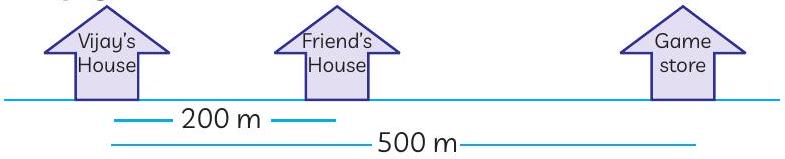
Ans. (b) Distance = 1200 m, Displacement = 200 m
Explanation: Distance travelled = 500 m (house to game store) + 500 m (return home) + 200 m (house to friend) = 1200 m.
Displacement is total distance between initial position and final position i.e., from Vijay’s House to his Friend’s house = 200 m.
A boy walks to his home at a distance of 6 km with a constant speed of 2.5 km per hour and walks back at a constant speed of 4 km per hour. What is the average speed of a round trip in km per hour?
Ans. (d) \(\frac{40}{13} km/h\)
Explanation: Given,
Distance, \(s=6 \mathrm{~km}\)
Boy covered a 6 km distance with a speed of 2.5 km/h in time \(t_1\).
While returning, the boy covered a 6 km distance with a speed of 4 km/h in time \(t_2\).
Total time,
Average speed,
Rita was enjoying a ride on a Ferris wheel which is revolving at a constant speed of 5 m/s. This shows that Rita is:
Ans. (c) in accelerated motion
Explanation: Rita is moving at a constant speed, but her velocity changes due to the continuous change in direction. Since velocity is changing, she is undergoing accelerated motion.
Assertion (A): The total distance travelled by an object can never be less than the magnitude of its displacement.
Reason (R): Displacement is the shortest straight-line distance between the initial and final positions, while distance is the total path length covered.
Ans. (a) Both (A) and (R) are true, and (R) is the correct explanation of (A).
Explanation: Displacement measures only the net change in position (shortest path), whereas distance accounts for the entire path travelled, including any back-and-forth motion. Therefore distance \(\geq\) |displacement| always, with equality only when the object moves in a single direction without turning back.
Raza and his brother Suhail ride their bicycles to school, leaving home at the same time and following the same route. However, they arrive at school at different times.

The distance they travelled at various periods is shown in the table below:
| Time | Distance travelled by Raza (km) | Distance travelled by Suhail (km) |
|---|---|---|
| 8:00 a.m. | 0 | 0 |
| 8:05 a.m. | 1 | 0.8 |
| 8:10 a.m. | 1.9 | 1.6 |
| 8:15 a.m. | 2.8 | 2.3 |
| 8:20 a.m. | 3.6 | 3 |
| 8:25 a.m. | – | 3.6 |
(A) Compare the average speed of Raza with that of Suhail.
(B) What will be Suhail’s speed in the last 5 minutes of his ride?
(C) Who reaches school faster, Raza or Suhail?
Ans. (A) Average speed of Raza will be:
Average speed of Suhail will be:
Average speed of Raza will be more than that of Suhail.
(B) Distance travelled in last \(5\mathrm{~min}=0.6\mathrm{~km}\)
Time taken, \(t=5\mathrm{~min}=\frac{5}{60}\mathrm{~h}\)
Therefore, speed covered by him in the last 5 minutes is 7.2 km/h.
(C) Since Raza reaches the final distance of 3.6 km in 20 minutes, while Suhail takes 25 minutes, Raza reaches school faster.
Read the three claims made by students during a class discussion:
(I) Anita: “If the speedometer of a car shows the same reading for 5 minutes, the acceleration of the car must be zero.”
(II) Bilal: “Distance can never be smaller than the magnitude of displacement.”
(III) Charu: “An object moving horizontally and slowing down has zero velocity the moment it stops, so its acceleration must also be zero at that point.”
Evaluate each claim, state whether it is correct or incorrect, and justify your decision in one or two sentences for each.
Ans. Anita’s claim is Incorrect.
The speedometer shows only the magnitude of velocity (speed). If the car turns along a curve, the direction of velocity changes, so acceleration is non-zero even when the speedometer reading is unchanged.
Bilal’s claim is Correct.
The actual path length is always at least equal to the shortest straight-line path between the start and end points. So distance \(\geq\) |displacement|, with equality only when motion is in a straight line in one direction.
Charu’s claim is Incorrect.
When the object is slowing down, a deceleration (negative acceleration) is acting on it the whole time. At the exact moment it stops, the velocity becomes zero, but the acceleration is still acting. In fact, that acceleration is the very reason the object slowed down and came to rest.
State which of the following situations are possible and give an example for each of these:
(A) An object with equal distance and equal displacement.
(B) An object moving with acceleration but with uniform speed.
(C) An object moving in a certain direction with an acceleration in the perpendicular direction.
Ans. (A) When an object move within same straight line of motion.

(B) In uniform circular motion, an object covers equal distances in equal intervals of time, but its direction continuously changes. Since velocity depends on both speed and direction, this change in direction causes acceleration even if the speed remains constant.
Example: A car moving at a steady speed around a circular track undergoes acceleration directed towards the center.
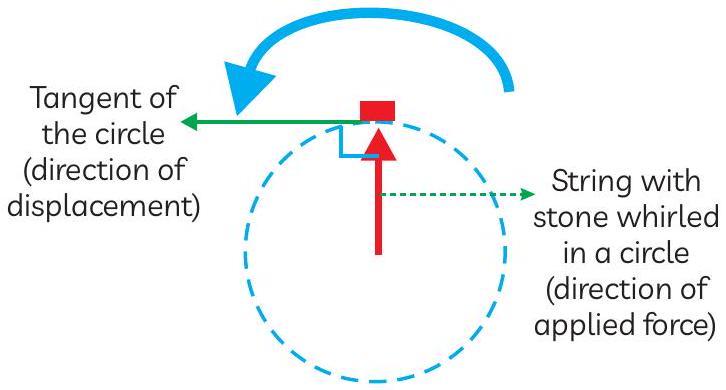
(C) When an object moves in a circular path, its velocity is always tangential, while the acceleration (centripetal acceleration) is always directed towards the center of the circle. This perpendicular acceleration keeps the object in circular motion.
Example: A stone tied to a string and swung in a circle experiences centripetal acceleration towards the center of rotation.
A train moves with a speed of 30 km/h in the first 15 minutes, with another speed of 40 km/h in the next 15 minutes and then with a speed of 60 km/h in the last 30 minutes. Calculate the average speed of the train for this journey.
Ans. Distance = Speed × Time
Distance 1, \(D_1=30\times\frac{15}{60}=7.5\mathrm{~km}\)
Distance 2, \(D_2=40\times\frac{15}{60}=10\mathrm{~km}\)
Distance 3, \(D_3=60\times\frac{30}{60}=30\mathrm{~km}\)
Total distance, \(D=D_1+D_2+D_3\)
Total Time, \(T=\frac{15}{60}+\frac{15}{60}+\frac{30}{60}=1\) hour
An athlete runs along a straight track as shown in the image. She starts at 0 at \(t=0\mathrm{~s}\), reaches A at \(t=12\mathrm{~s}\), then runs back to C at \(t=20\mathrm{~s}\).
From the figure, find:
(A) total distance travelled,
(B) magnitude of displacement, and
(C) average speed and magnitude of average velocity over the 20-second journey.
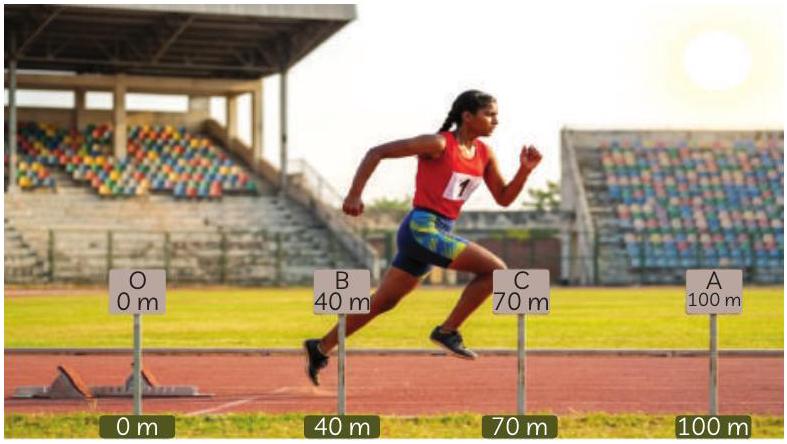
Ans. Given in figure: \(O=0\mathrm{~m}, A=100\mathrm{~m}, C=70\mathrm{~m}\). Athlete moves O → A → C.
(A) Total distance:
(B) Magnitude of displacement:
(in the positive direction)
(C) Average speed and average velocity over \(t=20\mathrm{~s}\):
(in direction O → C)
Sana goes for a morning jog around a circular park track of radius 70 m (use \(\pi=\frac{22}{7}\)). Starting from a point P on the track, she completes the rounds as described below.
Analyse the following three cases and find (in each) the total distance covered and the magnitude of the displacement:
(I) Case A: Sana runs exactly half a round (semicircle), ending at the diametrically opposite point of P.
(II) Case B: Sana runs exactly one complete round and stops back at P.
(III) Case C: Sana runs two-and-a-half rounds and stops at the diametrically opposite end of P.
Then justify: “For circular paths, displacement depends only on the start and end points and not on the number of complete rounds covered in between.” Use your answers to support this statement.
Ans. Given: \(R=70\mathrm{~m}, \pi=\frac{22}{7}\)
(straight-line distance from P to the diametrically opposite point)
Case A: Half a round (semicircle):
Case B: One complete round:
Case C: Two-and-a-half rounds:
(start at P; end at diametrically opposite point after 2 full rounds + half round)
Justification of the statement:
In Cases A and C the start point is P and the end point is the diametrically opposite point, even though the distances covered (220 m vs 1100 m) are very different, the displacements are identical (140 m). In Case B the start and end points coincide, so displacement = 0, regardless of having covered 440 m. This confirms that displacement depends only on the relative positions of the start and end points, not on the number of complete rounds (which only adds to the distance, not displacement).
Match each graphical feature in Column A with the physical quantity it represents in Column B.
| Column A (Feature) | Column B (Physical quantity) |
|---|---|
| (P) Slope of distance-time graph | (1) Acceleration |
| (Q) Slope of velocity-time graph | (2) Object at rest |
| (R) Area under velocity-time graph | (3) Displacement/distance |
| (S) Distance-time graph parallel to \(t\)-axis | (4) Speed |
Ans. (a) (P)-(4), (Q)-(1), (R)-(3), (S)-(2)
Explanation: Slope of distance-time graph \(=\frac{\Delta s}{\Delta t}=\) speed.
Slope of velocity-time graph \(=\frac{v-u}{t_2-t_1}=\) acceleration.
Area under velocity-time graph = velocity × time = displacement (or distance for one-direction motion).
Horizontal d-t graph means distance unchanged i.e., object at rest.
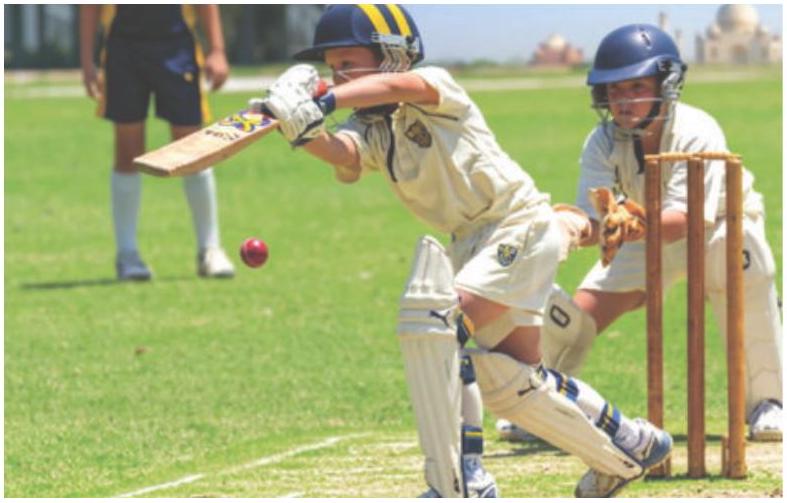
Some boys are playing cricket. A boy hits the ball and the ball slide over the surface of the ground (horizontally) with an initial velocity of 2 m/s, but its velocity decreases due to some external means at the rate of \(0.2\mathrm{~m/s^2}\). How much time will it take for the ball to stop?
Ans. (c) 10 s
Explanation: Given,
Initial velocity, \(u=2\mathrm{~m/s}\)
Final velocity, \(v=0\)
Since, velocity decreases, so it shows retardation,
Applying the first equation of motion,
A train’s velocity-time graph is shown below for a 360-second portion of its journey. It accelerates uniformly from rest, runs at constant velocity, then decelerates to a stop.
Using the graph, calculate:
(A) The acceleration during the first 60 s of motion.
(B) The deceleration during the last phase (240 s to 360 s).
(C) The total distance travelled by the train in 360 s, using the area-under-graph method.
(D) Verify the distance covered in Phase 1 (0-60 s) using the equation \(v^{2}=u^{2}+2as\).
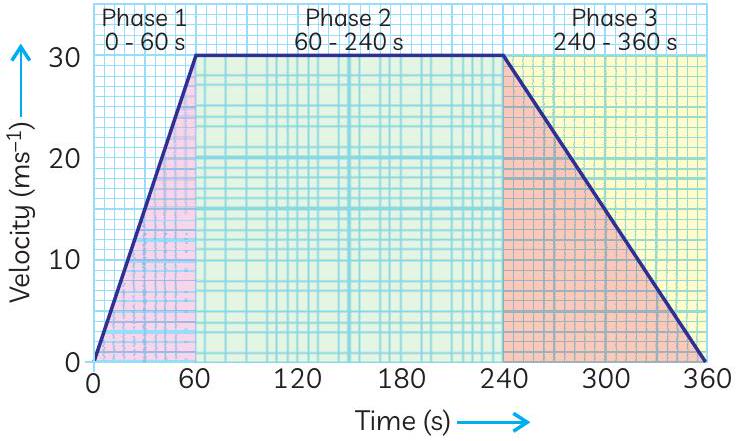
Ans. (A) Acceleration in Phase 1 (0-60 s):
(B) Deceleration in Phase 3 (240-360 s):
Magnitude \(=0.25\mathrm{~ms}^{-2}\); direction is opposite to motion (deceleration).
(C) Total distance from area under \(v-t\) curve:
Phase 1 (triangle): \(\frac{1}{2}\times60\times30=900\mathrm{~m}\)
Phase 2 (Rectangle): \(30\times(240-60)=30\times180=5400\mathrm{~m}\)
Phase 3 (triangle): \(\frac{1}{2}\times(360-240)\times30=\frac{1}{2}\times120\times30=1800\mathrm{~m}\)
Total distance \(=900+5400+1800=8100\mathrm{~m}=8.1\mathrm{~km}\)
(D) Verify Phase 1 distance using \(v^{2}=u^{2}+2as\):
Given: \(u=0, v=30, a=0.5\)
Always distinguish scalar quantities from vector quantities. In graph questions, remember: slope of a distance–time graph gives speed, slope of a velocity–time graph gives acceleration, and area under a velocity–time graph gives displacement or distance for one-direction motion.
Class 9 Science Chapter 4 Important Questions — FAQs
What is the difference between distance and displacement?
Distance is the total length of the actual path travelled, while displacement is the shortest straight-line change in position from the initial point to the final point, with direction.
What is the difference between speed and velocity?
Speed is a scalar quantity that tells how fast an object moves, while velocity is a vector quantity that includes both speed and direction.
Why is uniform circular motion accelerated motion?
Even when speed remains constant, the direction of velocity changes continuously in circular motion. Therefore velocity changes and the object has centripetal acceleration.
What does the slope of a velocity-time graph represent?
The slope of a velocity-time graph represents acceleration.
What does the area under a velocity-time graph represent?
The area under a velocity-time graph represents displacement; for motion in one direction, its magnitude also gives the distance travelled.
You May Also Like
- Class 9 Science Chapter 1 Important Questions with Answers – Understanding Science: How to Explore the World? (Exploration)
- Class 9 Science Chapter 2 Important Questions with Answers – Cell: The Building Block of Life (Exploration)
- Class 9 Science Chapter 3 Important Questions with Answers – Tissues (Exploration)
- Class 9 Science Chapter 4 Important Questions with Answers – Describing Motion Around Us (Exploration)
- Class 9 Science Chapter 5 Important Questions with Answers – Exploring Mixtures and their Separation (Exploration)
- Class 9 Science Chapter 6 Important Questions with Answers – How Forces Affect Motion (Exploration)
- Class 9 Science Chapter 7 Important Questions with Answers – Work, Energy, and Simple Machines (Exploration)