
Table of Contents
Last Updated on November 12, 2026 by XAM CONTENT
Practice these Class 9 Science Chapter 2 Important Questions from Cell: The Building Block of Life in the new NCERT Exploration. The set covers microscopy, osmosis, cell organelles, plant and animal cells, mitosis, meiosis, cancer and cell division.
The cell is the basic structural and functional unit of life. Its organelles perform specialised functions, while cell division enables growth, repair, reproduction and continuity of life.
Class 9 Science Chapter 2 Important Questions with Answers
Ayan views a slide of onion root cells in a compound microscope under a low power objective. He wants to increase the magnification to see the slide in a more clear manner. His teacher tells him to centre the portion of the slide he wants to see in the field of view before he shifts to the high power objective. This is important because ____.
Ans. (a) Under high power, a smaller area of the slide is observed.
Explanation: When the microscope is shifted from a low power objective to a high power objective, the magnification increases, but the field of view decreases. This means only a smaller portion of the slide can be seen under high power. Therefore, the desired part must first be centred while using low power so that it remains visible after switching to high power.
If the cell is placed in a hypotonic solution, water will move ____ the cell, causing it to ____.
Ans. (a) into, swell
Explanation: In a hypotonic solution, the concentration of water is higher outside the cell than inside. Therefore, water enters the cell by osmosis, causing the cell to swell.
Which of these properties qualifies Amoeba as a eukaryote?
Ans. (c) It has a membrane bound nucleus.
Explanation: Amoeba qualifies as a eukaryote because it has a membrane-bound nucleus, which is a defining feature of eukaryotic cells. While Amoeba is unicellular and needs food for energy, these characteristics are not exclusive to eukaryotes. The presence of a membrane-bound nucleus sets eukaryotes apart from prokaryotes, which lack a membrane-bound nucleus.
Identify the cellular structures (X) and (Y) based on the provided details:
(I) Cell (X) relies on its rigid outer boundary to withstand hypotonic environments and prevent bursting from osmotic pressure.
(II) Cell (X) can synthesize its own food using light energy, whereas cell (Y) must obtain food materials from its surroundings.
(III) Both cell (X) and cell (Y) possess a well-defined nucleus.
Ans. (b) (X) is plant cell; (Y) is animal cell
Explanation: Statement (I) indicates a rigid cell wall, which is present in plant cells but absent in animal cells. Statement (II) indicates photosynthesis (autotrophic nutrition) in cell (X), which is a feature of plant cells, while the animal cells are heterotrophic. Statement (III) confirms both are eukaryotic as they have a nucleus. Hence, (X) is a plant cell and (Y) is an animal cell.
Which of the following statement is INCORRECT for mitochondria and chloroplasts?
Ans. (c) Both organelles are the only sites in the cell where waste materials are broken down by powerful digestive enzymes.
Explanation: The mitochondria and chloroplasts are semi-autonomous organelles with their own DNA and ribosomes, supporting the endosymbiotic theory, and have double membranes. The waste breakdown by powerful digestive enzymes (hydrolytic enzymes) is the function of lysosomes.
Assertion (A): Raisins swell up in hypotonic solution and do not burst.
Reason (R): Cell wall exerts pressure on the swollen cell.
Ans. (a) Both (A) and (R) are true, and (R) is the correct explanation of (A).
Explanation: In a hypotonic solution, water enters the cell by the process of osmosis because the concentration of water is higher outside than inside the cell. As water moves in, the cell becomes swollen and develops internal pressure against its boundary. In plant cells, the rigid cell wall resists this pressure by exerting an equal and opposite force, known as turgor pressure. This balance of forces prevents the cell from bursting and allows it to remain stable even in very dilute external solutions.
Dr Parimal, a professor of Botany visited the Botanical Garden of Noida where many students had gathered for a tour. Students were very excited to explore the garden, which had a variety of plants with colorful flowers and different types of fruits. Some flowers were white, and the unripe fruits were green. The air was filled with pleasant fragrances from the flowers.
Lots of birds and insects were seen that were feeding on fruits and flowers, also helping in pollination and fruit dispersion. Students who were in the park recognised Dr. Parimal and out of curiosity asked the following questions.
(A) Which process is responsible for the spread of the pleasant fragrance throughout the area?
(a) Osmosis
(b) Reverse Osmosis
(c) Diffusion
(d) Evaporation
(B) Which plastid gives colour to flowers and fruits?
(a) Chloroplast
(b) Chromoplast
(c) Leucoplast
(d) Plasmolysis
(C) Why were unripe fruits green in colour?
(a) Due to the presence of chloroplast.
(b) Due to the presence of chromoplast.
(c) Due to the presence of leucoplast.
(d) Due to the absence of chloroplast.
(D) Choose the statement that shows the similarity between plastids and mitochondria.
(a) Both are equal in size.
(b) Both are semi-autonomous.
(c) Both hare identical shape.
(d) Both are present in animal cell.
OR
(D) Assertion (A): Chloroplast is the only plastid found in plants.
Reason (R): Plastids are responsible to provide colour to fruits and flowers.
(a) Both (A) and (R) are true, and (R) is the correct explanation of (A).
(b) Both (A) and (R) are true, and (R) is not the correct explanation of (A).
(c) (A) is true but (R) is false.
(d) (A) is false but (R) is true.
(A) (c) Diffusion
Explanation: Diffusion is the process responsible for the spread of the pleasant fragrance everywhere in the park. It is the process of moving substances from an area of higher concentration to an area of lower concentration until equilibrium is reached. This results in a uniform distribution of the substance throughout the surrounding space.
(B) (b) Chromoplast
Explanation: Chromoplasts contain pigments such as carotenoids that give flowers and fruits reddish, yellow, orange, pink, purple, and brownish colours. These colours help attract insects and birds for pollination and seed dispersal. They do not contain chlorophyll, so they do not produce green colour.
(C) (a) Due to the presence of chloroplast.
Explanation: Chloroplasts are present in the skin of unripe fruits, where they play a role in photosynthesis. As the fruits ripen, chloroplasts transform into chromoplasts, which are responsible for the red, yellow, orange, and other colors seen in ripe fruits. This color change is due to the presence of pigments like carotenoids in chromoplasts, which attract pollinators or help in seed dispersal.
(D) (b) Both are semi-autonomous.
Explanation: Both plastids (like chloroplasts) and mitochondria have their own DNA and are capable of self-replication, making them semi-autonomous organelles.
OR
(D) (d) (A) is false but (R) is true.
Explanation: There are three types of plastids found in plants namely chloroplast, chromoplast and leucoplast. Chromoplasts are responsible for imparting colour to fruits and flowers.
(A) The teacher draws the following diagram on the smart board and asks her students to identify the diagram and label its parts.
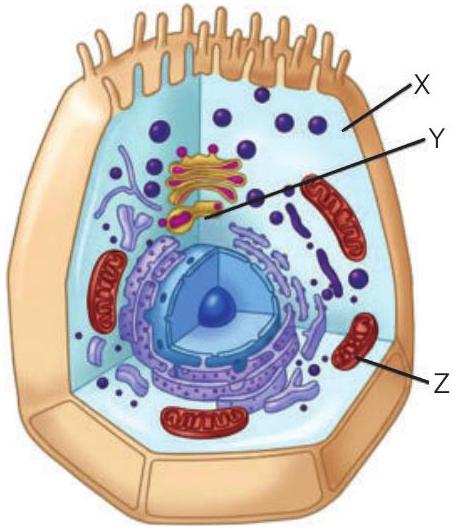
(i) The brain of the cell.
(ii) The jelly like-substance that is present in the brain of the cell.
(iii) The organelle which contains powerful digestive enzymes.
(iv) The organelle which takes part in storage, modification and packaging.
(B) Why is ‘X’ called selectively permeable membrane?
(C) Identify the structure marked as ‘Y’.
(D) Why is ‘Z’ called a strange organelle? Write its main function.
(A) The diagram is of animal cell.
(i) The brain of the cell – Nucleus.
(ii) The jelly – like substance present in the brain of the cell – Nucleoplasm.
(iii) Organelle which contains powerful digestive enzyme – Lysosomes.
(iv) Organelle which takes part in storage, modification and packaging – Golgi apparatus.
(B) ‘X’ is the plasma membrane or cell membrane. It is called a selectively permeable membrane because it regulates the entry and exit of certain substances, allowing some materials to pass through while blocking others.
(C) The structure marked as ‘Y’ is centriole.
(D) Organelle ‘Z’ is mitochondria. It is called a strange organelle because it has its own DNA and ribosomes, allowing it to make some of its own proteins.
Function of mitochondria: Mitochondria is called the powerhouse of the cell. It generate energy for various chemical processes by producing ATP. The inner folds of the mitochondrion, called cristae, increase the surface area, enhancing the efficiency of ATP production through chemical reactions.
A person accidentally cuts his finger. Over the next few days, the wound heals by the formation of new skin cells. Which process is primarily responsible for this repair?
Ans. (b) Mitosis
Explanation: Mitosis produces two genetically identical daughter cells from a single parent cell. In multicellular organisms like humans, mitosis is the key process for growth, repair, and replacement of damaged cells. Meiosis is involved in gamete formation, while binary fission and budding are methods of reproduction in certain organisms.
The given diagram shows the progression from a normal cell to a malignant tumour through genetic changes and uncontrolled cell division.
Which of the following statements best explains this progression?
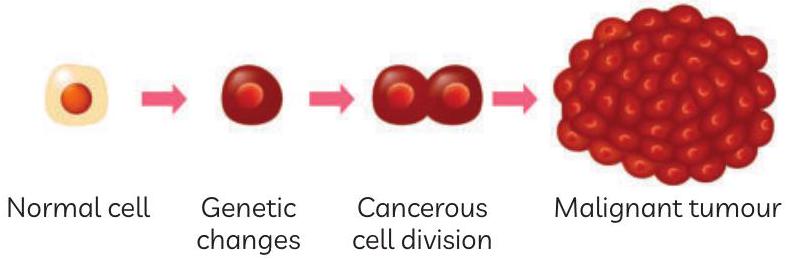
Ans. (b) Genetic changes cause loss of control over cell division, resulting in continuous cell division and tumour formation.
Explanation: A normal cell divides in a controlled way. When genetic changes (mutations) occur, the control over the cell cycle is lost. As a result, cells keep dividing uncontrollably, forming a mass of cells called a tumour. If this tumour invades nearby tissues and spreads, it becomes malignant (cancerous).
In a laboratory, 500 human skin cells are placed in a cell culture flask. After three complete cell cycles (all cells divide synchronously), what will be the total number of cells?
Ans. (c) 4000
Explanation: Cell division in human skin cells occurs by Mitosis, where each cell divides into 2 daughter cells every cycle.
Initial number of cells \(=500\)
After 1 cycle: \(500 \times 2=1000\)
After 2 cycles: \(1000 \times 2=2000\)
After 3 cycles: \(2000 \times 2=4000\)
Assertion (A): Meiosis is a specialized form of cell division that is absolutely necessary for sexual reproduction to occur across generations.
Reason (R): Meiosis halves the chromosome number in reproductive cells (gametes) so that the original chromosome number is restored during fertilization.
Ans. (a) Both (A) and (R) are true, and (R) is the correct explanation of (A).
Explanation: If human reproductive cells (sperm and egg) were created by regular mitosis, they would each have 46 chromosomes. Upon fusing during fertilization, the resulting child would have 92 chromosomes, disrupting the human genetic code. Meiosis prevents this by introducing two rounds of division, purposefully cutting the chromosome count in half to create gametes with 23 chromosomes. When these gametes combine, the standard 46-chromosome count is restored, maintaining the stability of the species generation after generation.
Why is it biologically critical for gametes to have exactly half the amount of DNA compared to the parent cell?
Gametes must have half the genetic material because during sexual reproduction and fertilisation, a gamete from each of the two individuals combines. Having half the DNA ensures that when these gametes fuse, the original, standard chromosome number of the species is accurately restored in the offspring.
Flowchart (A) shows a single parent cell dividing once to yield two identical cells. Flowchart (B) shows a single parent cell dividing into two, which then immediately divide again to form four cells with distinct, coloured internal structures.
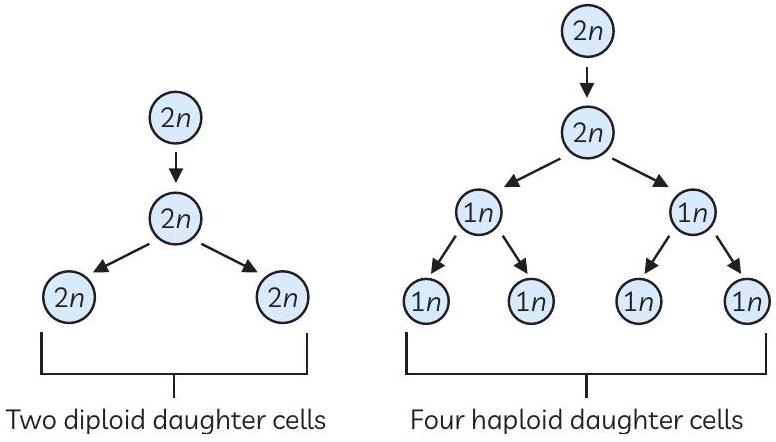
(A) Identify the cellular processes depicted in flowchart (A) and flowchart (B).
(B) Justify why the process in flowchart (B) is essential for creating variations among living organisms.
(A) Flowchart (A) depicts mitosis, which produces two identical daughter cells, while flowchart (B) depicts meiosis, which produces four gametes through a two-step division process.
(B) The process in flowchart (B) (meiosis) is strictly for sexual reproduction and is essential because it reduces the chromosome number to half and creates genetic diversity in the gametes. This diversity ensures that offspring inherit variations and resemble their parents without being exact identical copies.
Create a comparative analysis between mitosis and meiosis by evaluating the following parameters:
(A) The primary function in the organism.
(B) The specific types of cells where each process occurs.
(C) The total number of divisions and the final number of daughter cells produced.
(D) The genetic makeup and chromosome count of the daughter cells relative to the parent.
(A) Mitosis functions to facilitate normal body growth, tissue repair, and asexual reproduction, whereas meiosis is exclusively responsible for sexual reproduction and creating genetic diversity.
(B) Mitosis occurs in somatic (body) tissues, such as actively dividing skin cells or onion root tips, while meiosis occurs only in the cells of reproductive organs (like testes/ovaries in animals or anthers/ovaries in plants).
(C) Mitosis involves a single division resulting in two daughter cells, whereas meiosis is a two-step division process that yields four distinct daughter cells.
(D) Genetically, mitosis produces identical daughter cells that maintain the exact same DNA and chromosome number as the parent cell. In contrast, meiosis reduces the genetic material, producing gametes that contain exactly half the number of chromosomes compared to the parent cell, ensuring variation.
For cell questions, connect structure with function. For cell division, first decide whether the situation involves growth/repair or sexual reproduction, then identify mitosis or meiosis accordingly.
Class 9 Science Chapter 2 Important Questions — FAQs
Why is the cell called the structural and functional unit of life?
All living organisms are made of cells, and cells carry out the basic processes necessary for life.
What happens to a cell in a hypotonic solution?
Water enters the cell by osmosis. An animal cell may swell considerably, while a plant cell is protected from bursting by its rigid cell wall.
Why are mitochondria called semi-autonomous organelles?
Mitochondria contain their own DNA and ribosomes and can synthesise some of their own proteins.
What is the main difference between mitosis and meiosis?
Mitosis produces two genetically identical daughter cells with the same chromosome number, while meiosis produces four genetically different cells with half the chromosome number.
Why can uncontrolled cell division lead to cancer?
When normal cell-cycle controls fail, cells may continue dividing without stopping, forming tumours that can become malignant.
You May Also Like
- Class 9 Science Chapter 1 Important Questions with Answers – Understanding Science: How to Explore the World? (Exploration)
- Class 9 Science Chapter 2 Important Questions with Answers – Cell: The Building Block of Life (Exploration)
- Class 9 Science Chapter 3 Important Questions with Answers – Tissues (Exploration)
- Class 9 Science Chapter 4 Important Questions with Answers – Describing Motion Around Us (Exploration)
- Class 9 Science Chapter 5 Important Questions with Answers – Exploring Mixtures and their Separation (Exploration)
- Class 9 Science Chapter 6 Important Questions with Answers – How Forces Affect Motion (Exploration)
- Class 9 Science Chapter 7 Important Questions with Answers – Work, Energy, and Simple Machines (Exploration)