

Table of Contents
Last Updated on November 7, 2026 by XAM CONTENT
Practice these Class 9 Maths Chapter 4 Important Questions from Exploring Algebraic Identities in the new NCERT Ganita Manjari. The set covers algebraic identities, visual interpretation, expansion, factorisation, cubes and rational expressions. Attempt each question first, then open the solution to check your method.
An algebraic identity is true for all permissible values of its variables. Identities can be used in both directions: to expand algebraic expressions and to recognise patterns for factorisation.
Important Algebraic Identities
| Identity | Formula |
|---|---|
| Square of a sum | \((a+b)^2=a^2+2ab+b^2\) |
| Square of a difference | \((a-b)^2=a^2-2ab+b^2\) |
| Difference of two squares | \((a+b)(a-b)=a^2-b^2\) |
| Square of three terms | \((a+b+c)^2=a^2+b^2+c^2+2ab+2bc+2ca\) |
| Product with common first term | \((x+a)(x+b)=x^2+(a+b)x+ab\) |
| Cube of a sum | \((a+b)^3=a^3+3a^2b+3ab^2+b^3\) |
| Cube of a difference | \((a-b)^3=a^3-3a^2b+3ab^2-b^3\) |
| Sum of cubes | \(a^3+b^3=(a+b)(a^2-ab+b^2)\) |
| Difference of cubes | \(a^3-b^3=(a-b)(a^2+ab+b^2)\) |
Remember that \((a+b)^2\neq a^2+b^2\). The middle term \(2ab\) is essential. Similarly, when factorising, check both the sum and the product of the numbers used to split the middle term.
Class 9 Maths Chapter 4 Important Questions with Solutions
Which statement is an algebraic identity?
An identity is true for every permissible value of its variable. Expanding the left side gives
Answer: B.
Take three consecutive natural numbers \((n-1),n,(n+1)\). Prove that the sum of the squares of the first and third numbers minus twice the square of the middle number is always 2.
The required expression is
The variable \(n\) disappears completely, so the value is 2 for every natural number \(n\).
A square has side \((a+b)\). Explain how its area gives the identity \((a+b)^2=a^2+2ab+b^2\). Hence expand \((3x+2y)^2\).
A square of side \((a+b)\) can be divided into one square of area \(a^2\), one square of area \(b^2\), and two rectangles of area \(ab\) each.
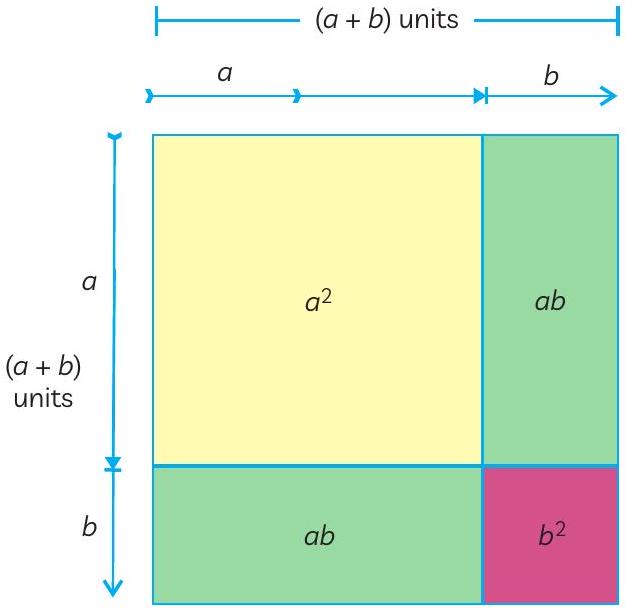
Now take \(a=3x\) and \(b=2y\):
Calculate \(103^2\) mentally using a suitable algebraic identity.
Write \(103=100+3\) and use \((a+b)^2=a^2+2ab+b^2\):
Factorise \(25p^2+30pq+9q^2\) using an algebraic identity.
Observe that
and the middle term is
Therefore,
The value of \((5x+7y)(5x-7y)\) is:
Use \((a+b)(a-b)=a^2-b^2\), with \(a=5x\) and \(b=7y\):
Answer: A.
Expand and simplify \((x+2y-3z)^2\).
Use
Here \(a=x\), \(b=2y\), \(c=-3z\). Therefore,
Hence,
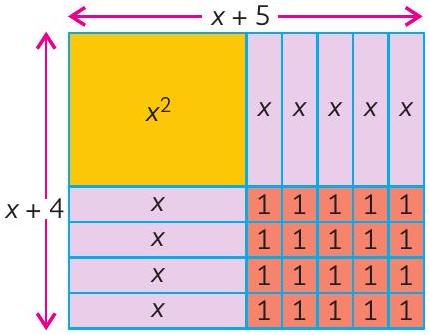
Factorise \(x^2+9x+20\). Explain how the factors can be interpreted as the side lengths of a rectangle formed using algebra tiles.
We need two numbers whose sum is 9 and product is 20. The numbers are 4 and 5.
Thus, an algebra-tile rectangle representing the expression has side lengths \((x+4)\) and \((x+5)\).
Factorise \(6x^2+7x+2\) by splitting the middle term.
The product of the coefficient of \(x^2\) and the constant term is
We need two numbers whose product is 12 and sum is 7. They are 3 and 4.
(i) Expand \((2p-3q)^3\).
(ii) Factorise \(x^3-27\).
(i) Use
Taking \(a=2p\) and \(b=3q\),
(ii) Use \(a^3-b^3=(a-b)(a^2+ab+b^2)\):
Three numbers \(x,y,z\) satisfy \(x+y+z=10\), \(xyz=25\), and \(x^2+y^2+z^2=38\). Find \(x^3+y^3+z^3\).
First use
Therefore,
Now use
Substituting the given values,
Simplify the rational expression \(\frac{x^2-5x+6}{2x^2+2x-12}\) and state the values of \(x\) for which the original expression is undefined.
Factor the numerator:
Factor the denominator:
Therefore,
However, the restrictions must come from the original denominator:
Hence, \(\boxed{x\neq2,-3}\).
Before expanding a long expression, look for a standard identity. Before factorising, first take out any common factor and then check whether the remaining expression matches a perfect-square, difference-of-squares, cube, or middle-term-splitting pattern.
Class 9 Maths Chapter 4 Important Questions — FAQs
What is an algebraic identity?
An algebraic identity is an equality that is true for all permissible values of its variables, unlike an equation that may be true only for particular values.
What is the identity for \((a+b)^2\)?
The identity is \((a+b)^2=a^2+2ab+b^2\). The term \(2ab\) comes from two equal rectangular parts in its geometric interpretation.
How are algebraic identities useful in factorisation?
Expansion identities can be read in reverse. For example, \(a^2+2ab+b^2\) can immediately be factorised as \((a+b)^2\).
How do we factorise \(x^2+bx+c\)?
Find two numbers whose sum is \(b\) and whose product is \(c\). These numbers determine the two binomial factors.
What should be remembered when simplifying rational algebraic expressions?
Factor the numerator and denominator completely, cancel only common factors, and always retain the restrictions obtained from the original denominator.
You May Also Like
- Class 9 Maths Chapter 1 Important Questions with Solutions – Orienting Yourself: The Use of Coordinates (Ganita Manjari)
- Class 9 Maths Chapter 2 Important Questions with Solutions – Introduction to Linear Polynomials (Ganita Manjari)
- Class 9 Maths Chapter 3 Important Questions with Solutions – The World of Numbers (Ganita Manjari)
- Class 9 Maths Chapter 4 Important Questions with Solutions – Exploring Algebraic Identities (Ganita Manjari)
- Class 9 Maths Chapter 5 Important Questions with Solutions – I’m Up and Down, and Round and Round (Ganita Manjari)
- Class 9 Maths Chapter 6 Important Questions with Solutions – Measuring Space: Perimeter and Area (Ganita Manjari)