

Table of Contents
Last Updated on November 7, 2026 by XAM CONTENT
Practice these Class 9 Maths Chapter 3 Important Questions from The World of Numbers in the new NCERT Ganita Manjari. The set covers integers, rational numbers, density, decimal expansions, irrational numbers, square-root constructions, real numbers and \(\pi\). Attempt each question first, then open the solution to check your method.
The number system expands step by step: \(\mathbb{N}\subset\mathbb{Z}\subset\mathbb{Q}\subset\mathbb{R}\). Rational and irrational numbers together form the set of real numbers.
Important Rules from The World of Numbers
| Concept | Rule / Result |
|---|---|
| Natural numbers | \(\mathbb{N}=\{1,2,3,\ldots\}\) |
| Integers | \(\mathbb{Z}=\{\ldots,-2,-1,0,1,2,\ldots\}\) |
| Rational number | \(\frac{p}{q}\), where \(p,q\in\mathbb{Z}\) and \(q\neq0\) |
| Density of rationals | Infinitely many rational numbers lie between any two distinct rational numbers. |
| Terminating decimal test | In lowest terms, the denominator has only \(2\) and/or \(5\) as prime factors. |
| Recurring decimal | A non-terminating recurring decimal is rational. |
| Irrational number | Its decimal expansion is non-terminating and non-recurring. |
| Real numbers | Rational numbers + irrational numbers. |
Do not assume every non-terminating decimal is irrational. A non-terminating recurring decimal is rational; only a non-terminating, non-recurring decimal is irrational.
Class 9 Maths Chapter 3 Important Questions with Solutions
Which relation correctly represents the hierarchy of the number systems studied in this chapter?
Every natural number is an integer, every integer is rational because it can be written with denominator 1, and every rational number is real.
Answer: A — \(\mathbb{N}\subset\mathbb{Z}\subset\mathbb{Q}\subset\mathbb{R}\).
At noon, the temperature of a hill station is \(4^\circ\text{C}\). During the night it falls by \(13^\circ\text{C}\). Find the final temperature and explain the integer operation involved.
A fall of \(13^\circ\text{C}\) means subtracting 13 from 4:
Therefore, the final temperature is \(-9^\circ\text{C}\). The answer is negative because the temperature has moved 9 units below zero.
Which of the following is not a rational number?
A rational number must be expressible as \(\frac{p}{q}\), where \(p\) and \(q\) are integers and \(q\neq0\). Division by zero is undefined, so \(\frac70\) is not a rational number.
Answer: C — \(\frac70\).
Find three rational numbers between \(\frac{3}{8}\) and \(\frac{1}{2}\). What property of rational numbers does this illustrate?
Write both fractions with denominator 40:
Three rational numbers between them are
For example, these may also be simplified where possible. This illustrates the density property: infinitely many rational numbers exist between any two distinct rational numbers.
Without performing long division, determine whether the decimal expansions of \(\frac{13}{40}\) and \(\frac{7}{12}\) terminate or recur.
Both fractions are already in lowest terms.
For \(\frac{13}{40}\):
The denominator contains only the prime factors 2 and 5. Therefore, the decimal expansion terminates.
For \(\frac{7}{12}\):
The denominator contains the prime factor 3 in addition to 2. Therefore, the decimal expansion is non-terminating recurring.
Express \(0.4\overline{7}\) in the form \(\frac{p}{q}\), where \(p\) and \(q\) are integers and \(q\neq0\).
Let
Multiplying by 10,
Subtract the first equation from the second:
Hence,
Classify each number as rational or irrational, giving a reason:
(i) \(\sqrt{121}\)
(ii) \(\sqrt{45}\)
(iii) \(0.272727\ldots\)
(iv) \(0.101001000100001\ldots\)
(i) \(\sqrt{121}=11\), so it is rational.
(ii) \(\sqrt{45}=3\sqrt5\). Since 45 is not a perfect square, it is irrational.
(iii) \(0.272727\ldots\) has the repeating block 27, so it is rational.
(iv) \(0.101001000100001\ldots\) is non-terminating and has no fixed repeating block, so it is irrational.
Prove that \(\sqrt5\) is irrational.
Assume, for contradiction, that \(\sqrt5\) is rational. Then it can be written in lowest terms as
where \(p\) and \(q\) are coprime integers and \(q\neq0\).
Squaring both sides,
Thus \(5\mid p^2\), so \(5\mid p\). Let \(p=5k\).
Therefore \(5\mid q\) as well. Hence both \(p\) and \(q\) are divisible by 5, contradicting the assumption that they are coprime.
Therefore, \(\boxed{\sqrt5\text{ is irrational}}\).
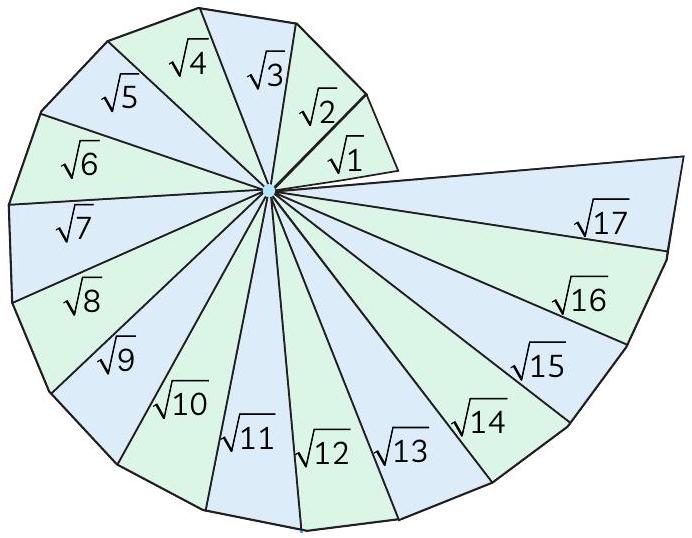
In the square-root spiral, each new right triangle has one side of length 1 unit and the other side equal to the previous hypotenuse. Find the hypotenuses of the first six triangles and identify which are rational.
Using the Pythagoras theorem successively:
Among these, only \(\sqrt4=2\) is rational because 4 is a perfect square. The others are irrational.
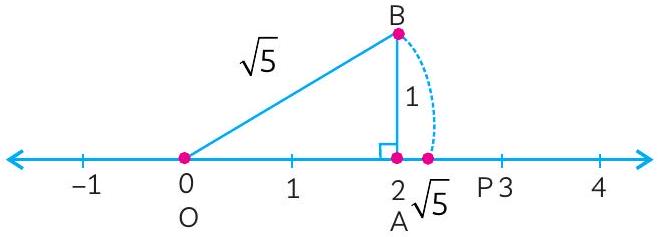
Describe how to construct and locate \(\sqrt5\) on the number line using a ruler and compass.
Step 1: Draw a number line and mark \(O=0\) and \(A=2\), so \(OA=2\) units.
Step 2: At \(A\), draw a perpendicular \(AB\) of length 1 unit.
Step 3: Join \(O\) to \(B\). By the Pythagoras theorem,
Step 4: With centre \(O\) and radius \(OB\), draw an arc cutting the positive number line at \(P\).
Then \(OP=\sqrt5\), so the point \(P\) represents \(\sqrt5\).
A student says, “\(\frac{22}{7}\approx3.14\) and \(\pi\approx3.14\), so \(\frac{22}{7}=\pi\).” Explain the error.
The student is confusing an approximation with an exact value.
This is a non-terminating recurring decimal and is therefore rational.
The decimal expansion of \(\pi\) is non-terminating and non-recurring, so \(\pi\) is irrational. Thus, \(\frac{22}{7}\) is only an approximation to \(\pi\), not its exact value.
Consider the numbers \(A=\sqrt{81}\), \(B=\sqrt{50}\), \(C=0.\overline{36}\) and \(D=\pi\).
(i) Classify each as rational or irrational.
(ii) Express the rational numbers in the form \(\frac{p}{q}\).
A:
Therefore, \(A\) is rational.
B:
Since 50 is not a perfect square, \(B\) is irrational.
C: \(0.\overline{36}=0.363636\ldots\) is recurring, so it is rational. Let
D: \(\pi\) is irrational because its decimal expansion is non-terminating and non-recurring.
Hence, the rational numbers are
while \(B\) and \(D\) are irrational.
When classifying a number, first ask whether it can be written exactly as \(\frac{p}{q}\). For square roots, check whether the number under the root is a perfect square. For decimals, check whether the expansion terminates, repeats, or continues without a repeating pattern.
Class 9 Maths Chapter 3 Important Questions — FAQs
What is a rational number?
A rational number is any number that can be written as \(\frac{p}{q}\), where \(p\) and \(q\) are integers and \(q\neq0\).
How can we tell whether a rational number has a terminating decimal?
First write the fraction in lowest terms. Its decimal expansion terminates exactly when the denominator contains no prime factors other than 2 and 5.
What is the difference between rational and irrational decimals?
A rational decimal either terminates or repeats. An irrational decimal neither terminates nor repeats in a fixed pattern.
Why is \(\sqrt5\) irrational but \(\sqrt9\) rational?
Since 9 is a perfect square, \(\sqrt9=3\), which is rational. The number 5 is not a perfect square, and \(\sqrt5\) cannot be expressed as a ratio of two integers.
Are \(\frac{22}{7}\) and \(\pi\) equal?
No. \(\frac{22}{7}\) is a rational approximation of \(\pi\). The number \(\pi\) is irrational and cannot be expressed exactly as a fraction.
You May Also Like
- Class 9 Maths Chapter 1 Important Questions with Solutions – Orienting Yourself: The Use of Coordinates (Ganita Manjari)
- Class 9 Maths Chapter 2 Important Questions with Solutions – Introduction to Linear Polynomials (Ganita Manjari)
- Class 9 Maths Chapter 3 Important Questions with Solutions – The World of Numbers (Ganita Manjari)
- Class 9 Maths Chapter 4 Important Questions with Solutions – Exploring Algebraic Identities (Ganita Manjari)
- Class 9 Maths Chapter 5 Important Questions with Solutions – I’m Up and Down, and Round and Round (Ganita Manjari)
- Class 9 Maths Chapter 6 Important Questions with Solutions – Measuring Space: Perimeter and Area (Ganita Manjari)