

Table of Contents
Last Updated on November 7, 2026 by XAM CONTENT
Practice these Class 9 Maths Chapter 2 Important Questions from Introduction to Linear Polynomials in the new NCERT Ganita Manjari. The set covers polynomials, degree, values and zeroes of linear polynomials, linear patterns, growth and decay, slope, intercepts, graphs and real-life linear models. Attempt each question first, then open the solution to check your method.
A linear polynomial in one variable has the form \(p(x)=ax+b\), where \(a\neq 0\). Its graph is a straight line, and its unique zero is obtained from \(ax+b=0\).
Important Formulae and Linear Polynomial Rules
| Concept | Formula / Rule |
|---|---|
| Linear polynomial | \(p(x)=ax+b,\; a\neq 0\) |
| Value at \(x=k\) | \(p(k)=ak+b\) |
| Zero of a linear polynomial | \(x=-\frac{b}{a}\) |
| Linear relationship | \(y=ax+b\) |
| Slope | \(a\) |
| y-intercept | \((0,b)\) |
| Parallel lines | Same slope, different intercepts |
| Linear pattern | Consecutive terms have a constant difference |
| Linear growth / decay | Positive slope → growth; negative slope → decay |
Do not confuse the degree of a polynomial with its number of terms. The degree is determined by the highest exponent of the variable with a non-zero coefficient.
Class 9 Maths Chapter 2 Important Questions with Solutions
What is the degree of the polynomial \(5x^4-2x^3+x-7\)?
The degree of a polynomial is the highest exponent of the variable. The highest power of \(x\) here is \(4\).
Answer: D — 4.
Which of the following is not a polynomial in \(x\)?
In a polynomial, every exponent of the variable must be a non-negative integer. Since \(\sqrt{x}=x^{1/2}\), the exponent \(\frac12\) is fractional.
Answer: C — \(\sqrt{x}+2\).
For the linear polynomial \(p(x)=4x-7\), find \(p(5)\) and its zero.
First substitute \(x=5\):
To find the zero, put \(p(x)=0\):
Therefore, \(p(5)=13\) and the zero is \(\frac74\).
Riya already has ₹450 in her savings account and saves ₹120 every month. Write a linear polynomial for her total savings after \(n\) months and find the amount after 8 months.
The initial amount ₹450 is fixed, while ₹120 is added every month.
After 8 months,
Hence, the linear polynomial is \(S(n)=120n+450\), and the savings after 8 months are ₹1410.
The sequence \(3,7,11,15,19,\ldots\) is a linear pattern. What is its common difference?
The consecutive difference remains constant.
Answer: B — 4.
Identify which of the following are linear patterns and justify your answer:
(i) \(2,5,8,11,14,\ldots\)
(ii) \(3,6,12,24,48,\ldots\)
(iii) \(100,95,90,85,\ldots\)
(i) The difference is always \(+3\), so it is a linear pattern.
(ii) The differences are \(3,6,12,24,\ldots\), which are not constant. Therefore, it is not a linear pattern.
(iii) The difference is always \(-5\), so it is a linear pattern representing linear decay.
A student has a 500-page book and reads 20 pages every day. Write a linear expression for the number of pages remaining after \(t\) days. How many pages remain after 15 days?
The book starts with 500 pages, and 20 pages are removed from the unread portion each day.
At \(t=15\),
Therefore, 200 pages remain after 15 days. The negative coefficient of \(t\) represents linear decay.
At which point does the line \(y=-3x+4\) cut the y-axis?
On the y-axis, \(x=0\). Therefore,
Answer: B — \((0,4)\).
Find a linear polynomial whose graph is parallel to \(y=5x-7\) and passes through the point \((0,4)\).
Parallel lines have the same slope. Hence the required polynomial has slope \(5\).
Let
Since the graph passes through \((0,4)\),
Therefore, the required polynomial is
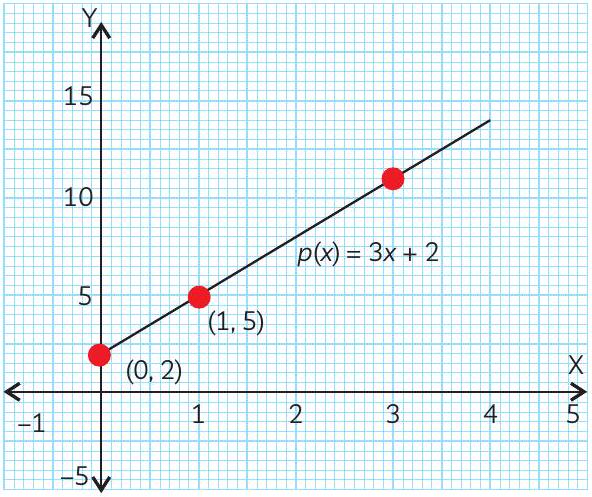
The graph of a linear polynomial \(p(x)\) passes through \((1,5)\) and \((3,11)\). Find \(p(x)\), its y-intercept and its x-intercept.
Let
Using \((1,5)\),
Using \((3,11)\),
Subtracting the first equation from the second,
Hence,
The y-intercept is obtained at \(x=0\), so it is \((0,2)\).
For the x-intercept, set \(p(x)=0\):
Therefore, the x-intercept is \(\left(-\frac23,0\right)\).
Two mobile data plans are offered. Plan A charges ₹100 fixed plus ₹10 per GB, while Plan B charges ₹50 fixed plus ₹15 per GB. If \(x\) is the data used in GB:
(i) write the bill for each plan as a linear polynomial,
(ii) find when both bills are equal, and
(iii) determine which plan is cheaper beyond that usage.
The two bills are
For equal bills,
So both plans cost the same at 10 GB. The common bill is ₹200.
Beyond 10 GB, Plan A increases by only ₹10 per additional GB while Plan B increases by ₹15 per GB. Therefore, Plan A is cheaper for usage above 10 GB.
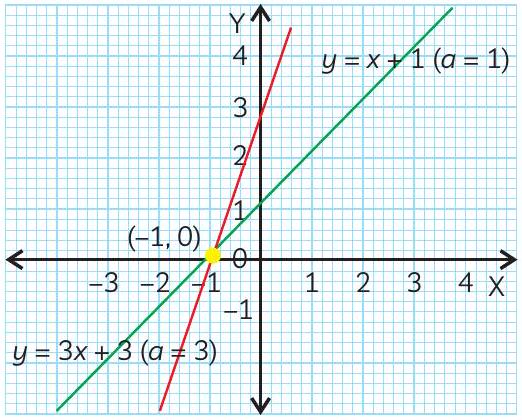
Consider the family of linear functions \(f(x)=ax+a\), where \(a>0\).
(i) Find \(f(0)\) and \(f(-1)\).
(ii) Show that every graph in this family passes through one fixed point.
(iii) Write the equations for \(a=1\) and \(a=3\).
For \(x=0\),
For \(x=-1\),
Thus, irrespective of the positive value of \(a\), every line passes through
For \(a=1\), the equation is \(y=x+1\).
For \(a=3\), the equation is \(y=3x+3\).
Whenever a question gives a real-life situation with a fixed starting value and a constant increase or decrease, look for a model of the form \(y=ax+b\). The coefficient \(a\) gives the rate of change, while \(b\) gives the initial value.
Class 9 Maths Chapter 2 Important Questions — FAQs
What is a linear polynomial in Class 9 Maths?
A linear polynomial in one variable has degree 1 and can be written as \(p(x)=ax+b\), where \(a\neq 0\).
How do you find the zero of a linear polynomial?
For \(p(x)=ax+b\), set \(p(x)=0\). Solving \(ax+b=0\) gives the zero \(x=-\frac{b}{a}\).
How can you identify a linear pattern?
A numerical pattern is linear when the difference between consecutive terms remains constant.
What do \(a\) and \(b\) represent in \(y=ax+b\)?
The coefficient \(a\) is the slope or rate of change, while \(b\) is the y-intercept and represents the value of \(y\) when \(x=0\).
When are two linear graphs parallel?
Two distinct lines are parallel when they have the same slope but different y-intercepts.
You May Also Like
- Class 9 Maths Chapter 1 Important Questions with Solutions – Orienting Yourself: The Use of Coordinates (Ganita Manjari)
- Class 9 Maths Chapter 2 Important Questions with Solutions – Introduction to Linear Polynomials (Ganita Manjari)
- Class 9 Maths Chapter 3 Important Questions with Solutions – The World of Numbers (Ganita Manjari)
- Class 9 Maths Chapter 4 Important Questions with Solutions – Exploring Algebraic Identities (Ganita Manjari)
- Class 9 Maths Chapter 5 Important Questions with Solutions – I’m Up and Down, and Round and Round (Ganita Manjari)
- Class 9 Maths Chapter 6 Important Questions with Solutions – Measuring Space: Perimeter and Area (Ganita Manjari)