

Table of Contents
Last Updated on November 17, 2026 by XAM CONTENT
Practice the NSEP 2019 Question Paper with answers and detailed worked solutions. The examination was held on 24 November 2019 and contains 70 questions: 60 single-correct questions followed by 10 multiple-correct questions.
NSEP 2019 Question Paper with Solutions
A pendulum is made by using a thread of length 300 cm and a small spherical bob of mass 100 g. It is suspended from a point \(S\). The bob is pulled from its position of rest at \(O\) to the point \(A\) so that the linear amplitude is 25 cm. The angular amplitude in radian and the potential energy of the bob in joule at \(A\) are respectively
Ans. (b)
Angular displacement \(\theta\) (in radian) \(=\frac{\text { Arc }}{\text { radius }}\)

Potential energy
Consider the following physical expressions
(I) \(\rho v^{2}\) ( \(\rho\) : density, \(v\) : velocity)
(II) \(\frac{Y \Delta L}{L}\) ( \(Y\) : Young’s modulus, \(L\) : length)
(III) \(\frac{\sigma^{2}}{\varepsilon_{0}}\) ( \(\sigma\) : surface density of charge)
(IV) \(h \rho r g\) ( \(h\) : rise of a liquid in a capillary tube of radius \(r\) )
The expressions having same dimensional formula are
Ans. (d)
Two simple pendulums of lengths 1.44 m and 1.0 m start swinging together in the same phase. The two will be in phase again after a time of
Ans. (c)
Time period of first pendulum \(T_{1}=2 \pi \sqrt{\frac{1.44}{9.8}}\)
Time period of second pendulum \(T_{2}=2 \pi \sqrt{\frac{1.0}{9.8}}\)
Particles will again comes in phase after \(n\) oscillations of longer pendulum and \((n+1)\) oscillations of smaller pendulum.
Total time \(t=n T_{1}=5 \times 2 \pi \sqrt{\frac{1.44}{9.8}}=\frac{5 \times 2 \times 3.14 \times 1.2}{3.14}\)
A home aquarium partly filled with water slides down an inclined plane of inclination angle \(\theta\) with respect to the horizontal. The surface of water in the aquarium
Ans. (b)

As aquarium slides down with acceleration \(g \sin \theta\) then water in aquarium experience pseudo force \(m g \sin \theta\) in backward direction parallel to incline. So net force parallel to incline is zero.
Hence to make surface perpendicular to resultant force (w.r.t. surface) \(m g \cos \theta\), surface of liquid becomes parallel to inclined plane.
A sound source of constant frequency travels with a constant velocity past an observer. When it crosses the observer the sound frequency sensed by the observer changes from 449 Hz to 422 Hz. If the velocity of sound is 340 m/s, the velocity of the source of sound is
Ans. (b)
Apparent frequency when source approaches observer, \(n_{1}=n\left(\frac{v}{v-v_{s}}\right)\)
Apparent frequency just after crossing the observer \(n_{2}=n\left(\frac{v}{v+v_{s}}\right)\)
Plots of intensity \((I)\) of radiation emitted by a black body versus wavelength \((\lambda)\) at three different temepratures \(T_{1}, T_{2}\) and \(T_{3}\) respectively are shown in figure. Choose the correct statement

Ans. (a)
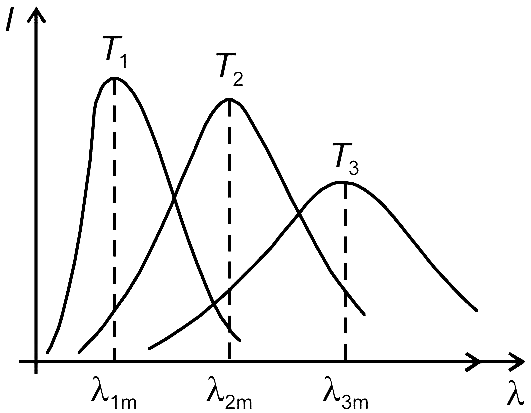
According to Wien’s displacement law,
Hence, \(T_{1}>T_{2}>T_{3}\)
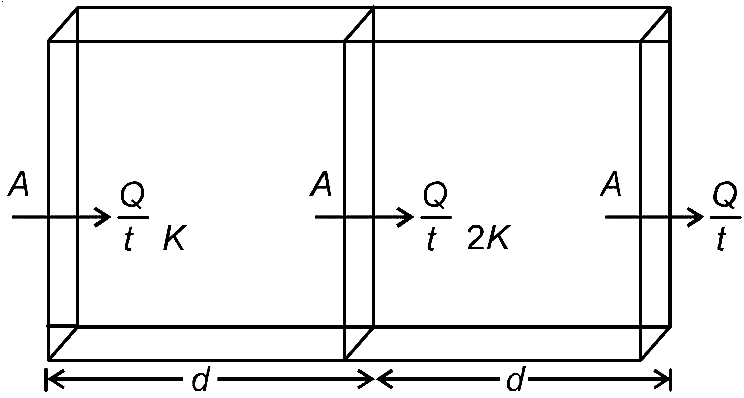
Consider a composite slab consisting of two different materials having equal thickness and equal area of cross-section. The thermal conductivities are \(K\) and \(2 K\) respectively. The equivalent thermal conductivity of the composite slab is
Ans. (d)
In steady state, heat current will be same in series, so
A large horizontal uniform disc can rotate freely about a rigid vertical axis passing through its centre \(O\). A man stands at rest at the edge of the disc at a point \(A\). The mass of the disc is 22 times the mass of the man. The man starts moving along the edge of the disc. When he reaches \(A\), after completing one rotation relative to the disc, the disc has turned through
Ans. (a)
Mass of disc \(=22 \mathrm{M}\)
Mass of man = M
From conservation of angular momentum,
\(M R^{2} \omega_{m}=-\frac{1}{2} 22 M R^{2} \omega_{D}\) ( \(M\) is mass of man)
So, disc turns through 30° in the opposite sense of motion of man.
Two factories are sounding their sirens at 400 Hz each. A man walks from one factory towards the other at a speed of 2 m/s. The velocity of sound is 320 m/s. The number of beats heard by the person in one second will be
Ans. (b)
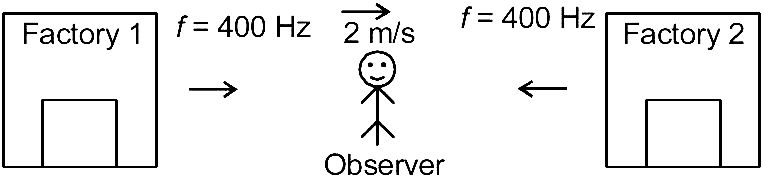
Apparent frequency received by observer from factory 1 is
Apparent frequency received by observer from factory 2 is
Therefore, frequency of beat heard by observer will be
The temperature of an isolated blackbody falls from \(T_{1}\) to \(T_{2}\) in time \(t\). Then, \(t=C x\) where \(x\) is
Ans. (c)
According to Stefan law the energy of thermal radiation emitted per unit time by a black body of surface area \(A\) is given by
( \(m\) is mass, \(c\) is specific heat capacity)
where \(C\) is a positive constant.
Tow charges \(-q\) and \(-q\) are placed at points \((0, d)\) and \((0,-d)\). A charge \(+q\), free to move along \(X\) axis, will oscillate with a force proportional to
Ans. (c)
Let us take a point \(P\) on \(x\)-axis at a distance \(x\) from origin

\(E_{1}\) [due to \(-q(0, d)\) ]
cancel each other]
∴ force on a charge placed at point \(P\) will be
The average translational kinetic energy of oxygen \((M=32)\) molecules at a certain temperature is 0.048 eV. The tranlational kinetic energy of nitrogen \((M=28)\) molecules at the same temeprature is (consider the two gases to be ideal)
Ans. (c)
Average translational kinetic energy per molecule of an ideal gas of molecular mass \(m\) is
Hence, average translational kinetic energy \(K\) is proportional to absolute temperature and independent of molecular mass of the gas.
Therefore, average translational kinetic energy of both the gases are same at the same temperature.
A concave mirror has a radius of curvature \(R\) and forms the image of an object placed at a distance \(1.5 R\) from the pole of the mirror. An opaque disc of diameter half the aperture of the mirror is placed with the pole at the centre. As a result
Ans. (d)
Since half part is covered with opaque disc, the image will be less brighter but the size and position of image will remain same.
A ray of white light is made incident on the refracting surface of a prism such that after refraction at this surface, the green component falls on the second surface at its critical angle. The colours present in the emergent beam will be
Ans. (c)
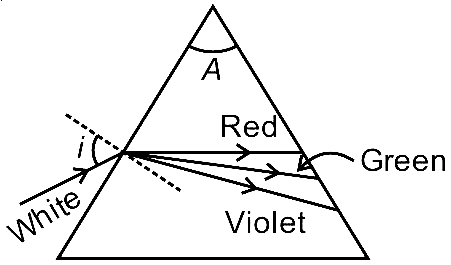
Dispersion takes place at first refracting place. Using Snell’s law,
So,
Now, angle of incidence at second suface,
So, \(\left(r_{2}\right)_{\text {violet }}>\left(r_{2}\right)_{\text {green }}>\left(r_{2}\right)_{\text {red }}\)
If \(\left(r_{2}\right)_{\text {green }}=C_{\text {green }}\), then \(\left(r_{2}\right)_{\text {red }}
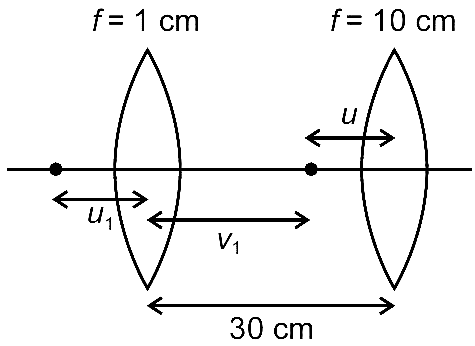
In a compound microscope, having tube-length 30 cm, the power of the objective and the eye-piece are 100D and 10D respectively. Then the magnification produced by the microscope when the final image is at the least distance of distinct vision (25 cm) will be
Ans. (c)
Parallel rays are incident on a glass sphere of diameter 10 cm and having refractive index 1.5. The sphere converges these rays at a certain point. The distance of this point from the centre of the sphere will be
Ans. (c)
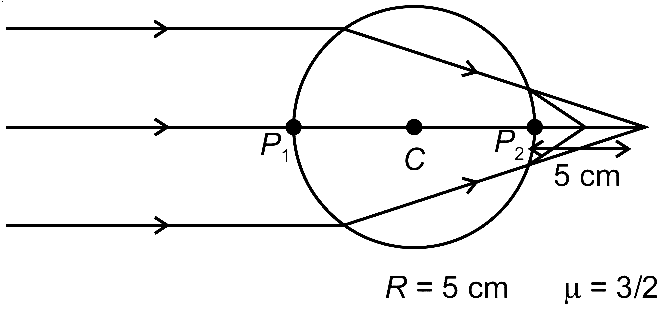
Applying the refraction formula at first refracting surface
For second refracting surface
Distance from centre of the sphere
A jet of water from 15 cm diameter nozzle of a fire hose can reach the maximum height of 25 m. The force exerted by the water jet on the hose is
Ans. (d)

Force exerted by water jet on the hose is
In an electromagnetic wave the phase difference between electric vector and magnetic vector is
Ans. (a)
In an electromagnetic wave, electric field vector and magnetic field vector are perpendicular to each other but are in same phase. Hence phase difference between them is zero.
A spherical capacitor is formed by two concentric metallic spherical shells. The capacitor is then charged so that the outer shell carries a positive charge and the inner shell carries an equal but negative charge. Even if the capacitor is not connected to any circuit, the charge will eventually leak away due to a small electrical conductivity of the material between the shells. What is the character of the magnetic field produced by this leakage current?
Ans. (d)
As the current will be spherically diverging from the central sphere, we do not any consistent argument for the direction of magnetic field for any one of the elemental current. Because same argument will be valid for other possible direction of magnetic field.
But if at all magnetic exist then it must have unique direction. So by argument of symmetry the magnetic field is zero.
If a cell of constant emf produces the same amount of heat during the same time in two independent resistors \(R_{1}\) and \(R_{2}\) when they are seperately connected across the terminals of the cell, one after the other. The internal resistance of the cell is
Ans. (d)
For any cell

Heat developed in time \((t)\) through a resistor \(R=H\)
Given, \(H_{1}=H_{2}\)
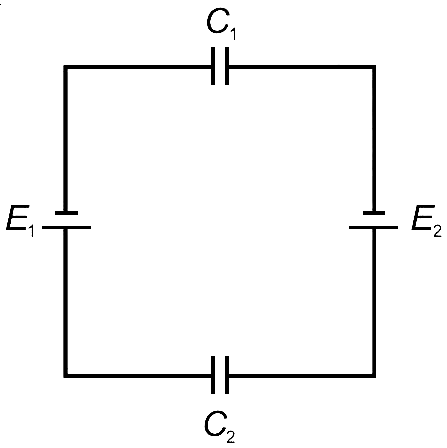
In the circuit shown beside the charge on each capacitor is
Ans. (c)
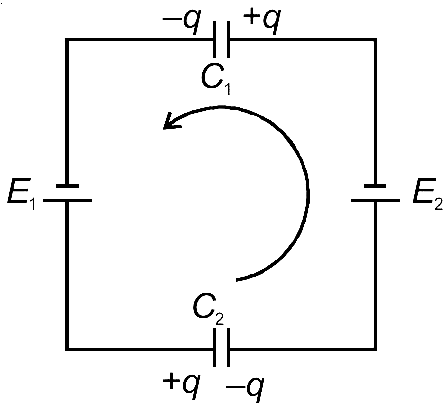
Let charge on each capacitor is ‘ \(q\) ‘
Applying KVL
A stationary hydrogen atom emits photon corresponding to the first line (highest wavelength) of Lyman series. If \(R\) is the Rydberg constant and \(M\) is the mass of the atom, the recoil velocity of the atom is
Ans. (c)
For first line of Lyman series
Now for recoil velocity of atom

Hence \(v=\frac{3 R h}{4 M}\)
Heat is absorbed or evolved when current flows in a conductor having a temperature gradient. This phenomenon is known as
Ans. (d)
The phenomenon of absorption or evolution of heat along the length of a conductor on passing current through it when its two ends are kept at a different temperature is known as Thomson’s effect.
Avalanche breakdown in a p-n junction primarily depends on the phenomenon of
Ans. (d)
The avalanche breakdown in a p-n junction diode primarily depends on the phenomenon called Impact ionization.
A source emits photons of energy 5 eV which are incident on a metallic sphere of work function 3.0 eV. The radius of the sphere is \(r=8 \times 10^{-3} \mathrm{~m}\). It is observed that after some time emission of photoelectrons from the metallic sphere is stopped. Charge on the sphere when the photoemission stops is
Ans. (b)
Energy of photons \(=h \nu=5 \mathrm{eV}\)
Work function \(=\phi=3 \mathrm{eV}\)
So, maximum kinetic energy of photoelectrons \(=(5-3) \mathrm{eV}=2 \mathrm{eV}\)
Potential on the surface of sphere (when charge \(q\) is attained) \(=\frac{1}{4 \pi \varepsilon_{0}} \frac{q}{r}\)
Photoemission ceases when,
The dc component of current in the output of a halfwave rectifier with peak value \(I_{0}\) is
Ans. (b)
In an experiment on photoelectric effect, the slope of straight line graph between the stopping potential and the frequency of incident radiation gives
Ans. (c)
If incident radiation has frequency \(v\), and the work function of metal is \(\phi\) and the stopping potential is \(V\), then
\(\therefore \frac{h}{e}\) is the slope of the mentioned graph.
According to Bohr’s theory, the ionization energy of H atom is 13.6 eV. The energy needed to remove an electron from Helium ion \(\left(\mathrm{He}^{+}\right)\)is
Ans. (d)
\(E_{n}=-13.6 \frac{Z^{2}}{n^{2}} \mathrm{eV}\)
Now, for \(\mathrm{He}^{+} Z=2\), and for ground state \(n=1\)
So, ionization energy \(=54.4 \mathrm{eV}\)
The phenomenon inverse to photo electric effect is
Ans. (d)
In a photoelectric emission, electrons are emitted by incidence of photons, while in production of \(X\)-rays in coolidge tube, photons are emitted using incidence of high energy electrons. Thus production of \(X\)-rays in coolidge tube is also termed as inverse photoelectric effect
A stationary hydrogen atom emits a photon of wavelength \(1025 \AA\). Its angular momentum changes by
Ans. (a)
Let the electron transitions from \(n=1\) to \(n=n\) in the atom
on solving, \(n \approx 3\)
Now change in angular momentum \(=3 \frac{h}{2 \pi}-\frac{h}{2 \pi}=\frac{h}{\pi}\)
An observer stands on the platform at the front edge of the first bogie of a stationary train. The train starts moving with uniform acceleration and the first bogie takes 5 seconds to cross the observer. If all the bogies of the train are of equal length and the gap between them is negligible, the time taken by the tenth bogie to cross the observer is
Ans. (d)
The resistive force on an aeroplane flying in a horizontal plane is given by \(F_{f}=k v^{2}\), where \(k\) is constant and \(v\) is the speed of the aeroplane. When the power output from the engine is \(P_{0}\), the plane flies at a speed \(v_{0}\). If the power output of the engine is doubled the aeroplane will fly at a speed of
Ans. (b)
\(P=F v\)
A 3.0 cm thick layer of oil (density \(\rho_{\text {oil }}=800 \mathrm{~kg} / \mathrm{m}^{3}\) ) floats on water (density \(\rho_{w}=1000 \mathrm{~kg} / \mathrm{m}^{3}\) ) in a transparent glass beaker. A solid cylinder is observed floating vertically with \(\frac{1}{3}\) of it in water and \(\frac{1}{3}\) in the oil. Oil is gently poured into the beaker until the cylinder floats in oil only. The fraction of the solid cylinder in oil now is
Ans. (c)
\(L \rho_{s} A=\frac{L}{3} \rho_{0} A+\frac{L}{3} \rho_{w} A\)
A wedge of mass \(M\) rests on a horizontal frictionless surface. A block of mass \(m\) starts sliding down the rough inclined surface of the wedge to its bottom. During the course of motion, the centre of mass of the block and the wedge system
Ans. (d)
The external force acting on the system of the wedge and the block is resultant of \((M+m) g\) downward and normal force on the wedge by the horizontal surface, which is also vertical.
⇒ centre of mass moves vertically downward with increasing speed (in general).
A uniform circular disc rotating at a fixed angular velocity \(\omega\) about an axis normal to its plane and passing through its centre has kinetic energy \(E\). If the same disc rotates with an angular velocity \(2 \omega\) about a parallel axis passing through the edge, its kinetic energy will be
Ans. (d)
Light of wavelength 640 nm falls on a plane diffraction grating with 12000 lines per inch. In the diffraction pattern on a screen kept at a distance of 12 cm from the grating, the distance of the second order maximum from the central maximum is
Ans. No option is correct.
\(d=\frac{2.54 \times 10^{-2}}{12,000}\)
If the force acting on a body in inversely proportional to its speed, the kinetic energy of the body varies with time \(t\) as
Ans. (b)
As shown in the figure, a block of mass \(m\) is hung from the ceiling by the system of springs consisting of two layers. The force constant of each of the springs is \(k\). The frequency of the vertical oscillations of the block is

Ans. (d)
For top 3 springs, \(k_{1}=3 k\)
For bottom 2 spings, \(k_{2}=2 k\)
Two simple harmonic motions are given by \(x_{1}=a \sin\) \(\omega t+a \cos \omega t\) and \(x_{2}=a \sin \omega t+\frac{a}{\sqrt{3}} \cos \omega t\). The ratio of the amplitudes of the first to the second and the phase difference between them respectively are
Ans. (a)
\(x_{1}=a \sin \omega t+a \cos \omega t=a \sqrt{2} \sin \left(\omega t+\frac{\pi}{4}\right)\)
\(x_{2}=a \sin \omega t+\frac{a}{\sqrt{3}} \cot \omega t=\frac{2 a}{\sqrt{3}} \sin \left(\omega t+\frac{\pi}{6}\right)\)
Now, \(\frac{A_{1}}{A_{2}}=\frac{a \sqrt{2}}{\frac{2 a}{\sqrt{3}}}=\frac{\sqrt{3}}{\sqrt{2}}=\sqrt{\frac{3}{2}}\)
Also, phase difference
A particle is projected from the ground with a velocity \(\vec{v}=(3 \hat{i}+10 \hat{j}) \mathrm{m} \mathrm{s}^{-1}\). The maximum height attained and the range of the particle are respectively given by (use \(g=10 \mathrm{~m} / \mathrm{s}^{2}\) )
Ans. (a)

Given \(\vec{u}=(3 \hat{i}+10 \hat{j}) \mathrm{m} / \mathrm{s}\)
i.e. \(u_{x}=3 \mathrm{~m} / \mathrm{s}\)
Also \(g=10 \mathrm{~m} / \mathrm{s}^{2}\)
Maximum height \(H=\frac{u_{y}^{2}}{2 g}\)
A 20 cm long capillary tube stands vertically with lower end just in water. Water rises up to 5 cm. If the entire system is now kept on a freely falling platform, the length of the water column in the capillary tube will be
Ans. (d)
When capillary is placed inside a system falling freely, then \(g_{\text {eff }}\) will be zero i.e. there is no force to balance surface tension, hence water will rise in column up to full length.
Hence \(h=20 \mathrm{~cm}\)
Position-time graph of a particle moving in a potential field is shown below. If the mass of the particle is 1 kg its total energy is approximately

Ans. (c)
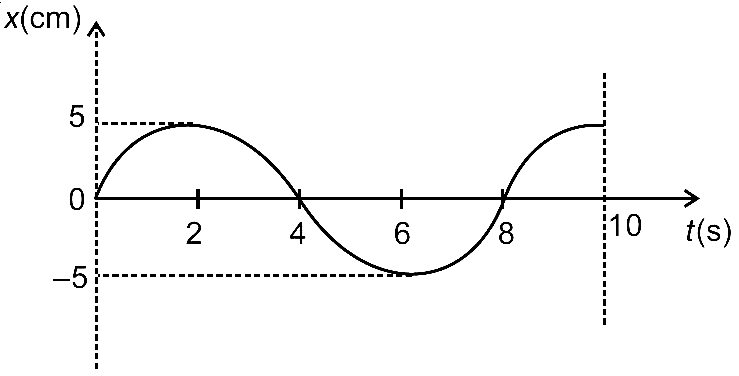
From the graph, equation of position in function of time is given as \(x=\left(5 \times 10^{-2}\right) \sin \left(\frac{2 \pi}{8}\right) t\)
i.e. \(x=\left(5 \times 10^{-2}\right) \sin \left(\frac{\pi}{4} t\right)\)
Now total energy of the particle will be
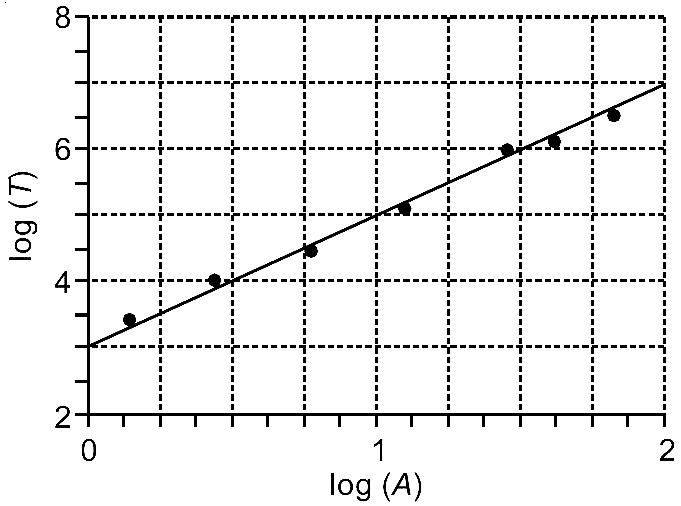
The log-log graph for a non-linear oscillator is shown below. Assuming the constants to have appropriate dimensions the relationship between time period \((T)\) and the amplitude \((A)\) can be expressed as
Ans. (a)
From the given graph, slope \(\frac{\log T}{\log A}=\frac{5-3}{1-0}=2\)
Now from equation \(\left(y-y_{0}\right)=m\left(x-x_{0}\right)\)
In many situations the point source emitting a wave starts moving, through the medium, with velocity \(V\) greater than the wave velocity in that medium. In such a case when source velocity \((V)>\) wave velocity \((v)\), the wave front changes
Ans. (b)
For \(v_{\text {source }}>v\),
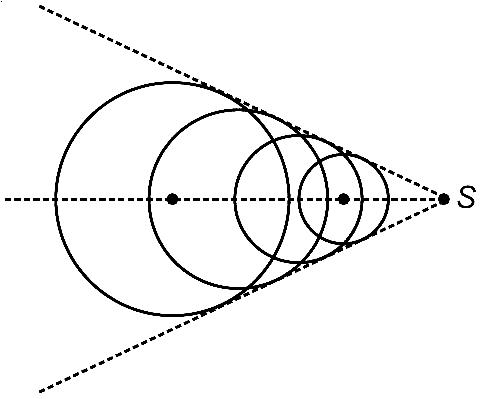
The spherical wavefronts i.e. originated at various positions of the source extends in three dimensions and becomes conical in shape.
If the average mass of a smoke particle in an Indian kitchen is \(3 \times 10^{-17} \mathrm{~kg}\), the rms speed of the smoke particles at 27°C is approximately
Ans. (a)
r.m.s speed of smoke particles is given by
Two wires, made of same material, one thick and the other thin are joined to form one composite wire. The composite wire is subjected to the same tension throughout. A wave travels along the wire and passes the point where the two wires are joined. The quantity which changes at the joint are
Ans. (d)
Wave speed depend on the inertia and elastic property and frequency remains unchanged even if the wave passes from one medium to other medium.
So wavelength and speed will change.
The frequency of the third overtone of a closed end organ pipe equals the frequency of the fifth harmonic of an open end organ pipe. Ignoring end correction, the ratio of their lengths \(I_{\text {open }}: I_{\text {close }}\) is
Ans. (a)

For closed organ pipe
Here, \(f=\frac{7 v}{4 L_{\text {closed }}}\)
And for open organ pipe fifth harmonic is \(f=\frac{5 v}{2 L_{\text {open }}}\)
So \(\frac{5 v}{2 L_{\text {open }}}=\frac{7 v}{4 L_{\text {closed }}}\)
A rectangular slab of glass of refractive index 1.5 is immersed in water of refractive index 1.33 such that the top surface of the slab remains parallel to water level. Light from a point source in air is incident on the surface of water at an angle \(\alpha\) such that the light reflected from the glass slab is plane polarised, the angle \(\alpha\) is
Ans. (a)
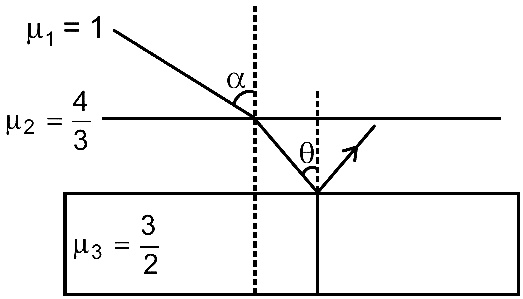
For air-water interface

But for water glass interface reflected light is completely polarized
In a spectrometer the smallest main scale division is \(\frac{1}{3}\) of a degree. The total number of divisions on the vernier scale attached to the main scale is 60 which coincide with the 59 divisions of the main circular scale. The least count of the spectrometer is
Ans. (b)
1 unit of main scale is \(\left(\frac{1}{3}\right)^{\circ}\)
Now 1 unit of vernier scale \(=\left(\frac{59}{60}\right)\) unit of main scale
White light is used to illuminate two slits in Young’s double slit experiment. Separation between the two slits is \(b\) and the screen is at a distance \(D(\gg b)\) from the plane of slits. The wavelength missing at a point on the screen directly in front of one of the slits is
Ans. (c)
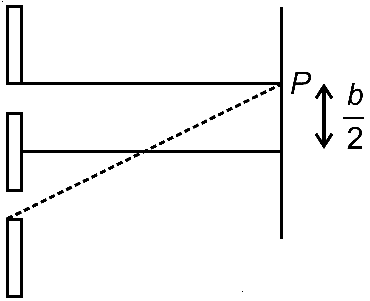
Path difference \(\Delta \alpha=\left[b^{2}+D^{2}\right)^{\frac{1}{2}}-D\)
if \(\Delta x=(2 n+1) \frac{\lambda}{2}\) then \(\lambda\) will be missing
In an ink-jet printer, an ink droplet of mass \(m\) is given a negative charge \(q\) by a computer-controlled charging unit. The charged droplet then enters the region between two deflecting parallel plates of length \(L\) separated by distance \(d\) (see figure below) with a speed \(v\). All over this region there exists a uniform downward electric field \(E\) (in the plane of paper). Neglecting the gravitational force on the droplet, the maximum charge that can be given to this droplet, so that is does not hit any of the plates, is
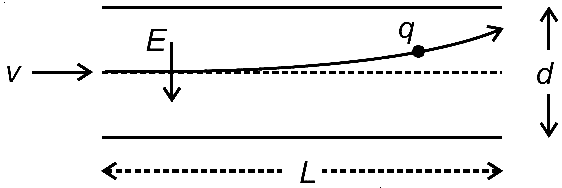
Ans. (b)
\(t=\left(\frac{L}{V}\right)\) in \(x\)-direction

In \(y\)-direction \(\frac{E q}{m}=a\)
And for max. charge on drop
A converging beam of light is pointing to \(P\). Two observations are made with (i) a convex lens of focal length 20 cm and (ii) a concave lens of focal length 16 cm placed in the path of the convergent beam at a distance 12 cm before the point \(P\). It is observed that
Ans. (a)
For concave lens if the virtual object would have been at a distance greater than 16 cm, then only it will make the virtual image. So concave lens will make the real image.
And convex lens will make the real image for virtual object.
Identify the rank in order from dimmest to the brightest when all the identical bulbs are connected in the circuit as shown below.
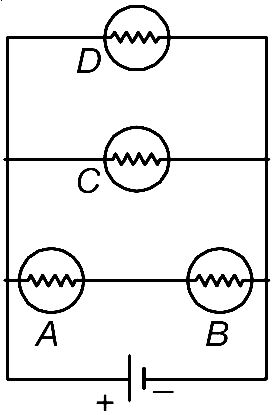
Ans. (d)
‘ \(C\) ‘ and ‘ \(D\) ‘ are subjected to same potential difference \(V\) (let) so they are equally bright. ‘ \(A\) ‘ and ‘ \(B\) ‘ are both subjected to same potential difference of \(\frac{V}{2}\)
So \(A=B
The unit of magnetizing field is
Ans. (d)
Magnetizing field ‘ \(H\) ‘ is related with magnetic field \(B\) as
⇒ unit of \(H\) is ampere turn/meter
A star undergoes a supernova explosion. Just after the explosion, the material left behind forms a uniform sphere of radius 8000 km with a rotation period of 15 hours. This remaining material eventually collapses into a neutron star of radius 4 km with a period of rotation
Ans. (d)
Let the mass be \(M_{0}\).
A number of identical absorbing plates are arranged in between a source of light and a photo cell. When there is no plate in between, the photo current is maximum. Under the circumstances let us focus on the two statements
(1) The photo current decreases with the increase in number of absorbing plates.
(2) The stopping potential increases with the increase in number of absorbing plates.
Ans. (c)
Number of absorbing plate will reduce the intensity so photocurrent will decrease on increasing the number of plates.
But stopping potential will be depending on the maximum energy of photon.
In a nuclear reaction, two photons each of energy 0.51 MeV are produced by electron-positron annihilation. The wavelength associated with each photon is
Ans. (a)
\(\frac{h c}{\lambda}=\Delta E\)
In the circuit shown if an ideal ammeter is connected between \(A\) and \(B\) then the direction of current and the current reading would be (assume \(I_{s}\) remains unchanged)

Ans. (c)
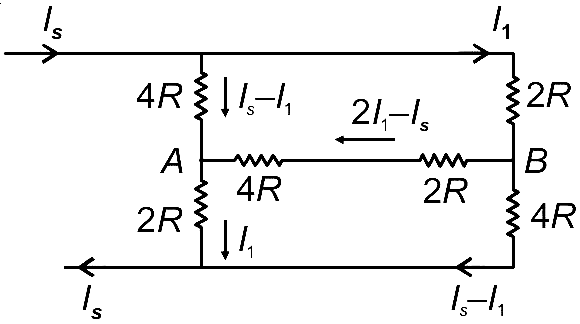
So the current in ammeter is \(I^{\prime}=\frac{10 I_{s}}{9}-I_{s}=\frac{I_{s}}{9}\) from \(B\) to \(A\)
In the following figures the velocity-time graphs for three particles 1, 2 and 3 are shown.

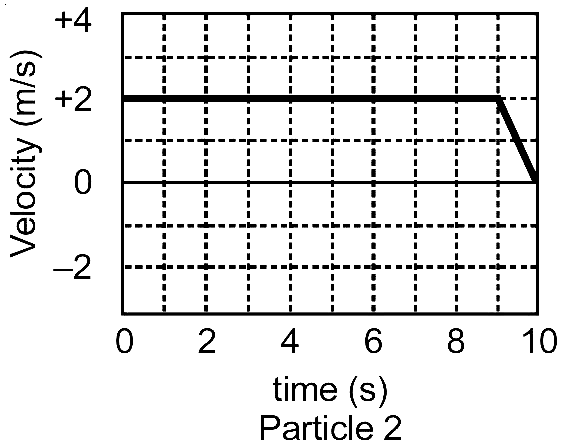

The magnitude of average acceleration of the three particles, over 10 s, bear the relationship
Ans. (d)
For particle (1), \(\left|\vec{a}_{1}\right|=\left|\frac{\overrightarrow{\Delta v}}{\Delta t}\right|=\frac{2}{10}\)
For particle (2), \(\left|\vec{a}_{2}\right|=\left|\frac{\overrightarrow{\Delta v}}{\Delta t}\right|=\frac{2}{10}\)
For particle (3), \(\left|\vec{a}_{3}\right|=\left|\frac{\overrightarrow{\Delta v}}{\Delta t}\right|=\frac{2}{10}\)
Clearly, \(\left|\vec{a}_{1}\right|=\left|\vec{a}_{2}\right|=\left|\vec{a}_{3}\right|\)
The potential energy (U) of a particle moving in a potential field varies with its displacement \((x)\) as shown below.

The variation of force \(F(x)\) acting on the particle as a function of \(x\) can be represented by
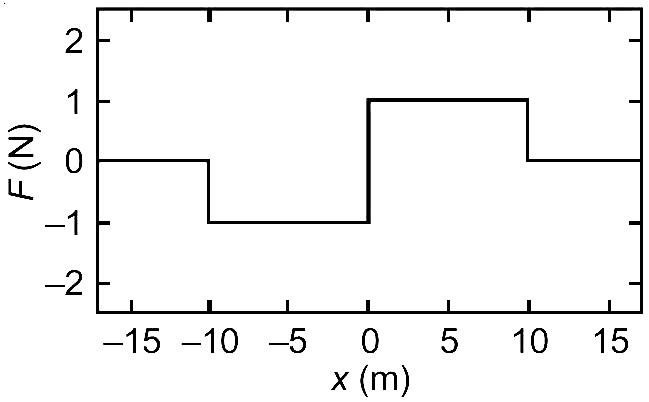
Fig (i)
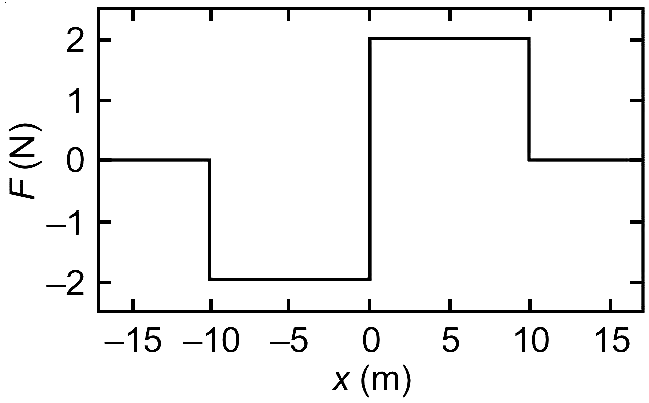
Fig (ii)

Fig (iii)
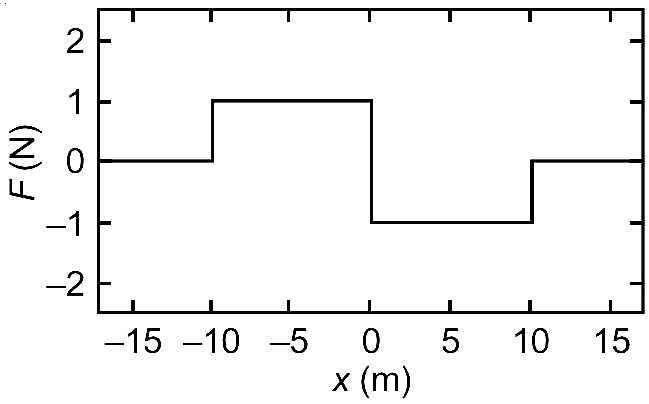
Fig (iv)
Ans. (d)
\(F=-\frac{d u}{d x}\)
∴ Force is of magnitude 1 N
And force is (+ve) for \(x=-10\) to \(x=0\)
And force is (-ve) for \(x=0\) to \(x=10\).
NSEP 2019 Questions 61–70
A pin of small length ‘a’ is placed along the axis of a concave mirror of focal length \(f\), at the distance \(u(>f)\) from its pole. The length of its image is ‘ \(b\) ‘. If the same object is placed perpendicular to its axis at the same distance \(u\) and the length of its image is now ‘ \(c\) ‘, then
Ans. (a, b, c, d)
Substituting value of \(b, c\) in option we get all the options.
A thin rod of length 10 cm is placed along the axis of a concave mirror of focal length 30 cm in such a way that one end of the image coincides with one end of the object. The length of the image may be
Ans. (a, c, d)
Case I : One of the ends is at centre and other in between centre and infinity
Case – II one of ends is at centre and other is between centre and pole
The mass of an electron can be expressed as
Ans. (b, c, d)
Select the correct statement(s), out of the following, about diffraction at N parallel slits.
Ans. (a, b, c, d)
(a) There use to be (N – 1) minima between each pair of principal maxima.
(b) There would be ( \(\mathrm{N}-2\) ) secondary maxima between each pair of principal maxima.
(c) For \(m^{\text {th }}\) order and \(d \sin \theta_{m}=m \lambda\)
width is proportional to \(\frac{1}{\mathrm{~N}}\)
(d) \(I=\mathrm{N}^{2} I_{0} \frac{\sin ^{2} \beta}{\beta^{2}} \therefore I \propto \mathrm{~N}^{2}\)
An electric dipole placed in a non-uniform electric field may experience
Ans. (a, b, c, d)
All the cases are possible.
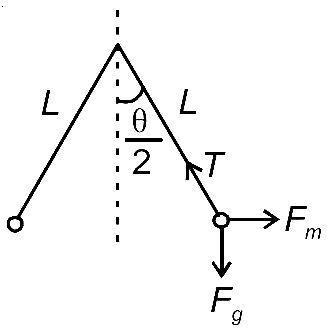
Two long parallel wires carry currents of equal magnitude \((I)\) but in opposite directions. These wires are suspended from fixed rod \(P Q\) by four chords of equal length \(L\) as shown. The mass per unit length of each wire is \(\lambda\), the value of angle \(\theta\) subtended by two chords \(O A\) and \(O B\), assuming it to be small, is
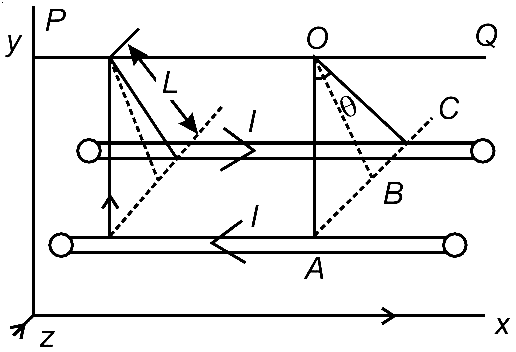
Ans. (b)
A block of mass \(m=10 \mathrm{~kg}\) is hanging over a frictionless light fixed pulley by an inextensible light rope. Initially the block is held at rest. The other end of the rope is now pulled by a constant force \(F\) in the vertically downward direction. The linear momentum of the block is seen to increase by 2 kg m/s in 1 s (in the first second). Therefore,
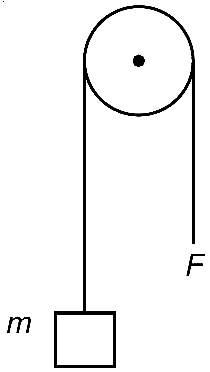
Ans. (a, d)
A ball of mass \(m_{1}\) travels horizontallly along the \(x\)-axis in the positive direction with an initial speed of \(v_{0}\). It collides with another ball of mass \(m_{2}\) that is originally at rest. After the collision, the ball of mass \(m_{1}\) has velocity \(\left(v_{1 x}{ }^{i}+v_{1 y} j\right)\) and the ball of mass \(m_{2}\) has velocity \(\left(v_{2 x} i+v_{2 y} j\right)\). Identify the correct relationship(s)
Ans. (c, d)
Momentum of the system remains conserved in absence of any external force
In a real gas
Ans. (a, c, d)
Variation of intermolecular forces as a function of intermolecular distance
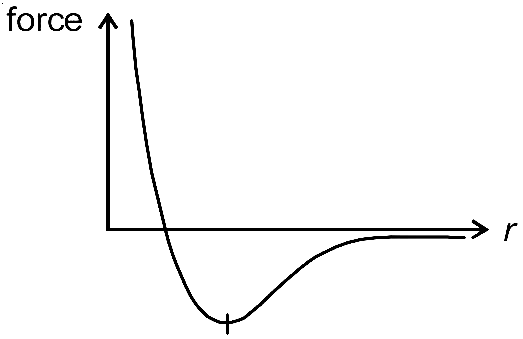
Internal energy of a real gas depends not just only temperature but also on volume and pressure as well.
A particle of mass \(m\) is thrown vertically up with velocity \(u\). Air exerts an opposing force of a constant magnitude \(F\). The particle returns back to the point of projection with velocity \(v\) after attaining maximum height \(h\), then
Ans. (a, b, c)
During upward journey,
So, \(0^{2}-u^{2}=-2\left(g+\frac{F}{m}\right) h\)
During downward journey
So, \(v^{2}-0^{2}=2\left(g-\frac{F}{m}\right) h \quad \downarrow m g\)
You may also like:
- NSEP 2025 Question Paper with Solutions – National Standard Examination in Physics
- NSEP 2024 Question Paper with Solutions – National Standard Examination in Physics
- NSEP 2023 Question Paper with Solutions – National Standard Examination in Physics
- NSEP 2022 Question Paper with Solutions – National Standard Examination in Physics
- NSEP 2016 Question Paper with Solutions – National Standard Examination in Physics
- NSEP 2017 Question Paper with Solutions – National Standard Examination in Physics
- NSEP 2018 Question Paper with Solutions – National Standard Examination in Physics
- NSEP 2019 Question Paper with Solutions – National Standard Examination in Physics
- IOQP 2020–21 Part I Physics Question Paper with Solutions (NSEP)
- IOQP 2021–22 Part I Physics Question Paper with Solutions (NSEP)