

Last Updated on May 4, 2025 by XAM CONTENT
Hello students, we are providing case study questions for class 7 Social Science. Case study questions are the new question format that is introduced in CBSE board. The resources for case study questions are very less. So, to help students we have created chapterwise case study questions for class 7 Social Science. In this article, you will find case study questions for cbse class 7 Social Science chapter 1 Geographical Diversity of India.
Exploring Society: India and Beyond” is the latest NCERT Social Science textbook for Class 7, designed to help students understand the diverse social, political, and cultural fabric of India while building strong civic and analytical skills in line with NEP 2020.
| Chapter | Geographical Diversity of India |
| Book | Exploring Society: India and Beyond |
| Type of Questions | Case Study Questions |
| Nature of Questions | Competency Based Questions |
| Board | CBSE |
| Class | 7 |
| Subject | Social Science |
| Useful for | Class 7 Studying Students |
| Answers provided | Yes |
| Difficulty level | Mentioned |
| Important Link | Class 7 Social Science Chapterwise Case Study |
Table of Contents
Case Study Questions on Geographical Diversity of India
Case Study Question 1:
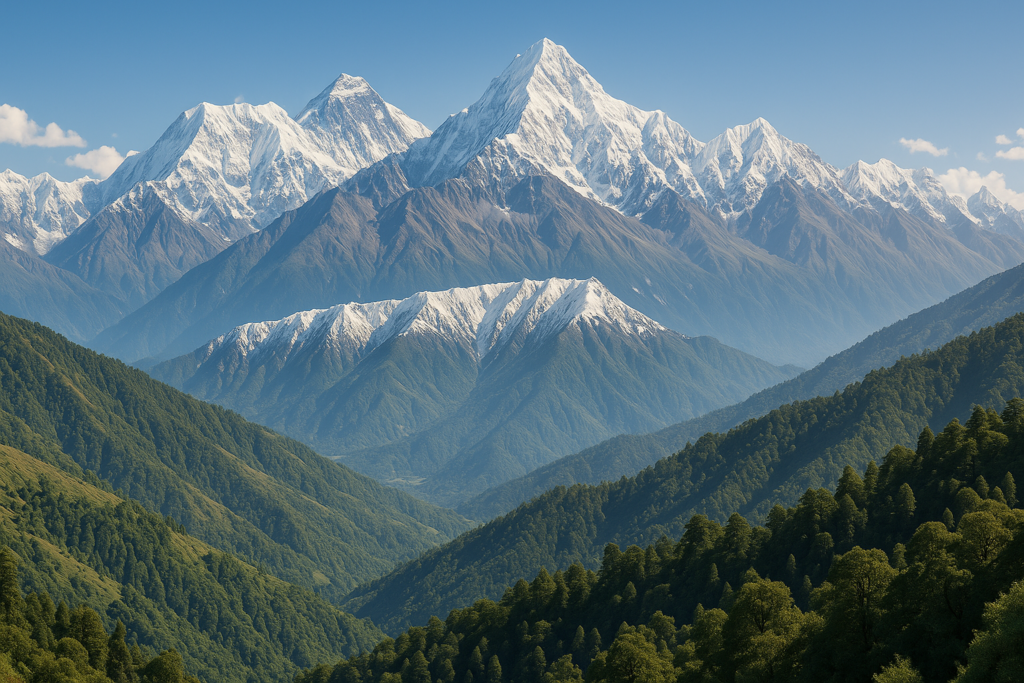
Passage: The Himalayas – Guardians of the North
The Himalayan mountain range acts as a towering shield in the north of India. Stretching across six countries and standing tall with peaks like Mount Everest and Kanchenjunga, the Himalayas are not only geographical barriers but also lifelines. Rivers like the Ganga and Brahmaputra originate here, making the Himalayas the “Water Tower of Asia.” They influence India’s climate, protect from cold winds, and contribute to agriculture, biodiversity, and even spirituality. The Himadri (Greater Himalayas) remains snow-covered year-round; Himachal has lush forests and famous hill stations, while the Shivaliks support dense wildlife.
Q1. Why are the Himalayas often referred to as the “Water Tower of Asia”?
(a) Because they store fossil fuels
(b) Due to high altitude snow that feeds major rivers
(c) They are home to deserts
(d) Due to mining of precious stones
Answer: (b)
Difficulty Level: Moderate
Explanation: The Himalayas feed rivers like Ganga, Brahmaputra, and Indus through snowmelt, providing water to millions.
Q2. Which part of the Himalayas contains famous hill stations and dense forests?
(a) Himadri
(b) Shivalik
(c) Himachal
(d) Deccan Plateau
Answer: (c)
Difficulty Level: Easy
Explanation: The Himachal region has moderate climate, biodiversity, and hill stations like Shimla and Mussoorie.
Q3. Which of the following is true about the formation of the Himalayas?
(a) They formed due to underwater volcanic activity
(b) They were always part of India’s landscape
(c) India collided with Eurasia and the land folded
(d) The Himalayas were carved by wind erosion
Answer: (c)
Difficulty Level: Tough
Explanation: The Himalayas were formed due to the collision between the Indian and Eurasian tectonic plates.
Q4. Why do very few people live in the Himadri region?
(a) It’s a protected forest reserve
(b) It has no rivers or water
(c) The region is completely flat and prone to flooding
(d) It has extremely harsh and cold conditions
Answer: (d)
Difficulty Level: Moderate
Explanation: Himadri has high altitudes with snow-covered peaks year-round, making it difficult for habitation.
Case Study Question 2
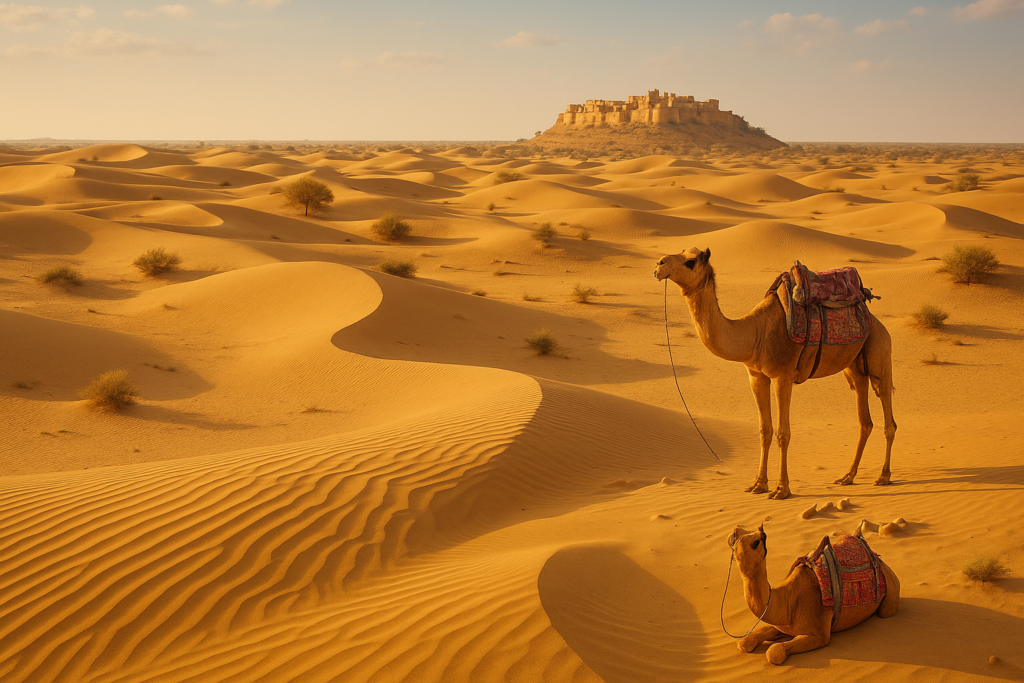
Passage: The Thar Desert – Life in the Harsh Sands
The Thar Desert in India stretches across Rajasthan and parts of Gujarat, Punjab, and Haryana. Despite being a harsh, arid region, communities have learned to adapt. Water scarcity is a major concern, leading to traditional conservation systems like taanka and kunds. Temperatures swing from scorching days to cold nights, and sand dunes shift due to wind. Yet, cities like Jaisalmer thrive, camels are used for transport, and local festivals add color to the dry landscape.
Q1. What is the main reason for the water scarcity in the Thar Desert?
(a) High altitude of the region
(b) Frequent flooding
(c) Very little rainfall and extreme temperatures
(d) Lack of mineral resources
Answer: (c)
Difficulty Level: Moderate
Explanation: The Thar Desert receives very little rainfall and has extreme day-night temperature fluctuations.
Q2. Which of the following traditional water conservation methods is used in the Thar region?
(a) Step wells
(b) Canals
(c) Taanka and Kunds
(d) Water sprinklers
Answer: (c)
Difficulty Level: Easy
Explanation: Taanka and kunds are traditional rainwater harvesting systems used to store scarce water.
Q3. What makes sand dunes in the Thar desert unique compared to mountains?
(a) They are formed by rivers
(b) Their shape is permanent
(c) They are solid and rocky
(d) They shift shape due to wind
Answer: (d)
Difficulty Level: Moderate
Explanation: Sand dunes are hill-like structures made of sand that change shape with the wind.
Q4. Which city is known as the ‘Golden City’ in the Thar Desert region?
(a) Udaipur
(b) Bikaner
(c) Jaisalmer
(d) Jaipur
Answer: (c)
Difficulty Level: Easy
Explanation: Jaisalmer, with its sandstone structures, is famously known as the ‘Golden City’.
We hope the given case study questions for Geographical Diversity of India Class 7 helps you in your learning.
Also check
- Case Study Questions for Class 12 Physics
- Crop Production and Management Assertion Reason for Class 8 Science
- Microorganisms: Friend and Foe Assertion Reason for Class 8 Science
- Coal and Petroleum Assertion Reason for Class 8 Science
- Combustion and Flame Assertion Reason for Class 8 Science
- Conservation of Plants and Animals Assertion Reason for Class 8 Science
- Numerical Problems on Convex and Concave Mirror with Answers
- Reproduction in Animals Assertion Reason for Class 8 Science
- Reaching the Age of Adolescence Assertion Reason for Class 8 Science
- Force and Pressure Assertion Reason for Class 8 Science
- Nutrition in Plants Assertion Reason for Class 7 Science
- Components of Food Assertion Reason for Class 6 Science
- What, Where, How and When Class 6 MCQ CBSE History Chapter 1
- From Hunting-Gathering to Growing Food Class 6 MCQ CBSE History Chapter 2
- What, Where, How and When Class 6 Case Study CBSE History Chapter 1
- How, When and Where Class 8 Revision Notes CBSE History Chapter 1
- From Trade to Territory Class 8 Revision Notes CBSE History Chapter 2
- Tracing Changes Through a Thousand Years Class 7 Revision Notes CBSE History Chapter 1
- New Kings and Kingdoms Class 7 Revision Notes CBSE History Chapter 2
- What, Where, How and When Class 6 Revision Notes CBSE History Chapter 1
- From Hunting-Gathering to Growing Food Class 6 Revision Notes CBSE History Chapter 2
- How, When and Where Class 8 Assertion Reason CBSE History Chapter 1
- From Trade to Territory Class 8 Assertion Reason CBSE History Chapter 2
- Ruling the Countryside Class 8 Revision Notes CBSE History Chapter 3
- Tribals, Dikus and the Vision of a Golden Age Class 8 Revision Notes CBSE History Chapter 4
🚀 Boost Your Exam Prep: Get case study questions for all subjects (Class 6-12) now!
👉 Explore more resources on CBSE Class 7
Topics from which case study questions may be asked
- Mountains
- Plains
- Plateaus
- Coastal areas
- Islands
India’s geography shapes its diversity and cultural richness.
Frequently Asked Questions (FAQs) on Geographical Diversity of India Case Study Questions
Q1: What are case study questions in CBSE Class 7 Social Science?
A1: Case study questions present a real-life scenario or passage followed by multiple-choice questions to test students’ understanding of concepts and their ability to apply knowledge in context.
Q2: Are case study questions part of the new CBSE exam pattern for Class 7?
A2: Yes, as per the NEP 2020 and CBSE’s competency-based learning approach, case study or passage-based questions are now included to promote critical thinking and concept application.
Q3: How should I prepare for case study questions in Class 7 Social Science?
A3: Focus on understanding concepts from the NCERT textbook thoroughly. Practice reading comprehension and analyze how social science concepts apply to real-life situations.
Q4: Where can I find chapterwise case study questions for Class 7 Social Science?
A5: You can access chapterwise CBSE-style case study questions with answers and explanations on educational websites like xamcontent.com and editablematerials.in, specially designed for practice and school exams.