

Last Updated on November 13, 2026 by sanjjeett
Practice the complete ICSE Class 10 Chemistry 2023 Question Paper with Solutions, including MCQs, chemical equations, electrolysis, analytical chemistry, organic chemistry, metallurgy and numericals. Use this solved paper to revise important concepts, practise board-style questions and strengthen your exam preparation.
Answer to this paper must be written on the paper provided separately.
You will not be allowed to write during the first 15 minutes. This time is to be spent in reading the question paper.
The time given at the head of this Paper is the time allowed for writing the answers.
Section A is compulsory. Attempt any four questions from Section B.
The intended marks for questions or parts of questions are given in brackets [ ].
ICSE Chemistry 2023 — Section A
An element in period 3, whose electron affinity is zero: [1]
Option (d) is correct
Explanation: It is a noble gas of period 3 whose electron affinity is zero.
An element with the largest atomic radius among the following is: [1]
Option (c) is correct
Explanation: Atomic radii decreases across the period from left to right.
The compound that is not an one of aluminium: [1]
Option (c) is correct
Explanation: Others are ore of aluminium. Fluorspar is \(\mathrm{CaF}^{+2}\).
The vapour density of \(\mathbf{C H}_{\mathbf{3}} \mathbf{O H}\) is ____. (At. Wt. \(\mathbf{C} \boldsymbol{=} \mathbf{1 2}, \mathbf{H} \boldsymbol{=} \mathbf{1}, \mathbf{O} \boldsymbol{=} \mathbf{1 6}\) ) [1]
Option (c) is correct
Explanation: Vapour density = molecular mass/2
Which of the following reactions takes place at the anode during the electroplating of an article with silver? [1]
Option (a) is correct
Explanation: Oxidation takes place at anode
The metallic hydroxide which forms a deep inky blue solution with excess ammonium hydroxide solution is: [1]
Option (b) is correct
Explanation: \(\mathrm{Cu}^{2+}\) ions form deep inky blue solution.
An example of a cyclic organic compound is: [1]
Option (d) is correct
Explanation: It has all carbon atoms in a ring structure.
In the laboratory preparation, HCl gas is dried by passing through: [1]
Option (b) is correct
Explanation: Other drying agents may react with HCl gas. Explanation: Other drying agents may react with HCl gas.
The nitrate which on thermal decomposition leaves behind a residue which is yellow when hot and white when cold: [1]
Option (a) is correct
Explanation: Lead nitrate on thermal decomposition gives lead oxide which is yellow in colour.
The salt formed when concentrated sulphuric acid reacts with \(\mathbf{K N O}_{\mathbf{3}}\) above 200°C: [1]
Option (c) is correct
Explanation: \(\mathrm{KHSO}_{4}\), potassium bisulphate Potassium bisulphate and nitric acid is formed. The reaction takes place below 200°C because above this temperature nitric acid decomposes to nitrogen dioxide.
The property exhibited by concentrated sulphuric acid when it is used to prepare hydrogen chloride gas from potassium chloride: [1]
Option (d) is correct
Explanation: Due to its reducing nature it shows non-volatile acid property.
The hydrocarbon formed when sodium propanoate and soda lime are heated together: [1]
Option (b) is correct
Explanation: This is decarboxylation reaction.
The acid which does not form acid salt by a basic radical: [1]
Option (a) is correct
Explanation: It is a weak acid so does not participate in formation of acidic salts.
THe general formula of hydrocarbons with single covalent bonds is: [1]
Option (a) is correct
Explanation: Alkane is hydrocarbon with single covalent bond.
The indicator which changes to pink colour in an alkaline solution is: [1]
Option (d) is correct
Explanation: It is used as an indicator in acid base titrations and give pink colour in alkaline solution.
Match the Column A with Column B: [5]
| Column A | Column B | ||
|---|---|---|---|
| (a) | Sodium Chloride | 1. | has two shared pair of electrons |
| (b) | Methane | 2. | has high melting and boiling points |
| (c) | Hydrogen chloride gas | 3. | a greenhouse gas |
| (d) | Oxidation reaction | 4. | has low melting and boiling points |
| (e) | Water | 5. | \(\mathrm{Zn}-2 \mathrm{e}^{-} \rightarrow \mathrm{Zn}^{2+}\) |
| 6. | \(\mathrm{S}+2 \mathrm{e}^{-} \rightarrow \mathrm{S}^{2-}\) |
Match the Column A with Column B: Column A
(a) Sodium Chloride
(b) Methane
(c) Hydrogen chloride gas
(d) Oxidation reaction
(e) Water
Column B
2. has high melting and boiling point.
3. a green house gas.
1. has two shared pair of electrons
5. \(\mathrm{Za}-2 \mathrm{e}^{-} \rightarrow \mathrm{Zn}^{2+}\)
4. has low melting and boiling point.
The following sketch illustrates the process of conversion of Alumina to Aluminium: Study the diagram and answer the following:
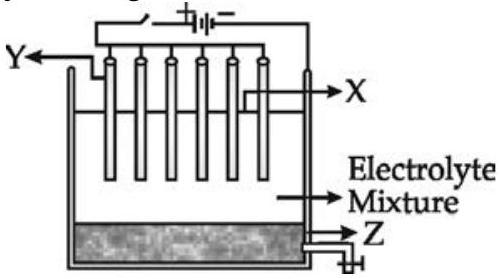
(a) Name the constituent of the electrolyte mixture which has a divalent metal in it.
(b) Name the powdered substance ‘X’ sprinkled on the surface of the electrolyte mixture.
(c) What is the name of the process?
(d) Write the reactions taking place at the electrodes ‘Y’ (anode) and ‘Z’ (cathode) respectively. [5]
(a) Fused alumina + cryolite + Fluorspar In \(\mathrm{CaF}_{2}\) (Fluorspar) calcium is divalent metal ion.
(b) Powdered coke is sprinkled, to reduce the heat loss by radiation.
(c) Hall-Heroult process
(d) At cathode (Z) : \(2 \mathrm{Al}^{3+}+6 \mathrm{e}^{-} \rightarrow 2 \mathrm{Al}\)
At anode (Y) \(6 \mathrm{O}^{2-} \rightarrow 3 \mathrm{O}_{2}+12 \mathrm{e}^{-}\)
Fill in the blanks with the choices given in the brackets:
(a) Metals are good ____. [oxidizing agents/reducing agents]
(b) Non-polar covalent compounds are ____ [good/bad] conductors of heat and electricity.
(c) Higher the pH value of a solution, the more
____ [acidic/alkaline] it is.
(d) ……………. [Silver chloride/Lead chloride] is a white precipitate that is soluble in excess of Ammonium hydroxide solution.
(e) Conversion of ethene to ethane is an example of
____ [hydration/hydrogenation] [5]
(a) Reducing agent.
(b) Bad
(c) Alkaline
(d) Silver chloride
(e) hydrogenation
State the terms/process for the following:
(a) The energy released when an atom in the gaseous state accepts an electron to form an anion.
(b) Tendency of an element form chains of identical atoms.
(c) The name of the process by which Ammonia is manufactured on a large scale.
(d) A type of salt formed by partial replacement of hydroxyl radicals with an acid radical.
(e) The ratio of the mass of a certain volume of gas to the same volume of hydrogen measured under the same conditions of temperature and pressure. [5]
(a) Electron affinity
(b) Catenation
(c) Haber’s process
(d) Basic salt
(e) Vapour density
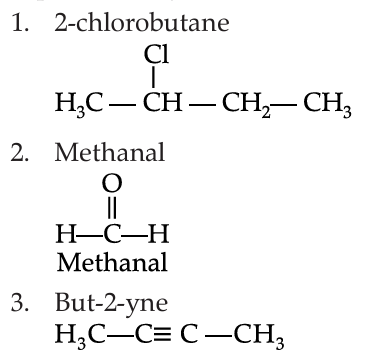
(a) Given the structural formula of the following organic compounds:
1. 2-chlorobutane
2. Methanal
3. But-2-yne
(b) Given the IUPAC name of the following organic compounds:
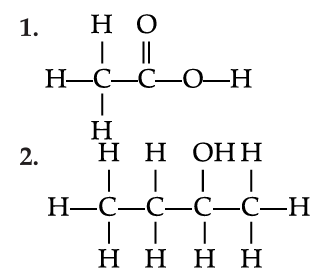
(a)
(b) 1. Acetic acid
2. Butan-2-ol
ICSE Chemistry 2023 — Section B
Identify the cation in each of the following cases:
(a) Ammonium hydroxide solution when added to Solution B gives a white precipitate which does not dissolve in excess of ammonium hydroxide solution.
(b) Sodium hydroxide solution when added to Solution C gives a white precipitate which is insoluble in excess of sodium hydroxide solution. [2]
(a) \(\mathrm{Pb}^{2+}\) which gives white ppt of \(\mathrm{Pb}(\mathrm{OH})_{2}\)
(b) \(\mathrm{Ca}^{2+}\) with NaOH gives white ppt of \(\mathrm{Ca}(\mathrm{OH})_{2}\).
Fill in the blanks by choosing the correct answer from the brackets:
(a) During electrolysis, the compound ____ in its molten state liberates reddish brown fumes at the anode. \(\left[\mathbf{N a C l} / \mathbf{P b B r}_{\mathbf{2}}\right]\)
(b) The ion which could be discharged most readily during electrolysis is ____. \(\left[\mathrm{Fe}^{2+} /\right.\) \(\mathrm{Cu}^{2+}\) ] [2]
(a) \(\mathrm{PbBr}_{2}\)
(b) \(\mathrm{Cu}^{2+}\)
Arrange the following as per the instruction given in the brackets:
(a) Al, K, Mg, Ca (decreasing order of its reactivity)
(b) N, Be, O, C (increasing order of non-metallic character)
(c) P, Si, F, Be (decreasing order of valence electrons) [3]
(a) \(\mathrm{K}>\mathrm{Al}>\mathrm{Ca}>\mathrm{Mg}\)
(b) \(\mathrm{Be}<\mathrm{C}<\mathrm{N}<\mathrm{O}\) (Increases across the period)
(c) \(\mathrm{F}>\mathrm{P}>\mathrm{Si}>\mathrm{Be}\) (increases across a period)
Complete and balance the following equations:
(a) \(\mathrm{NH}_{4} \mathrm{Cl}+\mathrm{Ca}(\mathrm{OH})_{2} \rightarrow\)
(b) \(\mathrm{CuSO}_{4}+\mathrm{NH}_{4} \mathrm{OH} \rightarrow\)
(c) \(\mathrm{Cu}+\) Conc. \(\mathrm{HNO}_{3} \rightarrow\) [3]
(a) \(2 \mathrm{NH}_{4} \mathrm{Cl}+\mathrm{Ca}(\mathrm{OH})_{2} \rightarrow \mathrm{CaCl}_{2}+2 \mathrm{NH}_{3}+2 \mathrm{H}_{2} \mathrm{O}\)
(b) \(\mathrm{CuSO}_{4}(\mathrm{aq})+2 \mathrm{NH}_{4} \mathrm{OH}(\mathrm{aq}) \rightarrow \mathrm{Cu}(\mathrm{OH})_{2}(\mathrm{~S})+\) \(\left(\mathrm{NH}_{4}\right)_{2} \mathrm{SO}_{4}(\mathrm{aq})\)
(c) \(\mathrm{Cu}+4 \mathrm{HNO}_{3} \rightarrow \mathrm{Cu}\left(\mathrm{NO}_{3}\right)_{2}+2 \mathrm{NO}_{2}+2 \mathrm{H}_{2} \mathrm{O}\) \(3 \mathrm{Cu}+8 \mathrm{HNO}_{3} \rightarrow 3 \mathrm{Cu}\left(\mathrm{NO}_{3}\right)_{2}+2 \mathrm{NO}+4 \mathrm{H}_{2} \mathrm{O}\) Any of the above reaction is correct.
State a relevant reason for the following:
(a) Hydrogen chloride gas cannot be dried over quick lime.
(b) Ammonia gas is not collected over water. [2]
(a) HCl is acidic and quicklime (CaO) is basic in nature. So they undergo chemical reaction when brought together.
(b) Gas is highly soluble in water so cannot be collected over water.
It is collected by downward displacement of air.
Identify the alloy in each case from the given composition:
(a) aluminium, magnesium, manganese, copper
(b) iron, nickel, chromium, carbon [2]
(a) Duralumin
(b) Stainless steel
Solve the following numerical problem. Ethane burns in oxygen according to the chemical equation:
If 80 ml of ethane is burnt in 300 ml of oxygen, find the composition of the resultant gaseous mixture when measured at room temperature. [3]
Molecular weight: 30324418 (in g/mol)
| \(\mathrm{C}_{2} \mathrm{H}_{6}\) | : | \(\mathrm{CO}_{2}\) |
|---|---|---|
| 2 | : | 4 |
| 1 | : | 2 |
No. of moles of \(\mathrm{CO}_{2}\) is twice that of \(\mathrm{C}_{2} \mathrm{H}_{6}\) So volume will also be twice. 80 ml of ethane will produce \(2 \times 80=160 \mathrm{ml}\) of \(\mathrm{CO}_{2}\)
No of moles of oxygen is 3.5 times So, the volume of oxygen will also be 3.5 times. To burn 80 ml of ethane, \(3.5 \times 80=280.0 \mathrm{ml}\) of oxygen is required
The resultant gaseous mixture is 160 ml of \(\mathrm{CO}_{2}\) and 20 ml of oxygen.
The following question are pertaining to the laboratory preparation of Ammonia gas from Magnesium nitride:
(a) Write a balanced chemical equation for its preparation.
(b) Why is this method seldom used?
(c) How do you identify the gas formed? [3]
(a) \(\mathrm{Mg}_{3} \mathrm{~N}_{2}+6 \mathrm{H}_{2} \mathrm{O} \rightarrow 3 \mathrm{Mg}(\mathrm{OH})_{2}+2 \mathrm{NH}_{3}\)
(b) As this is very expensive method.
(c) Bring a rod dipped in HCl near it. Dense
white fumes of ammonium chloride is formed.
Write one use of the following alloys:
(a) Bronze
(b) Fuse metal [2]
(a) Used in preparation of medals, musical instruments, as a ship propellents.
(b) For soldering of metals.
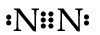
Draw the electron dot structure for the following:
(a) Ammonium ion
(b) A molecule of nitrogen [At. No.: \(\mathrm{N}=7, \mathrm{H}=1\) ] [2]
(a)
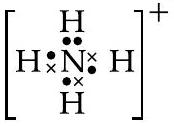
(b)
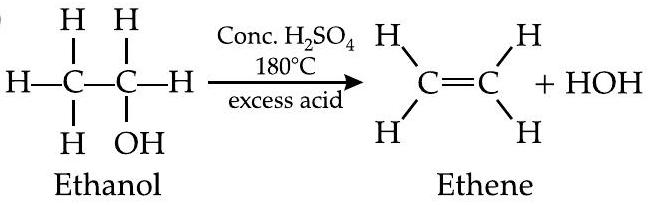
Give a balanced chemical equation for the following conversions with conditions:
(a) Ethene from ethanol
(b) Ethyne from calcium carbide
(c) Monochloromethane from methane [3]
(a)
(b)

(c)

Study the following observations and name the anions present in each of the reactions.
(a) When a crystalline solid ‘P’ is warmed with concentrated \(\mathbf{H}_{\mathbf{2}} \mathbf{S O}_{\mathbf{4}}\) and copper turnings a reddish brown gas is released.
(b) When few drops of dilute sulphuric acid is added to Salt ‘R’ and heated, a colourless gas is released which turns moist lead acetate paper silvery black.
(c) When few drops of barium nitrate solution is added to the salt solution ‘Q’, a white precipitate is formed which is insoluble in HCl. [3]
(a) Copper nitrate is the compound “P”.
\(\mathrm{NO}_{3}{ }^{2-}\) (nitrate) is the anions.
(b) \(\mathrm{H}_{2} \mathrm{~S}\) is the gas which turns moist lead acetate paper black.
\(\mathrm{S}^{2-}\) (sulphide) anions.
(c) \(\mathrm{SO}_{4}{ }^{2-}\) (sulphate) anions
Define/State:
(a) Electronegativity
(b) Gay-Lussac’s Law of combining volumes [2]
(a) Electronegativity: It is the tendency of an atom in a molecule to attract the shared pair of electrons towards itself is known as electronegativity.
(b) Gay Lussac’s Law of combining volumes: It states that, whenever the gases react, they always do so in volumes , which bear a simple whole number ratio to one another as well as to the gaseous products, if gaseous, all volumes being measured under similar condition of temperature and pressure.
The Empirical formula of an organic compound is \(\mathbf{C H C l}_{\mathbf{2}}\). If its relative molecular mass is 168, what is its molecular formula? [At. Wt. \(\mathbf{C}=\mathbf{1 2}, \mathbf{H}=\mathbf{1}, \mathbf{C l}=\mathbf{3 5 . 5}\) ] [2]
empirical formula mass
molecular formula = (empirical formula)n
Choose the substances given in the box below to answer the following questions:
| Iron | Magnesium sulphite | Zinc | Sodium sulphide |
|---|---|---|---|
| Lead | Ferric chloride | Copper | Ferrous sulphate |
(a) The metal that will not produce hydrogen gas when reacted with dilute acids.
(b) The compound that will produce sulphur dioxide gas when reacted with dilute HCl.
(c) The solution of this compound produces dirty green precipitate with NaOH. [3]
(a) Copper: It does not show reaction with acids.
(b) Magnesium Sulphite: \(\mathrm{MgSO}_{3}+\) dil. HCl → \(\mathrm{MgCl}_{2}+\mathrm{H}_{2} \mathrm{O}+\mathrm{SO}_{2}\)
(c) Ferrous Sulphite: It gives dirty green ppt with NaOH
State one relevant observation for each of the following:
(a) To the copper nitrate solution, initially few drops of sodium hydroxide solution is added and then added in excess.
(b) Burning of ammonia in excess of oxygen.
(c) Dry ammonia gas is passed over heated PbO. [3]
(a) Initially light blue ppt of \(\mathrm{Cu}(\mathrm{OH})_{2}\) is formed along with sodium nitrate.
The ppt is soluble in excess NaOH solution giving a deep blue coloured solution.
(b) It burns with yellowish green flame due to the formation of \(\mathrm{NO}_{2}\).
(c) Lead monoxide is reduced to grey coloured lead.
Name the following:
(a) Organic compounds with same molecular formula but different structural formula.
(b) Group of organic compounds where the successive members follow a regular structural pattern, successive compounds differ by a ‘ \(\mathrm{CH}_{2}\) ‘ group [2]
(a) Isomers: The compounds with same molecular formula and different structural formulae
(b) Homologous series
Give reason for the following:
(a) lonisation potential decreases down a group.
(b) lonic compounds do not conduct electricity in solid state. [2]
(a) Ionization potential decreases as we go down the group because as we go down:
Atomic size increases, so the force of attraction between nucleus and valence electron reduces. It becomes easy to remove the electron.
(b) In solid state the ions are not free to move While in molten state they can easy travel in solution thus allowing electricity to flow.
Calculate:
(a) The percentage of phosphate in the fertilizer super phosphate \(\mathrm{Ca}\left(\mathrm{H}_{2} \mathrm{PO}_{4}\right)_{2}\) correct to 1 decimal point.
(b) Write the empirical formula of \(\mathbf{C}_{\mathbf{8}} \mathbf{H}_{\mathbf{1 8}}\). [3]
(a) Molecular weight \(=\mathrm{Ca}\left(\mathrm{H}_{2} \mathrm{PO}_{4}\right)_{2}\)
Amount of \(\mathrm{P}=2 \times 31=62 \mathrm{~g}\)
(b) Empirical formula for \(\mathrm{C}_{8} \mathrm{H}_{18}\)
C : H 8 : 18 4 : 9 Thus empirical formula is \(\mathrm{C}_{4} \mathrm{H}_{9}\).
Answer the following questions with reference to electrorefining of copper:
(a) What is the anode made of?
(b) What do you observe at the cathode?
(c) Write the reaction taking place at the cathode. [3]
(a) A block of impure copper metal
(b) At cathode, cupric ions get discharged by gaining electrons from the cathode.
Reddish brown copper is deposited at cathode.
(c) \(\mathrm{Cu}^{2+}+2 \mathrm{e}^{-} \rightarrow \mathrm{Cu}\)
Arrange the following according to the instructions given in brackets:
(a) \(\mathrm{C}_{2} \mathrm{H}_{2}, \mathrm{C}_{3} \mathrm{H}_{6}, \mathrm{CH}_{4}, \mathrm{C}_{2} \mathrm{H}_{4}\) (In the increasing order of the molecular weight)
(b) \(\mathrm{Cu}^{2+}, \mathrm{Na}^{+}, \mathrm{Zn}^{2+}, \mathrm{Ag}^{+}\)(The order of Preferential discharge at the cathode) [2]
(a)
(b) \(\mathrm{Ag}^{+}>\mathrm{Cu}^{2+}>\mathrm{Zn}^{2+}>\mathrm{Na}^{+}\)
Elements at lower position get discharged easily.
Differentiate between the following pairs based on the criteria given in the brackets:
(a) Cane sugar and hydrated copper sulphate [using concentrated \(\mathrm{H}_{2} \mathrm{SO}_{4}\) ]
(b) Sulphuric acid and hydrochloric acid [type of salts formed] [2]
(a) Cane sugar: Results in the formation of black spongy mass of carbon known as sugar charcoal.
Copper sulphate: The blue crystal changes to white powder due to dehydration.
(b) The salts of sulphuric acid are sulphates and bisulphates.
e.g., \(\mathrm{NaHSO}_{4}\) while the salts of hydrochloric acid contains \(\mathrm{Cl}^{-}\)ions.
Convert the following reactions into a balanced chemical equation:
(a) Ammonia to nitric oxide using oxygen and platinum catalyst.
(b) Sodium hydroxide to sodium sulphate using sulphuric acid.
(c) Ferrous sulphide to hydrogen sulphide using hydrochloric acid. [3]
(a) \(4 \mathrm{NH}_{3}+5 \mathrm{O}_{2} \rightarrow 4 \mathrm{NO}+6 \mathrm{H}_{2} \mathrm{O}\)
This is Ostwald’s process to produce nitric oxide.
(b) \(\mathrm{H}_{2} \mathrm{SO}_{4}+2 \mathrm{NaOH} \rightarrow \mathrm{Na}_{2} \mathrm{SO}_{4}+2 \mathrm{H}_{2} \mathrm{O}\)
(Sulfuric (Sod. (Sod. (Water) acid) Hydroxide) Sulfate)
(c) \(\mathrm{FeS}(s)+2 \mathrm{HCl}(a q) \rightarrow \mathrm{FeCl}_{2}(s)+\mathrm{H}_{2} \mathrm{~S}(g)\)
Choose the answer from the list which fits in the description:
(a) A compound which undergoes thermal dissociation.
(b) An amphoteric oxide.
(c) A compound which is a non-electrolyte. [3]
(a) \(\mathrm{NH}_{4} \mathrm{Cl}\)
(b) PbO : It behaves both as acidic and basic oxide.
(c) \(\mathrm{CCl}_{4}\) : It is formed due to covalent bonding.