

Table of Contents
Last Updated on November 20, 2026 by XAM CONTENT
Practice the CBSE Class 10 Science Question Paper 2024 — Delhi Set 2 (31/1/2) with complete section-wise answers and worked solutions. The paper contains 39 questions for 80 marks with internal choices in selected questions.
Section A: Q1–20 (1 mark each) · Section B: Q21–26 (2 marks each) · Section C: Q27–33 (3 marks each) · Section D: Q34–36 (5 marks each) · Section E: Q37–39 (4 marks each). There is no overall choice; internal choice is provided in selected questions.
Section A — MCQs & Assertion–Reason
Select from the following a decomposition reaction in which source of energy for decomposition is light: [1]
Ans. (c)
Explanation: The decomposition reaction in which the source of energy for decomposition of light is typically referred to as a photochemical decomposition reaction. Among the options given, the reaction involving silver bromide \(\left(2 \mathrm{AgBr} \rightarrow 2 \mathrm{Ag}+\mathrm{Br}_{2}\right)\) is a photochemical decomposition reaction.
Oxides of aluminium and zinc are: [1]
Ans. (c)
Explanation: Zinc and aluminium don’t form acidic oxides but form amphoteric oxides.
Consider the following compounds:
The compound having maximum number of water of crystallisation in its crystalline form in one molecule is: [1]
Ans. (d)
Explanation: The compound with the maximum number of water molecules in its common crystalline form is \(\mathrm{Na}_{2} \mathrm{CO}_{3} .10 \mathrm{H}_{2} \mathrm{O}\) (Hydrated sodium carbonate). This compound contains 10 water molecules per formula unit.
The name and formula of third member of homologous series of alkyne is: [1]
Ans. (d)
Option (D) is correct.
Explanation: In the nomenclature of organic compounds, alkynes are hydrocarbons containing triple bonds between carbon atoms. Butyne is specifically an alkyne with four carbon atoms in its chain and a triple bond between the second and third carbon atoms.
A metal and a non-metal that exists in liquid state at the room temperature are respectively: [1]
Ans. (c)
Explanation: Mercury is the metal that exists as a liquid at room temperature, while bromine is the nonmetal which exits as a liquid at room temperature.
\(\mathrm{MnO}_{2}+4 \mathrm{HCl} \rightarrow \mathrm{MnCl}_{2}+2 \mathrm{H}_{2} \mathrm{O}+\mathrm{Cl}_{2}\)
The reaction given above is a redox reaction because in this case: [1]
Ans. (d)
Explanation: In \(\mathrm{MnO}_{2}\), manganese (Mn) goes from an oxidation state of +4 to +2 in \(\mathrm{MnCl}_{2}\). This means manganese is reduced. In HCl, chlorine (Cl) goes from an oxidation state of -1 to 0 in \(\mathrm{Cl}_{2}\). This means chlorine is oxidised.
When 2 mL of sodium hydroxide solution is added to few pieces of granulated zinc in a test tube and then warmed, the reaction that occurs can be written in the form of a balanced chemical equation as: [1]
Ans. (b)
Explanation: The balanced chemical equation for the reaction between sodium hydroxide
This equation ensures that the number of atoms of each element is the same on both sides of the reaction.
Which one of the following statements is NOT true? [1]
Ans. (d)
DNA carries hereditary information and also provides information for making proteins. A change in DNA information can produce a different protein and may therefore change the feature expressed. Hence the statement that features will remain the same even if the protein changes is NOT true.
In a nerve cell, the site where the electrical impulse is converted into a chemical signal is known as: [1]
Ans. (c)
Explanation: At a neuromuscular junction, the electrical impulse arriving at the nerve ending causes the release of chemical neurotransmitters. Thus, the electrical signal is converted into a chemical signal at the neuromuscular junction.
Chromosomes:
(i) carry hereditary information from parents to the next generation.
(ii) are thread like structures located inside the nucleus of an animal cell.
(iii) always exist in pairs in human reproductive cells.
(iv) are involved in the process of cell division.
The correct statements are: [1]
Ans. (d)
Explanation: Chromosomes carry hereditary information from parents to the next generation and are involved in cell division. Human reproductive cells contain a single set of chromosomes, not chromosome pairs. Hence, statements (i) and (iv) are correct.
A stoma closes when:
(i) it needs carbon dioxide for photosynthesis.
(ii) it does not need carbon dioxide for photosynthesis.
(iii) water flows out of the guard cells.
(iv) water flows into the guard cells.
The correct reason(s) in this process is/are: [1]
Ans. (c)
Explanation: A stoma closes when carbon dioxide is not required for photosynthesis and water moves out of the guard cells. Loss of water makes the guard cells flaccid, causing the stomatal pore to close.
In which of the following organisms, multiple fission is a means of asexual reproduction? [1]
Ans. (d)
Explanation: Multiple fission is a form of asexual reproduction, where a single parent cell divides into multiple daughter cells simultaneously. Plasmodium, which causes malaria, undergoes multiple fission during its life cycle. In the case of Plasmodium, the asexual reproduction involves the formation of multiple daughter cells (called merozoites) within a single parent cell (schizont). This process contributes to the rapid multiplication and spread of the parasite in the host’s bloodstream.
At what distance from a convex lens should an object be placed to get an image of the same size as that of the object on a screen? [1]
Ans. (c)
Explanation: To get an image of the same size as the object on a screen with a convex lens, the object should be placed at twice the focal length of the lens.
The lens system of the human eye forms an image on a light sensitive screen, which is called as: [1]
Ans. (d)
Explanation: The lens system of the human eye forms an image on the light-sensitive screen known as the retina.
The pattern of the magnetic field produced inside a current carrying solenoid is: [1]

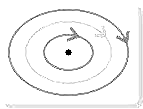
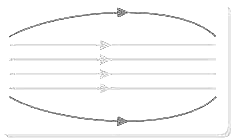
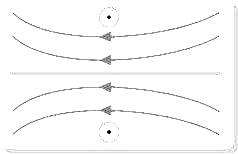
Ans. (a)
Explanation: Inside a current-carrying solenoid, the magnetic field lines are straight, parallel and closely spaced, representing a nearly uniform magnetic field. Therefore, option (A) shows the correct pattern.
Identify the food chain in which the organisms of the second trophic level are missing: [1]
Ans. (c)
Explanation: In option (C) “Tiger, grass, snake, frog,” the second trophic level, which typically consists of herbivores consuming plants, is missing and that could be grasshopper. This breaks the usual structure of a food chain where energy is transferred from producers (plants) to consumers (herbivores) and then to higher-level consumers (carnivores or omnivores). The absence of herbivores in this chain disrupts the natural flow of energy through trophic levels.
Assertion (A): The rate of breathing in aquatic organisms is much faster than in terrestrial organisms.
Reason (R): The amount of oxygen dissolved in water is very high as compared to the amount of oxygen in air. [1]
Ans. (c)
Explanation: Aquatic organisms, such as fishes, extract oxygen from water through their gills, where oxygen is dissolved. The concentration of dissolved oxygen in water is relatively low compared to atmospheric oxygen, necessitating a faster breathing rate in aquatic organisms compared to their terrestrial counterparts. This adaptation allows efficient extraction of the limited dissolved oxygen essential for their respiratory needs.
Assertion (A): The rainbow is a natural spectrum of sunlight in the sky.
Reason (R): Rainbow is formed in the sky when the sun is overhead and water droplets are also present in air. [1]
Ans. (c)
Explanation: The rainbow is a natural spectrum of sunlight, so the Assertion is true. The Reason is false because a rainbow is seen when the Sun is behind the observer and water droplets are present in front; it is not formed when the Sun is overhead.
Assertion (A): Accumulation of harmful chemicals is maximum in the organisms at the highest trophic level of a food chain.
Reason (R): Harmful chemicals are sprayed on the crops to protect them from diseases and pests. [1]
Ans. (b)
Explanation: The accumulation of harmful chemicals is indeed higher in organisms at the highest trophic levels due to the process of biomagnification, where toxins become more concentrated as they move up the food chain. The primary source of harmful chemicals in organisms at higher trophic levels is bioaccumulation from the consumption of contaminated prey, not necessarily from direct spraying on crops.
Assertion (A): Hydrogen gas is not evolved when zinc reacts with nitric acid.
Reason (R): Nitric acid oxidises the hydrogen gas produced to water and itself gets reduced. [1]
Ans. (a)
Explanation: Hydrogen gas is not liberated in the reaction between a metal and nitric acid due to the powerful oxidising nature of nitric acid. Nitric acid serves as a robust oxidising agent, causing the hydrogen gas generated during the metal reaction to undergo oxidation, ultimately forming water. Consequently, no free hydrogen gas is observed in the process.
Section B — Very Short Answer
(i) Two magnetic field lines do not intersect each other. Why? [2]
(ii) How is a uniform magnetic field in a given region represented? Draw a diagram in support of your answer.
(i) Magnetic field lines do not intersect each other because if they did, it would imply the existence of two different directions of the magnetic field at the same point, which is not physically meaningful. The basic principle is that a magnetic field line represents the direction of the magnetic force experienced by a hypothetical north pole placed at that point. If two field lines were to intersect, it would suggest conflicting directions for the magnetic force at the intersection point, violating the rules of a well-defined magnetic field. The non-intersection of magnetic field lines is a fundamental property of magnetic fields and is consistent with the nature of magnetic interactions.
(ii) A uniform magnetic field in a given region is represented by straight and parallel magnetic field lines. These field lines indicate that the magnetic field has the same strength and direction throughout the entire region. Here is a simple diagram illustrating a uniform magnetic field:
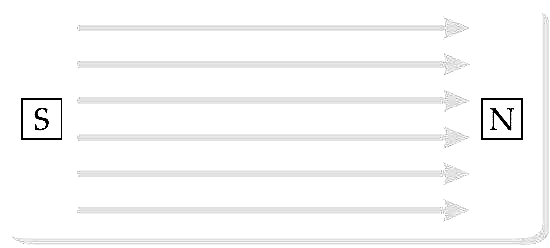
In this representation, the arrows indicate the direction of the magnetic field and the fact that they are straight and parallel suggests uniformity. The spacing between the lines represents the strength of the magnetic field, with closer lines indicating a stronger field. In a truly uniform magnetic field, the spacing between the lines would be consistent throughout the region.
(A) Show how you would connect three resistors each of resistance \(6 \Omega\), so that the combination has a resistance of \(9 \Omega\). Also justify your answer. [2]
OR
(B) In the given circuit calculate the power consumed in watts in the resistor of \(2 \Omega\) : [2]
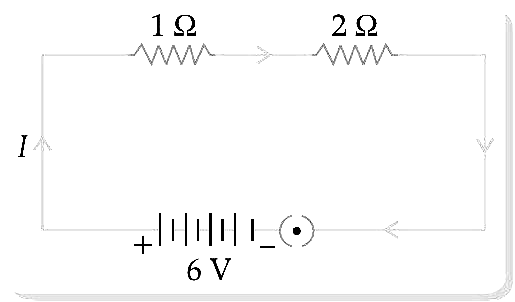
(A)
(i) First, we connect two resistors each of \(6 \Omega\) in parallel connection
then, \(\frac{1}{R}=\frac{1}{6}+\frac{1}{6}=\frac{2}{6}=\frac{1}{3}\)
If \(3^{\text {rd }}\) resistor of \(6 \Omega\) and \(3 \Omega\) are connected in series, then the resultant resistance \(=6 \Omega+3 \Omega\) \(=9 \Omega\)
(B)
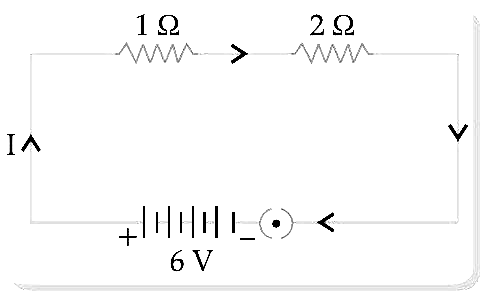
Total Resistance \(=1 \Omega+2 \Omega=3 \Omega\)
Total applied voltage(V) = 6V
Circuit Current \((\mathrm{I})=\frac{\mathrm{V}}{\mathrm{R}}=\frac{6 \mathrm{~V}}{3 \Omega}=2 \mathrm{~A}\)
Power Consumed across 2 ohm resistor \(=\mathrm{I}^{2} \mathrm{R}=\) \(2^{2} \times 2=8 \mathrm{~W}\)
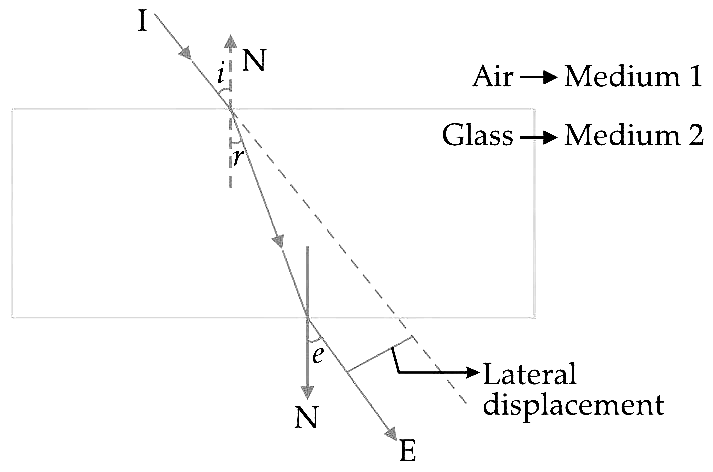
A ray of light falls making an angle of incidence \(\theta\) on the surface of a glass slab. Draw a labelled ray diagram to show its path. Also mark lateral displacement on it. [2]
(A) In which region of the brain is (i) medulla and (ii) cerebrum located? State one function of each. [2]
OR
(B) Name a hormone that promotes the growth of tendrils and explain how they help a pea plant to climb up other plants. [2]
(A) (i) Medulla Oblongata:
Location: The medulla oblongata is located in the hindbrain, at the base of the brainstem.
Function: It plays a crucial role in regulating vital involuntary functions such as heartbeat, breathing, blood pressure and reflex actions like swallowing and vomiting.
(ii) Cerebrum:
Location: The cerebrum is the largest part of the brain and is situated at the topmost part of the central nervous system.
Function: The cerebrum is primarily responsible for higher cognitive functions, including thinking, memory, perception and voluntary motor movements. It is also involved in processing sensory information and controlling conscious awareness.
OR
(B) The hormone that promotes the growth of tendrils in plants is auxin. Auxin is a plant hormone that plays a key role in various aspects of plant growth and development, including the elongation of cells.
Tendrils are slender, specialised structures that help climbing plants like peas to attach to and climb up other surfaces. Here’s how auxin and tendrils work together:
1. Auxin Production: The growing tip of the tendril produces auxin, which is then transported downwards.
2. Unequal Growth: Auxin promotes cell elongation, causing the cells on the side of the tendril opposite to the support to elongate more than the cells on the side touching the support.
3. Curling Response: As a result of unequal growth, the tendril undergoes a curling response. The side with more elongated cells grows faster, causing the tendril to curl around the support.
4. Attachment: The curled tendrils now wrap around the support, providing a means for the climbing plant to anchor itself and support its growth.
Mention the pathway of urine in our body starting from the organ of its formation to its excretion. What will happen if the tubular part of the nephron does not work properly? [2]
The pathway of urine in our body starts from the organ of its formation, the kidneys and ends with its excretion. Here’s the pathway:
1. Kidneys: Urine formation begins in the kidneys, which are the primary organs responsible for filtering blood and removing waste products. Each kidney contains numerous nephrons, which are the functional units responsible for urine production.
2. Renal Tubules: Within the nephrons, urine formation involves several stages in the renal tubules, including filtration, reabsorption and secretion.
3. Renal Pelvis: The formed urine is then collected in the renal pelvis, a funnel-shaped structure in the kidney that serves as a reservoir.
4. Ureters: From the renal pelvis, urine travels through the ureters, which are muscular tubes connecting the kidneys to the urinary bladder. Peristaltic contractions of the ureter walls help propel urine toward the bladder.
5. Urinary Bladder: Urine is temporarily stored in the urinary bladder until it is ready for elimination. The bladder is a muscular organ that expands as it fills with urine.
6. Urethra: The final part of the pathway is the urethra, a tube that carries urine from the bladder to the outside of the body during the process of micturition or urination.
If the tubular part of the nephron does not work properly, it can lead to various issues, including:
• Reduced Filtration: Impaired tubular function may result in decreased filtration of waste products from the blood, leading to the retention of toxins in the body.
• Electrolyte Imbalance: The tubules play a crucial role in maintaining the balance of electrolytes (such as sodium, potassium and calcium) in the body. Dysfunction can disrupt this balance.
• Fluid Imbalance: Proper tubular function is essential for regulating the body’s fluid balance. Impairment may lead to problems like edema or dehydration.
• Acid-Base Imbalance: The nephron tubules are involved in maintaining the body’s acid-base balance. Malfunction can result in acidosis or alkalosis.
• Excretion Issues: If the tubules are not functioning properly, the excretion of waste products and excess substances may be compromised.
Overall, the tubular part of the nephron is critical for maintaining homeostasis in the body and dysfunction can lead to various health problems.
Translate the following statements into chemical equations and then balance them: [2]
(i) Solution of barium chloride and aluminium sulphate in water react to give insoluble barium sulphate and the solution of aluminium chloride.
(ii) Aluminium metal reacts with steam to give aluminium oxide and hydrogen gas.
(i) The chemical equation for the reaction between barium chloride \(\left(\mathrm{BaCl}_{2}\right)\) and aluminum sulfate \(\left(\mathrm{Al}_{2}\left(\mathrm{SO}_{4}\right)_{3}\right)\) in water is:
To balance the equation, you need to ensure that the number of each type of atom is the same on both sides of the equation. The balanced equation is:
(ii) The chemical equation for the reaction between aluminum metal (Al) and steam \(\left(\mathrm{H}_{2} \mathrm{O}\right)\) to form aluminum oxide \(\left(\mathrm{Al}_{2} \mathrm{O}_{3}\right)\) and hydrogen gas \(\left(\mathrm{H}_{2}\right)\) is:
The balanced equation is:
These balanced chemical equations represent the reactions described in the given statements.
Section C — Short Answer
(i) The pH of a sample of tomato juice is 4.6. How is this juice likely to be in taste? Give reason to justify your answer. [1]
(ii) How do we differentiate between a strong acid and a weak base in terms of ion-formation in aqueous solutions? [1]
(iii) The acid rain can make the survival of aquatic animals difficult. How? [1]
(i) The pH of tomato juice is 4.6, which classifies it as slightly acidic. The taste of the juice is likely to be tangy or slightly sour. This is because acidic substances generally have a sour taste and the pH value of 4.6 indicates a mild acidity.
(ii) Differentiating between a strong acid and a weak base can be done by observing the ions formed in aqueous solutions. Strong acids ionize completely in water, forming a high concentration of hydrogen ions \(\left(\mathrm{H}^{+}\right)\), while weak bases partially ionise, leading to a lower concentration of hydroxide ions ( \(\mathrm{OH}^{-}\)). The distinguishing factor lies in the type and extent of ionisation.
(iii) Acid rain, formed by the release of sulfur dioxide \(\left(2 \mathrm{SO}_{2}\right)\) and nitrogen oxides (NOx) into the atmosphere, can lower the pH of precipitation. When acid rain falls into aquatic ecosystems, it increases the acidity of water bodies. This acidification poses a threat to aquatic life by affecting the pH balance essential for the survival of many species. It can harm fish, amphibians and other aquatic organisms, impacting their reproductive, feeding and respiratory processes.
Write one chemical equation each for the chemical reaction in which the following have taken place: [3]
(i) Change in colour
(ii) Change in temperature
(iii) Formation of precipitate
Mention colour change/temperature change (rise/fall)/compound precipitated along with equation.
(i) Change in Colour:
Reaction between iron and copper sulphate results in changing the blue colour of copper sulphate to a pale green.
(ii) Change in Temperature:
Methane \(\left(\mathrm{CH}_{4}\right)+\) Oxygen \(\left(\mathrm{O}_{2}\right) \rightarrow\) Carbon dioxide \(\left(\mathrm{CO}_{2}\right)+\) Water \(\left(\mathrm{H}_{2} \mathrm{O}\right)+\) Heat
The combustion of methane with oxygen releases heat energy, causing a rise in temperature.
(iii) Formation of Precipitate:
Lead Nitrate \(\left(\mathrm{Pb}\left(\mathrm{NO}_{3}\right)_{2}\right)\) + Potassium Iodide (KI) → Lead Iodide \(\left(\mathrm{PbI}_{2}\right)+\) Potassium Nitrate \(\left(\mathrm{KNO}_{3}\right) \downarrow\) In this reaction, lead iodide \(\left(\mathrm{PbI}_{2}\right)\) is formed as a yellow precipitate, indicating a change in colour and the formation of a solid.
Define reflex action. With the help of a flow chart, show the path of a reflex action such as sneezing. [3]
Reflex Action: A reflex action is an involuntary and rapid response to a stimulus that occurs without conscious thought. It is a protective mechanism designed to minimize potential harm to the body by eliciting a quick and automatic response.
Path of a Reflex Action – Sneezing:
Stimulus (Irritant in Nasal Passage)
↓
Sensory Receptor (Nasal Nerve Endings)
↓
Sensory Neuron (Carries Signal to Spinal Cord)
↓
Spinal Cord (Processing Center)
↓
Motor Neuron (Carries Signal to Effector)
↓
Effector (Muscles Involved in Sneezing – Diaphragm, Chest and Abdominal Muscles)
↓
Response (Sneezing)
Stimulus: Presence of an irritant in the nasal passage.
Sensory Receptor: Nasal nerve endings detect the irritant.
Sensory Neuron: Carries the sensory signal to the spinal cord.
Spinal Cord: Acts as the processing center for the reflex action.
Motor Neuron: Carries the processed signal from the spinal cord to the effector.
Effector: Muscles involved in the sneezing reflex, including the diaphragm, chest and abdominal muscles.
Response: Sneezing occurs as a rapid and involuntary expulsion of air to clear the irritant from the nasal passage.
In the context of the statement “chlorophyll is necessary for photosynthesis” answer the following questions: [3]
(i) What are variegated leaves? Give an example.
(ii) When leaf is boiled in alcohol, what happens to the colour of the leaf and the colour of the solution?
(iii) In what form is the carbohydrate produced, stored in the plant? Why is chlorophyll necessary for photosynthesis?
(i) Variegated Leaves:
• Variegated leaves are leaves that have more than one colour on them. These leaves typically display a combination of green and white, yellow or other pigments.
• Example: The Coleus plant has variegated leaves. The variations in color result from differences in chlorophyll content or the presence of other pigments.
(ii) Boiling Leaf in Alcohol:
• When a leaf is boiled in alcohol, chlorophyll is extracted from the leaf. As a result, the colour of the leaf fades and the alcohol solution takes on the green colour of chlorophyll.
(iii) Carbohydrate Storage in Plants:
• The carbohydrate produced during photosynthesis is primarily stored in the form of starch in plant cells, particularly in storage organs like roots, tubers and seeds.
Why Chlorophyll is Necessary for Photosynthesis:
• Chlorophyll is a pigment that plays a crucial role in photosynthesis. It absorbs light energy from the sun and facilitates the conversion of carbon dioxide and water into glucose (carbohydrate) and oxygen.
• The chlorophyll molecule is involved in the photochemical reactions that occur in the thylakoid membranes of chloroplasts during the light-dependent phase of photosynthesis.
• Without chlorophyll, plants cannot capture and harness light energy effectively, resulting in the inability to carry out photosynthesis. This process is vital for the synthesis of organic compounds that serve as energy sources for the plant and, in turn, for other organisms in the food chain.
(A) Plants → Deer → Lion
In the given food chain, what will be the impact of removing all the organisms of second trophic
level on the first and third trophic level? Will the impact be the same for the organisms of the third trophic level in the above food chain if they were present in a food web? Justify. [3]
OR
(B) A gas ‘X’ which is a deadly poison is found at the higher levels of atmosphere and performs an essential function.
Name the gas and write the function performed by this gas in the atmosphere. Which chemical is linked to the decrease in the level of this gas? What measures have been taken by an international organisation to check the depletion of the layer containing this gas? [3]
(A) In the given food chain “Plants → Deer → Lion,” if all the organisms of the second trophic level (Deer) are removed, the impact on the first and third trophic levels would be as follows:
1. Impact on the First Trophic Level (Plants):
• The removal of all Deer would lead to an increase in the population of Plants because there would be fewer herbivores to consume them. The Deer population controls the consumption of Plants, so their removal allows Plants to thrive.
2. Impact on the Third Trophic Level (Lion):
• With the removal of all Deer, the population of Lions would be adversely affected. Lions are predators at the third trophic level and their primary food source is Deer. Without Deer, Lions would face a decline in their prey, potentially leading to a decrease in their population.
3. If Present in a Food Web:
• In a food web, the impact on the organisms of the third trophic level (Lion) would depend on the complexity of the interactions. If Lions have alternative prey or multiple pathways for obtaining food, their population may not be as severely impacted. Food webs often involve multiple interconnected species, allowing for greater flexibility in resource availability.
(B) X is Ozone.
Ozone: Ozone \(\left(\mathrm{O}_{3}\right)\) is a molecule composed of three oxygen atoms. It exists in the Earth’s stratosphere and plays a crucial role in the atmosphere.
Functions of Ozone:
1. Ultraviolet (UV) Radiation Absorption: Ozone absorbs the majority of the sun’s harmful ultraviolet (UV) radiation in the stratosphere, preventing it from reaching the Earth’s surface and protecting life from the adverse effects of UV rays.
2. Temperature Regulation: Ozone contributes to temperature regulation in the stratosphere by absorbing solar energy, leading to the warming of the stratosphere.
Depletion of Ozone: Human activities, particularly the release of chlorofluorocarbons (CFCs), halons and other ozone-depleting substances (ODS), have led to the destruction of ozone molecules in the stratosphere. The release of these substances has resulted in the formation of ozone-depleting compounds, which break down ozone molecules and reduce the concentration of ozone in the stratosphere.
International Organisation to Check Ozone Depletion: The primary international organisation dedicated to addressing ozone depletion is the Montreal Protocol on Substances that Deplete the Ozone Layer adopted in 1987, the Montreal Protocol is an international treaty designed to phase out the production and consumption of ODS, such as CFCs and halons. It has been successful in reducing the emissions of ODS, contributing significantly to the recovery of the ozone layer.
The Ozone Secretariat, part of the United Nations Environment Programme (UNEP), oversees the implementation of the Montreal Protocol and provides support to countries in their efforts to eliminate ODS. The protocol is a testament to global cooperation in addressing environmental challenges.
A narrow beam, PQ of white light is passing through a glass prism ABC as shown in the diagram.
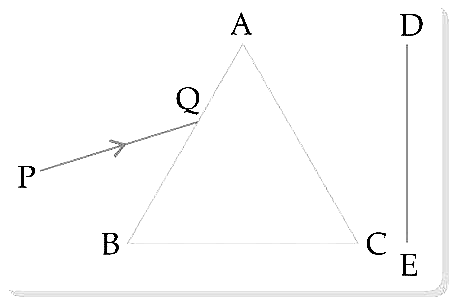
Draw a ray diagram to show the emergent beam as it falls on the screen DE. Also write the phenomenon involved and its cause. Using the second law of refraction state which colour of light must have the highest value of refractive index amongst seven visible colours of light. Justify your answer. [3]
A beam of white light gives a spectrum of seven colours on passing through a solid prism. This splitting up of white light into its constituent colours is known as dispersion of light.
The second law of refraction, also known as Snell’s Law, states that the refractive index (n) is inversely proportional to the speed of light in a medium. Mathematically, Snell’s Law is given by:
where:
• \(\mathrm{n}_{1}\) and \(\mathrm{n}_{2}\) are the refractive indices of the two media,
• \(\theta_{1}\) and \(\theta_{2}\) are the angles of incidence and refraction, respectively.
The speed of light in a medium is inversely proportional to its refractive index. Therefore, the color of light with the highest refractive index will be the one that undergoes the most significant decrease in speed when entering a denser medium.
Among the seven visible colors of light, violet light has the shortest wavelength. According to the relationship between wavelength and refractive index, shorter wavelengths are more significantly refracted than longer wavelengths. Therefore, violet light must have the highest refractive index among the seven visible colours of light.
In summary, the colour of light with the highest refractive index is violet, based on its shorter wavelength and the relationship between wavelength and refractive index.
(i) Name two safety measures commonly used in electric circuits and appliances. [1]
(ii) The power rating of an electric oven is 220 V; 2 kW. If it is used in a domestic electric circuit of current rating of 5A, what result do you expect? Justify your answer with necessary calculations. [2]
(i) Two common safety measures used in electric circuits and appliances are:
1. Fuse: A fuse is a safety device used in electric circuits to protect devices and wiring from excessive current. It consists of a thin wire that melts when the current exceeds a certain limit, breaking the circuit and preventing damage.
2. Earth wire: Earthing connects the metal body of an electrical appliance to the earth so that any leakage current flows safely to the ground and protects the user from electric shock.
(ii) To determine if the electric oven is suitable for use in a domestic electric circuit with a current rating of 5A, we can use the formula:
Power (P) = Voltage (V) × Current (I)
Given:
• Voltage (V) of the electric oven \(=220 \mathrm{~V}\)
• Power (P) of the electric oven \(=2 \mathrm{~kW}(2000 \mathrm{~W})\)
• Current rating of the domestic electric circuit = 5A
We can rearrange the formula to find the current (I):
Substitute the given values:
The calculated current (I) required by the electric oven is approximately 9.09A. This exceeds the current rating of the domestic electric circuit, which is only 5A. Therefore, the electric oven is not suitable for use in this domestic electric circuit and using it could lead to overloading and tripping of the circuit breaker.
To avoid this issue, a lower-power electric oven or upgrading the circuit to handle higher current loads would be necessary.
Section D — Long Answer
(A) (i) Define the term functional group. Identify the functional groups present in the following carbon compounds: [5]
(ii) What happens when ethanol reacts with acidified potassium dichromate solution? Write chemical equation for the reaction. Why is this reaction considered an oxidation reaction?
(iii) Write chemical equation for the reaction of ethanoic acid with sodium hydroxide.
OR
(B) (i) Describe method of preparation of soap giving chemical equation for the reaction involved. [5]
(ii) Explain with diagram the mechanism of the cleansing action of soaps.
(A) (i) A functional group is a specific atom or group of atoms within a molecule that imparts characteristic chemical and physical properties to the compound. It is the reactive center of a molecule, determining its reactivity and the type of chemical reactions it can undergo. Functional groups play a crucial role in organic chemistry, as they define the structure and behaviour of organic compounds.
(I) is ketone \(\left(\mathrm{C}=\mathrm{O}\right)\)
(II) is carboxyl \(\left(\mathrm{COOH}\right)\) group.
(ii) Ethanol reacts with acidified potassium dichromate solution, undergoing oxidation. The chemical equation is:
This reaction is considered oxidation as ethanol loses hydrogen atoms and gains oxygen. The dichromate ions are reduced to chromium(III) ions.
(iii) The reaction between ethanoic acid \(\left(\mathrm{CH}_{3} \mathrm{COOH}\right)\) and sodium hydroxide (NaOH) is a neutralisation reaction. The chemical equation for this reaction is as follows:
In this equation, ethanoic acid reacts with sodium hydroxide to form sodium acetate \(\left(\mathrm{CH}_{3} \mathrm{COONa}\right)\) and water \(\left(\mathrm{H}_{2} \mathrm{O}\right)\). This is a typical acid-base neutralisation reaction, where an acid reacts with a base to produce a salt and water.
OR
(B) (i) The method of preparation of soap involves a reaction called saponification, which is the hydrolysis of fats and oils in the presence of a strong base, typically sodium hydroxide (NaOH) or potassium hydroxide (KOH). The reaction results in the formation of soap molecules and glycerol. Here’s the general chemical equation for the saponification reaction:
Triglyceride (fat or oil) + 3NaOH → Soap + Glycerol
In more specific terms, let’s take the example of the saponification of a common fat, such as a triglyceride found in vegetable oil:
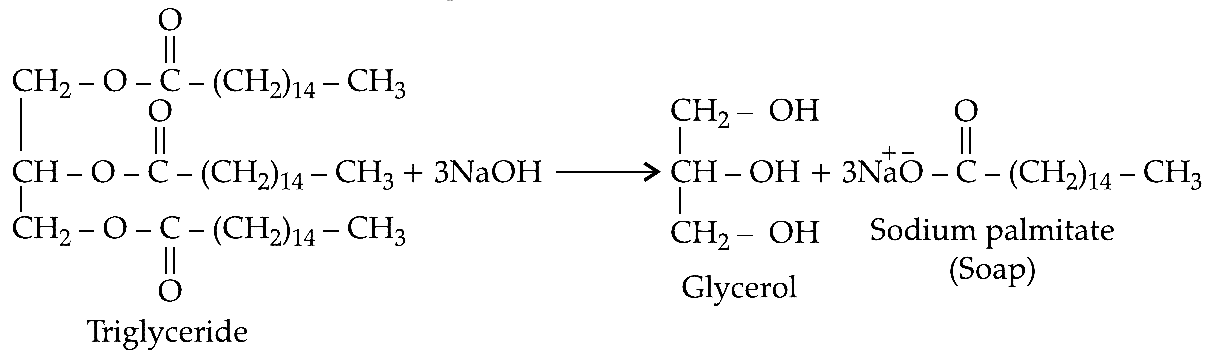
In this equation:
• The triglyceride represents the fat or oil, which is a triester of glycerol and three fatty acids.
• Sodium hydroxide (NaOH) is the strong base used in the saponification process.
• The soap formed is a sodium salt of the fatty acid and it consists of a hydrophobic (water-repelling) tail and a hydrophilic (water-attracting) head.
• Glycerol is a trihydric alcohol produced as a byproduct.
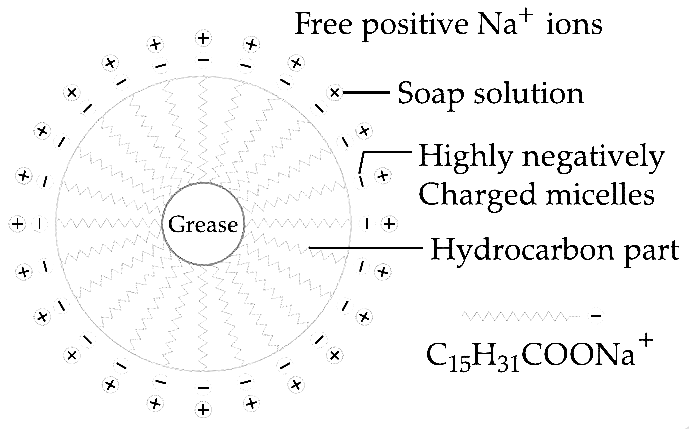
The soap molecules, being amphiphilic (having both hydrophobic and hydrophilic parts), can interact with both water and oily substances, allowing them to emulsify and lift away dirt and grease from surfaces.
(ii) Cleansing action of soap
(A) (i) Define electric power. Express it in terms of potential difference (V) and resistance (R). [5]
(ii) An electric oven is designed to work on the mains voltage of 220 V. This oven consumes 11 units of electrical energy in 5 hours. Calculate:
(a) power rating of the oven
(b) current drawn by the oven
(c) resistance of the oven when it is red hot
OR
(B) (i) Write the relation between resistance R and electrical resistivity \((\rho)\) of the material of a conductor in the shape of cylinder of length l and area of cross-section (A). Hence, derive the SI unit of electrical resistivity. [5]
(ii) The resistance of a metal wire of length 3 m is \(60 \Omega\). If the area of cross-section of the wire is \(4 \times 10^{-7} \mathrm{~m}^{2}\), calculate the electrical resistivity of the wire.
(iii) State how would electrical resistivity be affected if the wire (of part ‘ii’) is stretched so that its length is doubled. Justify your answer.
(A) (i) Electric power is the rate at which electrical energy is dissipated or consumed in a circuit.
(ii) The oven consumes 11 units of electrical energy in 5 hours. Since 1 unit = 1 kWh:
(a) Power rating
(b) Current drawn
(c) Resistance when red hot
OR
(B) (i) The relation between resistance and electrical resistivity is
Therefore, the SI unit of resistivity is \(\Omega\,\mathrm{m}\).
(ii) Here \(R=60\,\Omega\), \(l=3\,\mathrm{m}\) and \(A=4\times10^{-7}\,\mathrm{m}^{2}\).
(iii) The electrical resistivity remains unchanged when the wire is stretched because resistivity depends on the nature of the material (and temperature), not on the dimensions of the conductor.
(A) (i) Name three techniques/devices used by human females to avoid pregnancy. Mention the side effects caused by each. [5]
(ii) What will happen if in a human female (a) fertilisation takes place, (b) an egg is not fertilised?
OR
(B) (i) Draw a diagram showing spore formation in Rhizopus and label the (a) reproductive and (b) non-reproductive parts. Why does Rhizopus not multiply on a dry slice of bread? [5]
(ii) Name and explain the process by which reproduction takes place in Hydra.
(A) (i) Contraceptive Pills:
• Side Effects:
• Nausea
• Weight gain or loss
• Changes in mood
• Headaches
• Irregular bleeding
• Breast tenderness
(ii) Intrauterine Device (IUD):
• Side Effects:
• Cramping or pain during insertion
• Increased menstrual bleeding and cramps
• Expulsion of the device
• Perforation of the uterus (rare)
3. Barrier Methods (e.g., Condoms):
• Side Effects:
• Allergic reactions to latex (for latex condoms)
• Reduced sensitivity during intercourse
• Possible breakage or slippage, leading to contraceptive failure
(ii) (a) If Fertilisation takes place: If fertilisation occurs in a human female’s reproductive system, the fertilised egg (zygote) undergoes multiple divisions and forms a blastocyst. This blastocyst then travels down and reaches to the uterus and get implanted there.
(b) If the egg is not Fertilised:
If the egg is not fertilised, the following events occur:
• The corpus luteum, which is formed from the ovarian follicle after the release of the egg, degenerates.
• Hormone levels (progesterone and estrogen) drop.
• The thickened uterine lining is shed during menstruation.
OR
B. (i) Spore formation in Rhizopus
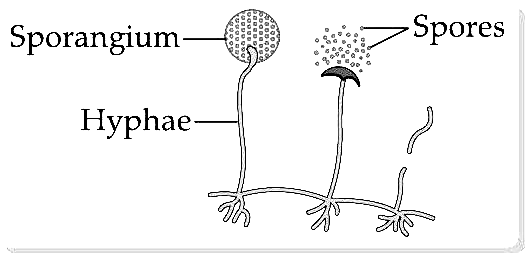
(a) Reproductive parts of bread mould (Rhizopus) – Sporangium (b) Non-reproductive parts of bread mould (Rhizopus) is Hyphae.
Rhizopus, being a fungus, requires moisture for growth and multiplication. It does not multiply on a dry slice of bread because the dry environment inhibits its hyphal growth and nutrient absorption.
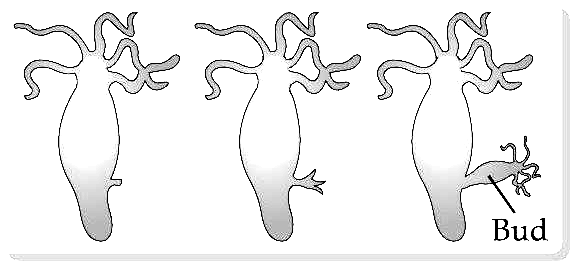
(ii) Hydra typically undergoes asexual reproduction through a process known as budding. This involves the formation of a bud on the tubular body of an adult Hydra, which then develops its own mouth and tentacles. Subsequently, the newly formed bud detaches from the parent Hydra, becoming an independent, fully
developed organism. The offspring Hydra then locates its own attachment site.
Section E — Case / Source Based
Study the data given below showing the focal length of three concave mirrors A, B and C and the respective distances of objects placed in front of the mirrors:
| Case | Mirror | Focal Length (cm) | Object Distance (cm) |
|---|---|---|---|
| 1 | A | 20 | 45 |
| 2 | B | 15 | 30 |
| 3 | C | 30 | 20 |
(i) In which one of the above cases the mirror will form a diminished image of the object? Justify your answer. [1]
(ii) List two properties of the image formed in case 2. [1]
(iii) (A) What is the nature and size of the image formed by mirror C? Draw ray diagram to justify your answer. [2]
OR
(B) An object is placed at a distance of 18 cm from the pole of a concave mirror of focal length 12 cm. Find the position of the image formed in this case. [2]
(i) Mirror A (Case 1) forms a diminished image because the object is placed beyond the centre of curvature: \(u=45\,\mathrm{cm}>2f=40\,\mathrm{cm}\).
(ii) In Case 2, the object is at \(2f\). The image is real and inverted and is of the same size as the object. (Any two properties.)
(iii) (A) For mirror C, \(f=30\,\mathrm{cm}\) and the object distance is 20 cm, so the object lies between the pole and focus of the concave mirror. The image formed is virtual, erect and magnified, behind the mirror. In the ray diagram, reflected rays diverge and their backward extensions meet behind the mirror.
OR
(iii) (B) Given \(f=-12\,\mathrm{cm}\) and \(u=-18\,\mathrm{cm}\):
Hence, \(v=-36\,\mathrm{cm}\). The image is formed 36 cm in front of the mirror.
Mendel worked out the rules of heredity by working on garden pea using a number of visible contrasting characters. He conducted several experiments by making a cross with one or two pairs of contrasting characters of pea plant. On the basis of his observations, he gave some interpretations which helped to study the mechanism of inheritance.
(i) When Mendel crossed pea plants with pure tall and pure short characteristics to produce \(\mathrm{F}_{1}\) progeny, which two observations were made by him in \(\mathrm{F}_{1}\) plants? [1]
(ii) Write one difference between dominant and recessive trait. [1]
(iii) (A) In a cross with two pairs of contrasting characters
RRYY X rryy
(Round Yellow) (Wrinkled Green)
Mendel observed 4 types of combinations in \(\mathrm{F}_{2}\) generation. By which method did he obtain \(\mathrm{F}_{2}\) generation? Write the ratio of the parental combinations obtained and what conclusions were drawn from this experiment? [2]
OR
(B) Justify the statement:
“It is possible that a trait is inherited but may not be expressed.” [2]
(i) In the \(F_{1}\) generation, all plants were tall and no short plants were observed. Also, no intermediate/medium-height plants were seen; only the dominant parental trait was expressed.
(ii) A dominant trait is expressed even when a single copy of its allele is present, whereas a recessive trait is expressed only when its allele is present in a pair.
(iii) (A) Mendel obtained the \(F_{2}\) generation by self-pollination (self-fertilisation/selfing) of the \(F_{1}\) plants. The ratio of the parental combinations Round Yellow : Wrinkled Green in \(F_{2}\) was \(9:1\). He concluded that traits are inherited independently (Law of Independent Assortment).
OR
(iii) (B) A trait can be inherited but remain unexpressed when it is recessive and is masked by a dominant allele. For example, when pure yellow-seeded pea plants are crossed with green-seeded plants, all \(F_{1}\) plants show yellow seeds, while the green-seed trait reappears in \(F_{2}\). Thus, the green trait was inherited in \(F_{1}\) but was not expressed.
The metals produced by various reduction processes are not very pure. They contain impurities, which must be removed to obtain pure metals. The most widely used method for refining impure metals is electrolytic refining.
(i) What is the cathode and anode made of in the refining of copper by this process? [1]
(ii) Name the solution used in the above process and write its formula. [1]
(iii) (A) How copper gets refined when electric current is passed in the electrolytic cell? [2]
OR
(B) You have two beakers ‘A’ and ‘B’ containing copper sulphate solution. What would you observe after about 2 hours if you dip a strip of zinc in beaker ‘A’ and a strip of silver in beaker ‘B’? Give reason for your observations in each case. [2]
(i) In electrolytic refining of copper, the cathode is a thin sheet of pure copper and the anode is impure copper.
(ii) The electrolyte is acidified copper sulphate solution, \(\mathrm{CuSO}_{4}\).
(iii) (A) When current is passed, copper from the impure anode dissolves into the electrolyte and an equivalent amount of pure copper is deposited on the cathode.
Soluble impurities enter the solution, while insoluble impurities settle below the anode as anode mud.
OR
(iii) (B) In beaker A, the blue colour of copper sulphate solution fades (or becomes colourless) because zinc is more reactive than copper and displaces it:
In beaker B, there is no change because silver is less reactive than copper and cannot displace copper from copper sulphate solution.
Use this solved paper as a timed practice test and compare your written answers with the solutions after attempting each question. More CBSE Class 10 Science 2024 sets can be added to the same previous-year-paper series.