

Table of Contents
Last Updated on November 17, 2026 by XAM CONTENT
Practice the CBSE Class 10 Science Question Paper 2025 — Delhi Set 2 (31/4/2) with complete section-wise answers and worked solutions. The paper contains 39 questions for 80 marks with internal choices in selected questions.
Section A: Q1–20 (1 mark each) · Section B: Q21–26 (2 marks each) · Section C: Q27–33 (3 marks each) · Section D: Q34–36 (5 marks each) · Section E: Q37–39 (4 marks each). There is no overall choice; internal choice is provided in selected questions.
Section A — MCQs & Assertion–Reason
To get an image of magnification -1 on a screen using a lens of focal length 20 cm, the object distance must be:
Ans. (c)
Explanation: Magnification: \(m=\frac{-v}{u}\). Since \(m=-1\), we have \(-1=\frac{v}{u}\), which simplifies to \(\mathrm{v}=-u\). This means the image distance is equal to the object distance.
Lens formula: Substitute \(v=-u\) and \(f=20 \mathrm{~cm}\) into the lens formula:
However, the magnitude of the object distance is 40 cm.
Alternate method :
Since the magnification is -1, it means that the magnitudes of the object distance \((u)\) and the image distance \((v)\) are equal but in opposite directions. This occurs when the object is placed at twice the focal length \((2 f)\) from the lens.
Given that \(f=20 \mathrm{~cm}\), we calculate:
When a pure-tall pea plant is crossed with a pure-dwarf pea plant, the percentage of tall pea plants in \(\mathrm{F}_{1}\) and \(\mathrm{F}_{2}\) generation pea plants will be respectively:
Ans. (c)
Explanation: When a pure tall (TT) plant is crossed with a pure dwarf (tt) plant, all \(\mathrm{F}_{1}\) offspring have the
genotype Tt (heterozygous tall) and because T (tall) is dominant, 100% of the plants in \(\mathrm{F}_{1}\) are tall. When \(\mathrm{F}_{1}\) plants are self-crossed (Tt × Tt), the plants in \(\mathrm{F}_{2}\) are 75% Tall (TT and Tt) and 25% Dwarf (tt).
Plants like rose and banana have lost the capacity to produce:
Ans. (c)
Explanation: Plants like roses and bananas have lost the ability to produce seeds for reproduction. Instead, they reproduce through vegetative propagation. Roses are commonly propagated using stem cuttings or grafting, where a part of the plant is used to grow a new one. Bananas reproduce through underground rhizomes or suckers, as most cultivated banana varieties are sterile and do not produce viable seeds.
In which one of the following situations a chemical reaction does not occur?
Ans. (d)
Explanation: The melting of glaciers is a physical change in which ice is converted into water, only a solid state is changed into a liquid state.
The property by virtue of which a solid material can be drawn into thin wires is called:
Ans. (b)
Explanation: Ductility is the physical property of a metal which means that metal can stretch rather than break.
In order to prepare dry hydrogen chloride gas in humid atmosphere the gas produced is passed through a guard tube (drying tube) which contains:
Ans. (a)
Explanation: Calcium chloride is used as an absorbent in the guard tube which can absorb moisture present in the air.
Select from the following a hydrocarbon having one C-C bond and one \(\mathrm{C} \equiv \mathrm{C}\) bond:
Ans. (d)
Explanation: Propyne contains three carbons. Carbon 1 and Carbon 2 are attached through a triple bond and carbon 2 and carbon 3 are attached through a single bond.
Which one of the following has half the number of chromosomes and half the amount of DNA as compared to the non-reproductive body cells?
Ans. (d)
Explanation: Germ cells (male sperm and female egg) contain half the number of chromosomes and DNA compared to non-reproductive body (somatic) cells.
The essential element taken up from the soil by the plants to synthesise proteins is:
Ans. (b)
Explanation: Nitrogen is an essential nutrient that plants absorb from the soil in the form of nitrates \(\left(\mathrm{NO}_{3}{ }^{-}\right)\)or ammonium \(\left(\mathrm{NH}_{4}{ }^{+}\right)\). It is a key component of amino acids, which are the building blocks of proteins.
Select TRUE statements about lymph from the following:
(A.) Lymph vessels carry lymph through the body and finally open into larger arteries.
(B.) Lymph contains some amount of plasma, proteins and blood cells.
(C.) Lymph contains some amount of plasma, proteins and red blood cells.
(D.) Lymph vessels carry lymph through the body and finally open into larger veins.
The true statements are:
Ans. (b)
Explanation: Lymph contains some amount of plasma, proteins and white blood cells (mainly lymphocytes) that help in immune defence. However, red blood cells (RBCs) are absent. Lymph from the intercellular spaces enters the lymphatic capillaries, which merge to form larger lymph vessels that eventually drain into larger veins.
Which one of the following gets biomagnified at different levels in a food chain?
Ans. (c)
Explanation: Biomagnification is the process by which the concentration of harmful substances like DDT (Dichlorodiphenyltrichloroethane) increases at higher trophic levels in a food chain. The increased concentration of DDT at each tropic level, poses severe threats to top predators and humans due to its long-term persistence in the ecosystem.
In the food chains given below. Select the most efficient food chain in terms of energy:
Ans. (c)
Explanation: A shorter food chain is more efficient than a longer food chain because less energy is lost at each trophic level, resulting in more energy reaching the top consumers. The food chain in option (c) has only two trophic levels and energy loss is minimal, making it an efficient way to transfer energy.
An optical device ‘X’ is placed obliquely in the path of a narrow parallel beam of light. If the emergent beam gets displaced laterally, the device ‘X’ is:
Ans. (c)
Explanation: When a parallel beam of light enters a glass slab obliquely, it refracts, travels through the glass slab and then refracts again as it exits. The emergent beam is parallel to the incident beam but laterally displaced. The amount of displacement depends on the angle of incidence and the thickness of the glassslab.
A piece of wire of resistance ‘R’ is cut lengthwise into three identical parts. These parts are then connected in parallel. If the equivalent resistance of this combination is R’, then the value of R/R’ is:
Ans. (d)
Explanation: When the wire is cut into 3 equal parts, the resistance of each part will be \(\frac{R}{3}\).
Now they are connected in parallel, so
Now \(\frac{\mathrm{R}}{\mathrm{R}^{\prime}}=9\)
The minimum number of identical bulbs of rating \(4 \mathrm{~V} ; 6 \mathrm{~W}\), that can work safely with desired brightness, when connected in series with a 240 V mains supply is:
Ans. (c)
Explanation: Resistance of each bulb
Maximum current that can flow through the bulb without damaging it
Thus, minimum resistance required in the circuit
Let \(n\) number of bulbs are connected in series in the circuit. Equivalent resistance of \(n\) bulbs
But,
⇒
Thus, the minimum number of bulbs required is 60.
An electric bulb is rated 220 V; 11W. The resistance of its filament when it glows with a power supply of 220 V is:
Ans. (a)
Explanation: Resistance \(=\frac{\mathrm{V}^{2}}{\mathrm{P}}=\frac{220 \times 220}{11}=4400 \Omega\)
Assertion (A): All exothermic reactions are accompanied with evolution of heat and light.
Reason (R): Combination reactions may or may not be exothermic.
Ans. (d)
Explanation: The statement “All exothermic reactions are accompanied by the evolution of heat and light” is false, as most of the exothermic reactions release heat and not light. The reason is correct.
Assertion (A): When ciliary muscles contract, eye lens becomes thin.
Reason (R): Ciliary muscles control the power of the eye lens.
Ans. (d)
Explanation: When ciliary muscles contract, the eye lens becomes thicker (more convex), not thinner. Ciliary muscles control the power of the eye lens. By contracting and relaxing, they change the shape of the lens and therefore its focal length and refractive power. This process is called accommodation.
Assertion (A): Concentrated nitric acid is diluted by adding water slowly to acid with constant stirring.
Reason (R): Concentrated nitric acid is easily soluble in water.
Ans. (d)
Explanation: The acid must always be added slowly to water with constant stirring as the process is highly exothermic.
Assertion (A): In reptiles, the temperature at which the fertilised eggs are kept decides the sex of the offsprings.
Reason (R): Sex is not genetically determined in some animals.
Ans. (a)
Explanation: In some animals, sex is influenced by environmental factors rather than genetics. In some reptiles, like turtles and crocodiles, sex is not genetically determined but the temperature at which eggs are incubated influences the sex of the hatchlings, a phenomenon known as Temperature-Dependent Sex Determination (TSD).
Section B — Very Short Answer
While burning a magnesium ribbon in air, list two safety measures which should be followed. Also state two observations of this activity.
Two safety measures are:
(i) Always wear eye protection to avoid looking at the bright flame directly.
(ii) Use tongs to hold the magnesium ribbon to avoid intense heat and light.
Observations:
(i) The burning of magnesium in the air produces magnesium oxide (MgO).
(ii) It is an exothermic chemical reaction in which bright light and heat are produced.
(A) Draw a ray diagram to show the refraction of a ray of light passing through an equilateral glass prism. Mark the angle through which the emergent ray bends from the direction of the incident ray and also name it.
OR
(B) Name the type of lenses required by the persons for the correction of their defect of vision called presbyopia. Write the structure of the lenses commonly used for the correction of this defect giving reason for such designs.
(A)

The angle through which the emergent ray bends from the direction of the incident ray is called \(\angle \Delta=\) Angle of deviation.
OR
(B) The lens is bi-focal which is used for the correction of presbyopia.
A common type of bi-focal lens consists of both concave and convex lenses. The upper portion consists of a concave lens. It facilitates distant vision. The lower part is a convex lens and it facilitates near vision.
“In human alimentary canal the small intestine is designed to absorb the digested food.” Justify this statement.
The small intestine is the primary site for absorption of digested food in the human alimentary canal. It is specifically adapted for this function and has the following features:
(i) Large Surface Area – The inner lining of the small intestine has numerous folds and projections called villi and microvilli, which increase the surface area for maximum absorption of nutrients.
(ii) Rich Blood Supply – The villi contain an extensive network of capillaries which help in the rapid transport of absorbed nutrients to different parts of the body.
Pure-tall (TT) pea plants are crossed with pure-dwarf (tt) pea plants. The pea plants obtained in \(\mathrm{F}_{1}\) generation are then self pollinated to produce \(\mathrm{F}_{2}\) generation.
(i) What do the plants of \(\mathrm{F}_{1}\) generation look-like? Justify your answer.
(ii) What is the ratio of pure-tall plants to pure-dwarf plants in \(\mathrm{F}_{2}\) generation?
(i) When a pure tall plant (TT) is crossed with a pure dwarf plant (tt), all offspring in the \(\mathrm{F}_{1}\) generation will have the Tt genotype. Since T (tall) is dominant over t (dwarf), all \(\mathrm{F}_{1}\) plants will express the tall phenotype and look similar.
(ii) In the \(\mathrm{F}_{2}\) generation, when \(\mathrm{F}_{1}\) plants (Tt) are self-pollinated, the trait combination is 1 TT (Pure Tall): 2 Tt (Hybrid Tall): 1 tt (Pure Dwarf). Hence, the ratio of pure-tall plants to pure-dwarf plants in the \(\mathrm{F}_{2}\) generation is 1:1.
(A) Show the formation of magnesium chloride by electron transfer. Write the name of the cation and anion present in the compound formed. (Atomic Number of \(\mathrm{Mg}=12, \mathrm{Cl}=17\) )
OR
(B) How is zinc extracted from its ore? Name the processes involved in the extraction and write chemical equations for the reactions that occur during these processes.
(A) Atomic number of Magnesium (Mg) atom is 12.
Electronic configuration \(=2,8,2\). So, it contains 2 valence electrons and loses 2 electrons to attain noble gas configuration and forms Magnesium ion \(\left(\mathrm{Mg}^{2+}\right)\) Atomic number of Chlorine (Cl) atom is 17.
Electronic configuration \(=2,8,7\). So, it gains 1 electron to attain noble gas configuration and forms Chloride ion \(\mathrm{Cl}^{-}\).

(B) The metals in the middle of the reactivity series like Zinc are moderately reactive and they are found as oxides- ZnO, sulphides – ZnS or carbonates- \(\mathrm{ZnCO}_{3}\) in the Earth’s crust.
Chemical reactions involved in the roasting and calcination of Zinc ores are as follows:
Concentration: The ore is crushed and then concentrated by the froth flotation process.
Roasting: Sulphide ores are heated below their melting point in the presence of air to form Zinc oxide.
Calcination: Carbonate ores are heated below their melting point in the absence of air to form Zinc oxide
Reduction of oxide ore: It can be done by heating oxide ore with a suitable reducing agent like carbon.
Purification: Zinc is purified by electrolytic refining.
State the role of an electric fuse, used in series with an electrical appliance. Why should in an electric circuit a fuse with defined rating not be replaced by one with a larger rating?
Role of an electric fuse:
An electric fuse is a safety device that protects an electrical appliance from damage due to excessive current flow.
It is a thin wire of alloy of tin and lead, connected in series with the appliance. When the current exceeds a certain limit, the fuse wire melts due to the heat generated by the current (Joule heating). This breaks the circuit, preventing further current flow and protecting the appliance from damage.
A fuse has a specific current rating, which is the maximum current it can carry without melting. If a fuse with a larger rating is used, it will not melt even if the current exceeds the safe limit for the appliance. This can lead to overheating, appliance damage or fire hazards.
Section C — Short Answer
What are decomposers? Give two examples. State how they maintain a balance in an ecosystem.
Decomposers are organisms that break down dead plants, animals and organic matter, converting them into simpler substances.
Examples: Bacteria (e.g., Pseudomonas, Bacillus), fungi (e.g., Mushrooms, Molds, Yeasts)
Functions help in maintaining ecological balance:
(i) Recycle nutrients: Break down organic matter into nutrients like carbon, nitrogen and phosphorus and return them to the soil, making them available for plants.
(ii) Waste removal: They prevent the accumulation of dead matter by cleaning up the environment.
Samples of four metals A, B, C and D were added one by one to the following solutions. The results obtained were tabulated as follows:
| Solution Metal | Iron Sulphate | Copper Sulphate | Zinc Sulphate | Aluminium Sulphate |
|---|---|---|---|---|
| A | – | Displacement | No reaction | No reaction |
| B | Displacement | Displacement | Displacement | – |
| C | Displacement | ? | – | No reaction |
| D | No reaction | No reaction | No reaction | No reaction |
Use the table above to answer the following questions about metals A, B, C and D:
(i) Which is the least reactive metal?
(ii) What would be observed if C is added to a solution of copper sulphate?
(iii) Arrange the metals A, B, C and D in the order of their decreasing reactivity.
(i) D is the least reactive metal.
(ii) From the table it is clear that C is more reactive than Fe because it gives a displacement reaction with \(\mathrm{FeSO}_{4}\). So, when C is added to \(\mathrm{CuSO}_{4}\) it will give a displacement reaction and copper gets reduced.
(iii) From the given data it is clear that B is the most reactive and D is the least reactive but there is no confirmation whether metal A or C is more reactive. If A does not react with \(\mathrm{FeSO}_{4}\) then C will be more reactive than A and the reactivity order will be: \(\mathrm{B}>\mathrm{C}>\mathrm{A}>\mathrm{D}\)
(i) Study the diagram and name the parts marked as A, B, C and D.
(ii) Write the function of A and C.
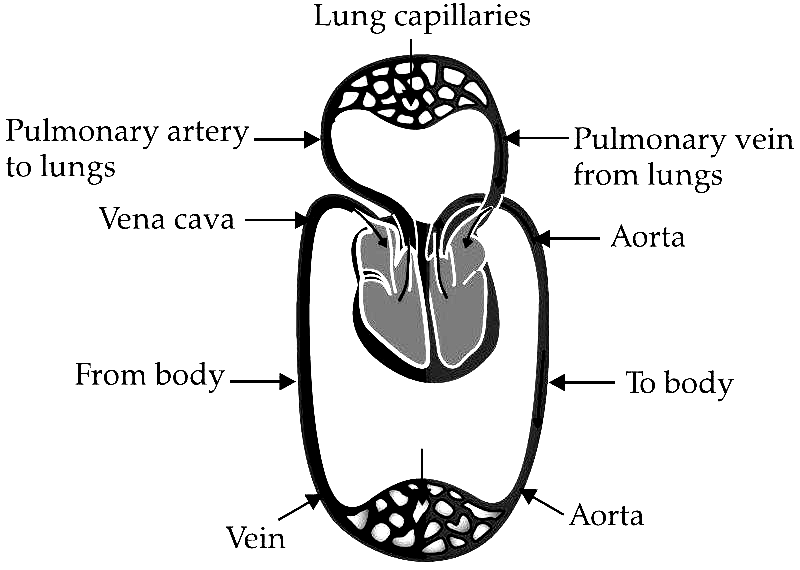
(i) A – Pulmonary artery
B – Pulmonary vein
C – Aorta
D – Vena cava
(ii) Pulmonary artery (A) carries deoxygenated blood from the right ventricle of the heart to the lungs for oxygenation.
The aorta (C) carries oxygenated blood from the heart to all parts of the body.
The electrical resistivity of three materials A, B and C at 20°C is given below:
| Material | Resistivity \(\boldsymbol{(} \boldsymbol{\Omega} \mathrm{~ m} \boldsymbol{)}\) |
|---|---|
| A | \(10^{17}\) |
| B | \(44 \times 10^{-6}\) |
| C | \(1.62 \times 10^{-8}\) |
(i) Classify these materials as conductor, alloy and insulator.
(ii) Give one example of each of these materials and state one use of each material in the design of an electrical appliance say an electric stove or an electric iron.
(i) Classification:
Material A: Resistivity is \(10^{17} \Omega \mathrm{~m}\). This is extremely high, indicating an insulator.
Material B: Resistivity is \(44 \times 10^{-6} \Omega \mathrm{~m}\). This value is in the range of resistivities for alloys. Alloys have higher resistivity than pure metals but lower than insulators.
Material C: Resistivity is \(1.62 \times 10^{-8} \Omega \mathrm{~m}\). This is very low characteristic of a conductor.
(ii) Examples and Uses:
Material A (Insulator):
Example: Mica
Use in an electric stove/iron: Mica (or other insulating materials like ceramic, bakelite, etc.) is used for electrical insulation. It prevents the current from flowing to unintended parts of the appliance and protects users from electric shock. For example, it might be used to insulate the heating element from the metal casing of the appliance.
Material B (Alloy):
Example: Nichrome (an alloy of nickel and chromium)
Use in an electric stove/iron: Nichrome is used for the heating element. Its relatively high resistivity compared to pure metals allows it to get hotter when current passes through it. It also has a high melting point and does not oxidise easily at high temperatures, making it suitable for this application.
Material C (Conductor):
Example: Copper
Use in an electric stove/iron: Copper is used for the connecting wires because of its excellent conductivity. It allows the electric current to easily reach the heating element.
If we want to obtain a real and magnified image of an object by using a concave mirror of focal length 18 cm. Where should the object be placed? Use mirror formula to determine the object distance for an image of magnification -2 by this mirror to justify your answer.
To obtain a real and magnified image using a concave mirror, the object should be placed between the principal focus (F) and centre of curvature (C).
Here, \(f=-18\,\text{cm}\) and magnification \(m=-2\).
Using \(m=-\frac{v}{u}\):
Using the mirror formula:
Thus the object should be placed 27 cm in front of the mirror, which lies between F (18 cm) and C (36 cm).
(A) Why do we balance a chemical equation? Name and state the law that suggests the balancing of a chemical equation? Balance the following chemical equation:
OR
(B) Define a precipitation reaction. Give its example and also express the reaction that occurs in the form of a balanced chemical equation.
(A) A balanced chemical equation has the same number of atoms on both sides of the equation.
Chemical equations are balanced to follow the law of conservation of mass, which states that matter can neither be created nor destroyed.
OR
(B) A chemical reaction in which an insoluble substance is formed is called a precipitation reaction.
Example: \(\mathrm{Na}_{2} \mathrm{SO}_{4}(\mathrm{aq})+\mathrm{BaCl}_{2}(\mathrm{aq}) \rightarrow \mathrm{BaSO}_{4}+2 \mathrm{NaCl}\) (aq) (ppt.)
Sodium sulphate reacts with Barium chloride to form precipitates of Barium sulphate.
State two limitations of electrical impulses in multicellular organisms. Why is chemical communication better than electrical impulses as a means of communication between cells in multicellular organisms?
Limitations of Electrical Impulses in Multicellular Organisms
(i) Restricted Communication: Electrical impulses can only reach cells connected by nervous tissue and do not communicate with every cell in the body.
(ii) Recovery Time: After transmitting an impulse, a nerve cell requires time to reset before generating and transmitting a new impulse, preventing continuous signalling.
Chemical communication (e.g., hormones) is better than electrical impulses in multicellular organisms because they can potentially reach all cells in the body, irrespective of nervous connections, and can occur continuously and consistently.
Section D — Long Answer
(A) (i) What are structural isomers? Draw structural isomers of butane \(\left(\mathrm{C}_{4} \mathrm{H}_{10}\right)\). Give reason why propane has no structural isomers?
(ii) What happens when butane is burnt in air? Write chemical equation for the reaction. Differentiate between the flames obtained when butane and butyne both are burnt in air in the similar conditions.
OR
(B) (i) Give reason why carbon can neither form \(\mathrm{C}^{4+}\) cations nor \(\mathrm{C}^{4-}\) anions but forms covalent compounds.
(ii) What is meant by functional group in carbon compounds? Write in tabular form the structural formula and the functional group present in the following compounds:
(a) Ethanol
(b) Ethanoic acid
(A) (i) Carbon compounds having the same molecular formula but different structural formulas are called structural isomers.
Butane \(\mathrm{C}_{4} \mathrm{H}_{10}\)
Iso-Butane \(\mathrm{C}_{4} \mathrm{H}_{10}\)
Propane has no structural isomer because there is only one possible arrangement with three carbon atoms connected in a chain.
(ii) Butane undergoes a combustion reaction in the presence of air.
Chemical equation:
Butane is a saturated hydrocarbon that burns with a clean flame, while butyne is an unsaturated hydrocarbon that burns with a yellow flame and produces a lot of black smoke.
OR
(B) (i) Atomic number of carbon is 6.
Electronic configuration is C- 2,4. It has 4 electrons in outermost valence shell. In order to get noble gas configuration, it needs 4 more electrons. Carbon is unable to form \(\mathrm{C}^{4-}\) anion as its nucleus with six protons, cannot hold ten electrons.
It is not possible to lose or remove 4 electrons to form \(\mathrm{C}^{4+}\) as it requires a huge amount of energy.
Due to this, carbon shares its valence electrons with other elements and forms covalent compounds.
(ii) A functional group is an atom or a group of atoms that is bonded to a carbon chain. It defines the chemical properties of the organic compound.
| Compound | Structural formula | Functional group |
|---|---|---|
| Ethanol | \(\mathrm{CH}_{3} \mathrm{CH}_{2} \mathrm{OH}\) | -OH (alcohol/hydroxyl) |
| Ethanoic acid | \(\mathrm{CH}_{3} \mathrm{COOH}\) | -COOH Carboxylic acid |
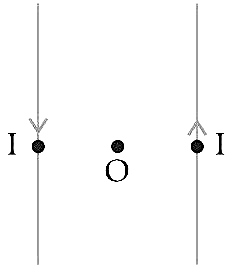
(A) (i) Draw the pattern of the magnetic field lines for the two parallel straight conductors carrying current of same magnitude ‘I’ in opposite directions as shown. Show the direction of magnetic field at a point O which is equidistant from the two conductors. (Consider that the conductors are inserted normal to the plane of a rectangular cardboard.)
(ii) In our houses we receive A.C. electric power of 220 V. In electric iron or electric heater cables having three wires with insulation of three different colours – red, black and green are used to draw current from the mains.
(a) What are these three different wires called? Name them colourwise.
(b) What is the potential difference between the red wire and the black wire?
(c) What is the role of the wire with green insulation in case of accidental leakage of electric current to the metallic body of an electrical appliance?
OR
(B) (i) By using the given experimental set-up. How can it be shown that:

(a) a force is exerted on the current-carrying conductor AB when it is placed in a magnetic field.
(b) the direction of force can be reversed in two ways.
(ii) When will the magnitude of the force be highest?
(iii) State Fleming’s left hand rule.
(A) (i)

The direction of the magnetic field at O which is equidistant from the two conductors is North to South on the plane of the card board as shown in the figure.
(ii) (a) The three wires are:
• Red: Live wire (or Phase wire)
• Black: Neutral wire
• Green: Earth wire (or Ground wire)
(b) The potential difference between the red (live) wire and the black (neutral) wire is 220 V.
(c) The green earth wire provides a low-resistance path for current to flow to the ground in case of an electrical fault, such as a short circuit or leakage. If the live wire accidentally comes in contact with the metallic body of the appliance, the current flows through the earth wire to the ground instead of passing through a person who might touch the appliance. This prevents electric shock.
OR
(B) (i) (a) From the deflection of the conductor AB, when current flows through the conductor, it can be shown that a force is exerted on it.
(b) The direction of force can be reversed if:
• the direction of current-flowing through the conductor is reversed.
• the poles of the horseshoe magnet is interchanged.
(ii) The magnitude of the force is the highest when the direction of the current is at right angles to the direction of the magnetic field.
(iii) Fleming’s Left-hand rule: Stretch the thumb, forefinger and middle finger of your left hand such that they are mutually perpendicular. If the first finger points in the direction of the magnetic field and the second finger in the direction of current,
then the thumb will point in the direction of motion or the force acting on the conductor.
(A) (i) What is regeneration? Give one example of an organism that shows this process and one organism that does not. Why does regeneration not occur in the latter?
(ii) Water in a pond appears dark green and contains filamentous structures. Name these structures and the method by which they reproduce. Explain the process.
OR
(B) (i) Name the part performing following functions in human male reproductive system:
(a) Carries sperm
(b) Production of male gametes
(c) Whose secretion makes the transport of sperms easier
(d) Provide suitable temperature for sperm formation
(ii) Write any two characteristics of sperms.
(iii) What are surgical contraceptive methods? Give the side effect caused by this procedure.
(A) (i) (a) Many fully differentiated organisms possess the ability to generate new individuals from their body parts through regeneration. If an organism is cut or broken into multiple pieces, some of these fragments can develop into separate individuals.
Examples: (a) Hydra can regenerate its entire body from a small portion.
(b) Humans and other mammals (e.g., lions, elephants, dogs) do not show regeneration.
Reason: They have differentiated cells that lack the ability to divide and form new body parts.
(ii) The filamentous structures seen in the dark green water of a pond are algae, such as Spirogyra.
Methods of reproduction:
Fragmentation (Asexual Reproduction): The filament breaks into smaller fragments due to natural processes or external forces. Each fragment regenerates the missing parts through cell division and growth and develops into a complete organism.
(B) (i) (a) Vas deferens
(b) Testes
(c) Prostate and Seminal vesicles
(d) Scrotum
(ii) Characteristics of sperm:
• Sperm cells are tiny and cannot be seen without a microscope.
• Sperm consists of a head (carries genetic material), a middle piece and a tail (for movement toward the female egg).
(iii) The surgical contraceptive methods are:
• Blockage of vas deferens in males
• Blockage of the fallopian tube in females
Side effect of this method: While these methods are effective and safe in the long run, improper surgery may lead to infections or complications.
Section E — Case / Source Based
The students in a class took a thick sheet of cardboard and made a small hole in its centre. Sunlight was allowed to fall on this small hole and they obtained a narrow beam of white light. A glass prism was taken and this white light was allowed to fall on one of its faces. The prism was turned slowly until the light that comes out of the opposite face of the prism appeared on the nearby screen. They studied this beautiful band of light and concluded that it is a spectrum of white light.
(i) Give any one more instance in which this type of spectrum is observed. [1]
(ii) What happens to white light in the above case? [1]
(iii) (A) List two conditions necessary to observe a rainbow. [2]
OR
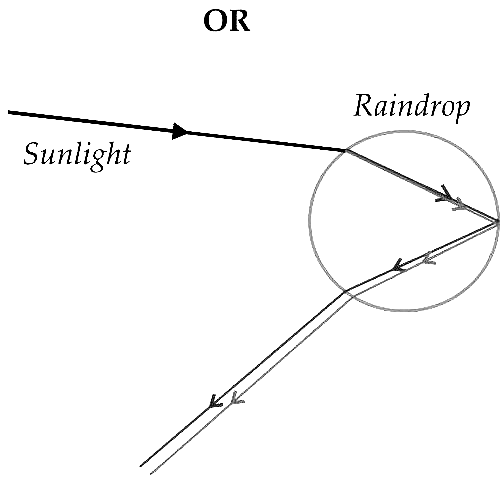
(iii) (B) Draw a ray diagram to show the formation of a rainbow. Mark on it, points (a), (b) and (c) as given below: [2]
(a) Where dispersion of light occurs.
(b) Where light gets reflected internally.
(c) Where final refraction occurs.
(i) Another instance where a spectrum of white light is observed is in the formation of a rainbow. It is a natural example of a spectrum of white light which is formed when sunlight is refracted and dispersed by raindrops.
(ii) When white light falls on the tiny water droplets, they refract and disperse the incident sunlight, then reflect it internally, and finally refract it again when it comes out of the raindrop forming a rainbow.
(iii) (A) Condition 1: Rain
• Rain droplets act like prisms that disperse light into a spectrum of colours. Rainbows are more likely to occur after a rainstorm or in the midst of a waterfall.
Condition 2: Sun’s position
• The sun must be behind the observer. The lower the sun is in the sky, the larger the arc of the rainbow will be.
OR
(iii) (B)
Common salt is a very important chemical compound for our daily life. It’s chemical name is sodium chloride and it is used as a raw material in the manufacture of caustic soda, washing soda, baking soda, etc. It is also used in the preservation of pickles, butter, meat, etc.
(i) Name the acid and the base from which common salt can be obtained. [1]
(ii) State the nature (acidic/basic/neutral) of sodium chloride. Give reason for the justification for your answer. [1]
(iii) (A) What happens when electric current is passed through an aqueous solution of sodium chloride (called brine)? Name the products obtained along with the corresponding places in the electrolytic cell where each of these products is obtained. [2]
OR
(iii) (B) How is washing soda obtained from sodium chloride? Give chemical equation of the reactions involved in the process. [2]
(i) Hydrochloric acid (HCl) and sodium hydroxide (NaOH) are used to obtain common salt (NaCl).
(ii) Sodium chloride (NaCl) is a neutral salt with a pH around 7 as it is made of strong acid (HCl) and strong base (NaOH).
(iii) (A) Brine solution (NaCl) undergoes electrolysis, causing the solution to decompose into chlorine gas at the anode and Hydrogen gas at the cathode, and sodium hydroxide remains in the solution.
OR
(iii) (B) Cold and concentrated solution of sodium chloride saturated with ammonia is allowed to react with \(\mathrm{CO}_{2}\) to form sodium bicarbonate, which on heating gives sodium carbonate with the evolution of \(\mathrm{CO}_{2}\). When sodium carbonate reacts with water to form sodium carbonate decahydrate.
In life there are certain changes in the environment called ‘stimuli’ to which we respond appropriately. Touching a flame suddenly is a dangerous situation for us. One way is to think consciously about the possibility of burning and then moving the hand. But our body has been designed in such a way that we save ourself from such situations immediately.
(i) Name the action by which we protect ourself in the situation mentioned above and define it. [1]
(ii) Write the role of (a) motor and (b) relay neuron. [1]
(iii) (A) What are the two types of nervous system in human body? Name the components of each of them. [2]
OR
(iii) (B) Which part of the human brain is responsible for: [2]
(a) thinking
(b) picking up a pencil
(c) controlling blood pressure
(d) controlling hunger
(i) Action: Reflex action
Definition: Reflex action is an automatic and immediate response to a stimulus without conscious thought, controlled by the spinal cord.
(ii) Role of Motor and Relay Neuron:
(a) Motor Neuron: Carries signals from the Central Nervous System (CNS) to the muscles, causing movement or response.
(b) Relay Neuron: Acts as a connector between sensory and motor neurons, transmitting signals within the spinal cord or brain.
(iii) (A) Two Types of Nervous Systems:
(i) Central Nervous System (CNS): Includes the brain and spinal cord.
(ii) Peripheral Nervous System (PNS): Includes nerves that connect the CNS to the rest of the body, further divided into the somatic and autonomic nervous systems.
OR
(iii) (B)
(a) Thinking → Cerebrum
(b) Picking up a pencil → Cerebellum
(c) Controlling blood pressure → Medulla Oblongata
(d) Controlling hunger → Hypothalamus