

Table of Contents
Last Updated on November 18, 2026 by XAM CONTENT
Practice the CBSE Class 10 Science Question Paper 2025 — Outside Delhi Set 1 (31/6/1) with complete section-wise answers and worked solutions. The paper contains 39 questions for 80 marks with internal choices in selected questions.
Section A: Q1–20 (1 mark each) · Section B: Q21–26 (2 marks each) · Section C: Q27–33 (3 marks each) · Section D: Q34–36 (5 marks each) · Section E: Q37–39 (4 marks each). There is no overall choice; internal choice is provided in selected questions.
Section A — MCQs & Assertion–Reason
In the following experimental setup of electrolysis of water, if P and Q are the gases collected in the test tubes enclosing the electrodes R and S, then select the option/options in which the matching is correct:
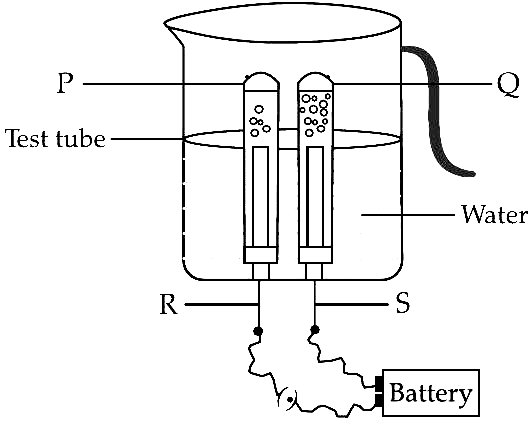
(i) P-Oxygen gas , R-Anode
(ii) P-Hydrogen gas , R-Cathode
(iii) Q-Hydrogen gas , S-Cathode
(iv) Q-Oxygen gas , S-Anode
Ans. (c)
Explanation: During the electrolysis process, water breaks down into its constituent gases, hydrogen and oxygen. The positively charged electrode (anode) attracts negatively charged ions and generates oxygen gas. The negatively charged electrode (cathode) attracts positively charged ions and generates hydrogen gas.
You have three aqueous solutions A, B and C as given below:
A – Potassium nitrate
B – Ammonium chloride
C – Sodium carbonate
The ascending order of the pH of these solutions is:
Ans. (d)
Explanation: Ammonium chloride is acidic \((\mathrm{pH}<7)\)
Potassium nitrate is neutral \((\mathrm{pH}=7)\)
Sodium carbonate is basic ( \(\mathrm{pH}>7\) )
Select from the following a statement which is not true about burning of magnesium ribbon in air:
Ans. (c)
Explanation: It is an exothermic reaction, as Magnesium burns in the presence of oxygen and produces heat and light.
A hydrocarbon which does not belong to the same homologous series of carbon compounds is
Ans. (c)
Explanation: Option a, b and d belong to alkanes with the general formula \(\mathrm{C}_{\mathrm{n}} \mathrm{H}_{2 \mathrm{n}+2}\) while option c belongs to alkenes with the general formula \(\mathrm{C}_{\mathrm{n}} \mathrm{H}_{2 \mathrm{n}}\).
The colour of the solution observed after about 1 hour of placing iron nails in copper sulphate solution is
Ans. (b)
Explanation: \(\mathrm{Fe}+\mathrm{CuSO}_{4} \rightarrow \mathrm{FeSO}_{4}+\mathrm{Cu}\)
Iron (Fe) is more reactive than Copper (Cu), so it displaces copper and the blue colour of copper sulphate \(\left(\mathrm{CuSO}_{4}\right)\) is changed into pale green due to the formation of ferrous sulphate \(\left(\mathrm{FeSO}_{4}\right)\).
Juice of tamarind turns blue litmus to red. It is because of the presence of a chemical compound called
Ans. (d)
Explanation: The presence of tartaric acid in tamarind juice makes it acidic and thus changes the colour of blue litmus to red.
The water of crystallisation is present in
(i) Bleaching Powder
(ii) Plaster of Paris
(iii) Washing Soda
(iv) Baking Soda
Ans. (b)
Explanation: Water of crystallisation is present in Plaster of Paris- \(\mathrm{CaSO}_{4} \frac{1}{2} \mathrm{H}_{2} \mathrm{O}\) and Washing soda – \(\mathrm{Na}_{2} \mathrm{CO}_{3} .10 \mathrm{H}_{2} \mathrm{O}\)
A tall pea plant with round seeds (TTRR) is crossed with a short pea plant with wrinkled seeds (ttrr). The \(\mathrm{F}_{1}\) generation will be
Ans. (d)
Explanation: Parent generation: TTRR (tall and round) x ttrr (short and wrinkled)
Gametes: TR × tr
\(\mathbf{F}_{\mathbf{1}}\) generation: 100\% TtRr (tall and round)
A pair of endocrine glands located in the human brain is
Ans. (d)
Explanation: The pineal gland is located on the dorsal side of the forebrain. The hypothalamus lies at the base of the thalamus and is the basal part of the diencephalon, forebrain. The four parathyroid glands are present on the back side of the thyroid gland, one pair in each of the two lobes of the thyroid gland. The pituitary gland is located in a bony cavity called sella turcica at the base of the brain. The thymus gland is a lobular structure located between the lungs.
Select the option having correct matching of the organism given in Column I with the mode of reproduction in Column II:
Column I
P. Leishmania
Q. Spirogyra
R. Planaria
S. Plasmodium
Column II
1. Regeneration
2. Multiple Fission
3. Binary Fission
4. Fragmentation
5. Budding
Ans. (c)
Explanation: Leishmania reproduces through binary fission with a longitudinal plane of division, while Spirogyra undergoes fragmentation, breaking into pieces to grow. Planaria demonstrates regeneration, exhibiting the ability to regrow body parts and
Plasmodium, the malaria-causing parasite, reproduces via multiple fission.
The basic filtration unit of the excretory system in human beings is:
Ans. (a)
Explanation: The nephron is the functional unit of the kidney responsible for filtering blood and forming urine. The urethra is a tube that carries urine from the urinary bladder to the outside of the body. A neuron is a specialised cell that transmits electrical signals in the nervous system. The urinary bladder is a muscular sac that stores urine until it is excreted from the body.
In human alimentary canal, the digestive juice secreted by the gastric glands are
Ans. (b)
Explanation: The gastric glands secrete hydrochloric acid to aid digestion, pepsin for protein breakdown and mucus to protect the stomach lining. Bile is produced by the liver, not gastric glands. Lipase is secreted by the pancreas, not the gastric glands. Salivary amylase is secreted by salivary glands, not gastric glands.
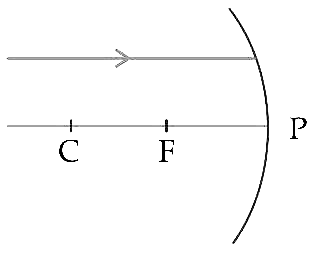
Identify from the following the ray diagram which shows the correct path of the reflected ray for the ray incident on a concave mirror as shown:
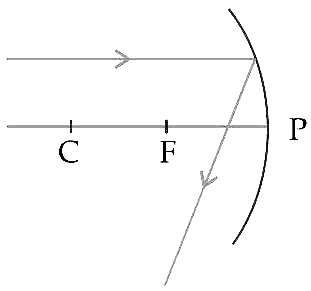
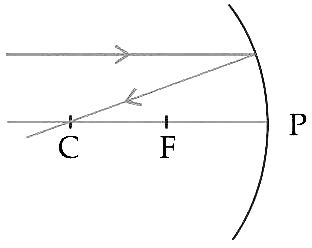
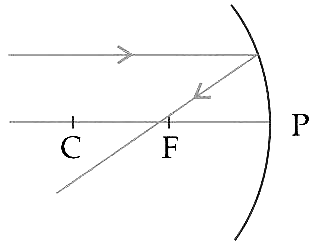
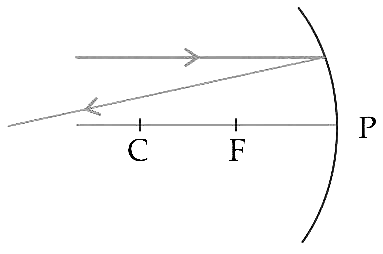
Ans. (c)
Explanation: According to the ray diagram for mirrors, ray parallel to the principal axis incident on a concave mirror, passes through focus after reflection.
The part of human eye which controls the amount of light entering into it.
Ans. (a)
Explanation: The iris controls the amount of light entering the eye by adjusting the size of the pupil.
Consider the following food chain:
Grass → Grasshopper → Frog → Snake → Eagle
If the amount of energy available at third trophic level is 50 kJ, the available energy at the producer level was:
Ans. (d)
Explanation: In a food chain, energy decreases as it moves up trophic levels, typically following the 10\% energy transfer rule. This means that only about 10\% of the energy is passed on to the next level, while the rest is lost as heat or used for metabolism.
Given that the energy available at the third trophic level (Frog) is 50 kJ:
From the third trophic level (Frog) to the second (Grasshopper), the energy would be 50 kJ/0.1 = 500 kJ. From the second trophic level (Grasshopper) to the first (Grass), the energy would be 500 kJ / \(0.1=5000 \mathrm{~kJ}\). So, the available energy at the producer level (Grass) was 5000 kJ.
The incorrect statement about ozone is
Ans. (c)
Explanation: Ozone is not commonly used as a refrigerant or in fire extinguishers due to its reactivity and toxicity. It is toxic in high concentrations. In the stratosphere, ozone absorbs harmful UV radiation from the Sun, protecting life on Earth. It forms when an oxygen molecule \(\left(\mathrm{O}_{2}\right)\) reacts with a free oxygen atom (O) in the atmosphere.
Assertion (A): Carbon and its compounds are our major sources of fuels.
Reason (R): Most of the carbon compounds on burning release a large amount of heat and light.
Ans. (a)
Explanation: Carbon fuels like coal and oil are used because burning them releases a lot of energy. That energy, in the form of heat and light, makes them effective as our main power sources.
Assertion (A): Xylem tissue moves water and minerals obtained from the soil by the roots.
Reason (R): Xylem tissue is found only in the roots of a plant.
Ans. (c)
Explanation: Xylem tissue is responsible for transporting water and dissolved minerals from the roots to other parts of the plant. Reason (R) is false. Xylem tissue is not only found in the roots. It is present throughout the plant, including in the stems and leaves, where it continues transporting water and minerals to various parts of the plant.
Assertion (A): In the common domestic circuits the earth wire is connected to a metallic plate buried deep inside the earth.
Reason (R): Earth wire ensures that any leakage of current to the metallic body of the appliance keeps its potential to that of the earth, so the user may not get a severe electric shock.
Ans. (a)
Explanation: Earth wire is connected to a metallic plate buried deep inside the earth.
The potential of the earth is zero, so the potential of the earth wire also becomes zero. Thus, the assertion is true..
The metallic body of an electrical appliance is connected to this earth wire. Any accidental leakage current now gets an easy path to flow to the earth through this wire without flowing through the user’s body. Hence, the user does not get a shock. So, the reason is also true and it explains the assertion.
Assertion (A): Food web is a network of several food chains operating in an ecosystem.
Reason (R): Food web decreases the stability of an ecosystem.
Ans. (c)
Explanation: Assertion (A) is true. A food web consists of multiple interconnected food chains within an ecosystem, where various species can be part of more than one food chain. It represents the complex feeding relationships in an ecosystem. Reason (R) is false. A food web increases an ecosystem’s stability because multiple interconnected food chains make the ecosystem more resilient to disturbances. If one food chain is disrupted, other chains can continue to function, helping maintain balance.
Section B — Very Short Answer
A light green coloured solution of sulphate salt of metal ‘P’ is taken in a beaker, a rod of another metal “Q’ is put in this solution as shown the following figures:
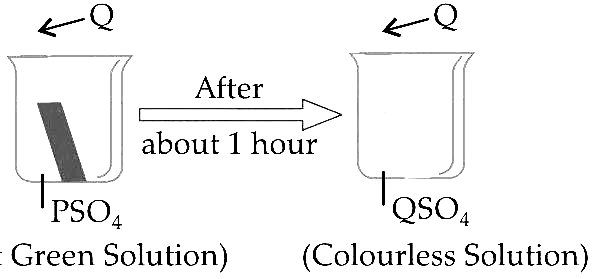
Identify the metals ‘P’ and ‘Q’ and write its chemical equation for the reaction that occurs. State the conclusion of this reaction in terms of reactivity series of metals.
P = Iron (Fe)
Zinc is more reactive than iron, so it displaces iron and thus green colour of iron sulphate disappears due to the formation of colourless zinc sulphate.
(a) How is brain protected in our body?
(b) A doctor finds in one of his patients that he is not maintaining a proper posture and balance of his body. State the region of brain and also the part of brain which is responsible for it.
(a) The brain is protected by the skull (cranium) and three protective layers known as meninges. Additionally, cerebrospinal fluid (CSF) acts as a cushion, protecting the brain from shocks.
(b) The hindbrain is the region of the brain responsible for maintaining posture and balance. Specifically, the cerebellum is part of the brain that controls body posture and balance.
(a) “Proteins control the expression of various characters.” Explain this statement by taking an example of “tallness” as a characteristic in plants.
OR
(b) Explain the mechanism of inheritance used by sexually reproducing organisms to ensure the stability of DNA of the species.
(a) Proteins are encoded by genes and play a crucial role in determining various traits. Proteins act as enzymes or assist in the formation of a hormone which in turn regulates a specific function. For example, in tall plants, the gene responsible for height produces a protein that regulates growth hormones, such as gibberellins, to control the plant’s growth and height.
(b) In sexually reproducing organisms, the process of gamete formation by meiosis followed by the fusion of gametes during fertilisation ensures DNA stability. During gamete formation by meiosis, each gamete receives one chromosome from each pair, either maternal or paternal. Upon fertilisation, the two gametes fuse, restoring the full set of chromosomes in the offspring. This mechanism preserves the integrity of the species’ DNA and ensures the transfer of genetic information to future generations.
Study the figure in which the path of a ray of light going from Medium 1 to Medium 2 is shown.
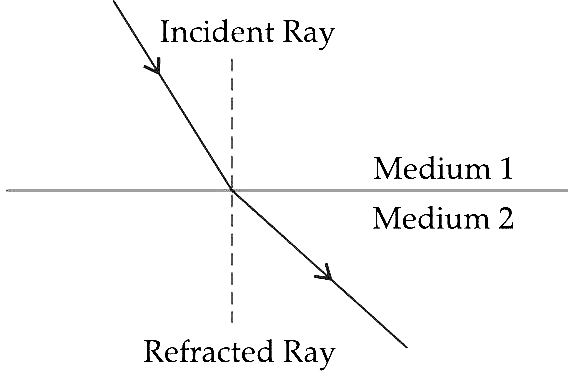
(a) Out of the two Media – Medium 1 and Medium 2, in which is the speed of light more?
(b) State reason of bending of the refracted ray away from the normal.
(c) Express refractive index of Medium 2 with respect to Medium 1 in terms of speed of light in two media.
(a) Medium 2 is the rarer medium. Hence, the speed of light is higher in medium 2.
(b) Medium 2 is rarer compared to medium 1 and the speed of light in medium 2 is greater than in medium 1. Hence, the light ray in medium 2 bends away from the normal.
(c) If \(\mathrm{v}_{1}\) and \(\mathrm{v}_{2}\) are the speed of light in medium 1 and medium 2 respectively, then the refractive index of medium 2 w.r.t. medium 1 is \(v_{1} / v_{2}\).
(a) Give reasons:
(i) The sky appears dark to passengers flying at very high altitude.
(ii) ‘Danger’ signal lights are red in colour.
OR
(b) What is a rainbow? “We see a rainbow in the sky only after the rainfall.” Why?
(a) (i) At very high altitudes, there is no atmosphere. Hence, no scattering takes place there.
So, the sky appears dark to passengers flying at very high altitudes.
(ii) Red colour has the longest wavelength in the visible range. Hence it scatters the least in the air and travels the farthest through fog and rain. Hence, it is used as a danger signal.
OR
(b) A rainbow is a natural optical phenomenon that appears as a multi-coloured arc in the sky, typically after a rainfall. It occurs when sunlight is refracted, at two points and reflected (total Internal reflection), and dispersed by water droplets in the atmosphere.
We do not clean natural ponds or lakes whereas an aquarium or a swimming pool needs to be cleaned regularly. Why?
Natural ponds and lakes do not require regular cleaning because these are self-sustaining ecosystems and include decomposers, such as bacteria, fungi, and other microorganisms. These decomposers break down organic matter, such as dead plants, animals, and other waste, turning it into simpler substances. This process recycles nutrients, such as nitrogen, phosphorus and carbon, back into the ecosystem, helping maintain water quality and balance. Additionally, plants and algae in these water bodies absorb excess nutrients, keeping the environment stable.
In contrast, aquariums or swimming pools do not have decomposers. Without the presence of decomposers and a balanced ecosystem, waste from fish, uneaten food and other organic materials accumulate in the water. So, regular cleaning and water changes are necessary to remove waste and maintain water quality.
Section C — Short Answer
Write balanced chemical equation for the reactions that occur when
(a) steam is passed over red hot iron.
(b) natural gas is burnt in air.
(c) glucose reacts with oxygen in the cells of our body and provides energy.
(a) \(3 \mathrm{Fe}+4 \mathrm{H}_{2} \mathrm{O} \xrightarrow{\text { Heat }} \mathrm{Fe}_{3} \mathrm{O}_{4}+4 \mathrm{H}_{2}\)
(b) \(\mathrm{CH}_{4}+2 \mathrm{O}_{2} \rightarrow \mathrm{CO}_{2}+2 \mathrm{H}_{2} \mathrm{O}\)
(c) \(\mathrm{C}_{6} \mathrm{H}_{12} \mathrm{O}_{6}+6 \mathrm{O}_{2} \rightarrow 6 \mathrm{CO}_{2}+6 \mathrm{H}_{2} \mathrm{O}+\) Energy (ATP)
(a) State the chemical property in each case on which the following uses of baking soda are based upon:
(i) as an anti-acids
(ii) as a constituent in making baking powder
(iii) in soda-acid fire-extinguishers
OR
(b) Write chemical equations to show what happens when an acid reacts with a
(i) metal
(ii) base and
(iii) carbonate
\item[] Write the name of the main product formed in each case.
(a) (i) Baking soda is used as an antacid because of its alkaline nature. It readily neutralises excess acid present in the stomach.
(ii) alkaline nature
(iii) ability to react with acids to produce carbon dioxide gas
OR
(b) (i) \(\mathrm{Zn}+2 \mathrm{HCl} \rightarrow \mathrm{ZnCl}_{2}+\mathrm{H}_{2}\)
Main product is zinc chloride.
(ii) \(\mathrm{HCl}+\mathrm{NaOH} \rightarrow \mathrm{NaCl}+\mathrm{H}_{2} \mathrm{O}\)
Main product is sodium chloride (common salt).
(iii) \(\mathrm{Na}_{2} \mathrm{CO}_{3}+2 \mathrm{HCl} \rightarrow 2 \mathrm{NaCl}+\mathrm{H}_{2} \mathrm{O}+\mathrm{CO}_{2}\)
Main product is sodium chloride (common salt).
Name the blood vessel that brings (i) oxygenated blood (ii) deoxygenated blood, to the human heart. Also name that chamber of the heart which receives deoxygenated blood and state how deoxygenated blood from this chamber is sent to lungs for oxygenation.
(i) Pulmonary Vein: It is the blood vessel that brings oxygenated blood to the human heart. It brings the blood from the lungs to the heart.
(ii) Vena Cava: It is the blood vessel that brings deoxygenated blood to the human heart. It brings the blood from all the body parts to the heart.
Chamber of the heart which receives the deoxygenated blood: Right atrium.
The deoxygenated blood from the right atrium enters the right ventricle through the tricuspid valve. The pulmonary artery carries deoxygenated blood from the right ventricle of the heart to the lungs for oxygenation. In the lungs, the blood is oxygenated and returns to the heart through the pulmonary veins.
The gene combination of purple flowered pea plants is denoted as (WW) and that of white flowered pea plants as (ww), when these two plants are crossed \(\mathrm{F}_{1}\) generation is obtained.
(a) List two observations made by Mendel in \(\mathrm{F}_{1}\) generation plants.
(b) Give the (i) percentage of white flowered plants and (ii) ratio of the gene combinations WW, Ww and ww in \(\mathrm{F}_{2}\) generation.
(c) Write one difference between dominant and recessive trait.
(a) Two observations made by Mendel in \(\mathbf{F}_{\mathbf{1}}\) plants:
• All the plants in the \(\mathrm{F}_{1}\) generation had purple flowers, which showed that the purple flower trait was dominant over the white flower trait.
• There was no segregation of the white flower trait in the \(\mathrm{F}_{1}\) generation, as all \(\mathrm{F}_{1}\) plants exhibited the dominant purple flower trait.
(b) Parent plants: WW (purple) × ww (white)
\(\mathrm{F}_{1}\) generation: Ww (purple)
\(\mathrm{F}_{2}\) generation: Ww x Ww
Gametes: W and w
(i) The percentage of white-flowered plants \((\mathrm{ww})=25 \%\)
(ii) In the \(\mathrm{F}_{2}\) generation (produced by self-crossing the \(\mathrm{F}_{1}\) generation, which was all Ww):
The genotypic ratio \(=1 \mathrm{WW}: 2 \mathrm{Ww}: 1 \mathrm{ww}\).
(c) Difference between dominant and recessive traits:
A dominant trait is expressed in the phenotype even if only one copy of the dominant allele is present (e.g., W for purple flowers).
A recessive trait is expressed only when both alleles are recessive (e.g., ww for white flowers).
A student placed a candle flame at different distances from a convex lens and focused its image on a screen. He recorded his observation in tabular form as given below:
Analyse the observation table and on the basis of your analysis only, answer the following questions (without doing any calculations):
(a) What is the focal length of the convex lens used? Give reason to justify your answer.
(b) Which one of the sets of observations is not correct and why?
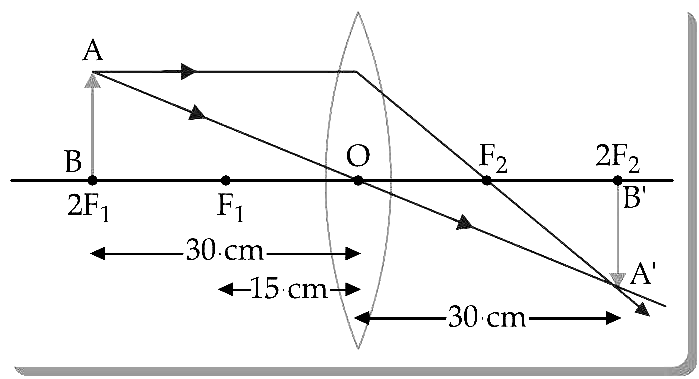
(c) Draw ray diagram to show image formation for any correct set of observation.
(a) Focal length of the convex lens used is 15 cm.
Reason: From the observation no. 4 of the observation table,
Object distance = Image distance \(=30 \mathrm{~cm}\).
This is possible only when the object is placed at the centre of curvature.
So, the radius of curvature \(=\mathrm{R}=30 \mathrm{~cm}\).
Hence, the focal length of the lens \(=f=\mathrm{R} / 2=15 \mathrm{~cm}\).
(b) Observation no. 8 is not correct.
Reason 1: When the object distance is less than the focal length, then the image formed by a convex lens is virtual and appears on the same side as the object. Therefore, the image distance should also be negative.
Reason 2: In observation no. 8, the object distance is less than the focal length of the lens but the image distance is positive, i.e., a real image on the other side of the lens is formed. This cannot happen.
(c) Ray diagram corresponding to observation no. 4:
A person uses lenses of +2.0 D power in his spectacles for the correction of his vision.
(a) Name the defect of vision the person is suffering from.
(b) List two causes of this defect.
(c) Determine the focal length of the lenses used in the spectacles.
(a) Hypermetropia.
(b) The causes of hypermetropia:
(i) the focal length of the eye lens is too long, or
(ii) the eyeball has become too small.
(c) P in Dioptre \(=\frac{1}{f}\) in metre
Or, 2D = \(\frac{1}{f}\) in metre
\(f=\frac{1}{2} \mathrm{~m}=50 \mathrm{~cm}\)
(a) Explain the statement “Potential difference between two points is 1 volt”.
(b) What do the symbols given below represent in an electric circuit? Write one function of each.
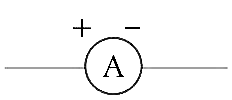
(i)
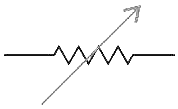
(ii)
(a) The potential difference between two points is 1V means that1 Joule of work is required to be done to move 1 Coulomb of charge from one point to the other.
(b) Symbol (i): It is the symbol of an ammeter. It is used to measure the current in a circuit.
Symbol (ii): It is the symbol of a variable resistor and used to control the flow of current in a circuit and hence the voltage across a certain component.
Section D — Long Answer
(a) Name an alcohol and a carboxylic acid having two carbon atoms in their structures. Draw their structures and state how this alcohol can be converted into a carboxylic acid. What happens when these two compounds react in the presence of an acid? Write chemical equations for the reactions involved in the two cases mentioned above.
OR
(b) What are soaps? Write the structure of a soap molecule. Explain the cleansing action of a soap. Why are soaps not considered suitable for washing clothes in a region where water is hard? How is this problem overcome?
(a) Ethyl (Ethanol) Alcohol: \(\mathrm{C}_{2} \mathrm{H}_{5} \mathrm{OH}\)
Ethanoic acid: (Acetic acid) \(\mathrm{CH}_{3} \mathrm{COOH}\)
Alcohols can be converted to acetic acid by the oxidation process.
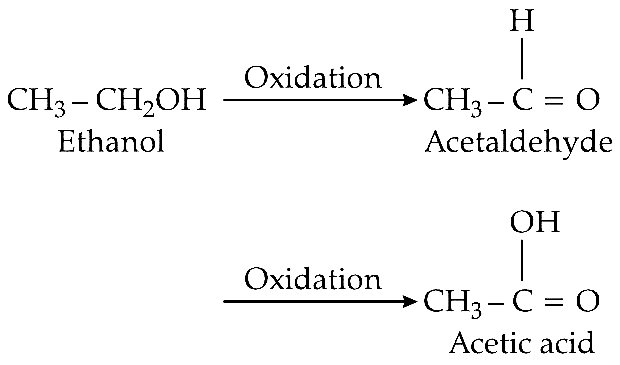
The two compounds i.e., ethanoic acid or acetic acid and ethanol react to form ester – ethyl ethanoate.
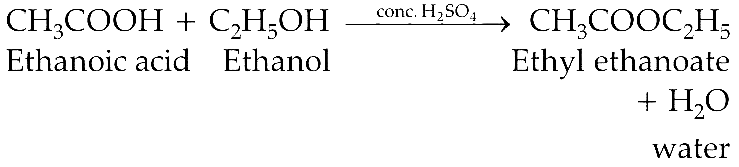
OR
(b) The sodium or potassium salts of the long-chain carboxylic acids are referred to as soaps. It consists of a long hydrocarbon chain having carboxylic acid on one end. This has an ionic bond with metal ions which is usually sodium or potassium.
Structure of soap:
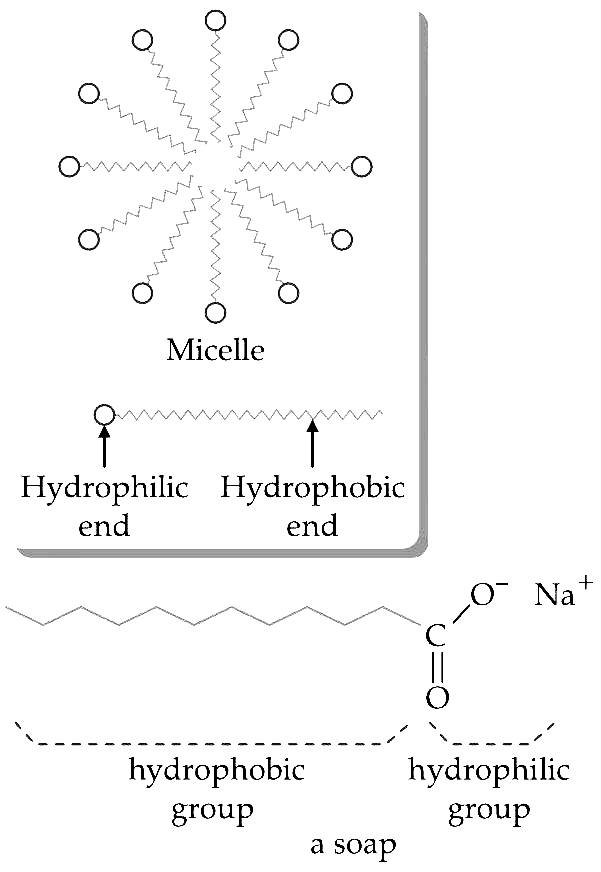
This is the structure of the soap molecule – sodium stearate. It has a hydrophilic and hydrophobic part in it. The hydrophobic end is non-polar and insoluble in water. In the above molecule, the hydrophobic part is – \(\mathrm{C}_{17} \mathrm{H}_{35}\). The hydrophilic end is polar and soluble in water. In the molecule, the hydrophilic end is – COONa.
Micelles is the name of soap molecules. The hydrophobic end is attached to the dust, oil, grease, dirt or materials which we want to remove, detaching takes place, gets suspended in water and can easily be removed.
\item[] When dirt is put in water containing soap, then the non-polar end of soap in a micelle attaches to an oil particle present on the surface of the dirt. The soap micelles trap the oily particles by the non-polar end. The polar end attaches to the water when the dirt is agitated in soap solution.
Soaps cannot be used in hard water because of its tendency to form precipitates with the calcium and magnesium salts which are present in hard water. This formation of precipitate results in prevention of the formation of lather in soap water.
To overcome this problem detergents can be used which are ammonium or sulphonate salts of fatty acids.
(a) Define Puberty. List any two changes seen in boys at the time of puberty.
(b) Why are testes in human males located outside the abdominal cavity in scrotum?
(c) List any three techniques of contraception used by humans. Which one of these is not meant for males?
5
OR
(a) Name the part performing following functions in human female reproductive system:
(i) production of eggs
(ii) site of fertilisation
(iii) site of implantation
(iv) entry of the sperms
(b) What changes are observed in the uterus:
(i) subsequent to implantation of zygote and
(ii) if an egg does not get fertilised?
(a) Puberty is a time of rapid physical growth and sexual maturity that occurs during adolescence.
Changes in boys:
Growth of Facial and Body Hair: Boys start growing facial hair (moustache and beard) and body hair (underarms, chest and pubic hair).
Deepening of Voice: The voice box (larynx) grows, causing the voice to become deeper.
(b) The testes are located in the scrotum outside the body to maintain a temperature that is slightly lower than the normal body temperature. This cooler temperature is essential for the proper production and storage of sperm.
(c) Three contraceptive techniques used by humans:
(i) Barrier methods: Condoms are the barrier methods worn during intercourse.
(ii) Intrauterine devices (IUDs): A device placed in the uterus to prevent pregnancy, used by females.
(iii) Surgical methods: Vasectomy is a surgical procedure for males in which the vas deferens (the tube that carries sperm) are cut or sealed to prevent the release of sperm during ejaculation. Tubectomy is a surgical procedure for females in which the fallopian tubes are cut or sealed to prevent the egg from reaching the uterus, preventing fertilisation.
Among these, IUDs are not used by males.
OR
(a) (i) Production of eggs: Ovaries
(ii) Site of fertilisation: Oviducts (fallopian tubes)
(iii) Site of implantation: Uterus
(iv) Entry of sperms: Vagina
(b) Change observed in the uterus:
(i) After implantation of a zygote
• The uterine lining thickens to support to developing embryo.
• The uterine lining is richly supplied with blood vessels so that nutrition and oxygen can be supplied to the developing foetus.
(ii) if an egg is not fertilised
When the egg is not fertilised, it is shed from the body, and the menstrual cycle occurs. Every month, the ovary releases one egg. Simultaneously, the uterus prepares to receive a fertilised egg by thickening its endometrial lining, making it spongy and nourishing to support the embryo. If fertilisation does not occur, this lining breaks down, leads to the discharge of blood and mucus through the vagina. The menstrual cycle typically lasts for 5 to 7 days, during which the endometrial lining along with blood is expelled from the body.
(a) What are magnetic field lines? How is the direction of magnetic field at a point determined? Draw the pattern of magnetic field lines of the magnetic field produced by a current carrying circular loop. Mark on it the direction of (i) current and (ii) magnetic field lines. Name the two factors on which the magnitude of the magnetic field due to a current carrying coil depends.
OR
(b) Why can’t two magnetic field lines cross each other? Draw magnetic field lines showing the direction of the magnetic field due to a current carrying long straight solenoid. State the conclusion which can be drawn from the pattern of magnetic field lines inside the solenoid. Name any two factors on which the magnitude of the magnetic field due to this solenoid depends.
(a) Magnetic field lines are the imaginary lines in a magnetic field, the tangent drawn at any point which gives the direction of the field at that point and its density gives the magnitude of the field.
The direction of a magnetic field at any point is determined by placing a small compass needle at that point, where the north pole of the needle will indicate the direction of the magnetic field.
Magnetic field produced by a current-carrying circular loop:
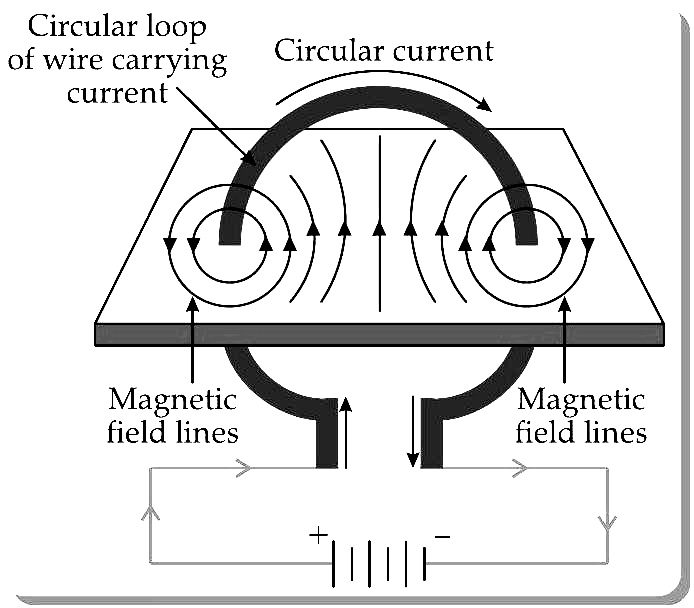
Factors on which the magnitude of the magnetic field due to a current-carrying coil depends:
(i) Magnitude of the current, (ii) Number of turns in the coil.
OR
(b) Two magnetic field lines cannot cross each other because if they do so, then it indicates two directions of the same magnetic field at that point which is not possible.
Magnetic field lines due to a current-carrying long straight solenoid:
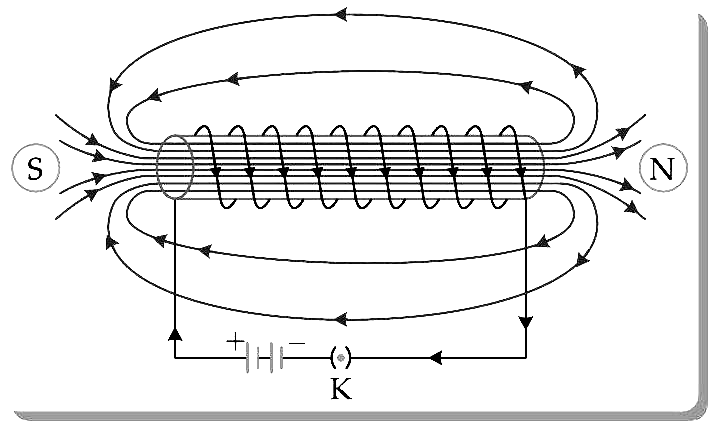
Inside the solenoid, the field lies straight. Those are close and parallel to one another, indicating that the field inside the solenoid is very strong and uniform. Factors on which the magnitude of the magnetic field due to a current-carrying coil depends:
(i) Magnitude of the current, (ii) Number of turns per unit length in the solenoid.
Section E — Case / Source Based
Many pure metals like copper, iron and gold are very soft and as such are considered unsuitable for certain uses. Metallic objects around us such as cooking utensils, statues, ornaments, guns, etc. are actually not made up of pure metals. Instead of pure metals, alloys are used in the design of most of the useful objects. Making alloys enhances the basic properties of a metal which is the primary constituent (metal) of an alloy.
(I) How does electrical conductivity and melting point of a metal change when it is converted to its alloy by mixing a small amount of an element in it?
(II) Name an alloy used for welding two wires together in an electric circuit. Write its major constituents.
(III) (a) What are alloys? How is ‘Brass’ (an alloy) prepared?
OR
(III) (b) What is stainless steel? How is it prepared? Write one important property which makes it more useful in making cooking utensils as compared to its primary metal.
(I) An alloy generally has a lower melting point and lower electrical conductivity compared to its constituent metals.
(II) Soldering wire is an alloy of lead and tin which is used to join electrical wires in an electric circuit.
(III) (a) An alloy is a combination of two or more metals or a metal and a nonmetal. Brass is an alloy of copper and zinc.
OR
(III) (b) Stainless steel is a corrosion-resistant alloy of iron, chromium and nickel. It is made by melting iron, chromium and nickel in an electric furnace.
Stainless steel is more useful for making cooking utensils because it has excellent properties like corrosion resistance, durability and non-reactive nature with food.
The growth movements of plant parts in which the direction of the stimulus determines the direction of the response is known as tropic movements or tropism. Plants also have non-directional movements which may not be growth dependent.
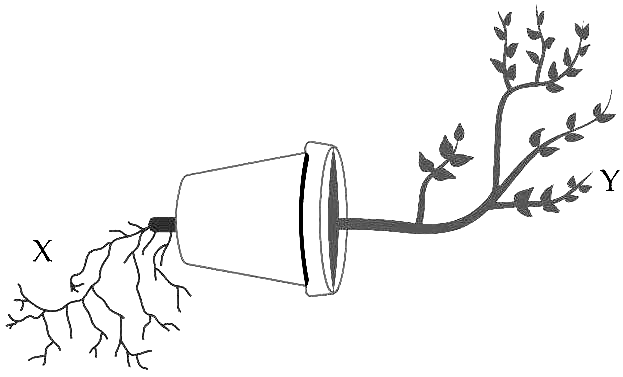
(I) Name the movement which causes ‘ X ‘ and Y to grow downwards and upwards respectively. (Refer above figure)
(II) Write the name of a hormone that plays a major role in (i) falling of leaves (ii) rapid cell division
(III) (a) Leaves of the sensitive plant move very quickly in response to ‘touch’. How is this stimulus of touch communicated and explain how the movement takes place.
OR
(III) (b) Name the plant hormone which is synthesised at the shoot tip. How does this hormone help the plant to bend towards light?
(I) X: Positive geotropism
Y: Negative geotropism
(II) (i) Hormone responsible for falling of leaves: Abscisic Acid (ABA).
(ii) Hormone responsible for cell division: Cytokinin
(III) (a) Leaves of Mimosa pudica are sensitive. When touched the stimulus reaches the base of the leaf and the water in the vacuoles of the cells of the leaf loses water to the adjacent cell. All the water escapes the leaf which then becomes flaccid. This causes the leaves to close due to the passing of impulse which changes turgor pressure. Owing to this stimulus, the turgor of the lower half of the pulvinus is lost and the leaf droops down.
The stimulus is transmitted as an action potential from a stimulated leaflet to the leaflet’s swollen base, and from there to the pulvini of the other leaflets, which run along the length of the leaf’s rachis. The action potential then passes into the petiole, and finally to the large pulvinus at the end of the petiole, where the leaf attaches to the stem.
OR
(III) (b) Plant growth hormone synthesised in shoot tips: Auxin.
During the presence of sunlight, the auxins in the stem start moving toward the area that is away from light. Thus, the auxin concentration in this region increases due to which growth takes place. Whereas the area of low auxin concentration exhibits no growth. This results in the bending of the stem towards sunlight.
Study the circuit shown in which two resistors X and Y of resistances \(3 \Omega\) and \(6 \Omega\) respectively are joined in series with a battery of 2 V.
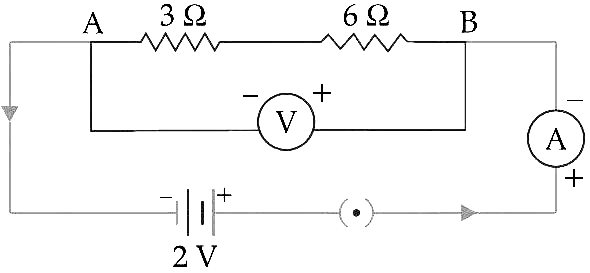
(I) Draw a circuit diagram showing the above two resistors X and Y joined in parallel with same battery and same ammeter and voltmeter.
(II) In which combination of resistors will the (i) potential difference across X and Y and (ii) current through X and Y, be the same?
(III) (a) Find the current drawn from the battery by the series combination of the two resistors (X and Y).
OR
(III) (b) Determine the equivalent resistance of the parallel combination of the two resistors (X and Y).
(I)
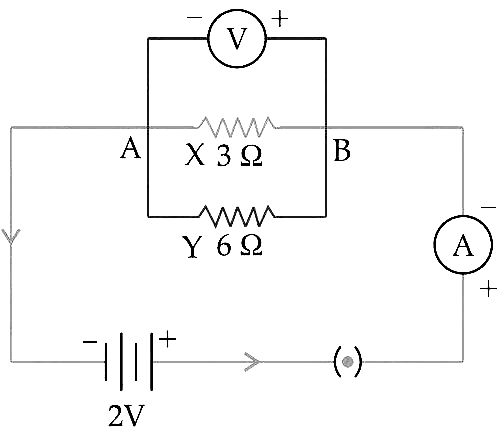
(II) (i) When the resistors are connected in parallel, then the potential difference across
X and Y for both the resistors will be the same.
(ii) When the resistors are connected in series, then the current through both the resistors connected across X and Y will be the same.
(III) (a) In the series combination, the current drawn
OR
(III) (b) In parallel combination, the equivalent resistance