

Table of Contents
Last Updated on November 17, 2026 by XAM CONTENT
Practice the NSEP 2018 Question Paper with answers and detailed worked solutions. The examination was held on 25 November 2018 and contains 70 questions: 60 single-correct questions followed by 10 multiple-correct questions.
NSEP 2018 Question Paper with Solutions
The SI unit of permeability of free space is
Ans. (d)
As we know that,
where,
and \(r=\) distance of point from conductor.
A uniform solid drum of radius \(R\) and mass \(M\) rolls without slipping down a plane inclined at an angle \(\theta\). Its acceleration along the plane is
Ans. (c)
Condition of a body rolling without slipping on an inclined plane is given by
where, \(K=\) radius of gyration. But we know that,
From Eq. (i), we get
Moment of inertia of cylinder,
A particle moves according to the law \(x=a t\), \(y=a t(1-\alpha t)\), where \(a\) and \(\alpha\) are positive constants and \(t\) is time. The time instant at which velocity makes an angle \(\pi / 4\) with acceleration is
Ans. (d)
Given, \(x=a t, y=a t(1-\alpha t)\) where, \(a\) and \(\alpha\) are positive constants and \(t\) is time. As we know that,
Similarly,
…(iv) From Eqs. (i) and (ii), we get
Similarly,
when \(\theta=\frac{\pi}{4}\), we have
The potential energy of a particle of mass \(m\) in a conservative force field can be expressed as \(U=\alpha x-\beta y\), where \((x, y)\) denote the position coordinates of the body. The acceleration of the body is
Ans. (d)
Given, Potential energy, \(U=\alpha x-\beta y\) As we know that,
Similarly,
∴
We know that,
A constant force \(F\) applied to the lower block of mass 15 kg makes, it slide between the upper block of mass 5 kg and the table below as shown in the figure. The coefficients of static \(\left(\mu_{s}\right)\) and kinetic \(\left(\mu_{k}\right)\) friction between the lower block and the tables are 0.5 and 0.4 respectively and those between two blocks are 0.3 and 0.1. The accelerations of the upper and the lower blocks are respectively,
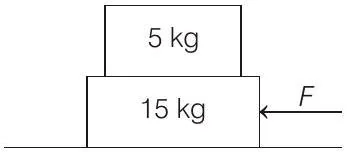
Ans. (d)
Since, there is sliding between 5 kg and 15 kg block. Hence,
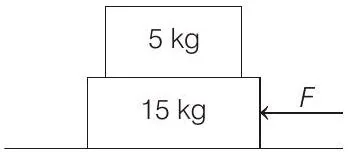
Now, acceleration of 15 kg block will depends on the value of applied force \(F\) but for all applied
force \(F\) magnitude of acceleration of 15 kg block will be greater than acceleration of 5 kg block. Hence, option (d) is correct.
Two bodies of equal masses moving with equal speeds make a perfectly inelastic collision. If the speed after the collision is reduced to half, the angle between their velocities of approach is
Ans. (d)
Let the mass of each ball is \(m\) and moving with equal velocity \(v\). Now, applying conservation of linear momentum along \(X\) and \(Y\)-axes.
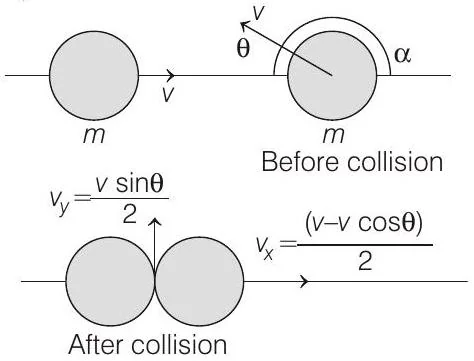
We have,
It is given that,
Hence, angle between velocities of approach, \(\alpha=\left(180^{\circ}-60^{\circ}\right)=120^{\circ}\)
A student performs an experiment with a simple pendulum and reading the time for 20 oscillations. If he would have recorded time for 100 oscillations, the error in the measurement of time period would have reduced by a factor of
Ans. (d)
Let the actual time period of oscillation is \(T_{0}\) and \(\Delta T\) is the least count (recording) of clock system. Then, measured time period for 20 oscillations would be \(T_{1}=20 T_{0}+\Delta T\) So, in this case time period (observed) for 1 oscillation.
So, error in measurement in 1st case is
Similarly, the error in measurement in 2nd case is
Dividing Eq. (i) by Eq. (ii), we get So, \(\frac{\Delta t_{1}}{\Delta t_{2}}=\frac{\Delta T \times 100}{20 \times \Delta T}=5\)
Hence, error will reduced by a factor of 5.
A satellite is launched from a point close to the surface of the earth (radius \(R\) ) with a velocity \(v=v_{0} \sqrt{1.5}\), where \(v_{0}\) is the velocity in a circular orbit. If the initial velocity imparted to the satellite is horizontal, the maximum distance from the surface of the earth during its revolution is
Ans. (b)
As we know that, Orbital velocity \(v_{0}=\sqrt{\frac{G M}{R}}\) Here \(R=\) radius of orbit \(M=\) mass of central body \(G=\) gravitational constant Let \(x\) is maximum distance from the centre of earth
…(ii)

Applying mechanical energy conservation,
On solving Eqs. (ii) and (iv), \(x=3 R\) and \(R\) ∴ Maximum distance from surface of the earth
The aperture diameter of a plano-convex lens is 6 cm and its thickness is 3 mm. If the speed of light through its material is \(v=2 \times 10^{8} \mathrm{ m} / \mathrm{s}\), the focal length of the lens is
Ans. (c)
Given, aperture diameter of lens = 6 cm Thickness of lens \(=3 \mathrm{ mm}\) Speed of light, \(v=2 \times 10^{8} \mathrm{ m} / \mathrm{s}\) According to the question,

In \(\triangle C P O\),
Focal length
⇒
⇒
Under standard conditions of temperature and pressure a piece of ice melts completely on heating it. Obviously the increase in internal energy of the system (ice and water) is
Ans. (b)
As the volume of the water (liquid form) is less than the ice (solid form), so work must have done on the water, so \(\Delta w\) (on water by atmosphere) = + ve (positive) Also, \(\Delta q\) is positive. According to the first law of thermodynamics So, \(\Delta u=\) heat supplied + work done on the system ∴ Change in internal energy will be slightly greater than the amount of heat supplied.
Rocket fuel is capable of giving an exhaust velocity of \(v_{\text {rel }}=2.4 \mathrm{ km} / \mathrm{s}\) in the absence of any external forces. The fuel required per kg of the payload to provide an exhaust velocity of 12 km/s to the rocket is
Ans. (c)
Let the fuel mass is \(m_{f}\) and mass of payload is \(m_{0}\), then at \(t=0\)
According to the law of conservation of mass, And mass at any time \(t\) is \(m(t)=m_{0}+m_{f}-r_{0} t\) where, \(r_{0}\) is the rate with which fuel burns and \(v_{\text {rel }}\) is already given as exhaust velocity of fuel \(=2.4 \mathrm{ km} / \mathrm{s}\). So, \(m \frac{d v}{d t}=r_{0} v_{\text {rel }}\) or \(d v=r_{0} v_{\text {rel }} \frac{d l}{m_{0}+m_{f}-r_{0} t}\)
A vertical spring of length \(l_{0}\) and force constant \(K\) is stretched by \(l\) when a mass \(m\) is suspended from its lower end. By pulling, the mass down a little, the system is left off to oscillate. The time period of oscillation is
Ans. (a)
We have,
Here \(K=\) force constant, \(m=\) mass / = stretched length Time period of spring system is given by
From Eqs. (i) and (ii), we get
Let \(R\) be the radius of the earth. In general, the loss of gravitational potential energy of a body of mass \(m\) falling from a height \(h\) to the earth surface is
Ans. (b)
At height \(h\), gravitational potential energy,
At the earth surface,
∴ Loss of potential energy,
Substituting the value from Eqs. (i) and (ii), we get
⇒
∴
The velocity of a projectile at the highest point of its trajectory is \(\sqrt{0.4}\) of its velocity at a point at half its maximum height. The angle of projection is
Ans. (c)
Let at highest point velocity is \(v^{\prime \prime}\) and at half the maximum height it is \(v^{\prime}\).
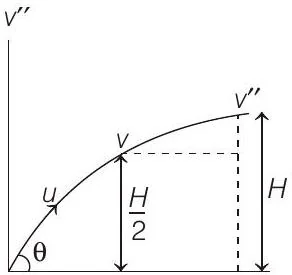
If initial speed of projection is \(u\) at angle \(\theta\), then \(u_{x}=u \cos \theta\) and \(u_{y}=u \sin \theta\) Clearly \(v^{\prime \prime}=u \cos \theta=\sqrt{\frac{4}{10}} \cdot v^{\prime}\)
…(i) Now,
and \(u^{2} \sin ^{2} \theta-v^{\prime} y^{2}=\frac{2 g H}{2}\) ∴
From Eq. (i), we get
\(\therefore \quad \frac{u^{2} \sin ^{2} \theta}{u^{2} \cos ^{2} \theta}=\frac{2 g H}{\frac{2 g H}{3}} \Rightarrow \tan ^{2} \theta=3\) \(\therefore \quad \theta=60^{\circ}\)
The combination of a steel wire (length 80 cm, area of cross-section \(1 \mathrm{ mm}^{2}\) ) and an aluminium wire (length 60 cm, area of cross-section \(3 \mathrm{ mm}^{2}\) ) joined end to end is stretched by a tension of 160 N. If the densities of steel and aluminium are 7.8 g/cc and 2.6 g/cc respectively, then the minimum frequency of a tuning fork which can produce standing waves in the composite wire, with the joint as a node, is
Ans. (b)
Given, length of a steel wire, \(I_{S}=80 \mathrm{ cm}\) Cross-section area of steel wire, \(A_{s}=1 \mathrm{ mm}^{2}=1 \times 10^{-6} \mathrm{ m}^{2}\) Length of aluminium wire, \(I_{\mathrm{Al}}=60 \mathrm{ cm}\) Cross-section area of aluminium wire,
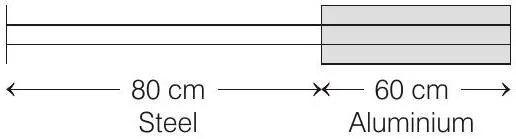
For steel wire, \(\mu_{s}=\rho_{s} A_{s}\)
∴ Wave velocity in steel wire,
\(\Rightarrow \quad v_{s}=143.2 \mathrm{ m} / \mathrm{s}\) For aluminium wire \(\mu_{\mathrm{Al}}\)
∴ Wave velocity in aluminium wire,
Both of the wire shall have the same wave velocity. So, for joint to behave as a node, wave length (maximum) should be in such a way that there should be 4 loops in steel wire and 3 loops in aluminium wire.
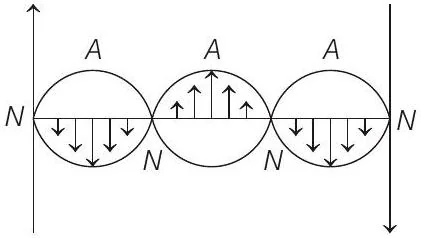
In a stationary wave,
Ans. (b)
In a stationary wave all the particles between two consecutive nodes vibrate in the same phase
An empty earthen pitcher is kept under a water tap and starts filling with water as the tap is opened. The pitch of the sound produced
Ans. (b)
Frequency of air column, \(f=\frac{n v}{4 l}\) ( \(l\) is length of air column)
As, \(I\) is decreasing and frequency is increasing.
The molar specific heat of an ideal gas in a certain thermodynamic process is \(\frac{\alpha}{T}\), where \(\alpha\) is a constant. If the adiabatic exponent is \(\gamma=\frac{C_{p}}{C_{V}}\), the work done in heating the gas from \(T_{0}\) to \(n T_{0}\) is
Ans. (b)
According to the first law of thermodynamics,
where, \(\Delta Q=\) heat supplied to system, \(\Delta U=\) change in internal of system and \(\Delta W=\) work done by the system on the surrounding. For one mole of gas,
Now,
Substituting the value of Eqs. (ii) and (iii) in Eq. (i), we get
An aircraft flies at a speed \(v\) from city \(A\) to city \(B\) and back in time \(t_{0}\). City \(B\) is to the east of city \(A\) at a distance \(d\). The aircraft takes time \(t_{1}\) for the round trip, if wind blows with speed \(\omega\) along \(A B\) and time \(t_{2}\), if the wind blows with the same speed perpendicular to \(A B\). Then,
Ans. (b)
Case-I When aircraft flies at a speed \(v\) from city \(A\) to city \(B\) as shown in the figure.
Time taken,
Case-II If wind blows with speed \(\omega\), time taken,
Case-III If wind blows with the same speed perpendicular to \(A B\)

Then,
Time taken,
The Hubble telescope in orbit above the earth has a 2.4 m circular aperture. The telescope has equipment for detecting ultraviolet light. The minimum angular separation between two objects that the telescope can resolve in ultraviolet light of wavelength 95 nm is
Ans. (a)
Given, circular aperture, \(D=2.4 \mathrm{ m}\) Wavelength, \(\lambda=95 \mathrm{ nm}\)
As we know that, limit of resolution,
A projectile is fired from ground with velocity \(u\) at an angle \(\theta\) with the horizontal. It would be moving perpendicular to its initial direction of projection after a time \(t\) equal to
Ans. (c)
As we know that,
For projectile motion,
For perpendicular condition,
The critical angle for light passing from glass to air is minimum for the light of wavelength
Ans. (d)
As we know that, Critical angle, \(i_{c}=\sin ^{-1}\left(\frac{1}{\mu}\right)\) where, \(\mu=\) refractive index of medium. Critical angle \(i_{C}\) is minimum for wavelength having maximum refractive index. Now, \(\mu=A+\frac{B}{\lambda^{2}}\) (Cauchy relation) \(\mu\) will be maximum for minimum wavelength which is \(0.4 \mu \mathrm{ m}\) out of the given options.
A thin hollow equiconvex lens, silvered at the back, converges a beam of light parallel to the principal axis at a distance 0.2 m. When filled with water \(\left(\mu=\frac{4}{3}\right)\), the same beam will be converged at a distance of
Ans. (c)
Given focal length \(f=0.2 \mathrm{ m}=20 \mathrm{ cm}\) As we know that,
For hollow lens,
When filled with water
Given, \(f_{m}=20 \mathrm{ cm}\) Substituting the value of Eqs. (ii) and (iii) in Eq. (i), we get
An air bubble is situated at a distance 2.0 cm from the centre of a spherical glass paper-weight of radius 5.0 cm and refractive index 1.5. The bubble is seen through the nearest surface. It appears at a distance \(v\) from the centre. Therefore, \(v\) is
Ans. (c)
According to the question,

As we know that,
So, distance from the centre \(=5-2.5=2.5 \mathrm{ cm}\)
A student while performing experiment with a sonometer with bridges separated by a distance of 80 cm, missed out some of the observations. However, he claimed that the three resonant frequencies for a given tuning fork were 84, 140 and 224 Hz. The speed of transverse waves on the wire is
Ans. (c)
Given distance \(I=80 \mathrm{ cm}\) and resonant frequencies are 84,140 and 224 Hz . As we know that, Resonant frequency, \(f=\frac{n v}{2 l}\)
From Eqs. (i) and (ii), we get
If \(f_{0}\) is fundamental frequency, \(3 f_{0}=84\)
Which of the following curves represents spectral distribution of energy of black body radiation ?


Ans. (a)
According to the Planck’s law, the spectral density of electromagnetic radiation emitted by a black body in thermal equilibrium at a given temperature, when there is no net flow of matter or energy between the body and its environment. Hence, option (a) is correct.
A sphere and a cube having equal surface areas are made of the same material. The two are heated to the same temperature and kept in identical surrounding. The ratio of their initial rates of cooling is
Ans. (d)
Let the side of cube is \(L\) and radius of sphere is \(R\), then
Ratio of pulling is inversely proportional to mass for a given material and equal surface area. Hence,
Consider the diffraction pattern due to a single slit. The first maximum for a certain monochromatic light coincides with the first minimum for red light of wavelength 660 nm. The wavelength of the monochromatic light is
Ans. (c)
Given, wavelength, \(\lambda_{2}=660 \mathrm{ nm}\) Now, according to the quesiton,
A concave lens of focal length \(f\) produces an image \(\left(\frac{1}{n}\right)\) times, the size of the object. The distance of the object from the lens is
Ans. (d)
As we know that,
where, \(v=\) image distance, \(u=\) object distance and \(f=\) focal length of concave lens. Magnification by concave lens is given by
According to the question,
From Eq. (i), we get
The sun having radius \(R\) and surface temperature \(T\), emits radiation as a perfect emitter. The distance of the earth from the sun is \(r\) and the radius of the earth is \(R_{e}\). The total radiant power incident on the earth is
Ans. (d)
Given, radius of sun \(=R\) Temperature of sun surface \(=T\) Radius of the earth \(=R_{e}\) According to the question,
where, \(P=\) radiant power

A cylinder containing water (refractive index \(\frac{4}{3}\) ) is covered by an equiconvex glass (refractive index \(\frac{3}{2}\) ) lens of focal length 25 cm. At the mid-day when the sun is just overhead, the image of the sun will be seen at a distance of
Ans. (b)
Given, \(u=\infty\) According to the question, we can draw the following diagram,
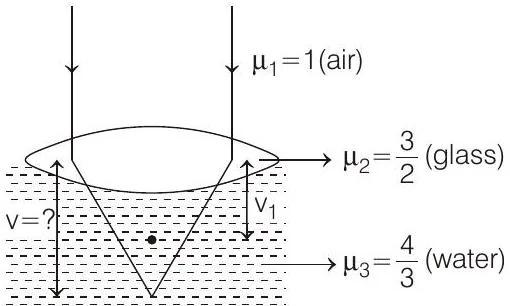
Now, from refraction through single curved surface is given by
From Eqs. (i) and (ii), we get
Substitute the all values in the above equation
A rectangular loop carrying a current is placed in a uniform magnetic field. The net force acting on the loop
Ans. (d)
When a rectangular loop carrying a current is placed in a uniform magnetic field, then the force acting on the loop is shown in the figure.
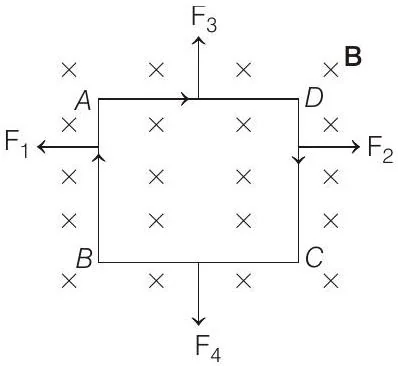
From the figure, we get \(\mathbf{F}_{1}=-\mathbf{F}_{2}\) and \(\mathbf{F}_{3}=-\mathbf{F}_{4}\) Hence, the net force on the loop is zero.
The capacitor in the circuit shown below carries a charge of \(30 \mu \mathrm{C}\) at a certain time instant. The rate at which energy is being dissipated in the \(3 \mathrm{k} \Omega\) resistor at that instant is
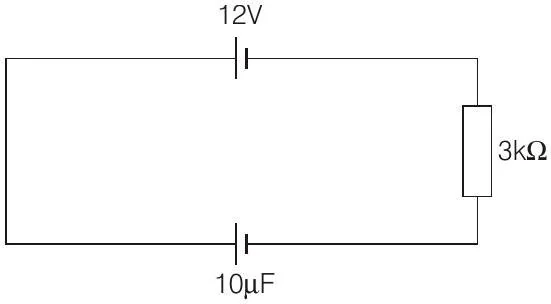
Ans. (c)
Voltage across the capacitor at that instant is
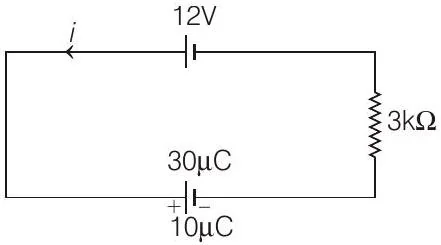
Now, from KVL, \(i=\frac{(12-3) V}{3}=3 \mathrm{ mA}\) Hence, power dissipated across, \(R=3 \mathrm{k} \Omega\) is
A hollow conducting sphere of radius 15 cm has a uniform surface charge density \(+3.2 \mu \mathrm{C} / \mathrm{m}^{2}\). When a point charge \(q\) is placed at the centre of the sphere, the electric field at 25 cm from the centre just reverses, its direction keeping the magnitude the same. Therefore, \(q\) is
Ans. (d)
Case I Given surface charge density
Initial Case
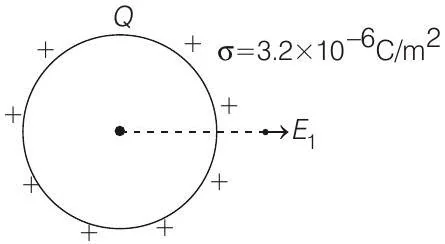
Electric field, \(E_{1}=\frac{Q}{4 \pi \varepsilon_{0} r^{2}}\) Final case

Electric field, \(E_{2}=\frac{Q+q}{4 \pi \varepsilon_{0} r^{2}}\) Given that,
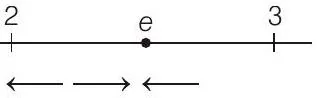
An electron \((e)\) and a proton \((p)\) are situated on the straight line as shown below. The directions of the electric field at the points 1, 2 and 3 respectively, are shown as



Ans. (b)
As we know that, the charge on an electron \((e)\) and proton \((p)\) is equal \(1.6 \times 10^{-19} \mathrm{C}\). Hence, the direction of electric field due to charge particle which is near to the point dominates at the point.

The direction of electric fields are following At point 1, net electric field is towards left (⟵). At point 2, net electric field is towards right (⟶). At point 3, net electric field is towards left (⟵). Hence, option (b) is correct.
In the circuit shown, \(R_{1} \neq R_{2}\). The reading in the galvanometer is the same with switch \(S\) open or closed. Then,

Ans. (b)
When switch is open, then current through resistance \(R_{2}\) is same as current \(I_{G}\) in galvanometer.
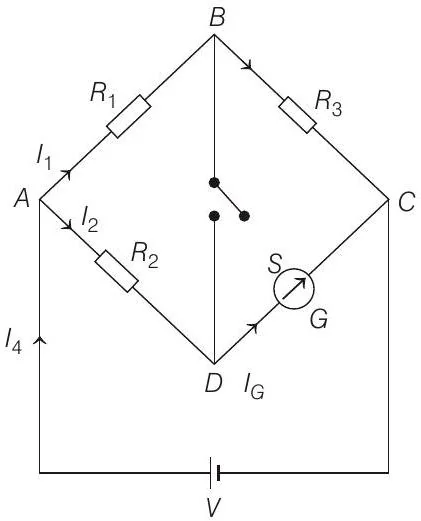
Hence, current in branch \(C D=\) current in branch DC
Now, it is given that current in galvanometer is same for switch is open or close. Hence, \(I_{2}=I_{G}\)
A thin wire of length 1 m is placed perpendicular to the \(X Y\) plane. If it is moved with velocity \(\mathbf{v}=4 \hat{\mathbf{i}}-\hat{\mathbf{j}} \mathrm{m} / \mathrm{s}\) in the region of magnetic induction \(\mathbf{B}=\hat{\mathbf{i}}+4 \hat{\mathbf{j}} \mathrm{ Wb} / \mathrm{m}^{2}\). The potential difference developed between the ends of the wire is
Ans. (d)
Given, Length of the wire, \(\mathbf{l}=\hat{\mathbf{k}} \mathrm{m}\) Velocity, \(\mathbf{v}=(4 \hat{\mathbf{i}}-\hat{\mathbf{j}}) \mathrm{m} / \mathrm{s}\) Magnetic induction, \(\mathbf{B}=(\hat{\mathbf{i}}+4 \hat{\mathbf{j}}) \mathrm{Wb} / \mathrm{m}^{2}\) As, we know that, Induced emf, \(e=(\mathbf{v} \times \mathbf{B}) \cdot \mathbf{1}=(\mathbf{v} \times \mathbf{B}) \cdot \mathbf{1}\)
A steel cooking pan has copper coating at its bottom. The thickness of copper coating is half the thickness of steel bottom. The conductivity of copper is three times that of steel. If the temperature of blue flame is 119°C and that of the interior of the cooking pan is 91°C, then the temperature at the interface between, the steel bottom and the copper coating in the steady state is
Ans. (c)
According to the question, we can draw the following diagram.
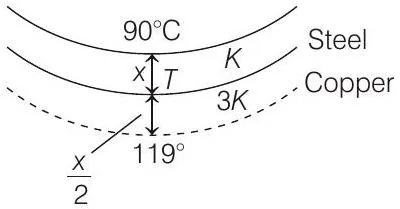
Let the temperature at the junction is \(T^{\circ} \mathrm{C}\). According to the law of conduction of heat, the rate of heat flow will be same. Hence, i.e. \(\frac{3 K A(119-T)}{\frac{x}{2}}=\frac{K A(T-91)}{x}\)
The total capacitance between points \(A\) and \(B\) in the arrangement shown below is

Ans. (d)
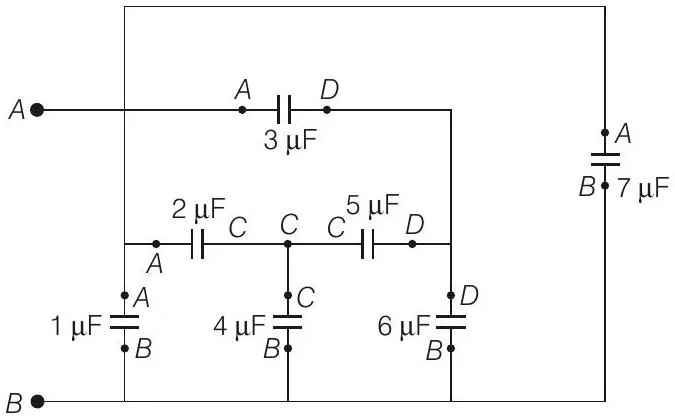
Equivalent circuit of this circuit can be redrawn as
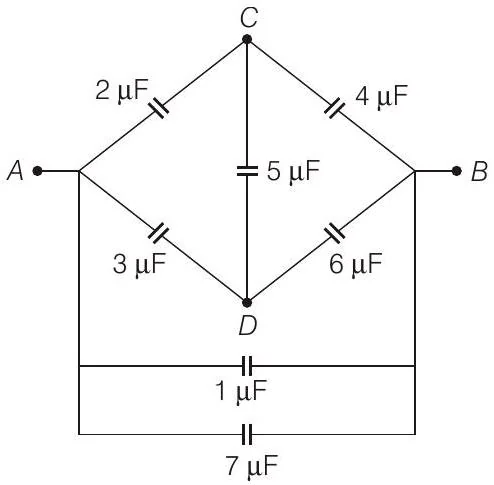
As Wheatstone bridge \(A D B C\) is balanced ∴ No current will flow through \(5 \mu \mathrm{ F}\) Hence equivalent circuit of above circuit can be redrawn as

A fibre sheet of thickness 1 mm and a mica sheet of thickness 2 mm are introduced between two metallic parallel plates to form a capacitor. Given that, the dielectric strength of fibre is 6400 kV/m and the dielectric constants of fibre and mica are 2.5 and 8, respectively the electric field inside the mica sheet just at the breakdown of fibre will be
Ans. (a)
Given, dielectric constant of fibre, \(K_{1}=2.5\) Dielectric constant of mica, \(K_{2}=8\) Dielectric strength of fibre, \(E_{1}=6400 \mathrm{kV} / \mathrm{m}\) Thickness of fiber sheet \(t_{1}=1 \mathrm{ mm}=1 \times 10^{-3} \mathrm{ m}\) Thickness of mica sheet \(t_{2}=2 \mathrm{ mm}=2 \times 10^{-3} \mathrm{ m}\) Let \(\sigma\) be the charge density on each plate and \(E_{1}, E_{2}\) be the electric fields in the fibre mica and \(K_{1}, K_{2}\) are dielectric constants. ∴
Dividing Eq. (ii) by Eq. (i),we get
∴
The position vector of a point mass is expressed as \(\mathbf{r}=a t \hat{\mathbf{i}}+b t^{2} \hat{\mathbf{j}}\). The trajectory of the particle is
Ans. (b)
As, given position vector
We know that position vector After comparing Eq. (i) with Eq. (ii), we get
and
From Eq. (iii) ∴
Substituting the value of \(t\) in Eq. (iv), we get ∴
∴
This is the equation of parabola. Hence, the trajectory of the particle is parabola.
In a series, \(L-C-R\) circuit fed with an alternating \(\mathrm{emf} E=E_{0} \sin \omega t\),
Ans. (c)
Considering series resonance \(R-L-C\) circuit \(V_{L}=V_{C}\), then emf \(E\) will be in phase with \(V_{R}\) (As \(/\) is in phase with \(V_{R}\) )
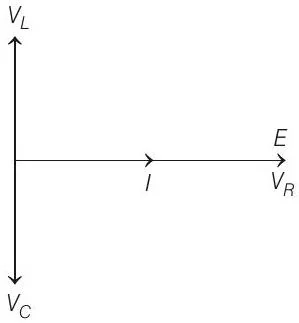
Note : The question seems to be incorrect, although the most appropriate answer is option (c)*
A conducting wire is bent in the form of a \(n\) sided regular polygon enclosed by a circle of radius \(R\). The magnetic field produced at its centre by a current \(i\) flowing through the wire is
Ans. (c)
For \(n\) sided polygon angle subtended by each side on centre is
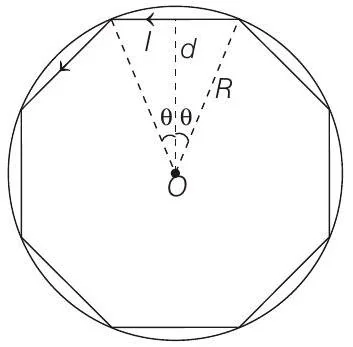
From the above figure,
Magnetic field at centre,
Now,
⇒
The effective resistance between points \(A\) and \(B\) in the circuit arrangement shown below is
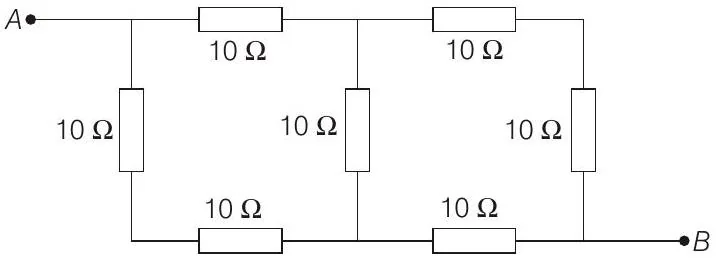
Ans. (a)
Given,

The above circuit can be redrawn with applying symmetry rule.
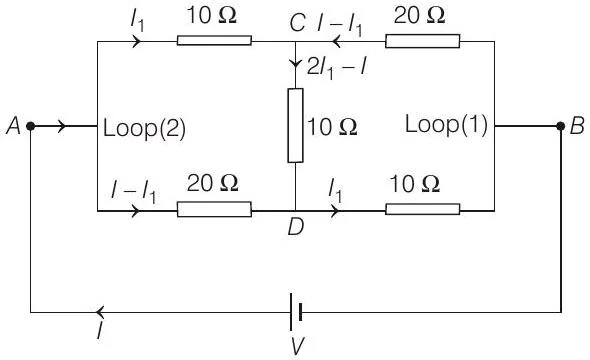
Let voltage applied across \(A B\) is \(V\). ∴
Apply KVL in loop 1, we get
Apply KVL in loop 2, we get
⇒
Substituting the value of \(I_{1}\) in Eq. (i), we get
∴
The magnetic dipole moment of an electron in the \(S\) state of hydrogen atom revolving in a circular orbit of radius 0.0527 nm with a speed \(2.2 \times 10^{6} \mathrm{ m} / \mathrm{s}\) is
Ans. (b)
Given, Radius of circular orbit, \(r=0.0527 \mathrm{ nm}\) As we know that, Magnetic moment of an electron is \(M=I A\) Here, speed of electron, \(v=2.2 \times 10^{6} \mathrm{ m} / \mathrm{s}\)
A steel cable hanging vertically can support a maximum load \(w\). The cable is cut to exactly half of its original length, the maximum load that it can support now is
Ans. (a)
As we know that, Breaking load = Breaking stress × Cross-sectional area Since, breaking stress is the property of material, which remains same as \(\frac{W}{A}\) Breaking load \(=\frac{W}{A} \times A=W\)
The strings \(A B\) and \(A C\) each of length 40 cm, connect a ball of mass 200 g to a vertical shaft as shown. When the shaft rotates at a constant angular speed \(\omega\), the ball travels in a horizontal circle with the strings inclined at \(\gamma=30^{\circ}\) to the shaft. If the tension in the string \(A C\) is 4N, that in the string \(A B\) and the angular speed \(\omega\) respectively, are

Ans. (a)
Given mass \(m=200 \mathrm{ g}\), length \(A B=A C\) = 40 cm tension \(T=4 \mathrm{ N}\), inclined angle \(r=30^{\circ}\) According to the question we can drawn the following diagram.
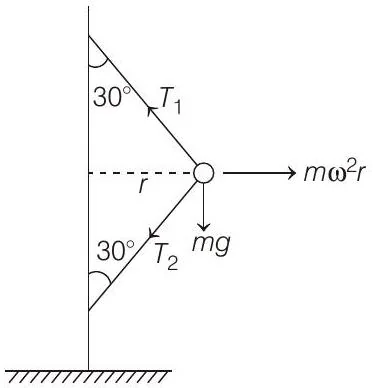
Centripetal force equation,
In vertical direction, \(T_{1} \cos 30^{\circ}=T_{2} \cos 30^{\circ}+m g\)
Here,
Substituting the value of \(T\) in Eq. (i), we get
Then, \(\omega=11.32 \mathrm{rad} / \mathrm{s}\)
A tightly would long solenoid carries a current 5A. An electron shot perpendicular to the solenoid axis inside it revolves at a frequency \(10^{8}\) rev/s. The number of turns per metre length of the solenoid is
Ans. (c)
Given, Current, \(I=5 \mathrm{ A}\), Angular velocity, \(\omega=10^{8} \mathrm{rad} / \mathrm{s}\) In the case of uniform magnetic field Angular velocity, \(\omega=\frac{q B}{m}\)
The same alternating voltage \(V=V_{0} \sin (\omega t)\) is applied in both the \(L-C-R\) circuit shown below. The current through the resistance \(R\) at resonance is

Fig. (1)
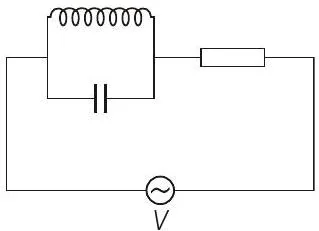
Fig. (2)
Ans. (c)
Series \(L-C-R\) circuit can be drawn as following circuit

Impedance, \(Z=R+j\left(\omega L-\frac{1}{\omega C}\right)\) at resonance, \(Z=Z_{\text {min }}=R\) I = maximum
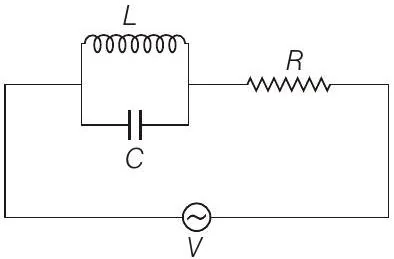
At resonance, current in parallel \(L-C\) circuit is 0. Hence, current is minimum.
The switch \(S\) in the circuit shown is closed for a long time and then opened at time \(t=0\). The current in the \(100 \mathrm{k} \Omega\) resistance at \(t=3 \mathrm{ s}\) is
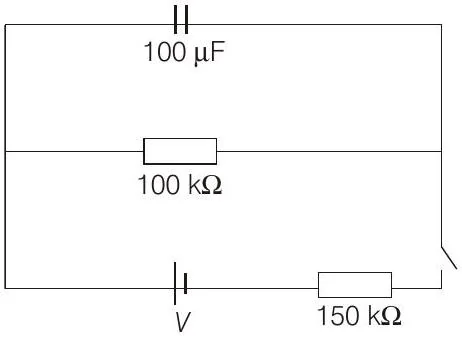
Source note: question incomplete
Question is incomplete because \(V\) is not given.
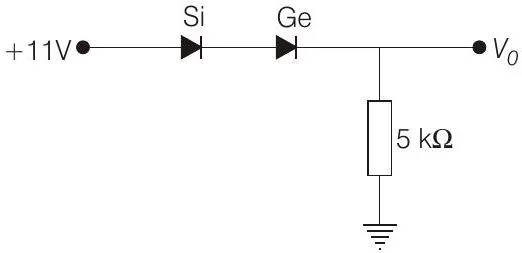
In the network shown below the voltage \(V_{0}\) is nearly
Ans. (a)
As we know that, In forward bias voltage drop across Si-diode is 0.7 V and Ge-diode is 0.3 V. Hence, voltage drop across diode

Therefore, Output voltage, \(V_{o}=V_{i}-V_{D}\)
The energy of the chracteristic X-ray photon in a Coolidge tube comes from
Ans. (d)
Characteristic X-rays are produced due to electronic transition of the target atoms. i.e.
The maximum wavelength that can ionise a hydrogen atom initially in the ground state is
Ans. (d)
As we know that, Energy of photon,
Here, \(\Delta E=13.6 \mathrm{eV}\)
The wavelength of the waves associated with a proton and a photon are the same. Therefore, the two have equal
Ans. (c)
As we know that, Wavelength, \(\lambda=\frac{h}{p}\) where, \(h=\) Planck’s constant \(p=\) momentum of particle (photon or proton). Here, \(h\) is constant and \(\lambda\) is same for both particles. So, proton and photon have equal momentum.
Which of the following sources emits light having highest degree of coherence?
Ans. (b)
LASER-Light Amplification by Stimulated Emission of Radiation and laser possess the highest degree of coherency.
An \(\alpha\)-particle with kinetic energy \(K\) approaches a stationary nucleus having atomic number \(Z\). The distance of closest approach is \(b\). Therefore, the distance of closest approach for a nucleus of atomic number \(2 Z\) is
Ans. (c)
As we know that, Kinetic energy of \(\alpha\)-particle,
From Eqs. (i) and (ii), we get
In a photodiode, the reverse current increases when exposed to light of wavelength 620 nm or less. The band gap of the semi-conductor used is
Ans. (c)
Given, Wavelength, \(\lambda=620 \mathrm{ nm}\) As we know that, Energy band gap
An electron in hydrogen atom jumps from a level \(n=4\) to \(n=1\). The momentum of the recoiled atom is
Ans. (a)
Given, \(n_{1}=1, n_{2}=4\) As we know that, \(\frac{1}{\lambda}=R\left[\frac{1}{n_{1}^{2}}-\frac{1}{n_{2}^{2}}\right]\)
Momentum,
For the Boolean equation \(Y=A B+A(B+C)+B(B+C)+\bar{B}\), which of the following statements is correct ?
Ans. (c)
\(Y=A B+A(B+C)+B(B+C)+\bar{B}\)
As we know that, \(B+\bar{B}=1\)
Hence, \(Y\) does not depend on \(B\).
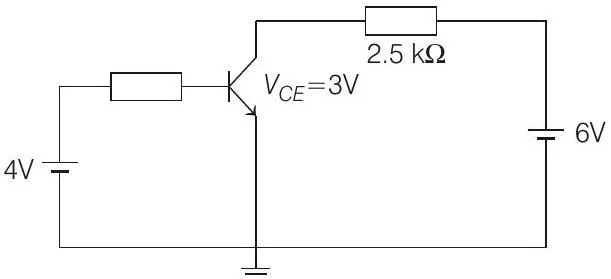
Refer to the common emitter amplifier circuit shown below, using a transistor with \(\beta=80\) and \(V_{B E}=0.7 \mathrm{ V}\). The value of resistance \(R_{B}\) is
Ans. (d)
Given, Current gain, \(\beta=80\) Base-emitter voltage, \(V_{B E}=0.7 \mathrm{ V}\)
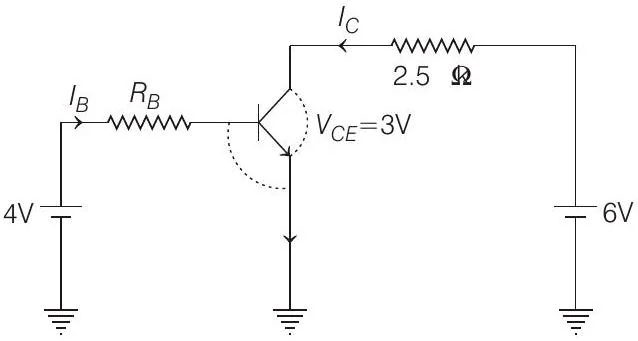
[From KVL law]
NSEP 2018 Questions 61–70
A horizontal insulated cylinder of volume \(V\) is divided into four identical compartments by stationary semipermeable thin partitions as shown. The four compartments from left are initially filled with 28 g helium, 160 g oxygen, 28 g nitrogen and 20 g hydrogen respectively. The left partition lets through hydrogen, nitrogen and helium, while the right partition lets through hydrogen only. The middle partition lets through hydrogen and nitrogen both. The temperature \(T\) inside the entire cylinder is maintained constant. After, the system is set in equilibrium
| He | \(\mathrm{O}_{2}\) | \(\mathrm{N}_{2}\) | \(\mathrm{H}_{2}\) |
Ans. (a, b, c, d)
As we know that, At equilibrium, partial pressure of each gas is same.
He accupies \(\frac{V}{2}\) volume. According to the ideal gas equation, we get
For oxygen,
Similarly, for nitrogen,
For hydrogen,
After charging a capacitor \(C\) to a potential \(V\), it is connected across an ideal inductor \(L\). The capacitor starts discharging simple. harmonically at time \(t=0\). The charge on the capacitor at a later time instant is \(q\) and the periodic time of simple harmonic oscillations is \(T\). Therefore,
Ans. (b, d)
As we know that, Energy remains constant in L-C oscillation, Hence,

Equation of SHM,
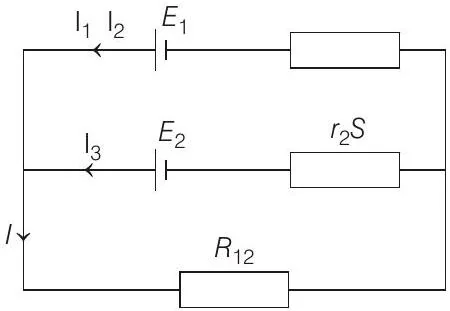
In the circuit arrangement shown two cells supply a current \(I\) to a load resistance \(R=9 \Omega\). One cell has an emf \(E_{1}=9 \mathrm{ V}\) and internal resistance \(r_{1}=1 \Omega\) and the other cell has an emf \(E_{2}=6 \mathrm{ V}\) and internal resistance \(r_{2}=3 \Omega\). The currents are as shown. Then,
Ans. (b, c)
Given,
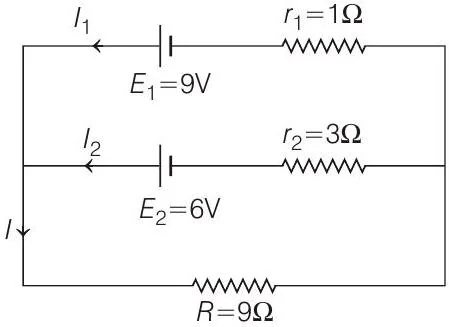
From the above circuit, equivalent emf
Equivalent resistance,
Now, \(E_{2}-I_{2} r_{2}=I \times R\)
Now, when \(E_{1}\) is removed, Current, \(I=\frac{6}{9+3}=0.5 \mathrm{ A}\) I will be smaller, when \(E_{2}\) is removed, Current, \(I=\frac{9}{9+1}=0.9 \mathrm{ A} \Rightarrow I\) will be larger.
A transparent cylindrical rod of length \(l=50 \mathrm{ cm}\), radius \(R=10 \mathrm{ cm}\) and refractive index \(\mu=\sqrt{3}\) lies onto a horizontal plane surface. A ray of light moving perpendicular to its length is incident on the rod horizontally at a height \(h\) above the plane surface such that this ray emerges out of the rod at a height 10 cm above the plane surface. Therefore, \(h\) is
Ans. (a, c, d)
Given, length of cylindrical rod, \(I=50 \mathrm{ cm}\) Radius of cylindrical rod, \(R=10 \mathrm{ cm}\) Refractive index, \(\mu=\sqrt{3}\) According to the question there are three cases are arises which are following, Case I When \(h=10.0 \mathrm{ cm}\)

Case II When \(h-10=R \sin (2 \theta)\)
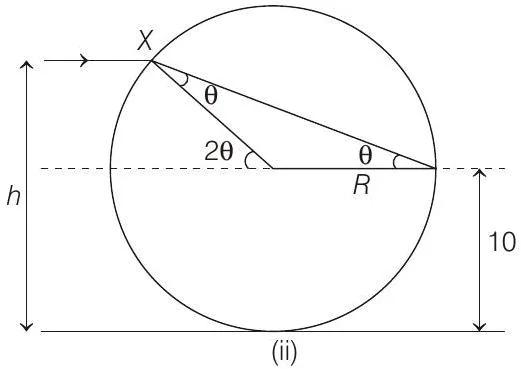
Applying Snell’s law at point \(X\)
Case III When \(R \sin 2 \theta=(10-h)\)
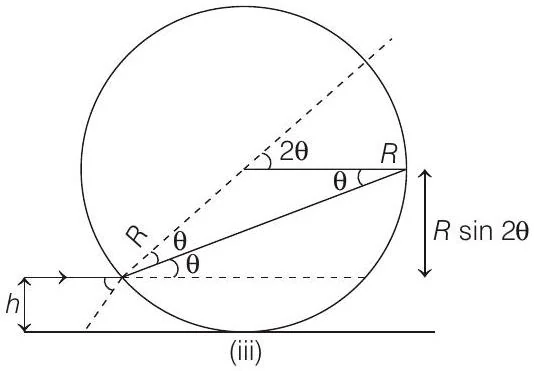
Two point charges \(+1 \mu \mathrm{C}\) and \(-1 \mu \mathrm{C}\) are placed at points (0,-0.1 m) and (0,+0.1 m), respectively in \(x y\)-plane. Then, choose the correct statement/s from the following.
Ans. (c, d)
According to the question, we can drawn the following diagram

Edirection changes. Dipole moment \(\mathbf{p}=q \times \mathbf{d}\)
\(V_{\infty}=0, V_{0}=0\)
\(\therefore W=0\) in bringing a test charge from infinity to the origin E is along + Y-axis at all points of X-axis. ∴ Correct option is (c, d).
An inductance \(L\), a resistance \(R\) and a battery \(B\) are connected in series with a switch \(S\). The voltages across \(L\) and \(R\) are \(V_{L}\) and \(V_{R}\), respectively. Just after closing the switch \(S\).
Ans. (a, d)
According to the question, we can drawn the following circuit diagram
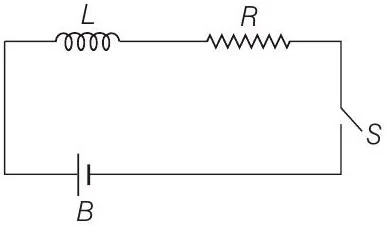
At \(t=0\), circuit will behave like an open circuit
A string of length \(l\), tied to the top of a pole carries a ball at its other end as shown. On giving the ball a single hand blow perpendicular to the string, it acquires an initial velocity \(v_{0}\) in the horizontal plane and moves in a spiral of decreasing radius by curling itself around the ople. Therefore,
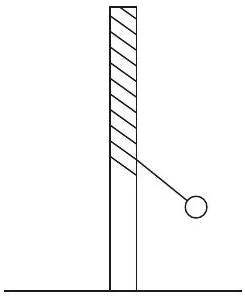
Ans. (a, c)

Instantaneous centre of revolution is at the instantaneous point of contact of string. So, option (a) is correct and angular momentum of the system is not conserved about point of contact as direction of L changes continuously. So, correct option is (c) also. Note However, if we consider angular momentum about vertical axis, then it is conserved.
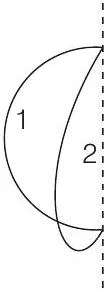
A circular loop of conducting wire of radius 1 cm is cut at a point \(A\) on its circumference. It is then folded along a diameter through \(A\) such that the two semicircular loops lie in two mutually perpendicular planes. In this region a uniform magnetic field B of magnitude 100 mT is directed perpendicular to the diameter through \(A\) and makes angles of 30° and 60° with the planes of the two semicircles. The magnetic field reduces at a uniform rate from 100 mT to zero in a time interval of 4.28 ms. Therefore,
Ans. (b, c)
As we know that, Magnetic flux, \(\phi=B A \cos \theta\) where,
A converging lens of focal length 40 cm is fixed at 40 cm in front of a screen. An object placed 120 cm from the fixed lens is required to be focused on the screen by introducing another identical lens in between. The second lens should be placed at a distance \(x\) from the object, where \(x\) is
Ans. (a, c)
According to the question we can drawn the following diagram
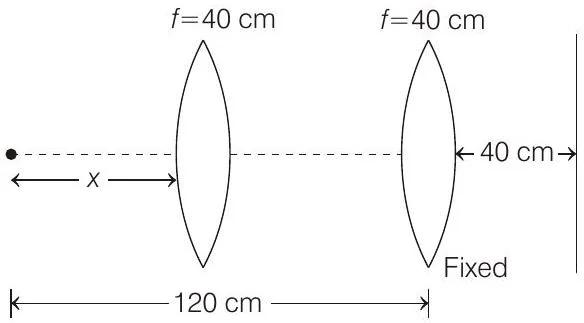
Case I To focus on screen by fixed lens, beam should be parallel from first lens.
Option (a) is correct Now, for \(x=50 \mathrm{ cm}\),
⇒ Not focused on screen. Case II If second lens is placed between screen and fixed lens, then
∴ \(x\) from object \(=120+20=140 \mathrm{ cm}\) ∴ Option (c) is correct.
Mysteriously a charged particle moving with velocity \(\mathbf{v}=v_{0} \hat{\mathbf{j}}\) entered the tube of Thomson’s apparatus, where the parallel metallic plates of length 5 cm along \(X\)-axis are separated by 2 cm. Under the influence of a magnetic field \(\mathbf{B}=\left(4.57 \times 10^{-2} \hat{\mathbf{k}}\right) \mathrm{T}\), the particle is found to deflect by an angle of 5.7°. When a potential of 2000 V is applied between the two plates, the particle is found to move straight to the screen without any deflection. Then,
Ans. (a, b, c, d)
Given, magnetic field,
As we know that, Electric field,
Now,
According to the question,
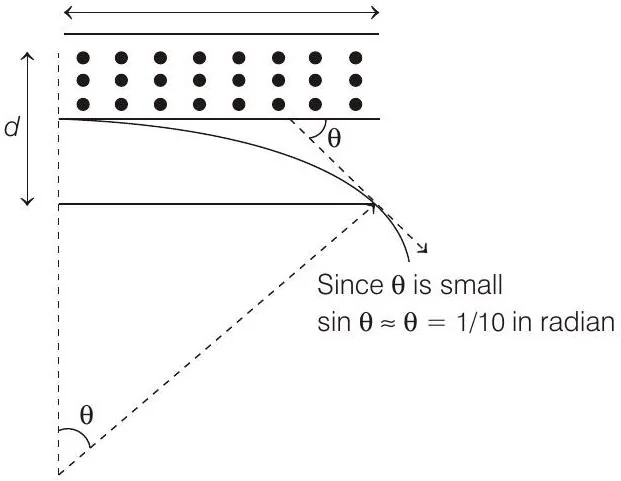
Here,
Now,
For proton,
Hence,