

Hello students, we are providing case study questions for class Class 8 Science. Case study questions are the new question format that is introduced in CBSE board. The resources for case study questions are very less. So, to help students we have created chapterwise case study questions for class Class 8 Science. In this article, you will find case study questions for cbse class Class 8 Science chapter 11 Keeping Time with the Skies.
| Chapter | Keeping Time with the Skies |
| Type of Questions | Case Study Questions |
| Nature of Questions | Competency Based Questions |
| Board | CBSE |
| Class | Class 8 |
| Subject | Maths |
| Useful for | Class 8 Studying Students |
| Answers provided | Yes |
| Difficulty level | Mentioned |
| Important Link | Class 8 Science Chapterwise Case Study |
Table of Contents
Case Study Questions on Keeping Time with the Skies
Case Study 1: Modelling the Phases of the Moon (Based on Activity 11.2)
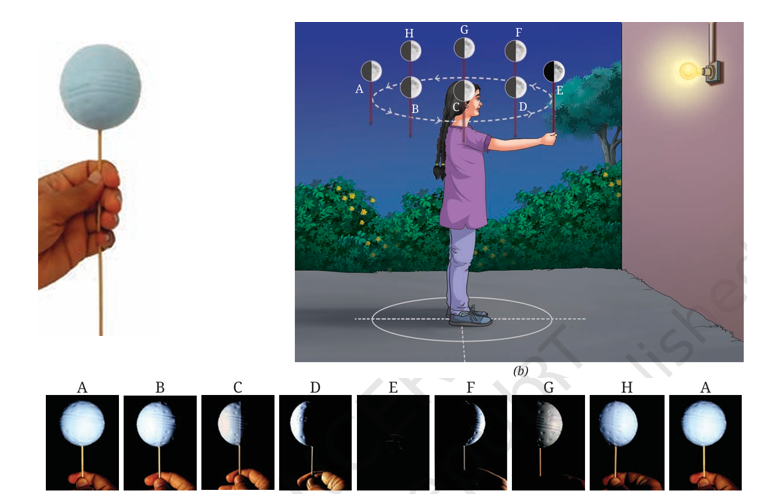
A student conducts Activity (Refer 11.2) to understand why the Moon’s appearance changes. The setup uses a small ball on a stick (the Moon) held at arm’s length, an electric lamp (the Sun), and the student’s head (the Earth). The experiment must be conducted in a dark place. The student faces the lamp (Position E) and observes the ball. Then, the student turns anti-clockwise while observing the illuminated portion of the ball. At Position A, 180∘ away from the lamp, the entire illuminated side of the ball is visible. In contrast, at Position E, the non-illuminated portion faces the student. The observed change in the illuminated shape mimics the Moon’s monthly cycle.
Questions
Q1. If the student observes the Waxing Crescent phase (less than half illuminated and increasing) as shown in Figure 11.4c, the ball must be revolving from which position to which position in the orbit?
A. From Position A to C (Waning period).
B. From Position E to G (Waxing period).
C. From Position C to A (Waxing period).
D. From Position E to C (Waning period).
Q2. Explain why the line separating the illuminated and non-illuminated portions of the Moon (ball) appears curved during most of the phases, rather than being a straight line.
Q3. If the Moon takes approximately 29.5 days to complete its cycle of phases (from New Moon back to New Moon), calculate the average number of days it takes for the illuminated portion to grow from New Moon (Position E) to the Full Moon (Position A).
Q4. If the model is left unattended with the ball at Position D (half-moon phase) for a week, describe how the observed phase would change when the student returns, assuming the Moon revolves anti-clockwise as shown in Figure 11.4b.
Answers
A1. B. From Position E to G (Waxing period).
Explanation: The waxing period is when the bright part of the Moon increases. Position E is the New Moon, where the bright portion is zero. As the Moon moves from E towards A (Full Moon), the visible illuminated portion grows. The period where the bright part increases (waxing) runs from E to G and back to A. Therefore, the crescent phase observed during the waxing period must occur as the ball moves away from E towards G.
A2. Explanation: The change in the shape of the visible illuminated portion of the Moon occurs because the observer on Earth only sees a fraction of the illuminated half of the Moon. Since the Moon is a sphere, when we see only a partial view of the illuminated half (i.e., less than a full circle), the boundary separating the visible illuminated side from the dark side naturally appears curved.
A3. Approximately 14.75 days (or about 15 days).
Step-by-step Calculation/Explanation: The cycle from one full Moon (A) to the next takes about a month, which is stated as approximately 29.5 days. The Moon must grow from the New Moon (E) to the Full Moon (A) during the waxing period, which constitutes half of this total cycle.
Time taken = Total cycle time / 2
Time taken ≈ 29.5 days / 2 = 14.75 days.
A4. The phase would change from the half-moon phase to the Full Moon (Position A), exhibiting a Gibbous phase in between.
Explanation: The cycle from the New Moon (E) to the Full Moon (A) takes about two weeks. Position D represents a half-moon phase, which occurs approximately 7 days after the New Moon day. If the model is left for one week (7 days) starting from position D, the ball would have moved another quarter cycle (approximately 7 days) to reach Position A (Full Moon). During this movement, the illuminated portion seen by the student would increase, passing through the gibbous phase (“more than half of the illuminated portion”)
We hope the given case study questions for Keeping Time with the Skies Class Class 8 helps you in your learning.
Also check
- Curiosity Class 8 Science Chapter 1 Exploring the Investigative World of Science Case Study Questions
- Curiosity Class 8 Science Chapter 2 The Invisible Living World Case Study Questions
- Curiosity Class 8 Science Chapter 3 Health: The Ultimate Treasure Case Study Questions
- Curiosity Class 8 Science Chapter 4 Electricity: Magnetic and Heating Effects Case Study Questions
- Curiosity Class 8 Science Chapter 5 Exploring Forces Case Study Questions
- Curiosity Class 8 Science Chapter 6 Pressure, Winds, Storms, and Cyclones Case Study Questions
- Curiosity Class 8 Science Chapter 7 Particulate Nature of Matter Case Study Questions
- Curiosity Class 8 Science Chapter 8 Nature of Matter: Elements, Compounds, and Mixtures Case Study Questions
- Curiosity Class 8 Science Chapter 9 The Amazing World of Solutes, Solvents, and Solutions Case Study Questions
- Curiosity Class 8 Science Chapter 10 Light: Mirrors and Lenses Case Study Questions
- Curiosity Class 8 Science Chapter 11 Keeping Time with the Skies Case Study Questions
- Curiosity Class 8 Science Chapter 12 How Nature Works in Harmony Case Study Questions
- Curiosity Class 8 Science Chapter 13 Our Home: Earth, a Unique Life Sustaining Planet Case Study Questions
Topics from which case study questions may be asked
- Movement of celestial bodies
- Day and night cycle
- Phases of the moon
- Solar and lunar eclipses
- Historical timekeeping
- Seasons and revolution
- Astronomical observations
The apparent motion of celestial bodies helps us measure time through days, months, and years.
Frequently Asked Questions (FAQs) on Keeping Time with the Skies Case Study Questions