

Last Updated on January 20, 2026 by XAM CONTENT
Hello students, we are providing case study questions for Class 8 Science. Case study questions are the new question format that is introduced in CBSE board. The resources for case study questions are very less. So, to help students we have created chapterwise case study questions for Class 8 Science. In this article, you will find case study questions for CBSE Class 8 Science chapter 13 Our Home: Earth, a Unique Life Sustaining Planet.
| Chapter | Our Home: Earth, a Unique Life Sustaining Planet |
| Type of Questions | Case Study Questions |
| Nature of Questions | Competency Based Questions |
| Board | CBSE |
| Class | Class 8 |
| Subject | Maths |
| Useful for | Class 12 Studying Students |
| Answers provided | Yes |
| Difficulty level | Mentioned |
| Important Link | Class 8 Science Chapterwise Case Study |
Table of Contents
Case Study Questions on Our Home: Earth, a Unique Life Sustaining Planet
We hope the given case study questions for Our Home: Earth, a Unique Life Sustaining Planet Class 8 helps you in your learning.
Case Study 1:
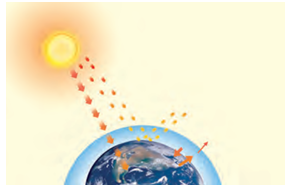
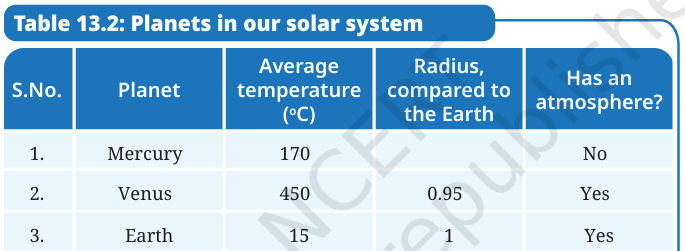
A student undertakes an Activity to investigate the characteristics of planets in our solar system and determine what makes Earth unique. Using library resources, the student compiles data into a table (Table 13.2) comparing the average temperature, radius, and atmospheric presence of Mercury, Venus, and Earth. The data reveals a general trend where planets become colder as they move away from the Sun. However, a significant anomaly is observed: Venus, the second planet, has an average temperature of 450∘C, making it hotter than Mercury (170∘C), which is closest to the Sun. The student also notes that Earth’s average temperature of 15∘C places it in a specific zone called the ‘Goldilocks zone’.
Questions
1. Based on the data collected in Activity (see Table), what is the primary scientific reason for the anomaly where Venus is hotter than Mercury despite being further from the Sun?
A. Venus has a larger radius than Mercury, generating more internal heat.
B. Venus is located within the ‘Goldilocks zone’.
C. Venus has a thick atmosphere rich in carbon dioxide that traps heat.
D. Mercury has a thick atmosphere that reflects all solar radiation.
Question Type: MCQ
Difficulty Level: Medium
Ans. C. Venus has a thick atmosphere rich in carbon dioxide that traps heat.
Explanation: Venus is the hottest planet not because of its distance, but because its “thick atmosphere traps heat” via the greenhouse effect, specifically due to gases like carbon dioxide. Mercury, in contrast, has no atmosphere, so it cannot trap heat in the same way.
2. (Conceptual) The student observes that Earth has a specific size (radius). If Earth were significantly smaller (like Mercury) but had the same density, how would this physically affect the atmosphere and the potential for life?
Question Type: Conceptual
Difficulty Level: Medium
Ans. If Earth were much smaller, its gravity would be too weak to hold onto the gases in the atmosphere.
Explanation: The size of the planet determines its gravitational pull. If Earth were much smaller, “its gravity would have been too weak to hold on to the gases in our atmosphere, and they would have escaped into space”. Without an atmosphere, life as we know it would not be supported because the atmosphere provides oxygen for breathing, carbon dioxide for photosynthesis, and protection from UV rays
3. The “Habitable Zone” is defined by the distance from a star where water remains liquid. Using the principles of this zone, explain what would happen to the hydrosphere if Earth were moved to the orbital position of Venus, and what would happen if it were moved to the orbital position of Mars (assuming current atmospheric conditions remain constant initially).
Question Type: Analytical
Difficulty Level: Medium
Ans. At Venus’s Position: The water would evaporate.
At Mars’s Position: The water would freeze.
Explanation: The habitable zone (Goldilocks zone) is the specific range of distances where temperature allows water to exist in liquid form, which is essential for life. Moving out of this zone transitions water into either gas (vapour) or solid (ice), neither of which supports the evolution of life in the same way liquid water does.
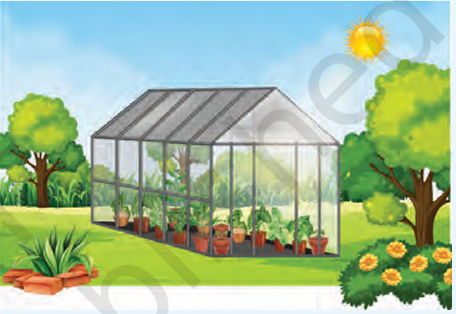
4. The student compares the warming of Earth to a glass greenhouse used for plants (See Fig.). Explain the fundamental difference in the mechanism of how heat is trapped in Earth’s atmosphere versus how it is trapped in a plant greenhouse.
Question Type: Conceptual
Difficulty Level: Medium
Ans. Earth’s Atmosphere: Gases like carbon dioxide trap heat by absorbing the radiation given off by the Earth after it is warmed by the Sun
Plant Greenhouse: It traps heat because it is a closed physical space (usually with glass walls). It heats up, and the physical barrier prevents the warm air from escaping or mixing with cooler outside air
Explanation: While both systems result in warming, the mechanisms differ: one is radiative absorption (atmosphere), and the other is preventing air circulation/convection (glass greenhouse).
Also check
- Sets Case Study Questions Class 11 Maths Chapter 1
- Relations and Functions Case Study Questions Class 11 Maths Chapter 2
- Trigonometric Functions Case Study Questions Class 11 Maths Chapter 3
- Complex Numbers and Quadratic Equations Case Study Questions Class 11 Maths Chapter 4
- Linear Inequalities Case Study Questions Class 11 Maths Chapter 5
- Permutation and Combinations Case Study Questions Class 11 Maths Chapter 6
- Binomial Theorem Case Study Questions Class 11 Maths Chapter 7
- Sequences and Series Case Study Questions Class 11 Maths Chapter 8
- Straight Lines Case Study Questions Class 11 Maths Chapter 9
- Conic Sections Case Study Questions Class 11 Maths Chapter 10
- Introduction to Three Dimensional Geometry Case Study Questions Class 11 Maths Chapter 11
- Limits and Derivatives Case Study Questions Class 11 Maths Chapter 12
Topics from which case study questions may be asked
- Earth’s structure and layers
- Atmosphere and climate
- Water cycle and hydrosphere
- Life-supporting conditions
- Biosphere and biodiversity
- Human responsibility
- Environmental protection
Earth is uniquely equipped with air, water, and temperature conditions suitable for life.
Frequently Asked Questions (FAQs) on Our Home: Earth, a Unique Life Sustaining Planet Case Study Questions